What Is DLSS 5? Nvidia’s AI Neural Rendering Explained
Nvidia’s DLSS 5 adds AI-generated lighting and material detail as a new final rendering stage. Here is how it works, what GPUs and games support it, and how to enable it.
DLSS 5 is Nvidia's newest neural rendering technology, and it works differently from every DLSS version before it: instead of only upscaling a frame or inserting extra frames between rendered ones, Nvidia says DLSS 5 becomes the final rendering stage of the graphics pipeline, using an AI model to add lighting and material detail — such as skin subsurface scattering and light passing through hair and foliage — directly onto the engine's output. It currently requires a GeForce RTX 50 Series GPU and, as of this writing, is live in one shipping game, NBA 2K27, with Nvidia saying more titles are coming.
Nvidia's own explainer on DLSS 5's release date and headline changes already covers the timeline (you can read that release-date roundup here). This piece is different: it is a technology explainer focused on what DLSS 5 actually is under the hood, how it differs architecturally from DLSS 4, which hardware and games currently support it, and exactly how to turn it on.
What is DLSS 5?
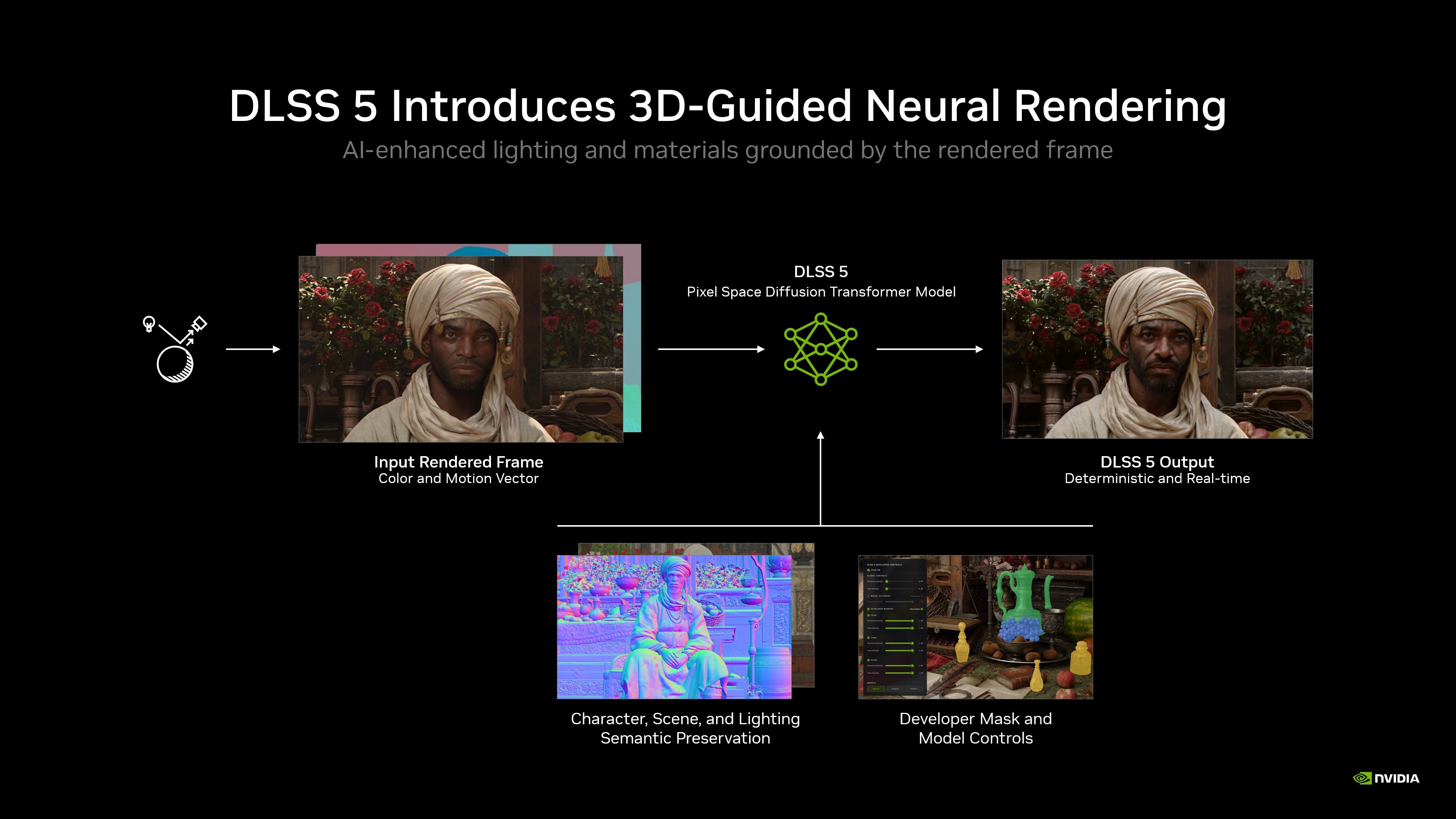
DLSS 5 is Nvidia's name for "3D-Guided Neural Rendering," a new stage Nvidia has added to the Deep Learning Super Sampling (DLSS) suite. Nvidia's GeForce news announcement describes it as "the final rendering stage of the graphics pipeline," which is a meaningful change from how every prior DLSS feature worked. DLSS Super Resolution, Frame Generation, and Ray Reconstruction are all forms of learned reconstruction: they take an existing, cheaper render and use an AI model to approximate what a more expensive version of that same frame would look like. According to Nvidia's research page for DLSS 5, hosted on its Applied Deep Learning Research (ADLR) lab site, DLSS 5 is "the first DLSS technology to generate the final displayed appearance" rather than reconstructing toward a known reference image.
In practical terms, Nvidia says DLSS 5 adds visual detail a game engine was never actually rendering — more convincing subsurface scattering in character skin, more realistic light transmission through hair and foliage, added contact shadows, and improved global illumination — on top of the frame the engine already produced. Nvidia is explicit that this is optional and independent: it can be toggled on or off separately from DLSS Super Resolution, Multi Frame Generation, and Ray Reconstruction, which continue to work as before.
- DLSS 5 = "3D-Guided Neural Rendering," an AI model that adds lighting and material detail as a final rendering stage.
- Nvidia's research page describes it as a one-step, pixel-space diffusion model that is causal and deterministic.
- Currently requires a GeForce RTX 50 Series GPU (desktop or laptop).
- NBA 2K27 is the only game Nvidia names as shipping with DLSS 5 support today.
- Enabled through a game's own video settings, plus a current GeForce Game Ready Driver.
How DLSS 5 actually works, according to Nvidia
Nvidia has published two primary descriptions of DLSS 5's mechanics: a consumer-facing explanation on its GeForce news page, and a more technical summary on its Applied Deep Learning Research site. Between the two, Nvidia describes a few consistent architectural details.
At inference time, Nvidia says the model takes a rendered frame's color and the game engine's motion vectors as input, carrying forward temporal state from prior frames. The ADLR research page is more specific about the underlying model class, calling DLSS 5 "a one-step pixel-space diffusion model designed for high-resolution, real-time rendering." That same page describes the inference process as "causal and deterministic," and says the model is "trained for frame-to-frame temporal stability" — in other words, it is built to produce a consistent result when fed the same input twice, and to avoid shimmering or flicker as the camera and objects move, which has historically been one of the hardest problems for any generative image model applied to real-time video.
Nvidia's GeForce-facing explanation calls this a "one-frame-in, one-frame-out model," distinguishing it from batch video-processing approaches, and says it runs as a "compact network" on the Tensor Cores built into GeForce RTX 50 Series GPUs. Nvidia also says the model is trained to recognize semantic, object-level scene information — distinguishing objects, materials, and light sources from one another — rather than only operating on raw pixel color. Nvidia's research page states the system is designed to run in real time at resolutions up to 4K on a single RTX 50 Series GPU.
One architectural note worth flagging for readers who want the full technical detail: neither of Nvidia's own pages uses the specific term "G-buffer," though both describe the model being trained against renderer-derived scene attributes such as surface albedo and normals. Nvidia has published a longer technical report through its research site for readers who want the complete architecture description beyond what its marketing pages cover.
The controls developers get — and why that matters to players
Because DLSS 5 is generating detail rather than only reconstructing it, Nvidia has built in several controls for developers to keep the AI model's output aligned with a game's intended art direction, rather than letting it override it. Per Nvidia's GeForce news page, these include:
- Structure Intensity, which controls how strongly DLSS 5 adds high-frequency detail such as ambient occlusion, reflections, and subsurface scattering.
- Tone Intensity, which controls lower-frequency lighting and color changes; Nvidia says setting it to zero shows the engine's original, unmodified colors.
- Semantic auto-masking and engine-level masking, which let developers target DLSS 5's effect at specific objects or character/asset groups, or exclude them entirely.
- Multiple selectable models with different parameter weights, which a developer can swap in per game or per scene.
Nvidia also says output quality scales with input quality: feeding DLSS 5 a ray-traced or path-traced frame, rather than a purely rasterized one, produces what Nvidia describes as "dramatically more-accurate results." That is Nvidia's own characterization of its technology's behavior, not an independently benchmarked claim, and it is worth keeping in mind that because developers choose how strongly to apply these controls, the same game can look noticeably different with DLSS 5 on versus off depending on how a studio has tuned it — which is part of why some early coverage of the feature has focused on whether AI-added detail changes a game's intended look.
DLSS 4 vs. DLSS 5: what's actually new
It helps to separate what DLSS 4 (and the 4.5 update that followed it) already does from what DLSS 5 adds on top. Nvidia's own DLSS technology page lays out the feature set this way:
| Feature | What it does (per Nvidia) | Introduced in | Minimum GPU generation |
|---|---|---|---|
| Super Resolution | Upscales a lower-resolution render using motion data and prior frames; second-generation transformer model improves stability and clarity | DLSS 2 (model updated in DLSS 4) | RTX 20 Series |
| Ray Reconstruction | Replaces hand-tuned denoisers with an AI model for ray-traced scenes; also upgraded to the second-generation transformer model | DLSS 3.5 (model updated in DLSS 4) | RTX 20 Series |
| Frame Generation | Generates additional frames with AI while NVIDIA Reflex works to keep responsiveness in check | DLSS 3 | RTX 40 Series |
| Dynamic Multi Frame Generation | Generates up to five frames per rendered frame, with the multiplier adjusting dynamically per scene | DLSS 4 / 4.5 | RTX 50 Series |
| 3D-Guided Neural Rendering (DLSS 5) | Adds AI-generated lighting and material detail as a new, final rendering stage | DLSS 5 | RTX 50 Series |
In short: DLSS 4 and 4.5 were mainly about generating more frames, faster, with a better upscaling and denoising model. DLSS 5 is a different kind of feature — Nvidia frames it as moving DLSS from a pure performance tool into visual fidelity territory, generating detail the game engine itself never rendered. If you're deciding whether a GPU upgrade is worth it specifically to get access to these newer DLSS features, our breakdown of the RTX 5090 vs. RTX 4090 upgrade question is a useful next read, since Dynamic Multi Frame Generation and DLSS 5 are both restricted to the RTX 50 generation.
Which GPUs support DLSS 5
Per Nvidia's own hardware support table on its DLSS technology page, 3D-Guided Neural Rendering is currently listed as supported only on GeForce RTX 50 Series GPUs, covering both desktop and laptop parts. Older cards — including the RTX 40, RTX 30, and RTX 20 Series — are listed as supporting Super Resolution, Ray Reconstruction, and DLAA, and the RTX 40 Series additionally supports (single-frame) Frame Generation, but none of those older generations appear on Nvidia's own table as supporting Dynamic Multi Frame Generation or DLSS 5's neural rendering.
Some secondary coverage of Nvidia's DLSS 5 announcement has suggested RTX 40 Series support could arrive later through a driver update, but that is not something confirmed on Nvidia's own GeForce or DLSS pages at the time of writing, so treat it as unconfirmed rather than a stated roadmap item. AMD's competing GPUs do not support any version of DLSS, since it is an Nvidia-exclusive technology.
Which games support DLSS 5 so far
As of Nvidia's own DLSS 5 announcement, the list of supported games is short. Nvidia names NBA 2K27 — developed by Visual Concepts and published by 2K — as the only game shipping with DLSS 5 support right now, available on GeForce RTX 50 Series GPUs and laptops, and through GeForce NOW Ultimate (streamed from RTX 5080-powered servers in the cloud). Nvidia's announcement states that developers can add DLSS 5 to their own games through an Unreal Engine 5 plugin or Nvidia's Streamline framework, and says "more titles" will integrate the feature "in the coming weeks and months" — but Nvidia's own announcement does not name those additional titles.
Nvidia's broader DLSS technology page separately highlights games such as Black Myth: Wukong, Indiana Jones and the Great Circle, and Still Wakes the Deep, alongside video references to titles including Cyberpunk 2077, Alan Wake 2, and Battlefield 6 — but it's not clear from that page whether all of those titles specifically support the new DLSS 5 neural rendering stage, as opposed to other DLSS suite features like Super Resolution or Multi Frame Generation that have broader game support. Readers should treat any DLSS 5 game list beyond NBA 2K27 as provisional until Nvidia confirms it directly on its DLSS 5 page.
How to turn on DLSS 5
Based on Nvidia's own instructions for its first supported title, enabling DLSS 5 follows a similar pattern to enabling other DLSS features:
- Update your GPU driver. Nvidia specifies the GeForce Game Ready Driver 616.64 WHQL or newer for NBA 2K27's DLSS 5 support. You can get this either directly from Nvidia's driver downloads or through the Nvidia App, which Nvidia presents as one available route rather than a strict requirement.
- Confirm you have a GeForce RTX 50 Series GPU. DLSS 5 will not appear as an option on older cards, since Nvidia's support table restricts it to RTX 50 Series hardware.
- Open the game's video settings. In NBA 2K27, Nvidia says the toggle is located under Video Settings as "DLSS Neural Rendering."
- Enable it alongside the rest of the DLSS suite. Nvidia notes you can configure DLSS Super Resolution, Frame Generation, and Nvidia Reflex settings in the same menu.
- Toggle it live if you want to compare. Nvidia says NBA 2K27 supports pressing F9 during gameplay and instant replays to switch DLSS Neural Rendering on and off, which is a convenient way to see exactly what the model is changing in real time.
As more titles add support, expect the exact menu wording to vary slightly by developer, the same way DLSS Super Resolution and Frame Generation settings are named slightly differently from game to game.
What Nvidia claims about performance
Nvidia has published specific frame-rate figures for DLSS 5 in NBA 2K27, and it's important to be precise about what these numbers do and don't represent: they are Nvidia's own performance claims from its own announcement, not independently benchmarked results, and they reflect a specific game, resolution, and settings combination rather than a general DLSS 5 performance guarantee.
Per Nvidia's GeForce news announcement, at 2560x1440 resolution with the Ultra preset and ray tracing enabled, Nvidia reports up to 590 FPS on an RTX 5090, 410 FPS on an RTX 5080, 350 FPS on an RTX 5070 Ti, and 260 FPS on an RTX 5070 — figures that reflect the full DLSS suite (not DLSS 5's neural rendering stage in isolation) running together. At 4K with the Ultra preset, ray tracing, and the full DLSS stack enabled, Nvidia cites up to 370 FPS on an RTX 5090. Nvidia also says it achieved a 5x performance improvement over roughly six months of optimization, going from requiring dual RTX 5090 GPUs during early development down to running on a single card, and separately states that "virtually all" RTX 50 Series owners should be able to run the feature with ray tracing enabled at 1080p.
Notably, neither of Nvidia's primary DLSS 5 pages makes a specific latency claim for the feature. Given that DLSS 5 is described as a one-frame-in, one-frame-out process layered onto the existing render rather than a multi-frame generation technique, it's reasonable to expect it behaves differently from Frame Generation's latency profile — but that is an inference, not something Nvidia has stated directly, so we aren't reporting a specific number here.
Why this is a bigger architectural shift than it sounds
It's easy to read "DLSS 5 adds better lighting" and assume it's an incremental update. The more significant claim, from Nvidia's own research team, is architectural: DLSS 5 is described as the first DLSS technology that generates the final displayed appearance rather than approximating toward one. Every earlier DLSS feature — Super Resolution, Ray Reconstruction, Frame Generation — worked by asking an AI model to reconstruct or interpolate toward something a traditional renderer could, in theory, have produced anyway, just at a higher computational cost. DLSS 5 generates visual information the traditional rendering pipeline was never computing at all.
That distinction is also why Nvidia built in the Structure Intensity, Tone Intensity, and masking controls described earlier: a model that is generating new detail, rather than reconstructing known detail, needs guardrails so it doesn't drift away from a game's intended look. It's also why outside researchers have characterized the approach, per Nvidia's framing, as hybrid rather than purely generative — the model is explicitly conditioned on the engine's own motion vectors and scene data rather than operating independently of the renderer.
If you're trying to decide how much GPU headroom you actually need to take advantage of features like this going forward, it's also worth checking how much VRAM current games and upcoming neural rendering features expect — our guide to how much VRAM you need in 2026 walks through that in more detail.
Frequently asked questions
Is DLSS 5 the same as Multi Frame Generation? No. Multi Frame Generation, part of DLSS 4/4.5, generates extra frames between rendered ones to boost frame rate. DLSS 5 (3D-Guided Neural Rendering) is a separate, optional feature that adds AI-generated lighting and material detail to each frame; Nvidia says the two can be used together.
Do I need the Nvidia App to use DLSS 5? Not strictly. Nvidia says the required driver (616.64 WHQL or newer, for NBA 2K27) can be downloaded either from Nvidia's website directly or through the Nvidia App — the app is a convenience, not a stated requirement.
What's next for DLSS 5
Nvidia's own announcement says to expect "upcoming model updates" through the fall of 2026 aimed at further improving performance, and says additional games will add DLSS 5 support "in the coming weeks and months" beyond NBA 2K27, via the Unreal Engine 5 plugin and Nvidia's Streamline framework. Nvidia has not published a confirmed list of those upcoming titles, nor has it confirmed whether DLSS 5 will ever extend to RTX 40 Series or older GPUs — both are reasonable questions to watch for in future driver and GeForce news updates, but neither is settled as of this writing. We'll update our coverage as Nvidia confirms more supported games and hardware.
Frequently asked questions
What is DLSS 5?
DLSS 5 is Nvidia's name for 3D-Guided Neural Rendering, a new final rendering stage that uses an AI model to add lighting and material detail — such as subsurface scattering and light through hair and foliage — on top of a game engine's rendered frame. Unlike earlier DLSS features, Nvidia says it generates detail rather than only reconstructing it.
Which GPUs support DLSS 5?
Per Nvidia's own DLSS technology page, DLSS 5 (3D-Guided Neural Rendering) is currently supported only on GeForce RTX 50 Series GPUs, desktop and laptop. Older RTX 20, 30, and 40 Series cards support other DLSS features but are not listed as supporting DLSS 5.
Which games support DLSS 5?
Nvidia names NBA 2K27 as the only game shipping with DLSS 5 support today, playable on RTX 50 Series GPUs or through GeForce NOW Ultimate. Nvidia says more games will add support through an Unreal Engine 5 plugin and its Streamline framework, but has not named those titles yet.
How do I turn on DLSS 5?
Update to GeForce Game Ready Driver 616.64 WHQL or newer (via Nvidia's website or the Nvidia App), then enable "DLSS Neural Rendering" in a supported game's video settings. In NBA 2K27, Nvidia says you can also toggle it live during gameplay with the F9 key.
Is DLSS 5 the same as DLSS 4 or Multi Frame Generation?
No. DLSS 4 and 4.5 are mainly about Dynamic Multi Frame Generation, generating extra frames for higher frame rates. DLSS 5 is a separate feature that adds AI-generated lighting and material detail as a new rendering stage, and Nvidia says the two can run together.
Does DLSS 5 affect input latency?
Nvidia has not published a specific latency claim for DLSS 5 on its GeForce news or research pages. It has published frame-rate figures for NBA 2K27 with the full DLSS suite enabled, but these are Nvidia's own performance claims, not independently verified benchmarks.
Sources
- Nvidia GeForce News: DLSS 5 — 3D-Guided Neural Renderingnvidia.com
- Nvidia Research (ADLR): DLSS 5 — Generative Neural Renderingresearch.nvidia.com
- Nvidia GeForce: DLSS Technology Overviewnvidia.com
- Nvidia Developer Blog: What's New for Game Developers — DLSS 5developer.nvidia.com
- Nvidia Appnvidia.com
Mara Lindqvist edits the hardware desk. She covers graphics cards, processors, memory and storage, the foundries and chip designers behind them, and what the numbers on a spec sheet mean for people choosing a PC. Specifications in her stories come from manufacturer spec pages and datasheets.