Nvidia DLSS 5: Release Date, How to Use It, and What Changed
DLSS 5 adds AI-generated lighting and materials via 3D-Guided Neural Rendering. Here is the release date, supported GPUs and games, and how to turn it on.
Nvidia DLSS 5 is live now. The feature launched September 3, 2026 inside NBA 2K27, arriving as part of GeForce Game Ready Driver 616.64 WHQL. At launch it runs on all GeForce RTX 50 Series desktop GPUs, RTX 50 Series laptops, and GeForce NOW Ultimate rigs in the cloud — RTX 40 Series support is confirmed but not yet dated. Unlike earlier DLSS versions, DLSS 5 doesn't just upscale frames or insert generated ones between them: it adds an entirely new AI rendering stage, called 3D-Guided Neural Rendering, that repaints a scene's lighting, materials, skin, hair and shadows before the frame reaches your screen.
Here's what Nvidia has actually said about how DLSS 5 works, which hardware and games support it today, how to turn it on, whether it costs anything, and how it's being received compared with DLSS 4.5 — including the unofficial community effort to run a version of it on AMD graphics cards.
- Release date: September 3, 2026, inside NBA 2K27
- Driver required: GeForce Game Ready Driver 616.64 WHQL or newer
- Supported GPUs at launch: GeForce RTX 50 Series desktop and laptop GPUs, plus GeForce NOW Ultimate
- Price: Free — bundled into the standard GeForce driver, no separate purchase
- What's new: 3D-Guided Neural Rendering — AI-generated lighting and materials, not just upscaling or frame generation
What Nvidia DLSS 5 actually is
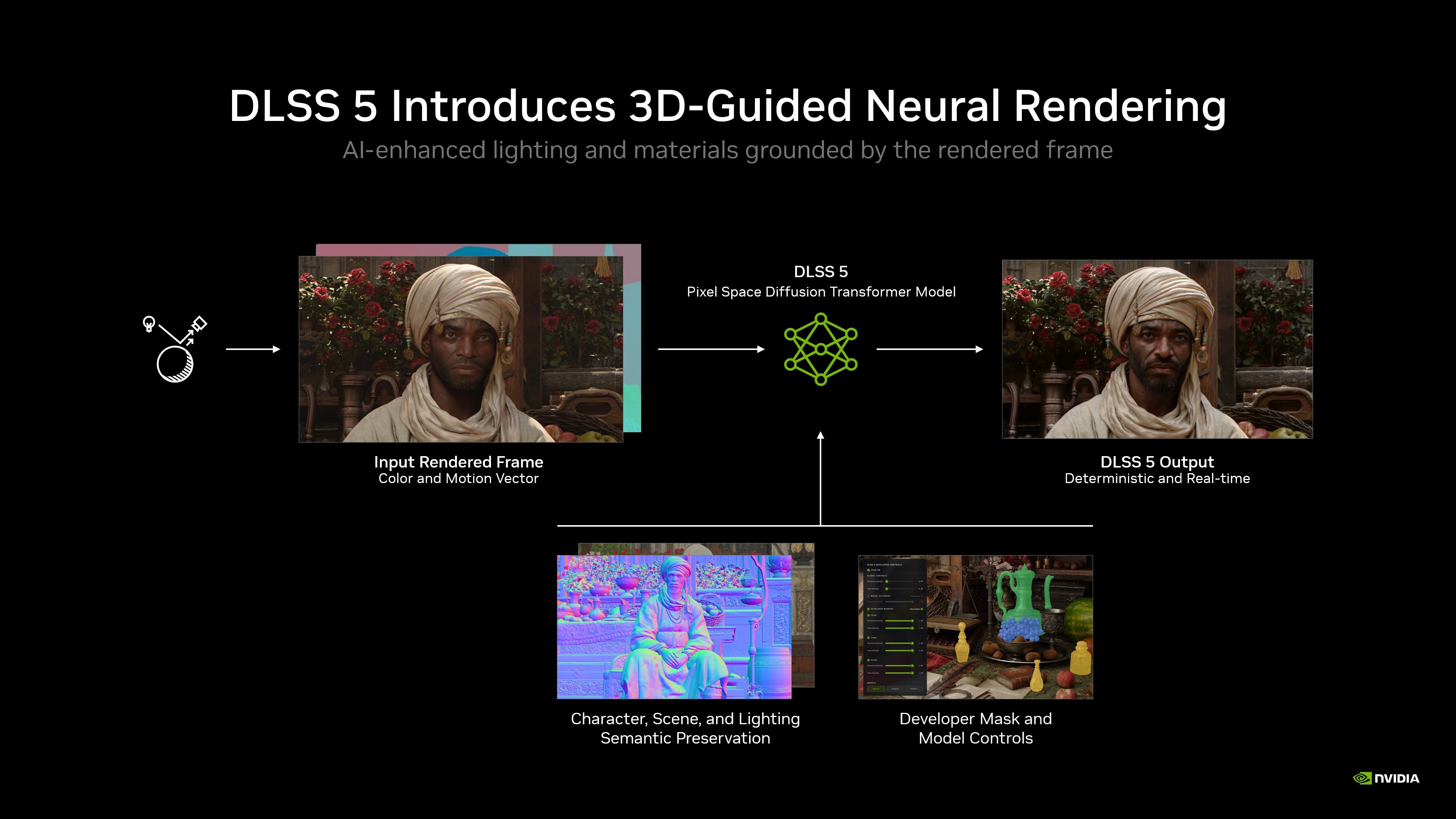
Nvidia describes DLSS 5 as the debut of "3D-Guided Neural Rendering," which it positions as a new final stage in the rendering pipeline rather than another upscaling mode. Every prior DLSS release — Super Resolution, Frame Generation, Ray Reconstruction — worked by reconstructing or interpolating pixels the traditional renderer had already produced or was going to produce. Nvidia's own framing is direct about the shift: DLSS 5 is "the first DLSS technology to generate the final displayed appearance rather than reconstruct a higher-cost reference output from the conventional renderer."
In practice, that means DLSS 5 takes the frame the game engine has already rendered — its color buffer, surface albedo, lighting buffers and surface normals — and uses an artist-guided AI model to add detail on top: natural subsurface scattering in skin, more convincing light transmission through hair and foliage, deeper contact shadows, richer ambient occlusion and global illumination. Nvidia says the network is anchored directly to the geometry, motion vectors and textures the engine supplies, and runs on a strict one-frame-in, one-frame-out basis using the game's own motion vectors — a deliberate design choice meant to keep output deterministic and temporally stable rather than drifting or flickering the way some generative video models can.
Crucially, Nvidia says the underlying scene structure, character identity and artistic intent are preserved; the network is tuned by each game's developers rather than applying a single one-size-fits-all look. Developers get controls Nvidia calls Structure Intensity (governing high-frequency detail like ambient occlusion and reflections) and Tone Intensity (governing broader lighting and color response), plus semantic AI masking that recognizes specific objects in a scene and engine-level masking for isolating particular props or asset groups.
Nvidia DLSS 5 release date and rollout
DLSS 5 shipped September 3, 2026 (Pacific time), bundled with GeForce Game Ready Driver 616.64 WHQL, which superseded the prior 616.56 WHQL driver. The launch showcase is NBA 2K27, developed by Visual Concepts and published by 2K, which became the first commercial game to ship with 3D-Guided Neural Rendering turned on. Nvidia says the feature is also rolling out simultaneously to GeForce NOW, where Ultimate members can stream it from Nvidia-operated, RTX 5080-powered cloud rigs.
Nvidia has publicly confirmed that RTX 40 Series support is coming, though it hasn't attached a date. Ada Lovelace's fourth-generation Tensor Cores already support the FP8 numerical format DLSS 5 relies on, which is why backward compatibility is technically feasible — Nvidia's stated priority for now is finishing performance tuning on RTX 50 Series before widening the rollout. Beyond NBA 2K27, Nvidia's developer materials list Gears of War: E-Day as a confirmed upcoming integration, with more titles expected to follow through the rest of the year.
Nvidia also frames the September launch as the payoff of months of optimization work: the company says DLSS 5 has picked up roughly a 5x performance improvement since it was first previewed in March 2026, when an early build needed two RTX 5090 GPUs working together. At launch, the feature runs on a single GPU across the full RTX 50 Series lineup at up to 4K resolution.
Neural rendering, explained without the marketing
The term "neural rendering" gets used loosely, so it's worth being specific about what Nvidia says DLSS 5 is and isn't. It is not a generative video model painting an entire scene from a text prompt, and it doesn't run on multi-frame chunks the way offline generative tools do. It processes one input frame at a time and produces one output frame, using the game engine's own motion vectors to stay temporally consistent — the same philosophy DLSS has used since Super Resolution, just applied to a much richer AI model and a different part of the image.
The distinction Nvidia draws is between reconstruction and generation. DLSS 4.5's Super Resolution, Frame Generation and Ray Reconstruction together are already responsible for rendering, in Nvidia's words, "23 out of every 24 pixels seen on the screen" in a fully optioned scene — but those pixels are reconstructions of what the traditional renderer would have produced anyway, just computed more cheaply. DLSS 5 instead generates lighting and material detail that the base renderer never computed at all, using the AI model as the actual source of that visual information rather than as a shortcut to something the renderer was already going to draw. Nvidia is candid that the results depend heavily on what the game feeds the model: the company's stated view is that "the higher the quality of the foundational information provided by the game, the better the final output."
Anyone unfamiliar with how the DLSS stack fits together — Super Resolution, Frame Generation, Ray Reconstruction and now Neural Rendering as separate, stackable toggles — may want to first confirm which of these their current GPU already supports; our guide to checking what graphics card you have walks through identifying your exact model on Windows, Mac and Linux before you go hunting for driver settings.
DLSS 5 vs. DLSS 4.5: what's actually different
Nvidia doesn't present DLSS 5 as a replacement for DLSS 4.5's tools — Super Resolution, Multi Frame Generation and Ray Reconstruction all keep running alongside it, and NBA 2K27's settings menu lets players combine Neural Rendering with those existing options. The difference is which part of the image pipeline each one touches.
| Capability | DLSS 4.5 | DLSS 5 |
|---|---|---|
| What it touches | Resolution upscaling, generated in-between frames, denoised ray-traced reflections/GI | Final lighting and material appearance of each frame |
| Core method | Reconstructs pixels the renderer would otherwise have to compute directly | Generates lighting/material detail the base renderer never computed |
| Frame model | Uses surrounding frames to generate interpolated frames | Strict one-frame-in, one-frame-out with engine motion vectors |
| GPU requirement | Wide RTX support; Multi Frame Generation needs RTX 50 Series | GeForce RTX 50 Series only at launch; RTX 40 Series confirmed, undated |
| Developer control | Preset-driven | Per-title AI model choice, Structure/Tone Intensity sliders, semantic masking |
| Launch game | Broadly supported across dozens of titles | NBA 2K27 only, with Gears of War: E-Day confirmed next |
In short: DLSS 4.5 is about getting more frames on screen for less compute; DLSS 5 is about making each frame look more like a pre-rendered cinematic than a real-time render, at a real performance cost that scales with GPU tier.
Which GPUs support DLSS 5 at launch
Nvidia's own launch materials are specific: DLSS 5 works on GeForce RTX 50 Series desktop GPUs, GeForce RTX 50 Series laptop GPUs, and GeForce NOW when streaming from an Ultimate-tier, RTX 5080-powered rig in Nvidia's cloud. Older RTX cards — including the entire RTX 40, RTX 30 and RTX 20 Series — are not supported yet.
| Platform | DLSS 5 status |
|---|---|
| GeForce RTX 50 Series desktop GPUs | Supported now |
| GeForce RTX 50 Series laptop GPUs | Supported now |
| GeForce NOW (Ultimate tier, RTX 5080 cloud rigs) | Supported now |
| GeForce RTX 40 Series | Confirmed coming, no date; hardware (4th-gen Tensor Cores/FP8) is compatible |
| GeForce RTX 30 Series and older | Not announced |
Nvidia's published performance figures for NBA 2K27 at 4K with the game's Ultra preset and ray tracing enabled show DLSS 5 running acceptably across the RTX 50 stack: up to roughly 370 fps on RTX 5090, and, at 1440p, up to roughly 410 fps on RTX 5080, 350 fps on RTX 5070 Ti and 260 fps on RTX 5070 — figures Nvidia measured with DLSS Super Resolution and Frame Generation also enabled alongside Neural Rendering. Those are Nvidia's own numbers from a specific title and settings combination, not independent benchmarks, so treat them as a best case rather than a universal expectation across future DLSS 5 games.
Which games support DLSS 5 at launch
Right now, exactly one shipping game uses DLSS 5: NBA 2K27, which Nvidia and 2K built around the feature specifically to show off lighting and materials on real-world athletes' skin, hair and facial geometry. Peter Kavic, senior producer at Visual Concepts, said in Nvidia's own materials that the studio valued having granular control over the effect: "What's great is the level of control that it gives us... we can set the overall tone and style to match our existing art direction."
Nvidia's developer-facing materials confirm Gears of War: E-Day as the next title with DLSS 5 integration coming, without a firm date. Nvidia has signaled that additional titles will follow through the rest of 2026 as more studios integrate the feature via Nvidia's Streamline framework or an Unreal Engine 5 plugin, but at publication only NBA 2K27 and the cloud version of it on GeForce NOW are actually playable with DLSS 5 turned on.
The same September 3 driver also added Game Ready support and DLSS 4.5 features — Multi Frame Generation, DLAA and Reflex — for Onimusha: Way of the Sword, though that title uses the existing DLSS 4.5 stack rather than Neural Rendering. If you're tracking what else shipped in that driver cycle, our rundown of a recent GeForce Game Ready driver's new games, fixes and known issues covers the format Nvidia uses for these updates.
How to enable DLSS 5 in NBA 2K27
Turning DLSS 5 on is a driver-plus-in-game-toggle process, not a separate install:
- Update to GeForce Game Ready Driver 616.64 WHQL or newer through the NVIDIA app or geforce.com.
- Launch NBA 2K27 and open Video Settings.
- Switch on "DLSS Neural Rendering."
- Configure DLSS Super Resolution, Frame Generation and Reflex alongside it to taste — they run independently of Neural Rendering.
- Toggle Neural Rendering on or off at any time during gameplay or instant replays with the F9 key, to compare the look directly.
Because DLSS 5 is gated to RTX 50 Series hardware, the option simply won't appear for RTX 40 Series or older GPUs until Nvidia ships that support. If you're not sure which RTX generation your card belongs to, checking the exact model name against Nvidia's product pages is the fastest way to confirm eligibility before chasing a driver update that won't unlock anything.
Is DLSS 5 free, or does it cost anything?
DLSS 5 has no separate price tag. It arrives as part of the standard, free GeForce Game Ready Driver — the same driver anyone with a supported GPU already downloads for game compatibility and bug fixes — and NBA 2K27 doesn't charge extra to enable it. The real cost is indirect: DLSS 5 currently requires an RTX 50 Series GPU (or an Ultimate GeForce NOW subscription streaming from RTX 5080 cloud hardware), and running the feature has a measurable performance overhead on top of traditional rendering, which is why Nvidia publishes per-GPU frame-rate figures rather than claiming it's free in a performance sense. In plain terms: the software is free, the hardware and the frame-rate trade-off are not.
The unofficial DLSS 5 mod for AMD GPUs
Nvidia has not released, endorsed or supported any version of DLSS 5 for non-Nvidia hardware. That said, an independent modding effort has drawn significant attention since launch: multiple community projects have built unofficial ports that get a version of DLSS 5's neural rendering running on AMD's RDNA 4 cards, including the Radeon RX 9070 XT, by reimplementing the runtime from scratch for AMD's architecture and routing the toggle through an existing FSR profile in supported DirectX 12 games.
Reporting on these projects has been consistent that they are rough, early-stage and entirely unofficial: initial builds reportedly ran at roughly 10 frames per second before rapid community iteration pushed later alpha builds into the 50–70 fps range in specific test scenes, with visual artifacts and support currently limited to single-player titles using FSR. Nvidia and AMD have not commented on or supported this work, and there's no indication either company intends to. Given that gap, and that RTX 50 Series pricing and availability already shape a lot of GPU-shopping decisions this generation, our comparison of the RX 9070 GRE, RTX 5070 and RTX 5060 Ti is a useful reference if you're weighing an AMD card against Nvidia hardware that gets official DLSS 5 support.
DLSS 5 vs. DLSS 4: how it's being talked about
The framing around DLSS 5 has consistently been "different job, not just a bigger number." DLSS 4 and 4.5 were sold on frame-rate multiplication — more frames, generated faster, with Nvidia touting how much of the final image those techniques were responsible for producing. DLSS 5's pitch is explicitly about image quality rather than raw throughput: Nvidia's own material describes it as closing the gap between real-time rendering and "Hollywood-grade photorealism," anchored to lighting and materials rather than frame count.
That shift is also why DLSS 5's rollout looks narrower at launch than past DLSS generations did. DLSS 4.5's frame-generation tools spread across dozens of games relatively quickly because they largely slot into an existing upscaling pipeline. DLSS 5 asks developers to feed it specific engine buffers and tune per-title AI models with Structure and Tone Intensity controls, which is a heavier integration lift — hence one launch game, one confirmed follow-up, and a single supported GPU generation for now, with RTX 40 Series support promised but not scheduled.
What's next for DLSS 5
The near-term roadmap Nvidia has actually confirmed is narrow but specific: RTX 40 Series support is coming after further RTX 50 Series performance tuning, Gears of War: E-Day is next in line for integration, and Nvidia has said more titles will follow via Streamline and the Unreal Engine 5 plugin path. Whether DLSS 5 becomes as ubiquitous as Super Resolution did will depend on how many studios are willing to do that per-title tuning work, and on how quickly Nvidia can extend hardware support beyond the RTX 50 Series without giving up the performance headroom it says it needed to ship this on a single GPU in the first place.
Frequently asked questions
When did Nvidia DLSS 5 release?
DLSS 5 launched September 3, 2026, bundled with GeForce Game Ready Driver 616.64 WHQL, with NBA 2K27 as the first supported game.
Which GPUs support DLSS 5 at launch?
All GeForce RTX 50 Series desktop and laptop GPUs, plus GeForce NOW Ultimate members streaming from RTX 5080-powered cloud rigs. RTX 40 Series support is confirmed but not yet dated.
How do you turn on DLSS 5 in NBA 2K27?
Update to GeForce Game Ready Driver 616.64 WHQL or newer, open Video Settings in NBA 2K27, and switch on "DLSS Neural Rendering." You can toggle it on or off during gameplay or replays with the F9 key.
Is Nvidia DLSS 5 free?
Yes. DLSS 5 is included in the standard, free GeForce Game Ready Driver with no separate purchase required. The only costs are needing an RTX 50 Series GPU (or GeForce NOW Ultimate) and the performance overhead of running the feature.
How is DLSS 5 different from DLSS 4?
DLSS 4 and 4.5 reconstruct or interpolate frames the renderer was already going to produce, for higher frame rates. DLSS 5 adds a new AI rendering stage, 3D-Guided Neural Rendering, that generates lighting and material detail the base renderer never computed, aimed at image quality rather than frame count.
Can DLSS 5 run on AMD GPUs?
Not officially. Nvidia has not released or supported any version of DLSS 5 for AMD hardware. Independent modders have built unofficial, unsupported ports that run a version of it on AMD RDNA 4 cards like the RX 9070 XT, with rough early performance and visual artifacts.
Sources
- Nvidia: DLSS 5 – 3D-Guided Neural Renderingnvidia.com
- Nvidia: GeForce Game Ready Driver 616.64 (NBA 2K27, DLSS 5)nvidia.com
- Nvidia GFN Thursday: DLSS 5 and September gamesblogs.nvidia.com
- Nvidia Developer Blog: What's New for Game Developers – DLSS 5developer.nvidia.com
- Wikipedia: Deep Learning Super Samplingen.wikipedia.org
Mara Lindqvist edits the hardware desk. She covers graphics cards, processors, memory and storage, the foundries and chip designers behind them, and what the numbers on a spec sheet mean for people choosing a PC. Specifications in her stories come from manufacturer spec pages and datasheets.