Nvidia DLSS 5 Update: 2x Faster Model, NBA 2K27 and Hogwarts Dates
Nvidia's October DLSS 5 model update cuts GPU overhead in half and VRAM use by 20%, with NBA 2K27 first in line and Hogwarts Legacy and Where Winds Meet to follow.
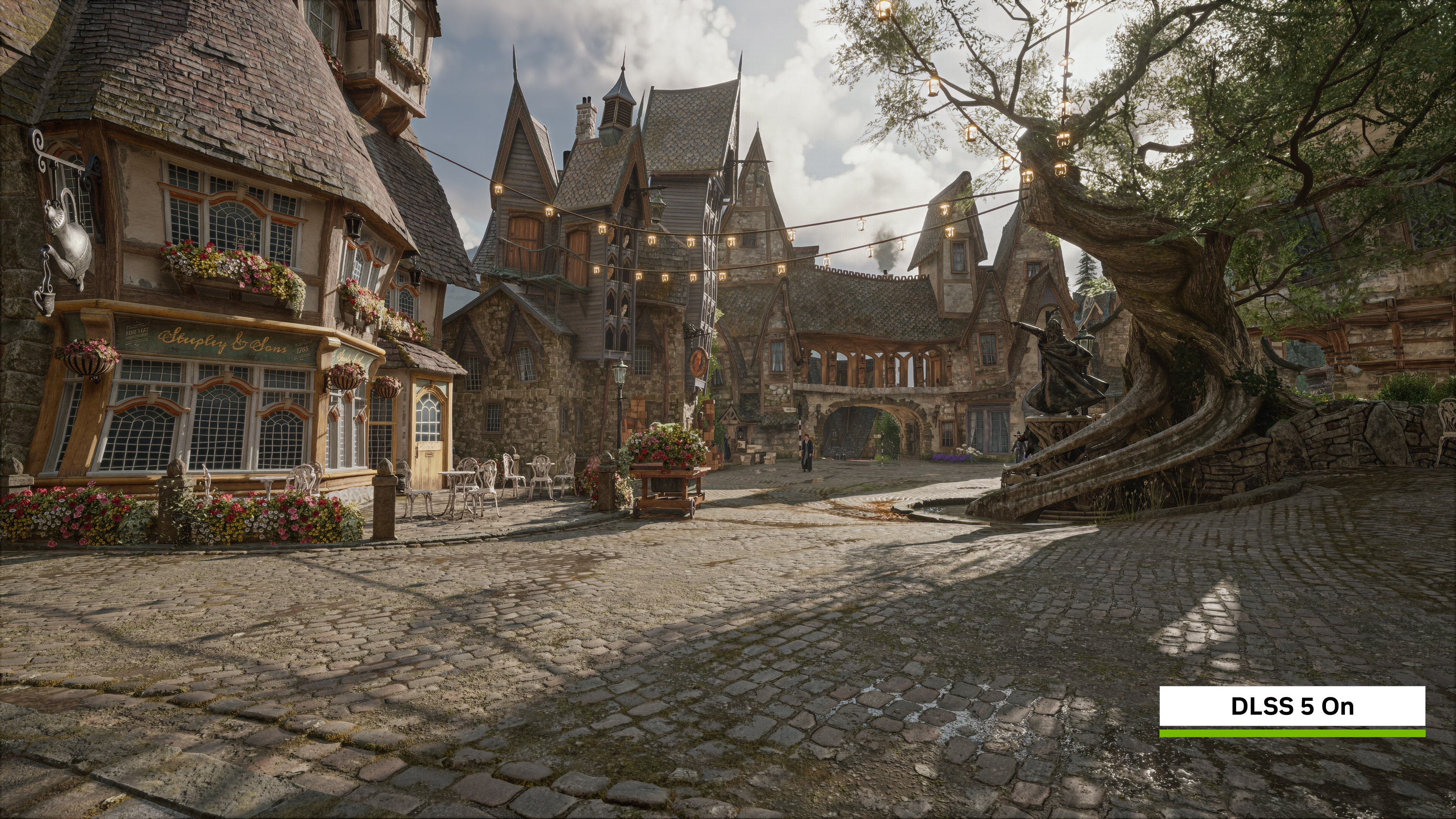
Nvidia has shipped a new DLSS 5 AI model that it says runs roughly twice as fast and uses about 20% less VRAM at 4K than the version that launched in September, and the rollout has already started: NBA 2K27 got the faster model on October 16, Hogwarts Legacy is scheduled for November 5, and Where Winds Meet follows in late November. Nvidia has also shipped a separate beta called Frame Generation Performance Mode that swaps out the frame-generation pipeline's optical-flow model for a lighter algorithm, claiming up to 35% faster frame generation on a GeForce RTX 5060.
Both updates target the same underlying problem: DLSS 5's neural rendering is heavier on the GPU than older upscaling and frame-generation methods, and reviewers have been vocal about the performance cost on real hardware. Here's exactly what changed, which games have it now, and what's still coming.
- What: Nvidia's October DLSS 5 "3D-Guided Neural Rendering" model is about 2x faster to run and uses roughly 20% less VRAM at 4K than the September model.
- Model size: Cut by about 24%, from roughly 155 million to about 118 million parameters; Nvidia says GPU overhead is about half what it was in September.
- NBA 2K27: Got the new model on October 16, 2026. Nvidia claims up to 40% higher frame rates (its own figure is "up to 1.4x").
- Hogwarts Legacy: Scheduled for November 5, 2026.
- Where Winds Meet: Scheduled for late November 2026.
- RTX Remix titles (including Fallout 4 and Mirror's Edge mods): getting the new model and Performance Mode on October 23, 2026.
- Separately: A new "Frame Generation Performance Mode" (Preset C) beta claims up to 35% faster frame generation on an RTX 5060, with a minor image-quality trade-off.
What actually changed in the October DLSS 5 model
Nvidia detailed the update in a GeForce News post published October 13, 2026. The company says it rebuilt the pipeline around its "3D-Guided Neural Rendering" model — the AI system DLSS 5 uses to reconstruct and upscale frames using 3D scene data rather than just prior rendered frames — and applied what it describes as pipeline optimizations and neural model refinements to cut the model's runtime cost roughly in half.
The headline numbers from Nvidia's own post:
- The model runs about 2x faster than the version that shipped with DLSS 5's September debut.
- VRAM usage at 4K drops by about 20%.
- The model's parameter count shrinks by about 24%, from roughly 155 million down to about 118 million parameters.
- Nvidia says GPU processing overhead is now about half of what it was in September, while visual fidelity is described as "comparable."
- Nvidia also frames this as part of a longer trend, claiming the model is now about 10x faster overall than when DLSS 5 was first announced in March 2026.
Independent coverage from Guru3D and TweakTown lines up with Nvidia's own figures, though both outlets note that Nvidia's "2x faster" claim is about the model's own runtime cost, not necessarily a direct 2x increase in in-game frame rates — those depend heavily on the game, resolution, and GPU.
Why lower VRAM and overhead matters for mid-range cards
DLSS 5's neural rendering has been the most demanding part of Nvidia's upscaling stack since launch, and that cost falls hardest on GPUs with less VRAM and less raw compute headroom — exactly the RTX 50-series cards below the 5080 and 5090, plus Nvidia's new RTX Spark mini-PC/laptop platform. A model that needs 20% less memory at 4K and roughly half the GPU overhead to run should, in theory, leave more headroom for the actual game rendering on those parts, rather than eating into it before a single frame of upscaling work is counted.
That's also why Nvidia is tying this update explicitly to RTX Spark laptops, which launched alongside the October DLSS 5 model and lean on efficient, lower-power silicon where every point of GPU overhead matters more than it does on a desktop RTX 5090. It's a different audience than the one that cares about DLSS 5 versus AMD's FSR 4.1 on flagship cards — this update is squarely about making neural rendering viable further down the stack.
NBA 2K27 got the new model first, on October 16
NBA 2K27 was the first game to ship with DLSS 5's 3D-Guided Neural Rendering back in September, and it's also the first to receive the faster October model, which Nvidia enabled on October 16, 2026 for GeForce RTX 50-series GPUs, RTX Spark laptops, and GeForce NOW. Nvidia's own claim for the update in that specific game is frame-rate gains of up to 40% (Nvidia states it as "up to 1.4x") compared with the September model, at the same visual settings.
That figure describes the new model replacing the old one in the same game — it isn't a claim about the model's general "2x faster" runtime translating directly into a 40% in-game boost everywhere. TweakTown has flagged that distinction explicitly, cautioning that a model running twice as efficiently doesn't automatically mean every scene renders twice as fast, since plenty of other work (ray tracing, physics, game logic) still has to happen on the same GPU.
The game-by-game rollout schedule
Nvidia is rolling the new model out title by title rather than as a universal driver-level swap, with RTX Remix mod support arriving on the same October 23 date this article is being published. Here's the confirmed schedule so far, according to Nvidia's own GeForce News post:
| Game / platform | Supported hardware | DLSS 5 (new model) date | Nvidia's claimed gain |
|---|---|---|---|
| NBA 2K27 | GeForce RTX 50 Series, RTX Spark laptops, GeForce NOW | October 16, 2026 | Up to 40% higher frame rates (Nvidia: "up to 1.4x") |
| RTX Remix titles (Fallout 4, Mirror's Edge mods, etc.) | GeForce RTX 50 Series | October 23, 2026 | Not separately quantified by Nvidia |
| Hogwarts Legacy | GeForce RTX 50 Series, RTX Spark, GeForce NOW | November 5, 2026 | Not separately quantified by Nvidia |
| Where Winds Meet | GeForce RTX 50 Series (expected) | Late November 2026 (exact date TBA) | Not separately quantified by Nvidia |
Nvidia says the faster model will ship by default in future DLSS 5 titles going forward, so games that adopt DLSS 5 after this point should launch with the October model rather than the heavier September version.
Hogwarts Legacy and Where Winds Meet are next
Hogwarts Legacy is set to receive DLSS 5 with the new 3D-Guided Neural Rendering model on November 5, 2026, supporting GeForce RTX 50-series GPUs, GeForce NOW, and RTX Spark hardware, per Nvidia's GeForce News post. Where Winds Meet — Everstone Studio's open-world action game — is slated to get DLSS 5 support in "late November," though Nvidia has not published an exact date for that title yet.
Nvidia has not broken out separate performance claims for either title the way it did for NBA 2K27's October 16 update, so there's no official frame-rate figure yet for what the faster model does specifically in Hogwarts Legacy or Where Winds Meet. That's worth watching for once each update actually ships, especially since the September-era model's performance cost varied noticeably by game.
The separate story: Frame Generation Performance Mode
Alongside the DLSS 5 model update, Nvidia is also shipping a distinct beta feature called Frame Generation Performance Mode, exposed in the NVIDIA App as "Preset C" under the DLSS Override's Frame Generation model presets. This is a change to Nvidia's frame generation pipeline, not the neural rendering model discussed above, and it affects DLSS Frame Generation, Multi Frame Generation, and Dynamic Multi Frame Generation alike.
According to Nvidia, the standard frame-generation pipeline relies on a second AI model to calculate optical flow — motion data used to smooth elements like UI overlays and ray-traced effects between generated frames. Performance Mode replaces that optical-flow model with a lighter, faster algorithm. Nvidia's own figure is up to 35% faster frame generation on a GeForce RTX 5060, with what the company describes as a minor reduction in image quality. The feature supports GeForce RTX 40-series and RTX 50-series GPUs as well as RTX Spark laptops, and like the DLSS 5 model update, it's also coming to RTX Remix on October 23.
Coverage from independent outlets such as Club386 largely matches Nvidia's description, though several note that Nvidia has so far published only a limited set of test scenarios (Cyberpunk 2077 at 1440p, in Nvidia's demonstrated case) rather than a broad before/after comparison across games and GPUs — so how consistent that 35% figure is in other titles remains to be independently verified.
How to try Frame Generation Performance Mode
Because it's a beta, Preset C isn't on by default. It currently requires opting into beta or experimental features in the NVIDIA App's settings, then selecting "Preset C" from the Frame Generation override under DLSS Override – Model Presets for a supported game. Nvidia hasn't given a date for when — or whether — Performance Mode graduates out of beta as the default frame-generation behavior.
A model update, but the debate over DLSS 5's cost isn't settled
Nvidia's framing is that the October model closes the gap between DLSS 5's visual ambitions and its performance cost, but that cost has been a real point of contention since launch, and the faster model hasn't been independently retested by major outlets at the time of writing. Worth noting for context: in September testing on an RTX 5080, TweakTown reported that enabling Neural Rendering in NBA 2K27 at 4K with DLAA and ray-traced reflections cut frame rates from 145 FPS down to 50 FPS — a roughly 65% hit — using the original September model. Separately, PC Gamer measured an RTX 5080 at 1440p, Ultra settings with ray tracing on, dropping from 230 FPS native to 93 FPS average with DLSS 5 enabled — a drop the outlet put at up to 73% in that scenario.
Those are both pre-October figures, run against the heavier September model rather than the one shipping now, so they shouldn't be read as a verdict on the new build. But they're the reason Nvidia's "2x faster, 20% less VRAM" claims are being met with some skepticism rather than taken at face value: the September model's performance cost was large enough, in testing by outlets with no stake in the outcome, that a 2x efficiency gain in the model itself doesn't automatically erase the hit once it's layered on top of ray tracing and 4K rendering in a specific game. Independent testing of the October model specifically, once it's more widely available, should settle whether the real-world gap has actually closed.
What this means if you own a mid-range RTX 50-series card
If you're running an RTX 5060, 5070, or an RTX Spark system rather than a 5080 or 5090, the October changes are the more relevant ones to watch. A 20% VRAM reduction at 4K and roughly half the GPU overhead should matter more on cards with less memory and compute headroom than on flagship silicon, where DLSS 5's cost was already more absorbable. Frame Generation Performance Mode's RTX 5060-specific benchmark is itself a signal of who Nvidia is targeting with this round of updates — not the enthusiasts debating image quality on a 5090, but buyers of the cards that make up the bulk of the RTX 50-series lineup.
For background on how DLSS 5 itself works and how it differs from the version Nvidia shipped at launch, see our DLSS 5 release and setup guide.
What's next
Expect three things over the coming weeks: Hogwarts Legacy's DLSS 5 update on November 5, Where Winds Meet's "late November" update once Nvidia confirms an exact date, and likely independent benchmarking of the new October model in NBA 2K27 now that it's live, which should clarify whether Nvidia's efficiency gains hold up outside the company's own test scenes. Frame Generation Performance Mode remains in beta with no confirmed graduation date, so treat its 35% figure as a best-case number until more games and GPUs are tested.
Frequently asked questions
What changed in Nvidia's October 2026 DLSS 5 update?
Nvidia shipped a new AI model for DLSS 5's 3D-Guided Neural Rendering that it says runs about 2x faster and uses roughly 20% less VRAM at 4K than the model that launched in September. The model's parameter count also dropped by about 24%, from roughly 155 million to about 118 million parameters, with GPU overhead cut roughly in half.
Which games have the faster DLSS 5 model right now?
NBA 2K27 received it on October 16, 2026. RTX Remix mod support (covering titles like Fallout 4 and Mirror's Edge remasters) follows on October 23. Hogwarts Legacy is scheduled for November 5, and Where Winds Meet is expected in late November.
What is Nvidia's Frame Generation Performance Mode?
It's a separate beta feature, labeled 'Preset C' in the NVIDIA App, that replaces the optical-flow model used in DLSS Frame Generation, Multi Frame Generation, and Dynamic Multi Frame Generation with a lighter algorithm. Nvidia claims up to 35% faster frame generation on a GeForce RTX 5060, with a minor image-quality trade-off.
Does the new DLSS 5 model fix the performance complaints from launch?
It's too early to say definitively. Nvidia's efficiency claims are about the model's own runtime cost; independent outlets measured substantial frame-rate hits (up to roughly 65-73%, depending on the scenario) with the original September model in NBA 2K27 at high settings. Those tests haven't yet been repeated against the October model, so the real-world gap is not yet independently confirmed either way.
Which GPUs support the new DLSS 5 model and Frame Generation Performance Mode?
The faster DLSS 5 model targets GeForce RTX 50-series GPUs, RTX Spark laptops, and GeForce NOW. Frame Generation Performance Mode additionally supports GeForce RTX 40-series GPUs alongside RTX 50-series and RTX Spark hardware.
How do I enable Frame Generation Performance Mode?
It requires opting into beta/experimental features in the NVIDIA App, then selecting 'Preset C' under the Frame Generation override in DLSS Override – Model Presets for a supported game.
Sources
- NVIDIA GeForce News: DLSS 5 Faster AI Model, Hogwarts Legacy, RTX Spark Laptopsnvidia.com
- Guru3D: Nvidia DLSS 5 Gets 2x Faster AI Model With Lower VRAM Usageguru3d.com
- TweakTown: Nvidia Says DLSS 5 Model Is Now 2x Faster and Uses 20% Less VRAM at 4Ktweaktown.com
- PC Gamer: DLSS 5 Can Slash Performance by Up to 73 Percent on an RTX 5080pcgamer.com
- Club386: Nvidia Claims It's Boosted DLSS Frame Gen Speed by 35% With New Presetclub386.com
Mara Lindqvist edits the hardware desk. She covers graphics cards, processors, memory and storage, the foundries and chip designers behind them, and what the numbers on a spec sheet mean for people choosing a PC. Specifications in her stories come from manufacturer spec pages and datasheets.