RTX 5080 Super vs RTX 5090: Specs, Price and Which to Buy
Nvidia has not launched the RTX 5080 Super yet. Here is how its reported specs and price stack up against the RTX 5090 for gaming, AI and creator workloads.
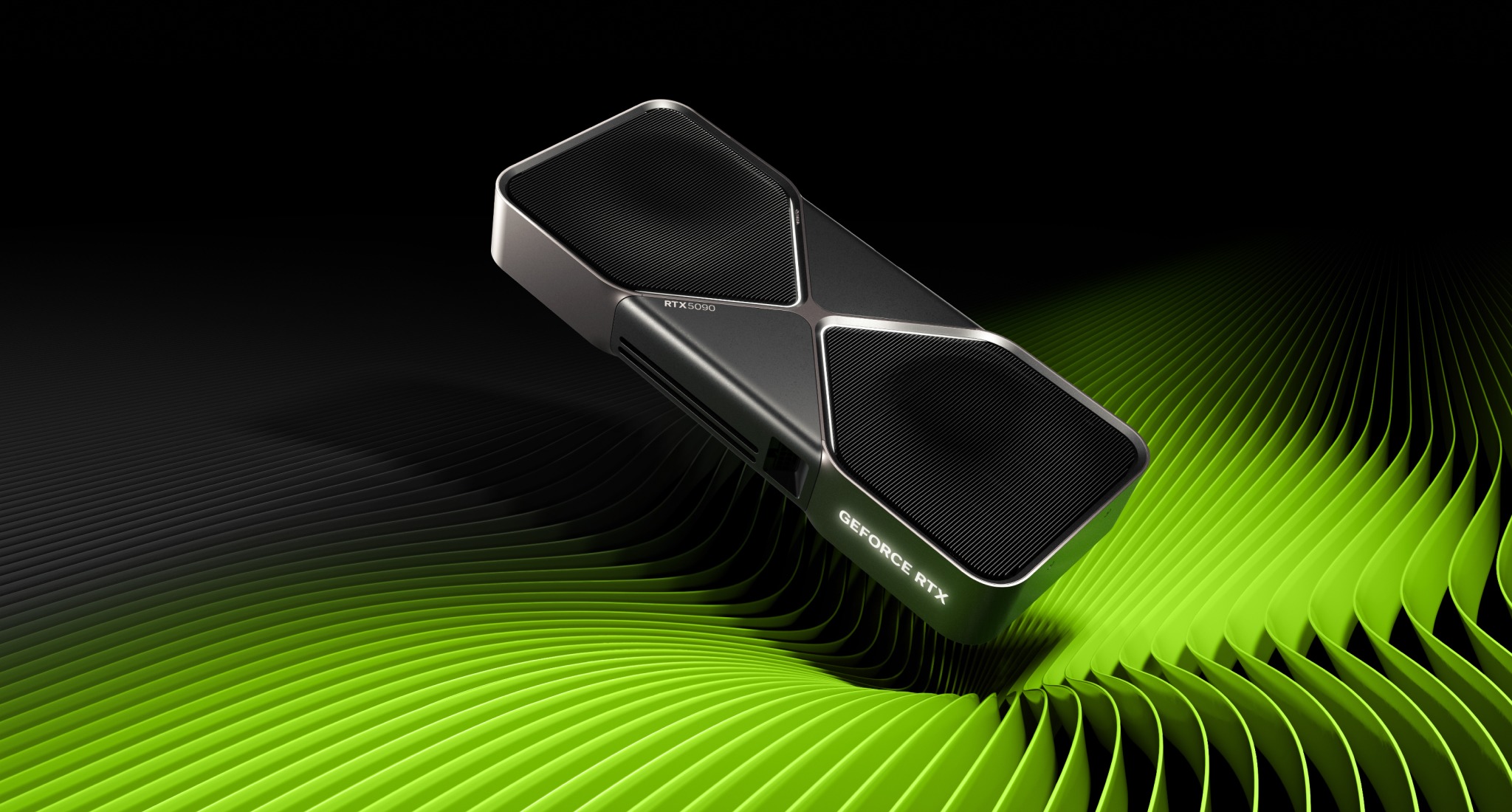
The short answer: the RTX 5090 is the only one of these two cards you can actually buy today, and the RTX 5080 Super exists only as a reported, unlaunched Nvidia refresh. Based on the specs leakers have converged on, the RTX 5080 Super would pair the standard RTX 5080's 10,752 CUDA cores with a 24GB GDDR7 frame buffer and a 415W power limit, aimed at roughly $999–$1,199. The RTX 5090 is Nvidia's confirmed flagship, with 21,760 CUDA cores, 32GB of GDDR7 at 1,792GB/s of bandwidth, a 575W TGP and a $1,999 MSRP. For gaming at 1440p or 4K, the reported 5080 Super looks like the better value if and when it ships. For AI training, large local models or professional creator workloads that need maximum VRAM and compute, the 5090 remains the clear choice. Here is everything confirmed versus reported, specs, pricing and which one actually fits your use case.
Is the RTX 5080 Super even real yet?
As of this writing, Nvidia has not announced, priced or shipped an RTX 5080 Super. Every spec attached to the card below comes from hardware leakers and reputable tech press reporting on leaked board partner documents, not from an Nvidia newsroom post or product page. Timelines for the card have shifted repeatedly — early reports pointed to a late-2025 launch, then a 2026 window tied to CES, and more recent reporting suggests Nvidia has quietly held finished boards back, with some outlets now speculating the launch could slip toward CES 2027. Treat every 5080 Super number in this piece as reported, not confirmed, until Nvidia publishes its own spec page.
The RTX 5090, by contrast, is fully official. Nvidia announced it at CES 2025 and launched it on January 30, 2025, as the flagship of the GeForce RTX 50 series built on its Blackwell architecture, and its specs, pricing and official product page have been stable since.
RTX 5080 Super vs RTX 5090: specs compared
The gap between these two cards is large by design — Nvidia has always positioned the 5090 as a halo part well above the rest of the RTX 50 lineup. The table below lines up Nvidia's confirmed RTX 5090 numbers against the RTX 5080 Super figures that have leaked from board partner documentation and been corroborated across multiple outlets.
| Spec | RTX 5080 Super (reported) | RTX 5090 (official) |
|---|---|---|
| Status | Unannounced / unlaunched | Launched January 30, 2025 |
| GPU die | GB203 (full configuration) | GB202 |
| CUDA cores | 10,752 (reported, unchanged from RTX 5080) | 21,760 |
| Memory | 24GB GDDR7 (reported, up from 16GB) | 32GB GDDR7 |
| Memory bus | 256-bit (reported) | 512-bit |
| Memory speed / bandwidth | ~32Gbps / ~1,024GB/s (reported) | 28Gbps / 1,792GB/s |
| Total graphics power (TDP) | ~415W (reported, vs 360W on RTX 5080) | 575W |
| Recommended PSU | Not disclosed | 1,000W |
| Reported/launch price | $999–$1,199 (reported) | $1,999 MSRP (Founders Edition) |
Even on paper, the RTX 5090 has roughly double the CUDA core count, a wider memory bus and far more bandwidth than the reported RTX 5080 Super. The 5080 Super's main reported upgrade over the standard RTX 5080 isn't raw compute — it keeps the same core count — it's memory capacity, jumping from 16GB to a reported 24GB, plus a modest clock and power bump that leakers like Moore's Law Is Dead have pegged at roughly a 7–14% real-world performance gain over the vanilla 5080.
Ray tracing, tensor cores and connectivity
The CUDA core count is only part of the picture. On the official RTX 5090, Nvidia pairs those 21,760 CUDA cores with 4th-generation RT cores (rated at 318 TFLOPS of ray tracing performance) and 5th-generation Tensor cores (rated at 3,352 AI TOPS), running at a 2.01GHz base and 2.41GHz boost clock. Display output is equally built for the high end: three DisplayPort 2.1b outputs plus HDMI 2.1b, enough to drive 4K at 480Hz or 8K at 165Hz with DSC enabled, across up to four independent monitors. The card itself is a 2-slot, 304mm design, and Nvidia ships it with either four PCIe 8-pin-to-12V-2x6 adapter cables or a single native 600W PCIe Gen 5 power cable.
None of those finer-grained figures — RT core generation, Tensor TOPS, boost clocks, or connector layout — have leaked for the RTX 5080 Super. Leakers have focused almost entirely on the headline numbers that drive gaming and compute performance: core count, memory, and power. Given the Super is reported to reuse the same GB203 die as the standard RTX 5080, it's a reasonable assumption that RT and Tensor core counts, clock structure and display outputs would carry over largely unchanged from the existing RTX 5080 — but until Nvidia confirms a spec sheet, that's an inference, not a reported fact.
CUDA cores and memory: why the gap matters
CUDA core count is the simplest proxy for raw shading and compute throughput, and the reported 10,752 cores on the 5080 Super versus 21,760 on the 5090 is almost exactly a 2x gap. That difference shows up directly in anything compute-bound: path tracing, 4K rendering with heavy ray reconstruction, or any GPU-accelerated production workload.
Memory capacity tells a more nuanced story. The reported jump from 16GB to 24GB on the 5080 Super matters for gaming at 4K with texture-heavy mods or multiple ray tracing passes, and it also matters for running larger local AI models — 24GB clears the threshold for a lot of mid-size open-weight LLMs and image generation checkpoints that choke a 16GB card. But the RTX 5090's 32GB, paired with that 512-bit bus and 1,792GB/s of bandwidth, is in a different league entirely for anything that scales with VRAM: large batch training, big diffusion models, or multi-model creative pipelines.
Power draw and price
Power tells the same story as compute. Nvidia's official RTX 5090 draws up to 575W and needs a 1,000W-class power supply — a serious thermal and electrical commitment for a case and PSU. The reported RTX 5080 Super's 415W TGP is meaningfully easier to accommodate, sitting closer to what a high-end gaming rig already budgets for.
On price, the official RTX 5090 launched at a $1,999 MSRP for the Founders Edition, though real-world street pricing has been far higher than that for most of 2026 — driven largely by GDDR7 and DRAM supply constraints that have also pushed up RAM prices industry-wide. Tom's Guide has reported street prices climbing toward $3,000 and beyond well after launch, and partner cards on retailers like Newegg have regularly listed well above MSRP. If the RTX 5080 Super does launch at the reported $999–$1,199 range, it would land roughly $800–$1,000 cheaper than the 5090's official MSRP — and likely far cheaper than whatever the 5090 is actually selling for by the time the Super ships.
- RTX 5090: 21,760 CUDA cores, 32GB GDDR7, 1,792GB/s bandwidth, 575W TGP, $1,999 MSRP — official and shipping.
- RTX 5080 Super: reportedly 10,752 CUDA cores, 24GB GDDR7, ~1,024GB/s bandwidth, ~415W TGP, $999–$1,199 — unconfirmed, unlaunched.
- Nvidia has not set an official release date for the RTX 5080 Super as of this writing.
Which is the better buy for gaming?
For pure gaming, the calculus is about price-to-performance rather than peak specs. The standard RTX 5080 already delivers excellent 1440p and 4K performance for a fraction of the 5090's price, and our RTX 5080 vs RX 9070 XT comparison breaks down how it stacks up against AMD's closest competitor. If the reported RTX 5080 Super ships at anywhere near $999–$1,199 with a 7–14% uplift and 50% more VRAM than the vanilla 5080, it would be the far more sensible gaming purchase than a 5090 for almost everyone — the extra CUDA cores and bandwidth on the 5090 mostly go to waste once a game is already running at your monitor's refresh ceiling. The 5090 only pulls ahead for gamers specifically chasing the highest possible frame rates at 4K or 8K with every ray tracing setting maxed, or those using the extra VRAM headroom for heavily modded titles.
Which is the better buy for AI and creator workloads?
For AI training, local LLM inference, or professional content creation, the equation flips hard in the 5090's favor. More VRAM lets you load larger models and bigger batches without offloading to system memory, and the 512-bit bus and 1,792GB/s of bandwidth keep that larger memory pool fed. 32GB versus a reported 24GB is also the difference between comfortably running many popular open-weight models at higher precision versus needing to quantize more aggressively on the smaller card. If your work involves Stable Diffusion/image-gen fine-tuning, local LLM serving, 3D rendering, or video workflows in apps that lean on CUDA and tensor cores, the RTX 5090's extra compute and memory headroom will pay for itself far faster than it does in a game benchmark.
Should you wait for the RTX 5080 Super?
Whether waiting makes sense depends entirely on how urgently you need a new GPU and how much weight you put on unverified leaks. The case for waiting: if the reported specs hold, the 5080 Super would offer the single biggest practical upgrade over the base RTX 5080 — 50% more VRAM — at a price Nvidia has reportedly considered holding flat versus the existing 5080's $999 MSRP. That would make it a much easier recommendation than the RTX 5090 for most gaming builds, and it would undercut whatever inflated street price the 5090 is commanding by that point. The case against waiting: Nvidia has already slipped the card's rumored launch window at least twice, from a theoretical late-2025 date out toward 2026 and, per some recent reporting, possibly into early 2027. A card that keeps getting pushed back isn't useful to someone who needs a GPU this quarter, and nothing is stopping Nvidia from changing the final specs, clocks or price between now and an eventual retail launch.
If you're gaming on an older GPU and your card is struggling right now, it's worth making sure you're also running current drivers before you consider a costly upgrade — see our rundown of what changed in a recent Nvidia GeForce driver release — before deciding whether an upgrade, a wait, or a different tier like the RTX 5070 Ti makes more sense for your budget.
What should you actually buy right now?
Since the RTX 5080 Super isn't purchasable yet, this isn't really an apples-to-apples buying decision today — it's a "wait or not" decision. If you need a GPU now for gaming, the standard RTX 5080 or RTX 5090 (via Nvidia's own RTX 5090 product page) are your real options, and checking that you're on current drivers first can help you squeeze out more performance before you spend. If you can wait and your priority is gaming value rather than AI/creator headroom, holding out for the reported RTX 5080 Super's higher VRAM and lower price makes sense, assuming Nvidia actually ships it. If your workload is AI- or compute-heavy, don't wait on a rumor — the RTX 5090 is real, specced for that job, and available now (at a markup).
How we know what we know about the 5080 Super
The reported specs in this article trace back to board partner documentation that leaked through known hardware leakers, most notably Moore's Law Is Dead, and were subsequently reported and cross-checked by outlets including Tom's Hardware. Our earlier piece on what leaks say about the RTX 5080 Super's release date, specs and price tracks the full timeline of those reports, including the conflicting launch-window claims. None of these numbers are confirmed by Nvidia, and board partners have been known to finalize different clocks, power limits or even memory configurations between leaked engineering samples and retail launch.
Bottom line: what's next
Until Nvidia actually announces the RTX 5080 Super, this comparison is necessarily "official flagship vs. rumor." The RTX 5090 is real, expensive, and built for the heaviest AI, creator and 4K/8K gaming workloads. The RTX 5080 Super, if it launches close to its reported specs and price, would be a far more sensible everyday gaming GPU — more VRAM than the current 5080, a meaningful price gap below the 5090, and performance aimed squarely at 1440p/4K gaming rather than compute headroom. Our advice: buy for what exists today if you need a card now, and treat every 5080 Super spec and price point in this article as subject to change until Nvidia says otherwise. We'll update this piece the moment Nvidia makes it official.
Frequently asked questions
Is the RTX 5080 Super officially confirmed by Nvidia?
No. As of this writing, Nvidia has not announced, priced or released an RTX 5080 Super. All specs and pricing for it come from hardware leakers and tech press reporting on leaked board partner documents, not from Nvidia itself.
What are the reported specs of the RTX 5080 Super?
Leaks point to 10,752 CUDA cores (unchanged from the standard RTX 5080), 24GB of GDDR7 memory on a 256-bit bus, roughly 1,024GB/s of bandwidth, and a TGP of around 415W, up from 360W on the RTX 5080.
How much will the RTX 5080 Super cost?
Reported pricing ranges from $999 to $1,199, with some leakers suggesting Nvidia may hold the price close to the existing RTX 5080's $999 MSRP despite the extra memory.
What are the official RTX 5090 specs?
Nvidia's RTX 5090 has 21,760 CUDA cores, 32GB of GDDR7 memory on a 512-bit bus with 1,792GB/s of bandwidth, a 575W total graphics power rating, and launched at a $1,999 MSRP for the Founders Edition.
Is the RTX 5090 better for gaming than the RTX 5080 Super?
For most gamers, no. The RTX 5090's extra compute mostly benefits 4K/8K gaming with every setting maxed; the reported RTX 5080 Super's lower price and extra VRAM over the base 5080 would make it a better value pick for typical 1440p/4K gaming if it launches as leaked.
Which card is better for AI or creator work?
The RTX 5090, by a wide margin. Its 32GB of VRAM, 512-bit bus and far higher bandwidth make it much better suited to large AI models, big batch sizes and demanding creative workloads than the reported 24GB RTX 5080 Super.
Sources
- Nvidia - GeForce RTX 5090 official specsnvidia.com
- Nvidia - GeForce RTX 5080 official specsnvidia.com
- Tom's Hardware - RTX 5080 Super rumored specstomshardware.com
- Tom's Guide - RTX 5090 price trendstomsguide.com
- Wikipedia - GeForce RTX 50 seriesen.wikipedia.org
Mara Lindqvist edits the hardware desk. She covers graphics cards, processors, memory and storage, the foundries and chip designers behind them, and what the numbers on a spec sheet mean for people choosing a PC. Specifications in her stories come from manufacturer spec pages and datasheets.