HDMI 2.2 Explained: Release Date, Specs, and HDMI 2.2 vs 2.1
HDMI 2.2 doubles bandwidth to 96Gbps, adds the Ultra96 cable and Latency Indication Protocol, and sets the stage for 16K displays.
HDMI 2.2 is the next major version of the HDMI specification, finalized by the HDMI Forum on June 25, 2025 after being unveiled at CES in January 2025. It doubles maximum bandwidth from 48Gbps to 96Gbps, enables resolutions and refresh rates up to 4K at 480Hz and 16K at 60Hz, introduces a new certified cable called Ultra96, and adds a Latency Indication Protocol (LIP) to fix audio-video sync problems in home theater setups. The spec is finished and licensable today, but Ultra96 cables only began reaching retail in late 2025, and no mainstream TV, graphics card, or game console has shipped with an HDMI 2.2 port yet — so for most buyers, there's nothing to do right now beyond understanding what's coming.
- Announced: January 6, 2025, ahead of CES; finalized: June 25, 2025
- Bandwidth: up to 96Gbps, double HDMI 2.1's 48Gbps ceiling
- New cable: Ultra96 HDMI Cable, required to hit full bandwidth
- Top resolutions: 4K@480Hz, 8K@240Hz, up to 12K@120Hz / 16K@60Hz
- New feature: Latency Indication Protocol (LIP) for better A/V sync
- Connector: unchanged — same Type A/C/D HDMI plugs, fully backward compatible
- First consumer hardware: not expected until 2026 at the earliest, with wider availability more likely in 2027
What is HDMI 2.2?
HDMI 2.2 is the latest specification update from the HDMI Forum, the non-profit trade group of more than 90 consumer electronics and component manufacturers that governs the HDMI standard. The HDMI Forum first revealed HDMI 2.2 on January 6, 2025, the day before CES opened in Las Vegas, and then released the completed specification to its adopter companies on June 25, 2025. It supersedes HDMI 2.1 (and the minor 2.1a/2.1b revisions) as the current version of the standard, though HDMI 2.1 hardware remains fully supported and will keep shipping for years.
At its core, HDMI 2.2 is a bandwidth and signaling upgrade. It uses a "next-gen" version of HDMI's Fixed Rate Link (FRL) transmission technology to push the maximum data rate from 48Gbps to 96Gbps — the same kind of jump HDMI 2.1 made over HDMI 2.0 back in 2017. That extra headroom is what unlocks higher resolutions, higher refresh rates, and higher-fidelity, less-compressed color at the high end, while also leaving room for future formats the HDMI Forum says are already on a multi-year roadmap for AR/VR, spatial displays, and commercial applications like digital signage and medical imaging.
HDMI 2.2 vs HDMI 2.1: what's actually different
For most people the question is simple: what does HDMI 2.2 add that HDMI 2.1 doesn't already have? The headline differences are bandwidth, resolution ceilings, the new cable requirement, and the addition of LIP for sync correction. Connector shape, basic feature set (VRR, ALLM, eARC, Dynamic HDR), and general backward compatibility all carry over unchanged.
| Spec | HDMI 2.1 | HDMI 2.2 |
|---|---|---|
| Max bandwidth | 48Gbps | 96Gbps |
| Cable needed for max bandwidth | Ultra High Speed HDMI Cable | Ultra96 HDMI Cable |
| Uncompressed full-chroma ceiling | 4K@120 / 8K@60 (with subsampling) | 4K@240/4:4:4 and 8K@60/4:4:4, 10/12-bit |
| Max resolution with compression | Up to 10K | Up to 12K@120 and 16K@60 |
| A/V sync correction | None dedicated | Latency Indication Protocol (LIP) |
| Link technology | Fixed Rate Link (FRL) | Next-gen Fixed Rate Link |
| Connector | Type A / C / D | Same Type A / C / D (unchanged) |
| Finalized | November 2017 | June 25, 2025 |
Note that HDMI 2.2 is a superset, not a replacement that obsoletes your gear overnight. A 2.2-certified source and display will still negotiate down to whatever a 2.1 cable or earlier device can handle, exactly the way HDMI has always been backward compatible.
The Ultra96 cable, explained
Every full bandwidth jump in HDMI's history has needed a new cable rated for the higher data rate, and HDMI 2.2 is no exception. The HDMI Forum's new certified cable is officially named the Ultra96 HDMI Cable, and it's built to carry the full 96Gbps that HDMI 2.2 makes possible. It joins — rather than replaces — the existing Ultra High Speed HDMI Cable introduced for HDMI 2.1, which tops out at 48Gbps and remains perfectly fine for any device that doesn't need the new spec's full bandwidth.
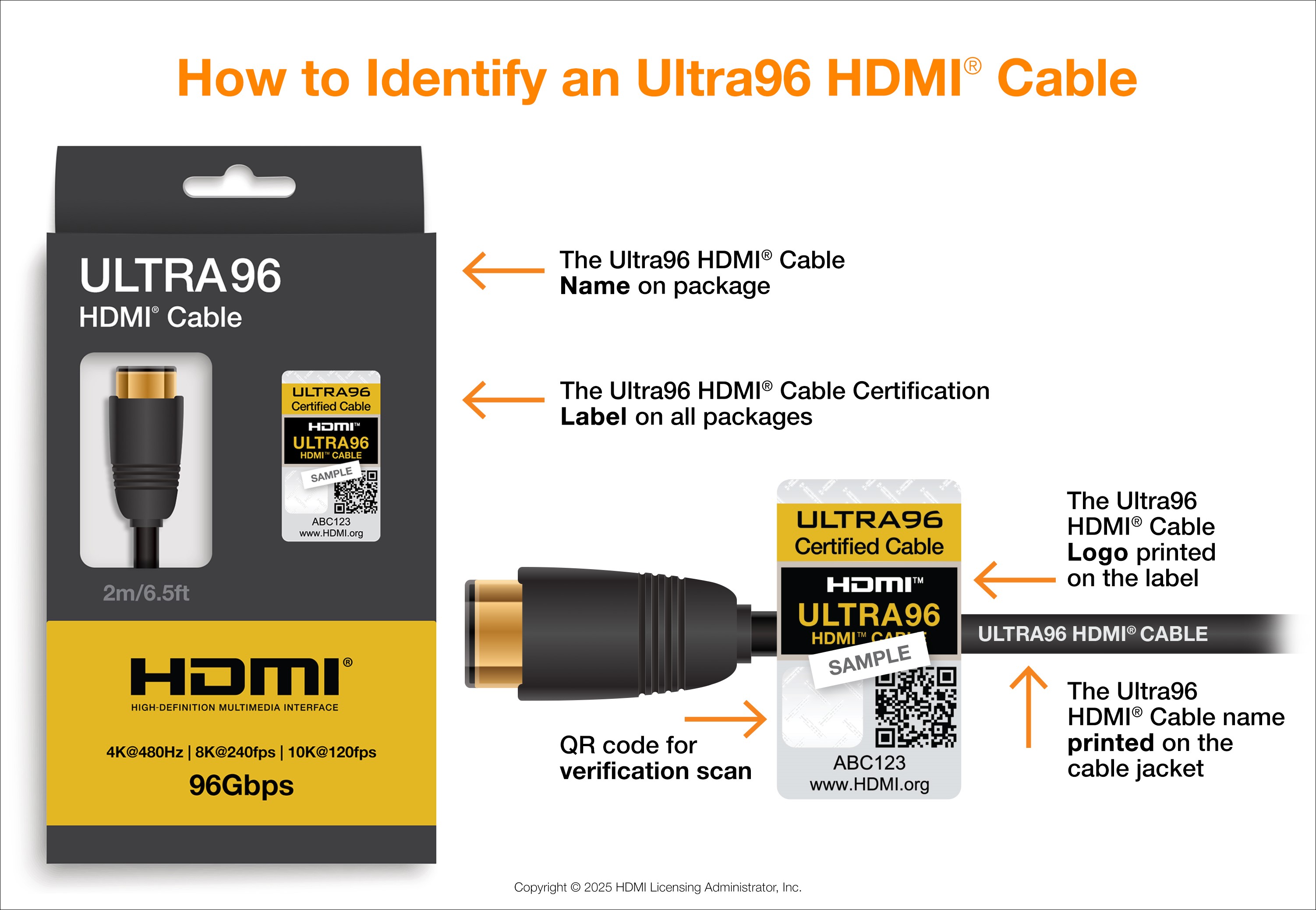
The HDMI Forum has also introduced "Ultra96" as a feature name that manufacturers are encouraged to print on ports, spec sheets, user guides, on-screen menus, and packaging to indicate a product supports a maximum of 64Gbps, 80Gbps, or 96Gbps under HDMI 2.2. Any product that advertises the Ultra96 name requires the Ultra96 cable to actually deliver that bandwidth end to end — an older Ultra High Speed cable will physically plug in and work, but it will cap performance at 48Gbps. Like previous Ultra cables, Ultra96 cables go through the HDMI Forum's certification program, with every model and length individually tested, on-cable identification printing, anti-counterfeiting QR-code labels, and ongoing compliance audits. According to the HDMI Forum's own specification overview, Ultra96 cables were expected to begin reaching the market in the third and fourth quarter of 2025, and the connector itself is unchanged — Ultra96 cables use the same Type A plug as every HDMI cable before them, so there's no new port shape to worry about.
Resolutions and refresh rates HDMI 2.2 supports
The extra bandwidth is mostly there to feed much higher combinations of resolution and refresh rate than HDMI 2.1 could manage. Per the HDMI Forum's official specification overview, HDMI 2.2 supports uncompressed, full-chroma formats including 8K at 60Hz and 4K at 240Hz, both at 10-bit and 12-bit color with 4:4:4 chroma sampling — no subsampling shortcuts needed. Layer in compression and chroma subsampling, and the ceiling rises further to 4K at 480Hz, 5K at 240Hz, 8K at 240Hz, 10K at 120Hz, and 12K at 120Hz, with the HDMI Forum's spec pages citing 16K at 60Hz as the practical top end of the standard.
In plain terms, this is overkill for essentially every display on the market today. No consumer TV or monitor ships anywhere near 12K or 16K resolution, and even 8K television sales remain a niche. The near-term, real-world benefit is more likely to show up at the high-refresh end: uncompressed 4K at 240Hz with full 12-bit color is a meaningfully bigger jump for high-end gaming monitors and future game consoles than anything HDMI 2.1 could offer without leaning on Display Stream Compression. The 16K/12K ceiling exists for the HDMI Forum's stated use cases further out — commercial signage, medical imaging, machine vision, and AR/VR/spatial displays — rather than for living-room TVs.
Fixed Rate Link and the new Latency Indication Protocol
Two technical pieces do the real work in HDMI 2.2. The first is next-gen Fixed Rate Link, the physical-layer signaling technology that actually carries the higher 96Gbps data rate between source and display. FRL itself isn't new — HDMI 2.1 introduced it — but HDMI 2.2 extends it to the higher data rate and is designed with headroom for further increases as gaming and VR/AR payload bandwidth needs keep roughly doubling every two to three years, per the HDMI Forum.
The second, and arguably more interesting piece for everyday home theater setups, is the Latency Indication Protocol, or LIP. Anyone who has dealt with a soundbar or AV receiver that puts the audio slightly out of step with on-screen lip movement has run into the problem LIP is built to solve. In multi-hop setups — source device to AV receiver to TV, for example — video and audio can each pick up small, different processing delays along the chain, and today's HDMI has no standardized way for devices to tell each other how much delay they're introducing. LIP changes that: every device in the chain can report its own audio and video delay, so a source device can calculate the right compensating delay and apply it centrally, rather than each display or receiver guessing independently. The HDMI Forum frames LIP as particularly useful for complex, multi-device home theater chains and notes it can also help correct for mismatched content or headphone playback, where sync drift is easy to notice and hard to fix downstream.
How does this compare with DisplayPort?
It's worth a brief note so the two standards aren't confused: DisplayPort, the competing display connector standard maintained by VESA, is on version 2.1, with its fastest UHBR20 mode topping out at 80Gbps of raw bandwidth — below HDMI 2.2's 96Gbps ceiling. DisplayPort remains far more common on PC monitors and graphics cards, while HDMI dominates TVs, consoles, soundbars, and AV receivers, so in practice the two rarely compete head-to-head for the same port on the same device. HDMI 2.2 doesn't change that division of labor; it simply keeps HDMI's bandwidth ahead of DisplayPort's for the living-room and high-end-display use cases HDMI is built for.
When are HDMI 2.2 cables and devices actually coming?
The specification itself is done — it was finalized and handed to HDMI Forum adopter companies on June 25, 2025 — but a finished spec and shipping hardware are two different things. Ultra96 cables were the first products out of the gate, with the HDMI Forum's own overview targeting market availability in Q3/Q4 2025, and early certified cables have since begun appearing from accessory makers. Actual source and display hardware with HDMI 2.2 ports — TVs, graphics cards, game consoles, AV receivers, projectors — takes much longer, because silicon vendors need to design, validate, and ship new chipsets around the new FRL rates before any device maker can build around them. As of this writing, no mainstream TV, GPU, or console has launched with an HDMI 2.2 port; current flagship graphics cards and the newest consoles remain built around HDMI 2.1. Industry reporting around the June 2025 finalization generally pointed to the first HDMI 2.2-equipped products arriving no earlier than 2026, with broader availability across TVs and AV gear more likely in 2027 as chipmakers and set manufacturers work the new spec into their product cycles.
That timeline tracks with how past HDMI transitions have played out: HDMI 2.1 was finalized in late 2017, but the first HDMI 2.1-capable TVs and the PS5/Xbox Series X didn't ship until 2020. A similar multi-year gap between "spec finalized" and "hardware on shelves" should be expected for HDMI 2.2.
Do you need to do anything right now?
No. If you're shopping for a TV, monitor, GPU, soundbar, or cable today, HDMI 2.2 isn't a factor yet — there's no certified consumer hardware to buy, and HDMI 2.1 (or even 2.1a/2.1b) remains the right target for anything you're purchasing in the current generation. A few practical notes for anyone tracking this closely:
- Your existing Ultra High Speed HDMI cables are not wasted money — they'll keep working at up to 48Gbps with HDMI 2.1 gear indefinitely, and will still physically connect to future HDMI 2.2 devices, just capped below the new ceiling.
- Don't buy an "Ultra96" cable speculatively unless you already own a device that needs it; there's nothing on the market yet that can use the extra bandwidth.
- Watch for the Ultra96 certification label and QR code if you do eventually buy one, since counterfeit high-bandwidth HDMI cables are common and the Forum's certification program is the only way to verify a cable actually meets spec.
- If you're buying a high-refresh gaming monitor, a next-gen GPU like Nvidia's latest cards (see our RTX 5080 Super vs RTX 5090 comparison), or a new AV receiver this year, buy for what it actually supports today — HDMI 2.2 compatibility isn't a box any current product can check.
HDMI 2.2 slots into a broader pattern of 2025-2026 connectivity upgrades — alongside standards like Wi-Fi 7 and Thunderbolt 5 — where the specification arrives well ahead of the hardware that actually uses it, giving the industry runway to build silicon before asking consumers to upgrade cables or devices.
What's next
With the specification locked and Ultra96 cables beginning to reach retail, the next milestones to watch are silicon: the first GPUs, SoCs, and TV panel controllers built around HDMI 2.2's higher FRL rate, which will determine when actual consumer devices start listing HDMI 2.2 ports. Expect the HDMI Forum to use future CES events for adopter and compliance-testing updates, and expect TV and graphics card makers to stay quiet about HDMI 2.2 support until they're closer to shipping hardware that can use it — likely starting in 2026 and becoming more mainstream in 2027. Pandromeda will update this explainer as certified cables, chipsets, and the first HDMI 2.2 devices are confirmed.
Frequently asked questions
When was HDMI 2.2 released?
The HDMI Forum announced HDMI 2.2 on January 6, 2025, ahead of CES, and finalized the full specification for adopter companies on June 25, 2025. It is an official, licensable spec today, though consumer hardware has not yet shipped.
What is the maximum bandwidth of HDMI 2.2?
HDMI 2.2 supports up to 96Gbps of bandwidth, double the 48Gbps ceiling of HDMI 2.1, using a next-generation version of HDMI's Fixed Rate Link signaling technology.
Do I need a new cable for HDMI 2.2?
Yes. To get the full 96Gbps, you need a certified Ultra96 HDMI Cable. Existing Ultra High Speed HDMI cables still work with HDMI 2.2 devices but are capped at 48Gbps.
Will my current HDMI cables and devices still work?
Yes. HDMI 2.2 is backward compatible and uses the same Type A, C, and D connectors as earlier HDMI versions, so existing cables and HDMI 2.1 devices continue to function as before.
When will HDMI 2.2 TVs and graphics cards be available?
As of late 2025, Ultra96 cables are the only HDMI 2.2 products on the market. Industry reporting around the June 2025 finalization pointed to the first HDMI 2.2-equipped TVs, GPUs, and consoles arriving no earlier than 2026, with broader availability more likely in 2027.
What does the Latency Indication Protocol (LIP) do?
LIP lets every device in an HDMI chain, such as a source, AV receiver, and TV, report its own audio and video delay, so the source device can apply the correct compensating delay and keep sound and picture in sync, especially in multi-device home theater setups.
Sources
- HDMI Forum: HDMI 2.2 Specification Technology Overviewhdmi.org
- HDMI Forum: HDMI 2.2 Specification Announcement (January 6, 2025)hdmi.org
- HDMI Forum: Version 2.2 of the HDMI Specification Released (June 25, 2025)hdmiforum.org
- HDMI Licensing Administrator: HDMI 2.2 Specification Overview (official deck)hdmi.org
- HDMI Forum Press Resourceshdmi.org
- Wikipedia: HDMIen.wikipedia.org
Mara Lindqvist edits the hardware desk. She covers graphics cards, processors, memory and storage, the foundries and chip designers behind them, and what the numbers on a spec sheet mean for people choosing a PC. Specifications in her stories come from manufacturer spec pages and datasheets.