AMD Ryzen AI Max+ 395 vs Nvidia DGX Spark: Which to Buy
Compact AI desktops with up to 128GB of unified memory, compared on specs, bandwidth, price and which one actually suits local LLM inference.
Nvidia's DGX Spark and AMD's Ryzen AI Max+ 395 both cram enough unified memory into a shoebox-sized desktop to run large language models locally, but they get there in very different ways and at very different prices: DGX Spark pairs a 20-core Arm/Blackwell superchip with up to 128GB of LPDDR5x and a starting price of $4,999 for the new 64GB model, while Ryzen AI Max+ 395 mini PCs like the Framework Desktop pair a 16-core Zen 5 CPU with up to 128GB of LPDDR5x for as little as $1,959. For most people building a local-AI box on a budget, the Ryzen AI Max+ 395 is the better buy; for CUDA-dependent developers who need Nvidia's software stack and the fastest possible token throughput, DGX Spark justifies its premium.
- AMD Ryzen AI Max+ 395: 16-core/32-thread Zen 5 CPU, Radeon 8060S (40 CU) GPU, XDNA 2 NPU rated up to 50 TOPS, up to 128GB of 256-bit LPDDR5x-8000 (256GB/s bandwidth)
- Nvidia DGX Spark: GB10 Grace Blackwell superchip, 20-core Arm CPU, Blackwell GPU rated up to 1 petaFLOP of FP4 AI compute, 64GB or 128GB of LPDDR5X (273GB/s bandwidth)
- Framework Desktop (Ryzen AI Max+ 395, OEM example) starts at $1,959 for 64GB and $3,449 for 128GB, per Framework's own configurator
- DGX Spark starts at $4,999 for the new 64GB model (ships October 23, 2026); the 128GB Founders Edition's MSRP rose from $3,999 to $4,699 in February 2026 and has traded well above that at retail since, as Nvidia has cited ongoing DRAM supply constraints
- Nvidia's figure is an FP4 tensor-core throughput number for GPU-accelerated inference; AMD's is an INT8 NPU/platform TOPS figure, so the two are not directly comparable watt-for-watt
What is the AMD Ryzen AI Max+ 395?
The Ryzen AI Max+ 395 is AMD's top "Strix Halo" chip, a single piece of silicon that combines 16 Zen 5 CPU cores (32 threads) with a 40-compute-unit RDNA 3.5 integrated GPU (branded Radeon 8060S) and an XDNA 2 neural processing unit, all built on a 4nm process. According to AMD's own product page, the chip has a default TDP of 55W with a configurable range of 45-120W, a 64MB L3 cache, and crucially a 256-bit LPDDR5x-8000 memory interface shared across the CPU, GPU and NPU, good for 256GB/s of bandwidth and up to 128GB of total capacity. AMD rates the NPU alone at up to 50 TOPS and the full platform (CPU+GPU+NPU combined) at up to 126 TOPS, a figure AMD also discussed in its own launch blog post for the chip.
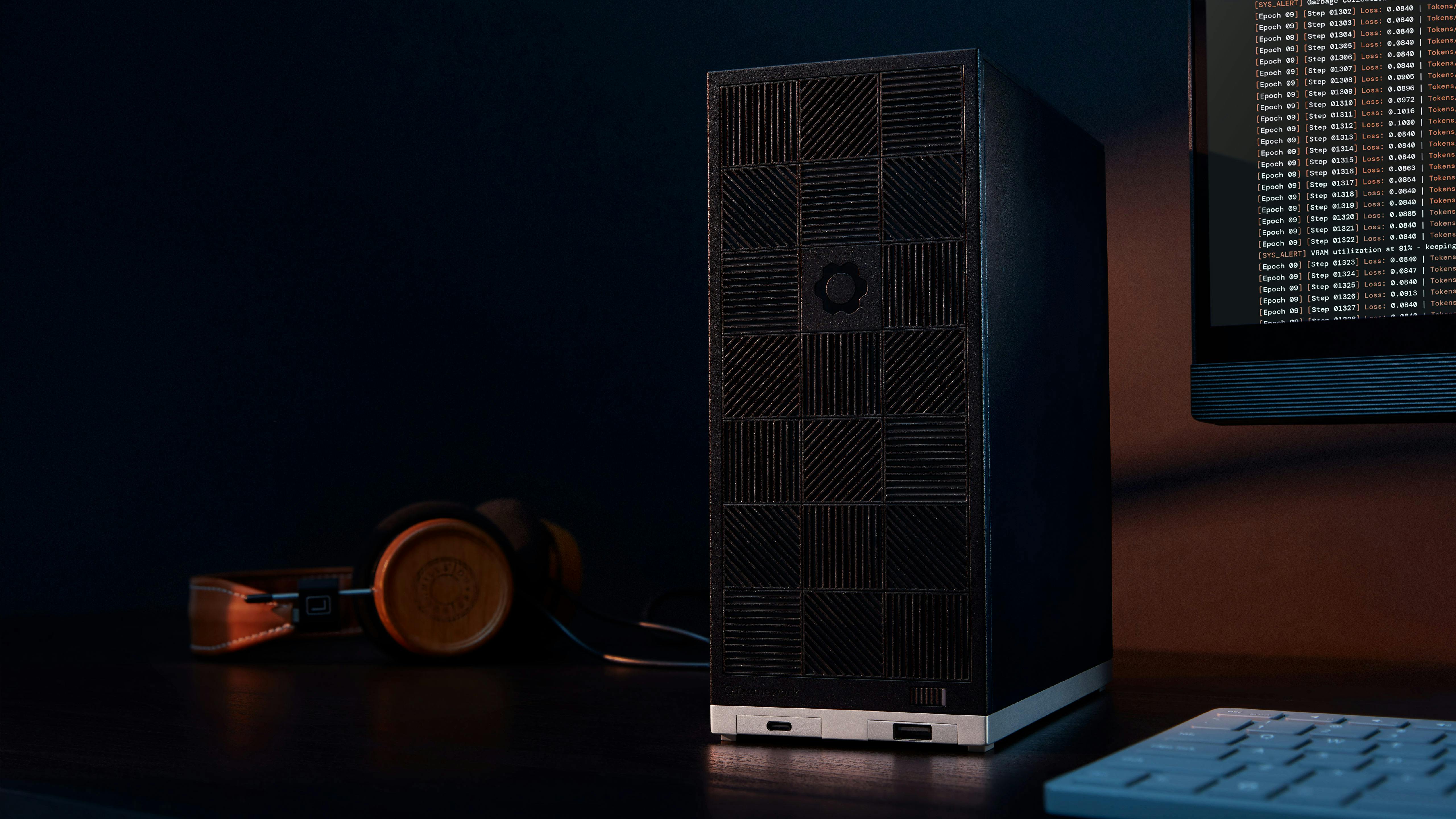
AMD doesn't sell finished desktops itself; it sells the chip to OEM partners. The best-known implementation is the Framework Desktop, a Mini-ITX board in a roughly 4.5-liter case, but GMKtec, Asus (ROG Flow Z13 and desktop variants), HP and others also ship Ryzen AI Max+ hardware. Because the memory is unified and soldered rather than added as discrete VRAM, a Ryzen AI Max+ 395 machine can dedicate most of its RAM to a single large model, the same trick that makes Apple Silicon and DGX Spark attractive for local inference.
What is Nvidia DGX Spark?
DGX Spark is Nvidia's own "personal AI supercomputer," built around the GB10 Grace Blackwell Superchip: a 20-core Arm CPU (10 Cortex-X925 performance cores plus 10 Cortex-A725 efficiency cores) paired on-package with a Blackwell-generation GPU carrying 5th-generation Tensor Cores and 4th-generation RT Cores. Per Nvidia's own product page, DGX Spark delivers up to 1 petaFLOP of AI compute at FP4 precision, ships with either 64GB or 128GB of LPDDR5X coherent unified memory at 273GB/s of bandwidth, up to 4TB of self-encrypting NVMe storage, and networking that includes a 200Gbps ConnectX-7 NIC, 10GbE, Wi-Fi 7 and Bluetooth 5.4. It runs Nvidia's own DGX OS (an Ubuntu-based Linux distribution) with the full CUDA, cuDNN, TensorRT and NIM stack preinstalled, and the whole unit measures 150 x 150 x 50.5mm and draws up to 240W.
Two units can be linked over a single QSFP cable using what Nvidia calls Sync Cluster Assistant, pooling memory and letting a pair of 64GB Sparks act as a 128GB system with roughly 1.7x the inference throughput of one unit, according to Nvidia's own breakdown of the newer 64GB configuration.
Spec-by-spec comparison
The table below lines up the chip-level specs from AMD's and Nvidia's own product pages, plus Framework's configurator for a concrete AMD-based system, since AMD doesn't sell a complete desktop itself.
| Spec | AMD Ryzen AI Max+ 395 (Framework Desktop) | Nvidia DGX Spark |
|---|---|---|
| Chip | Ryzen AI Max+ 395 ("Strix Halo"), TSMC 4nm | GB10 Grace Blackwell Superchip |
| CPU | 16-core / 32-thread Zen 5, up to 5.1GHz boost | 20-core Arm (10x Cortex-X925 + 10x Cortex-A725) |
| GPU | Radeon 8060S, 40 CUs, RDNA 3.5 | Blackwell architecture, 5th-gen Tensor Cores, 4th-gen RT Cores |
| Dedicated AI engine | XDNA 2 NPU, up to 50 TOPS (126 TOPS platform combined) | Blackwell Tensor Cores, up to 1 petaFLOP FP4 (sparse) |
| Memory | Up to 128GB LPDDR5x-8000, 256-bit bus | 64GB or 128GB LPDDR5X, unified |
| Memory bandwidth | 256GB/s | 273GB/s |
| Storage | 2x M.2 PCIe 4.0 (up to 16TB, user-selected) | Up to 4TB NVMe (self-encrypting) |
| Networking | 5GbE, Wi-Fi 7, USB4 | ConnectX-7 (200Gbps), 10GbE, Wi-Fi 7 |
| OS | Windows 11 or Linux (user choice; Fedora pre-built option) | Nvidia DGX OS (Ubuntu-based) |
| Starting price | $1,959 (64GB) / $3,449 (128GB) | $4,999 (64GB) / ~$4,699 MSRP, higher at retail (128GB) |
Memory and bandwidth: the real bottleneck
For local LLM inference, the two numbers that matter most are how much unified memory you get and how fast the system can move data through it, because token-generation speed on these architectures is usually bandwidth-bound rather than compute-bound. On paper, DGX Spark's 273GB/s edges out the Ryzen AI Max+ 395's 256GB/s by about 7%, a real but modest advantage. Both chips cap out at 128GB of total addressable unified memory on their largest configurations, enough to hold a roughly 70-billion-parameter model at 8-bit quantization with headroom for context, or a ~200-billion-parameter model at heavier quantization.
Where the two diverge is price-per-gigabyte: Framework's 128GB Ryzen AI Max+ 395 board lists at $3,449, while a 128GB DGX Spark MSRP'd at $4,699 before climbing further at retail as Nvidia and the rest of the industry absorbed a sharper DRAM price run-up through late 2026. That gap alone will decide the purchase for a lot of buyers.
Price and availability
| Configuration | Memory | Price | Availability |
|---|---|---|---|
| Framework Desktop, Ryzen AI Max 385 | 32GB | $1,269 | Shipping (subject to stock) |
| Framework Desktop, Ryzen AI Max+ 395 | 64GB | $1,959 | Shipping (subject to stock) |
| Framework Desktop, Ryzen AI Max+ 395 | 128GB | $3,449 | Shipping (subject to stock) |
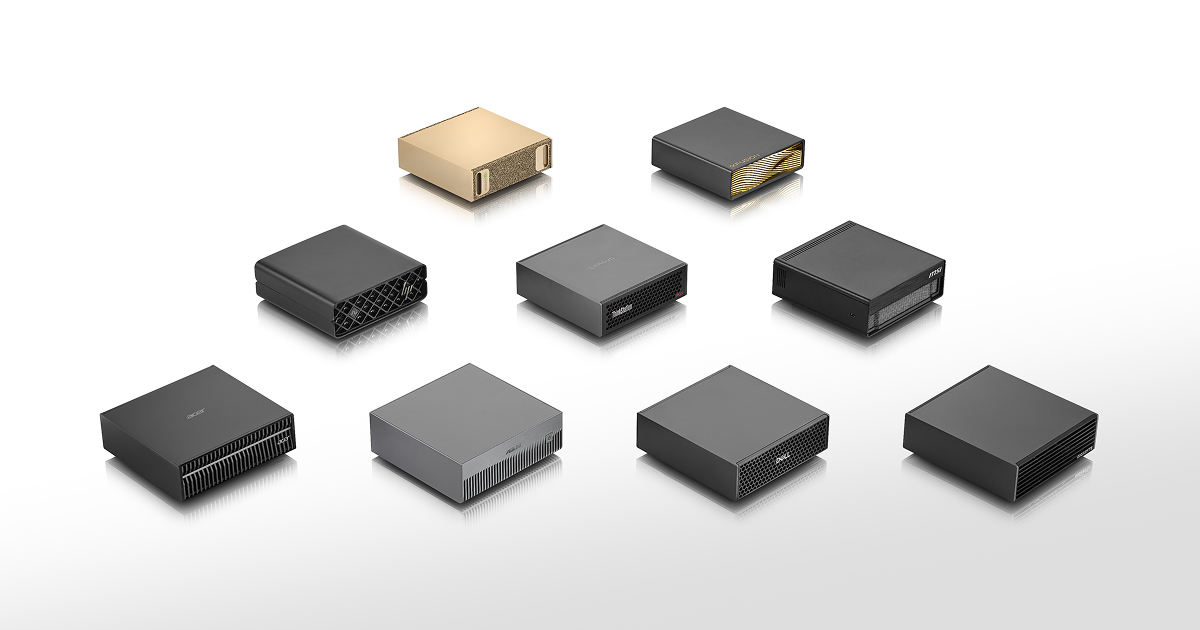
| Nvidia DGX Spark | 64GB | $4,999 starting | Ships October 23, 2026, via OEM partners (Acer, Asus, Dell, Gigabyte, HP, MSI) |
| Nvidia DGX Spark Founders Edition | 128GB | $3,999 at launch, raised to $4,699 MSRP in Feb. 2026; higher at many retailers since | Available now via Nvidia's marketplace and partners |
Those Framework prices are live from the company's own configurator as of this week and are themselves up from the $1,599/$1,999 launch pricing Framework announced in 2025, which tells you the DRAM shortage squeezing Nvidia is hitting AMD's OEM partners too. Nvidia's own developer forum confirmed the Founders Edition price change in February, attributing it to "industry wide memory supply constraints," and the company's announcement of the 64GB model in October described the same dynamic shaping its decision to split DGX Spark into a cheaper 64GB tier and a pricier 128GB one rather than raise the price of a single SKU further.
AI performance: TOPS vs. petaFLOPS, explained
It's tempting to put "126 TOPS" and "1 petaFLOP" side by side and declare a winner, but the numbers aren't measuring the same thing. AMD's "Overall TOPS" figure is an INT8 throughput estimate that adds together the CPU, the Radeon 8060S GPU and the dedicated XDNA 2 NPU; the NPU alone is rated at up to 50 TOPS and is mainly used for low-power, always-on tasks like Windows Studio Effects rather than running a full LLM. The heavy lifting for large local models on a Ryzen AI Max+ 395 machine actually happens on the Radeon 8060S GPU through ROCm or Vulkan, not the NPU.
Nvidia's "1 petaFLOP" figure, by contrast, is a GPU Tensor Core number at FP4 precision with structured sparsity, a format specifically tuned for transformer-based LLM inference and training, and it's generated entirely by the Blackwell GPU portion of the GB10 die, with CUDA, TensorRT and Nvidia's NIM microservices built to exploit it directly out of the box. In practice this means DGX Spark's software stack is purpose-built for feeding that compute figure, while a Ryzen AI Max+ 395 box depends more on how well a given inference runtime (llama.cpp's Vulkan backend, ROCm, ONNX Runtime) has been tuned for RDNA 3.5. Neither company has published directly comparable third-party benchmarks as of this writing, so treat the headline numbers as architectural context rather than a scoreboard.
Which is better for local LLM and on-device AI work?
If your workflow lives inside Nvidia's ecosystem, DGX Spark is the easier, more supported choice: CUDA is still the default target for most open-source inference and fine-tuning frameworks, Nvidia ships a complete, tested software image, and the ConnectX-7 networking makes clustering multiple units for bigger models straightforward. That support and the extra 17GB/s of bandwidth come at a real cost, roughly $1,300-$1,500 more than an equivalently sized Ryzen AI Max+ 395 machine at today's prices.
If your priority is the most unified memory per dollar, more flexibility on OS choice, and you're comfortable running inference through Vulkan or ROCm rather than CUDA, the Ryzen AI Max+ 395 is hard to beat. A 128GB Framework Desktop costs about 30% less than the new 64GB DGX Spark while offering twice the memory, though with somewhat lower bandwidth and a less mature AI software stack than Nvidia's.
Who should buy which
- Buy Ryzen AI Max+ 395 if: you want the most memory for the least money, you're fine building your own inference stack, or you also want a capable general-purpose desktop (the Radeon 8060S handles 1440p gaming reasonably well, something DGX Spark isn't built for).
- Buy DGX Spark if: you're already working in CUDA/PyTorch/TensorRT, you need Nvidia's guaranteed software compatibility and support, or you plan to cluster multiple units for larger models.
- Consider neither if: your models fit comfortably in 24-32GB of VRAM, where a single discrete GPU like those compared in our RTX 5070 Ti vs. RX 9070 XT breakdown will likely run faster per dollar than either unified-memory box.
Frequently asked questions
See the FAQ section below the article for quick answers on pricing, memory, and which machine suits which workload.
What's next
Both products are moving targets right now. Nvidia's 64GB DGX Spark doesn't actually ship until October 23, 2026, so real-world benchmarks and reviewer impressions are still to come; AMD's OEM partners, meanwhile, are juggling the same DRAM shortage that pushed Nvidia to raise prices twice in eight months, so expect Framework and its rivals' pricing to keep moving too. Anyone buying either machine today should budget for further price volatility through the rest of 2026 and check current stock directly with the maker before ordering, since configurations have gone in and out of availability for both product lines this year.
Frequently asked questions
What's the main difference between the AMD Ryzen AI Max+ 395 and Nvidia DGX Spark?
The Ryzen AI Max+ 395 is a conventional x86 CPU with integrated RDNA graphics and an NPU, sold by OEM partners like Framework starting around $1,959. DGX Spark is Nvidia's own purpose-built Arm/Blackwell AI appliance running a custom CUDA-based OS, starting at $4,999 for the new 64GB model, with a mature software stack but a much higher price.
Which has more memory bandwidth, Ryzen AI Max+ 395 or DGX Spark?
Nvidia DGX Spark, with 273GB/s versus the Ryzen AI Max+ 395's 256GB/s, according to each company's official specifications. The gap is roughly 7%, modest compared with the price difference between the two platforms.
How much does a Ryzen AI Max+ 395 mini PC cost compared to DGX Spark?
A Framework Desktop with 64GB and the Ryzen AI Max+ 395 starts at $1,959, and the 128GB version is $3,449, per Framework's own configurator. DGX Spark starts at $4,999 for 64GB, while the 128GB Founders Edition has an MSRP of $4,699 (up from $3,999 at launch) and has sold higher than that at many retailers.
Can the Ryzen AI Max+ 395 run the same size AI models as DGX Spark?
Both top out at 128GB of unified memory on their largest configurations, so they can address similarly sized models in terms of raw capacity. DGX Spark's slightly higher bandwidth and CUDA-tuned software stack generally give it an edge in actual inference speed for the same model size.
Is DGX Spark good for gaming?
No. DGX Spark runs Nvidia's DGX OS and is built and priced as an AI development appliance, not a gaming PC. A Ryzen AI Max+ 395 machine, which typically runs Windows or standard Linux, is far better suited to doubling as a general-purpose or gaming desktop.
Which is better for local LLM inference?
DGX Spark generally wins on raw throughput and software maturity thanks to CUDA and Nvidia's tuned inference stack, but the Ryzen AI Max+ 395 offers more memory per dollar and greater flexibility, making it the better value pick for most local-AI hobbyists and developers not locked into CUDA.
Sources
- AMD Ryzen AI Max+ 395 product specificationsamd.com
- AMD Ryzen AI Max+ 395 launch blog postamd.com
- Framework Desktop official configuratorframe.work
- Nvidia DGX Spark product pagenvidia.com
- Nvidia DGX Spark 64GB official announcementblogs.nvidia.com
- Nvidia developer forum: DGX Spark price change announcementforums.developer.nvidia.com
Mara Lindqvist edits the hardware desk. She covers graphics cards, processors, memory and storage, the foundries and chip designers behind them, and what the numbers on a spec sheet mean for people choosing a PC. Specifications in her stories come from manufacturer spec pages and datasheets.