RTX 5070 Ti vs RX 9070 XT: Specs, Price and Which to Buy
Nvidia's $749 RTX 5070 Ti and AMD's $599 RX 9070 XT target the same 1440p-to-4K buyers. Here is how their official specs, pricing and ray tracing stack up.
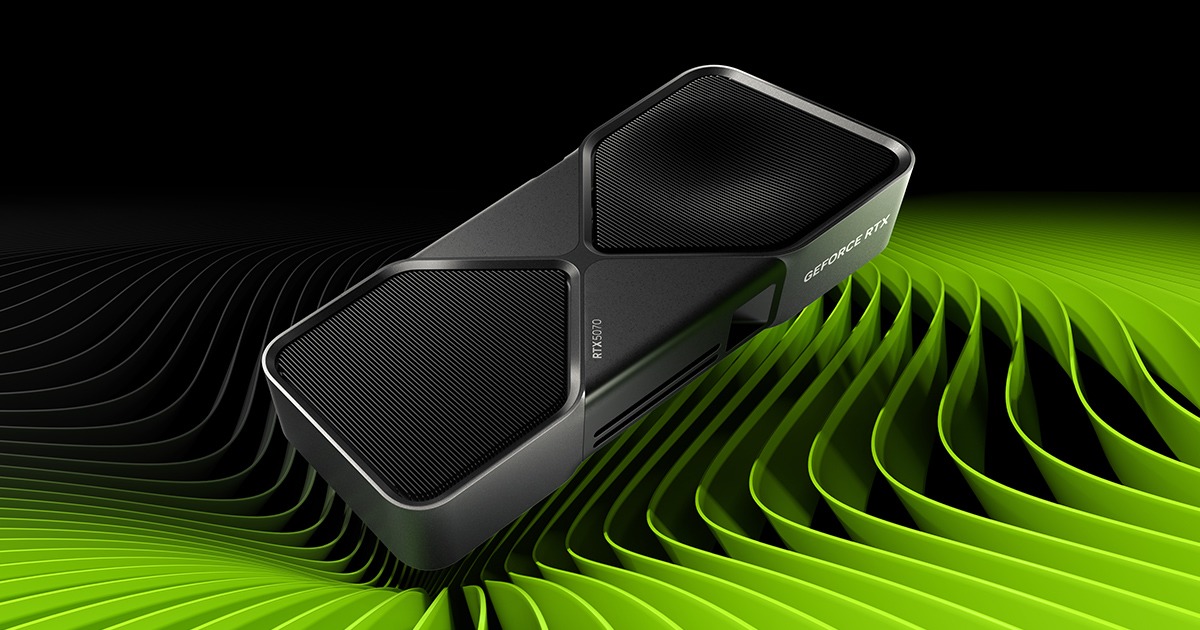
The RTX 5070 Ti is the faster, pricier card: Nvidia's own spec sheet lists a $749 starting price against AMD's $599 for the RX 9070 XT, and that $150 gap buys 16GB of GDDR7 instead of GDDR6, stronger ray-tracing hardware, and access to DLSS 4 multi-frame generation. If ray tracing and upscaling quality matter most, the RTX 5070 Ti is the safer buy. If the budget is fixed around $600 and most of the gaming is rasterized at 1440p, the RX 9070 XT is the better value and is readily available closer to its list price.
Both cards launched within about two weeks of each other in early 2025 and have remained the default recommendations in their respective price brackets ever since, with no direct successor to either announced by Nvidia or AMD as of this writing. That makes the RTX 5070 Ti vs RX 9070 XT decision one of the most searched GPU comparisons for anyone building or upgrading a 1440p-to-4K gaming PC right now, which is exactly why getting the official specs and pricing straight matters more than chasing marketing slogans from either company.
Quick take: RTX 5070 Ti — $749 MSRP, 8,960 CUDA cores, 16GB GDDR7, 300W, best ray tracing and DLSS 4. RX 9070 XT — $599 MSRP, 4,096 stream processors, 16GB GDDR6, 304W, strongest raster-per-dollar and FSR 4. Both cards recommend a 750W power supply.
RTX 5070 Ti vs RX 9070 XT: specs at a glance
Both cards were announced within days of each other in early 2025 and compete directly for 1440p and 4K gamers. The numbers below come straight from Nvidia's RTX 5070 family product page and AMD's RX 9070 XT product page.
| Spec | RTX 5070 Ti | RX 9070 XT |
|---|---|---|
| Architecture | Nvidia Blackwell | AMD RDNA 4 |
| Shader units | 8,960 CUDA cores | 4,096 stream processors (64 CUs) |
| Ray tracing hardware | 70 4th-gen RT cores (~133 RT TFLOPS) | 64 Ray Accelerators |
| AI/matrix hardware | 280 5th-gen Tensor cores (1,406 AI TOPS) | 128 AI Accelerators |
| Boost clock | 2.45GHz | Up to 2,970MHz |
| Base/game clock | 2.3GHz base | 2,400MHz game clock |
| Memory | 16GB GDDR7 | 16GB GDDR6 |
| Memory bus | 256-bit | 256-bit |
| Memory bandwidth | ~896GB/s | Up to 640GB/s |
| Extra cache | — | 64MB Infinity Cache |
| Board/total power | 300W TGP | 304W TBP |
| Recommended PSU | 750W | 750W |
| MSRP | $749 | $599 |
On paper the two cards are closer than the spec sheet alone suggests. AMD's RX 9070 XT clocks noticeably higher and carries more raw shader throughput, while Nvidia leans on memory bandwidth, more capable ray-tracing and tensor hardware, and a more mature upscaling stack to close the gap and pull ahead in demanding modes.
Price and availability
Nvidia set the RTX 5070 Ti's MSRP at $749 with no Founders Edition, meaning every card at launch comes from an add-in-board partner such as Asus, MSI, Gigabyte or Zotac, each adding its own premium on top of that baseline. AMD, meanwhile, confirmed a $599 suggested price for the RX 9070 XT (and $549 for the non-XT RX 9070) in its own RDNA 4 launch announcement, again sold exclusively through board partners like Sapphire, PowerColor, ASRock and XFX.
That $150 difference is the first filter for most buyers. Shoppers comparing this pair against a tier up should also look at how the RTX 5080 stacks up against the same RX 9070 XT, since the 5080 narrows the ray-tracing gap further but at a much higher price. At the other end of the stack, buyers on a tighter budget may want to see how the RX 9070 GRE, RTX 5070 and RTX 5060 Ti compare before committing to either flagship-adjacent card here.
Blackwell vs RDNA 4: the architecture difference
The RTX 5070 Ti is built on Nvidia's Blackwell architecture, the same generation that underpins the RTX 5080 and RTX 5090, just with fewer streaming multiprocessors enabled (70 of the GB203 die's available units). That gives it 8,960 CUDA cores, 70 fourth-generation RT cores and 280 fifth-generation Tensor cores, paired with 16GB of GDDR7 on a 256-bit bus.
The RX 9070 XT runs AMD's RDNA 4 architecture, AMD's first GPU generation built with a dedicated focus on ray-tracing throughput and AI-accelerated upscaling after RDNA 3 fell behind in both areas. AMD's own spec sheet lists 53.9 billion transistors on the die, packed into 64 compute units (4,096 stream processors), 64 Ray Accelerators and 128 AI Accelerators, backed by 16GB of GDDR6 on a matching 256-bit bus plus 64MB of Infinity Cache to help offset GDDR6's lower raw bandwidth versus Nvidia's GDDR7.
That transistor and cache strategy matters because it's how AMD closes the bandwidth gap without paying for more expensive GDDR7 modules: Infinity Cache keeps frequently accessed data closer to the compute units, reducing how often the GPU needs to reach out to VRAM at all. Nvidia takes the more direct route on the RTX 5070 Ti, paying for faster GDDR7 memory instead of leaning on a large on-die cache, which is part of why the 5070 Ti carries the higher price even though both cards ship with the same 16GB capacity and 256-bit bus width.
Both chips are built on similar leading-edge TSMC process nodes and land in a comparable power envelope — 300W for the RTX 5070 Ti versus 304W for the RX 9070 XT — so neither has a meaningful efficiency advantage baked into the silicon alone.
Ray tracing, DLSS 4 and FSR 4
This is where Nvidia's hardware advantage is clearest. The RTX 5070 Ti's higher RT core count and dedicated Tensor cores give it more headroom in heavily ray-traced titles, and it supports Nvidia's DLSS 4 suite, including multi-frame generation, which can insert multiple AI-generated frames per rendered frame on RTX 50-series cards specifically.
AMD's answer is FSR 4, detailed on its own FidelityFX Super Resolution page, which moved to a machine-learning-based upscaling model with RDNA 4 and is a significant step up from FSR 3's more traditional approach. AMD has also closed much of the ray-tracing performance gap that separated RDNA 3 from Nvidia's Ada and Blackwell generations, though Nvidia's RT and Tensor core counts on the 5070 Ti still give it room to pull ahead in path-traced and heavily ray-traced games. FSR 4's trade-off is narrower day-one game support compared to DLSS, which has a multi-generation head start and a larger supported library.
Raster performance and gaming
Outside of ray tracing, the two cards are positioned as close rivals in traditional rasterized gaming. The RX 9070 XT's higher stream processor count and aggressive boost clock give it strong throughput in raster-heavy titles, and AMD built the card specifically to compete with Nvidia's x70-class tier rather than concede that segment. Nvidia's own specs for the RTX 5070 Ti point to similar peak FP32 throughput, with its real-world edge expected to show up most in games that lean on ray tracing or DLSS rather than pure raster workloads.
Neither company publishes head-to-head frame-rate comparisons between these two specific cards, so buyers chasing exact FPS numbers in a given game should consult independent reviews that test both cards on the same bench rather than relying on marketing slides from either side. What both companies do confirm is the underlying hardware budget each card is working with, which is why the spec table above is the more reliable starting point than any single benchmark.
Connectivity and display outputs
AMD's spec sheet confirms the RX 9070 XT connects over a PCIe 5.0 x16 interface and outputs through DisplayPort 2.1a and HDMI 2.1b, which is enough bandwidth for high-refresh 1440p and 4K monitors plus most current 8K displays. Nvidia's RTX 50 series, including the RTX 5070 Ti, uses the same PCIe 5.0 interface generation and a comparable DisplayPort 2.1 and HDMI 2.1 output configuration on reference and partner designs, so neither card should be a bottleneck for a modern high-refresh monitor setup. The practical difference buyers will notice comes down to the specific port mix (DisplayPort versus HDMI count) on whichever board-partner card they choose, since that varies by model rather than by GPU vendor.
Power, cooling and system requirements
Power draw is close enough that it shouldn't factor into the decision: Nvidia lists 300W total graphics power for the RTX 5070 Ti, AMD lists 304W total board power for the RX 9070 XT, and both companies recommend a 750W system power supply as a baseline. Expect a dual or triple-fan cooler on most board-partner cards at this tier, and check case clearance before buying, since several 9070 XT and 5070 Ti partner cards run close to 320–340mm long.
Driver support is mature on both sides at this point. AMD maintains a dedicated drivers and downloads page for the RX 9070 XT, while Nvidia continues to ship regular Game Ready driver updates for the RTX 50 series alongside the rest of its GeForce lineup. If it's been a while since a system refresh, it's worth taking a minute to check which graphics card is currently installed before assuming an upgrade is even necessary.
Which one should you buy
Buy the RTX 5070 Ti if ray tracing, DLSS 4 multi-frame generation, or the extra memory bandwidth from GDDR7 matter for the games being played, or if the plan includes creative workloads that benefit from Nvidia's broader CUDA software ecosystem. The extra $150 over the RX 9070 XT buys meaningfully stronger ray-tracing hardware and a more mature upscaling feature set. It's also the safer pick for anyone who regularly turns on path tracing in supported titles, since that workload leans hardest on exactly the RT and Tensor core advantage Nvidia built into Blackwell.
Buy the RX 9070 XT if the budget is capped closer to $600, the gaming library leans heavily on rasterized titles rather than path tracing, or FSR 4 already covers the games in question. AMD's card undercuts Nvidia's by 20% at MSRP while matching it on memory capacity and bus width, which makes it the stronger pick for buyers prioritizing raw value over ray-tracing headroom. It's also a reasonable choice for anyone already invested in an AMD-centric platform, such as a Ryzen system using AMD's Smart Access Memory, though that feature works across GPU vendors and isn't a hard requirement either way.
Neither card is aimed at pure esports players chasing the absolute highest frame rates in lightweight competitive titles — both are overkill for that use case and a cheaper GPU from either lineup would do the job at a lower price. This pairing makes the most sense for 1440p ultra-settings gaming, entry-level 4K gaming, or mixed gaming-and-content-creation builds where the extra VRAM and compute headroom get used.
Real-world street prices for both cards have fluctuated well above MSRP at various points since launch, so it's worth checking current retailer pricing against the $749 and $599 baselines above before deciding — the gap between the two cards can narrow or widen significantly depending on regional stock.
Bottom line
Nvidia and AMD have drawn a clear line between these two cards: the RTX 5070 Ti is the ray-tracing and upscaling specialist at a premium price, and the RX 9070 XT is the value-focused rasterizer at a meaningfully lower one. Neither company has announced a refresh to either card as of this writing, so this generation's RTX 5070 Ti vs RX 9070 XT matchup is likely to remain the relevant comparison at this price tier through the rest of the product cycle. Buyers who want to see how the tier above shapes up can also read how the RTX 5080 Super compares against the RTX 5090 for a sense of where Nvidia's higher-end Blackwell cards land on price and performance.
Frequently asked questions
Which is better, the RTX 5070 Ti or the RX 9070 XT?
It depends on priorities. The RTX 5070 Ti has stronger ray-tracing hardware, faster GDDR7 memory and DLSS 4 multi-frame generation, making it the better choice for ray-traced and path-traced games. The RX 9070 XT costs $150 less at MSRP and is the stronger pick for rasterized gaming on a tighter budget.
How much do the RTX 5070 Ti and RX 9070 XT cost?
Nvidia set the RTX 5070 Ti at a $749 MSRP, and AMD set the RX 9070 XT at a $599 suggested price, according to each company's own product pages and launch announcements. Neither card has a first-party reference edition, so street prices vary by board partner and region.
Do the RTX 5070 Ti and RX 9070 XT have the same amount of VRAM?
Yes, both cards ship with 16GB of memory on a 256-bit bus. The RTX 5070 Ti uses faster GDDR7 (about 896GB/s of bandwidth), while the RX 9070 XT uses GDDR6 (up to 640GB/s) backed by 64MB of Infinity Cache to help close the gap.
Is the RX 9070 XT as good as the RTX 5070 Ti for ray tracing?
The RX 9070 XT closed much of AMD's historical ray-tracing deficit with RDNA 4, but the RTX 5070 Ti still has more dedicated RT and Tensor cores on paper (70 RT cores and 280 Tensor cores versus 64 Ray Accelerators), giving Nvidia an edge in heavily ray-traced and path-traced titles.
What power supply do I need for the RTX 5070 Ti or RX 9070 XT?
Both Nvidia and AMD recommend a 750W system power supply as a baseline. The RTX 5070 Ti has a 300W total graphics power rating, and the RX 9070 XT has a 304W total board power rating, so their power demands are nearly identical.
What is the difference between DLSS 4 and FSR 4?
DLSS 4 is Nvidia's upscaling and frame-generation suite, available on the RTX 5070 Ti with multi-frame generation support. FSR 4 is AMD's machine-learning-based upscaling technology on the RX 9070 XT, a major step up from FSR 3 but with a smaller supported game library than DLSS at this point.
Sources
Mara Lindqvist edits the hardware desk. She covers graphics cards, processors, memory and storage, the foundries and chip designers behind them, and what the numbers on a spec sheet mean for people choosing a PC. Specifications in her stories come from manufacturer spec pages and datasheets.