ChatGPT for Teens: College Planner, Flashcards and What's New
Flashcards, quizzes and note scanning are live in ChatGPT for Teens now; a College Planner for US grades 10-12 and a College Advising Corps tie-in are coming soon.
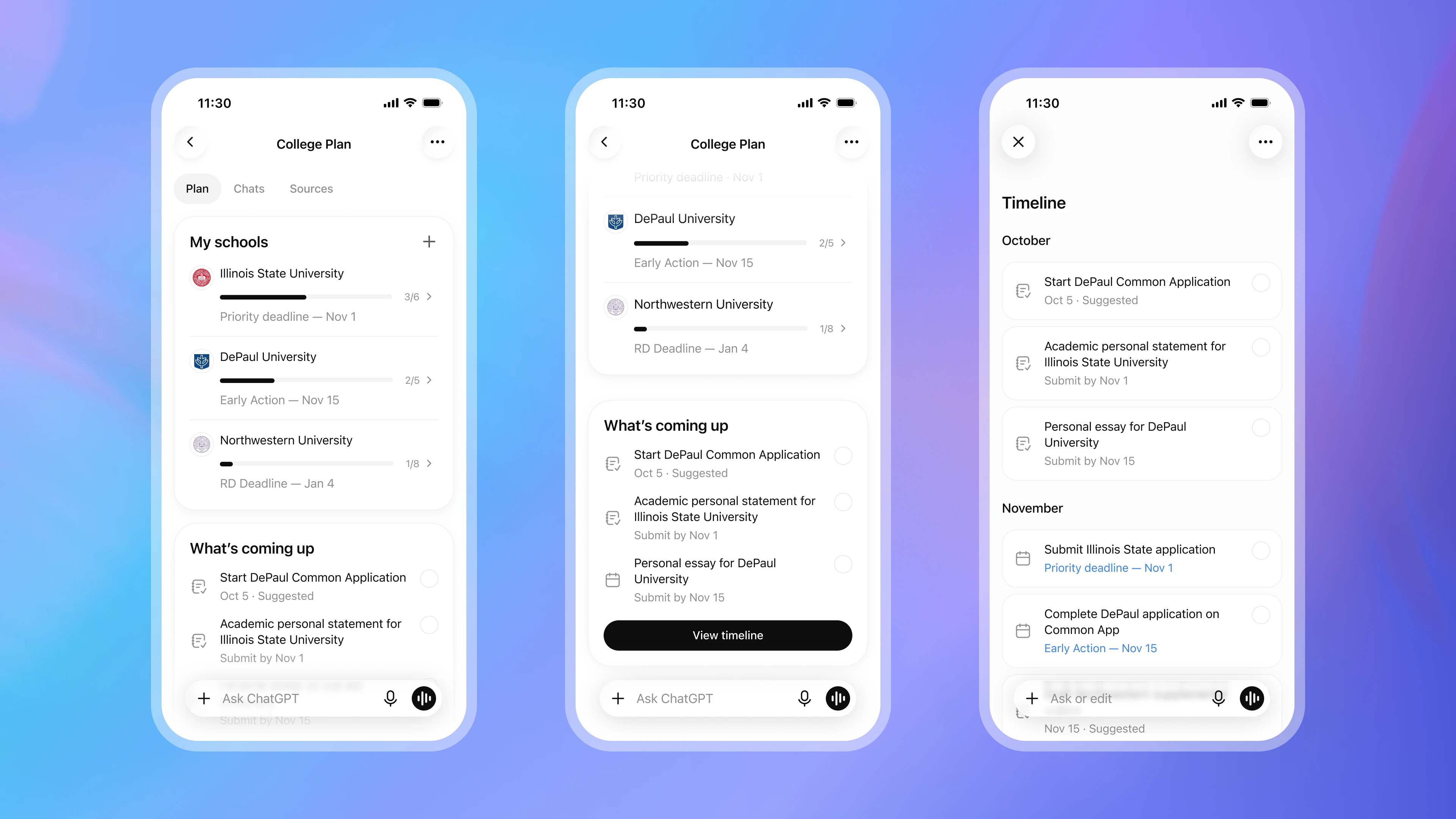
OpenAI is rolling a batch of new study tools into ChatGPT for Teens: flashcards, interactive quizzes and multi-photo note scanning are live now, while a dedicated College Planner for US students in grades 10-12 is described by OpenAI only as coming "soon," with no specific launch date given. The changes, detailed in an OpenAI announcement published October 7, 2026, also include a three-year commitment to a Boston Children's Hospital student advisory program and a new partnership with the nonprofit College Advising Corps.
Key facts
- Flashcards, interactive quizzes and continuous multi-photo note scanning (iOS) are available now in ChatGPT for Teens.
- College Planner is not yet available. OpenAI says it is "soon" adding the tool, without naming a release date.
- College Planner's initial US version targets students in grades 10-12 applying to four-year colleges; two-year, technical and trade schools, plus other countries, come later.
- OpenAI is supporting Boston Children's Hospital's Digital Wellness Lab and its independent Student Advisory Council for three years, starting with about 22 students in the 2026-27 school year.
- OpenAI is also backing College Advising Corps, a nonprofit that places recent graduates as advisers in under-resourced high schools, to help it expand and launch an AI fellowship for its advisers.
What's already live in ChatGPT for Teens
Three of the five features OpenAI announced on October 7 are available immediately, not pending a future rollout. According to OpenAI's own post, the company heard from students that photographing and uploading notes "can take hours," which is the problem the latest study tools are meant to solve.
The first is continuous, multi-photo note capture. Students can now photograph several pages of handwritten or printed notes in one sequence, and ChatGPT automatically stitches them into a single PDF ready to upload. OpenAI says this is available on iOS now, with Android support still "working" its way to release.
The second is flashcards. A student preparing for, say, a biology test can upload class notes or simply name a topic, and ChatGPT turns the material into a deck of cards to review. Cards marked as known can be set aside, missed ones can be revisited, and the whole deck can be reshuffled. Decks are saved to a teen's Library so a study session can be picked up later, and students can ask ChatGPT to create a scheduled task that reminds them to practice.
The third is an upgrade to quizzes: students can now upload notes directly and have them converted into interactive quizzes inside the chat, and OpenAI says ChatGPT is better at recognizing when a student wants a self-test and generating one without being asked twice.
None of these three tools requires a separate app or subscription tier beyond the standard ChatGPT for Teens experience, which OpenAI applies automatically to accounts it identifies as belonging to someone under 18. For background on how OpenAI's broader product interface has been evolving around the same release window, see how ChatGPT's interactive answers and UI changes work.
College Planner: what it will do when it arrives
The headline feature in OpenAI's announcement is College Planner, and it is explicitly not live yet. OpenAI's own wording is that it will "soon be adding College Planner to ChatGPT for Teens" — a phrase that signals near-term intent without committing to a date. Reporting from outlets including EdTech Innovation Hub and Android Headlines, published in the days after the announcement, also describes the tool as forthcoming rather than available, and neither cites a specific release window beyond OpenAI's own "soon."
OpenAI frames the motivation in usage terms: the company says hundreds of thousands of US teens already use ChatGPT every week to plan for college, tracking deadlines, researching schools and trying to understand financial aid on their own. College Planner is designed to formalize that behavior rather than introduce a new one.
Once it ships, College Planner will bring together, in a single plan per student, each school's application requirements, deadlines, outstanding tasks and financial-aid steps. Students applying to multiple colleges will be able to return to the plan to log progress, consult a timeline, and see what's left to do, while also asking ChatGPT follow-up questions about anything confusing, from what a specific requirement means to how to start it.
OpenAI is explicit about scope at launch: the initial US version is designed for high-school students in grades 10 through 12 who are planning to attend a four-year college. Two-year colleges, technical colleges, trade schools, and support for students outside the US are all described as later expansions, with no timeline attached.
College Planner is also meant to help with the financial side of applying: understanding financial-aid requirements, tracking each school's aid deadlines, and surfacing scholarships and application fee waivers. OpenAI says its goal is to make that kind of help more accessible regardless of a family's financial circumstances — while working alongside, not replacing, counselors, advisers and families.
| Feature | Status as of this announcement | Details |
|---|---|---|
| Flashcards | Live now | Generated from uploaded notes or a chosen topic; saved to Library; schedulable practice |
| Interactive quizzes | Live now | Upload notes to auto-generate a quiz, or ask in chat |
| Multi-photo note scanning | Live now on iOS | Combines multiple note photos into one PDF; Android "in progress" |
| College Planner | Not yet available — OpenAI says "soon" | US grades 10-12, four-year colleges first; no date specified by OpenAI |
| Student Advisory Council support | Starting 2026-27 school year | ~22 students across two tracks, run by Boston Children's Hospital's Digital Wellness Lab |
A student advisory program — not an OpenAI-run "Teen AI Council"
Some secondary coverage of this announcement has shorthanded one piece of it as a "Teen AI Council." That label does not appear in OpenAI's own post. What OpenAI actually announced is three years of support for Boston Children's Hospital's Digital Wellness Lab and its independent Student Advisory Council — a program run by the hospital's lab, not by OpenAI itself.
For the 2026-27 school year, the Lab plans to bring together roughly 22 students split across two tracks: about 12 students aged 14 to 18 working on digital-wellbeing projects in their own communities, and about 10 students aged 16 to 20 focused on AI chatbots and emerging technology. These students work alongside the Lab's researchers and clinicians. OpenAI says students on the AI track will test tools and recommend changes based on how they actually use AI for learning and in their personal lives, and that it expects to seek their feedback specifically on teen safety defaults, parental controls, notifications and AI literacy.
OpenAI describes the goal as giving teenagers "a meaningful stake at the table as AI is being designed," with a commitment to bring student recommendations into product and model decisions early and report back on what changes and why. It's a feedback and research relationship rather than a governance body with authority over ChatGPT's roadmap, and it sits alongside — not in place of — OpenAI's existing teen-safety work, which the company has described separately in its own posts on why it built ChatGPT for Teens in the first place.
The College Advising Corps partnership
Alongside College Planner, OpenAI is supporting College Advising Corps, a nonprofit that places recent college graduates as advisers inside under-resourced high schools to help students navigate the path to higher education. OpenAI frames this as the human-support half of the same problem College Planner addresses on the software side: a planner can track deadlines and paperwork, but many students still need someone to help them think through their actual options.
OpenAI's contribution is intended to help College Advising Corps expand into new states and to create an AI fellowship program. Through that fellowship, advisers across participating states will test and share practical ways to use AI to help more students get through the college and enrollment process. Neither OpenAI's announcement nor the secondary reporting reviewed for this article specifies a funding amount or names which states will be added, so those details should be treated as undisclosed rather than assumed.
How teens are already using ChatGPT, by OpenAI's own numbers
OpenAI used part of the same announcement to share usage data about ChatGPT for Teens, the under-18 experience it rolled out as the default for accounts it identifies as belonging to minors. As access expanded to more teens globally, those with it sent, on average, about 2.7 million more learning-related messages than teens who didn't yet have access, according to OpenAI. In one week, the company says nearly 1.2 million teens used its Learning Visualizations feature for math and science concepts, and more than 180,000 used Study Mode for step-by-step support.
On usage patterns, OpenAI says teens spend under 15 minutes a day on ChatGPT on average, and that fewer than 2% spend more than three consecutive hours on it. The company also says that in almost half of teen conversations where its built-in break reminder appeared, teens took a break or ended the conversation within five minutes. OpenAI contrasts this with publicly reported averages of around five hours of daily teen social-media use, framing ChatGPT for Teens as built for learning and creating rather than passive scrolling — though, as with any self-reported platform data, these are OpenAI's own figures rather than independently audited numbers.
This is the same underlying product that reshaped how a lot of teens interact with AI assistants generally; for a broader comparison of how different assistants handle similar tasks, see how Siri, Gemini and ChatGPT compare as AI assistants.
Why OpenAI is pushing study tools and College Planner now
OpenAI's own framing ties this update to two things: the sheer scale of teen usage it says it's observing, and a stated goal of equalizing access to college-planning help that's traditionally depended on a family's ability to pay for counselors or private advisers. The timing also follows a broader pattern of OpenAI announcements this year aimed at making ChatGPT more useful for structured, everyday tasks rather than open-ended chat — a pattern also visible in the changes covered in OpenAI's DevDay 2026 announcements and in ongoing updates to ChatGPT's broader feature set.
It's worth being precise about what OpenAI has and hasn't committed to here. The company has committed to shipping College Planner, but not to a date. It has committed to the Student Advisory Council relationship for three years and specified rough participant numbers for the first year. It has not disclosed the size of its College Advising Corps funding or which states will see the new AI fellowship first. Readers planning around any of these features — especially students currently in the college-application cycle — should treat "coming soon" as OpenAI's own language, not a confirmed date from any source.
What's next
The near-term things to watch are straightforward: whether OpenAI gives College Planner an actual release date beyond "soon," whether multi-photo note scanning reaches Android as promised, and what the first cohort of Boston Children's Hospital's Student Advisory Council actually recommends once the 2026-27 school year gets underway. OpenAI has said it will keep evaluating ChatGPT for Teens and sharing what it learns from teens, families and educators, which suggests further updates to this specific feature set are likely before the next school year's application season begins in earnest. Until OpenAI publishes a firmer timeline, students and families planning around College Planner should rely on the currently available tools — flashcards, quizzes and note scanning — and treat the planner itself as not yet available.
Frequently asked questions
Is ChatGPT's College Planner available yet?
No. OpenAI's October 7, 2026 announcement says it will "soon" add College Planner to ChatGPT for Teens, without giving a specific release date.
Who will be able to use College Planner at launch?
OpenAI is designing the initial US version for high-school students in grades 10-12 who are planning to attend a four-year college. Two-year colleges, technical and trade schools, and support outside the US are planned for later.
Are flashcards and quizzes available in ChatGPT for Teens right now?
Yes. Both are live now: flashcards can be generated from uploaded notes or a chosen topic, and uploaded notes can be converted into interactive quizzes.
Does the new multi-photo note scanning work on Android?
Not yet. OpenAI says continuous multi-photo capture, which stitches several note photos into one PDF, is available on iOS now, with Android support still in progress.
What is the 'Teen AI Council' some reports mention?
OpenAI's own announcement does not use that phrase. It describes support for Boston Children's Hospital's independent Student Advisory Council, a feedback program bringing together about 22 students starting in the 2026-27 school year.
What does the College Advising Corps partnership involve?
OpenAI is helping the nonprofit College Advising Corps expand into new states and launch an AI fellowship for its advisers. OpenAI has not disclosed a funding amount or which states are involved.
Sources
- OpenAI: Helping teens learn, plan, and shape the future of AIopenai.com
- OpenAI: Introducing ChatGPT for Teensopenai.com
- OpenAI: Why teens deserve access to safe AIopenai.com
- College Advising Corpscollegeadvisingcorps.org
- Boston Children's Hospital: Digital Wellness Lab Student Advisory Councildigitalwellnesslab.org
Theo Park runs the AI desk at Pandromeda. He follows model launches from the frontier labs and the open-weight community, tracks the assistants and developer tools built on them, and explains what each release changes on pricing, capability and safety. His reporting leans on primary sources: model cards, technical reports, API documentation and the companies' own announcements.