Perplexity Computer vs Claude Cowork: Which AI Agent Should You Use?
Anthropic's Cowork and Perplexity's Computer both run tasks for you with little supervision. Here is what each actually does, costs and is built for.
Claude Cowork and Perplexity Computer are both "give it a goal and let it work" AI agents, but they are built for different jobs: Cowork is Anthropic's agent for everyday knowledge work inside the files and apps you already use, bundled into existing Claude plans starting around $17–20 a month, while Computer is Perplexity's heavier-duty system of orchestrated sub-agents for longer, more autonomous projects, gated behind the $200-a-month Max tier. If you want an AI that quietly handles spreadsheets, research docs and recurring office tasks without leaving Claude, Cowork is the simpler and cheaper pick. If you want one prompt to spin up a team of specialized agents that can code, design and run for hours or days unattended, Computer is built for that — at a steeper price.
- Claude Cowork: Anthropic's agent for non-coding work, built on Claude Code, included on Claude Pro ($17–20/mo), Max ($100/mo), Ultra ($200/mo), Team ($20/seat) and Enterprise plans.
- Perplexity Computer: Perplexity's multi-agent orchestration system, introduced February 2026, available to Perplexity Max subscribers (its top consumer tier) with Enterprise Max support "coming soon."
- Core difference: Cowork works inside your own folders, browser and tools under close supervision; Computer spins up isolated sub-agents across several frontier models to run longer, more independent jobs.
What is Claude Cowork?
Claude Cowork is Anthropic's agentic feature for the non-coding half of office work — research, analysis, document creation and the kind of multi-step busywork that used to mean ten browser tabs and a spreadsheet. According to Claude's own product page, you give Claude a goal, it works across the files and tools you choose, and it returns finished work for you to review. Anthropic describes Cowork as built on the same foundations as Claude Code but reframed for a broader, non-engineering audience, and the company now treats it less as a separate app and more as a mode: the page's own banner puts it plainly as "now part of Claude," rolling out across the Pro, Max and Ultra tiers with more plans following.
What makes Cowork an agent rather than just a better chat window is that every step is visible and interruptible. You can watch which files it opens, which tools it calls and the decisions it makes along the way, and redirect it mid-task. It can also run unattended — continuing after you close your laptop, or on a recurring schedule — and it can split a large project into pieces that run in parallel rather than one step at a time.
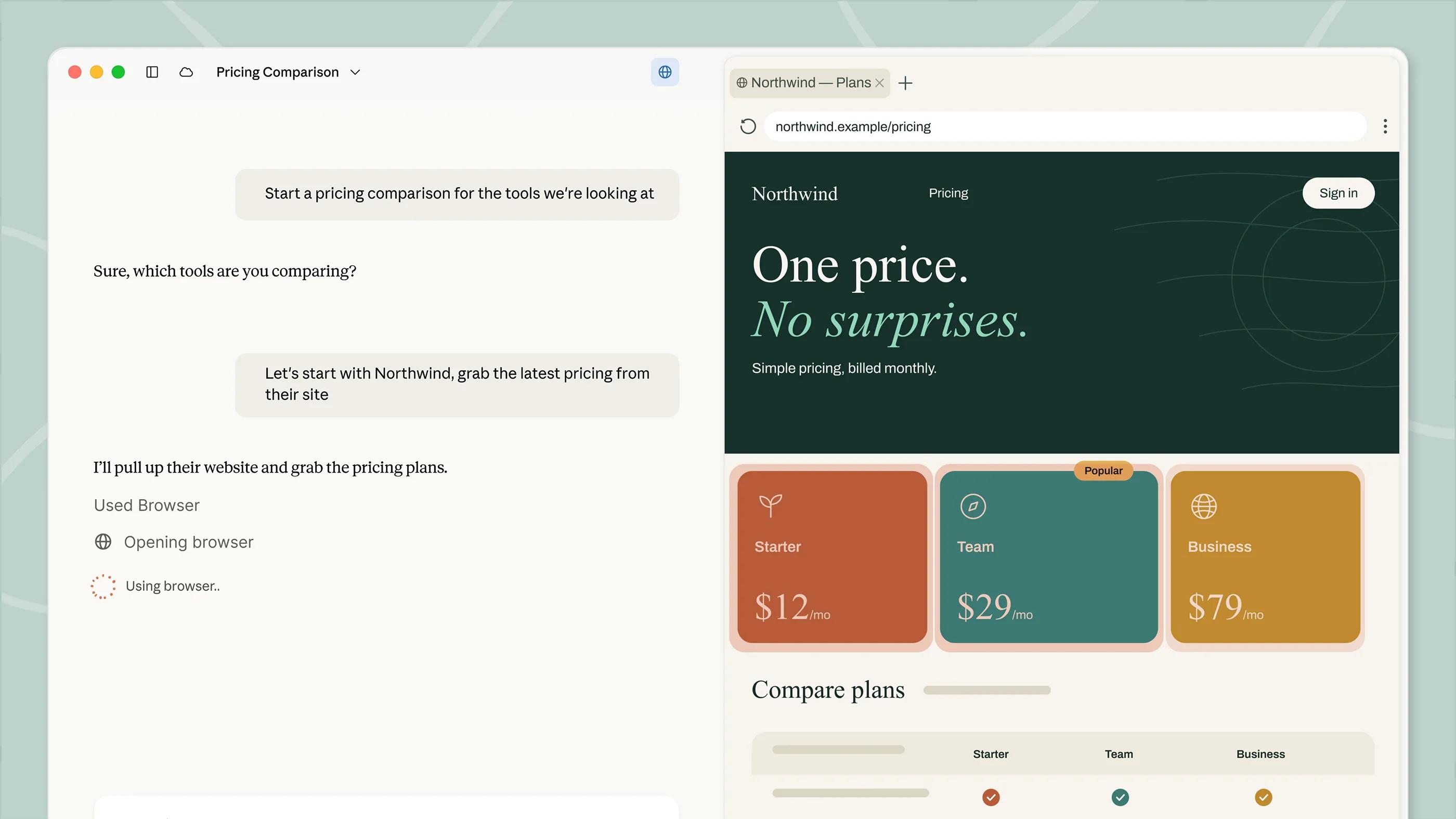
Cowork also ships with a built-in browser that opens sites and fills in forms inside its own side panel, kept separate from your regular browser tabs, plus support for plugins, skills, connectors and sub-agents that let teams extend it for specific roles. For anyone curious how a similar work-agent pitch plays out at a rival lab, it's worth reading how Cowork stacks up against ChatGPT's own work agent before deciding which ecosystem to commit to.
What is Perplexity Computer?
Perplexity Computer is a different kind of agent: instead of one assistant working through your files, it's a system that breaks a goal into tasks and subtasks and hands them to a team of specialized sub-agents. Perplexity's own announcement, introducing Computer on February 25, 2026, calls it a "digital worker" that uses the same software interfaces — a browser, a filesystem, connected apps — that a human would, rather than a narrow API integration.
Each task Computer runs gets its own isolated compute environment: its own filesystem, its own browser, its own tool integrations. That isolation is what lets Computer take on long-running, asynchronous work — Perplexity says jobs can run for hours or even months — and let you run several Computers on different projects in parallel rather than waiting on one thread at a time.
The other defining trait is how Computer routes work across models instead of relying on just one. Per Perplexity's announcement, Claude Opus 4.6 serves as the core reasoning engine, while sub-agents hand off to other models for specific jobs: Gemini for deep research, Nano Banana for image generation, Veo 3.1 for video, Grok for lightweight tasks, and ChatGPT 5.2 for long-context recall and broad search. You can also choose which model handles a given subtask yourself. Perplexity has applied the same orchestration idea to shopping and retail tasks specifically — see our breakdown of how Perplexity Computer handles e-commerce and shopping workflows for that narrower use case.
Claude Cowork vs Perplexity Computer at a glance
| Claude Cowork | Perplexity Computer | |
|---|---|---|
| Maker | Anthropic | Perplexity |
| Built on | Claude Code foundations | Multi-model sub-agent orchestration |
| Core reasoning model | Claude (model choice depends on plan) | Claude Opus 4.6 |
| Sub-agent models | Not applicable — one Claude session plus connectors | Gemini, Nano Banana, Veo 3.1, Grok, ChatGPT 5.2 |
| Where it works | Your own folders, apps and a built-in browser side panel | Isolated per-task environments with their own filesystem and browser |
| Run length | Can run unattended and on a schedule | Designed for hours-to-months-long async jobs |
| Parallelism | Splits one project into parallel parts | Multiple independent Computers in parallel |
| Plan required | Pro, Max, Ultra, Team or Enterprise | Max (Enterprise Max "coming soon") |
| Entry price | $17–20/month (Pro) | Reported at $200/month for Max (not stated as a figure on Perplexity's own page) |
| Admin controls | Permissions, spend limits, SIEM export via OpenTelemetry | SOC 2 / SSO-style enterprise controls (per third-party coverage; not detailed on the launch post) |
How they actually work day to day
The practical difference between these two shows up the moment you hand over a task. Cowork is designed to be watched: Anthropic's page is explicit that you approve which folders and tools Claude can access, that deleting anything requires your approval, and that you can set Claude to show its plan and wait for a go-ahead before any significant action. It's an agent you supervise closely, which fits its target job — turning your own documents and tools into finished work without surprises.
Computer leans the opposite way. Because each task runs in its own sandboxed environment and is meant to run for long, unattended stretches — Perplexity's own language is "hours or even months" — it's built around delegation rather than step-by-step approval. You describe the outcome, Computer's planner decomposes it into subtasks, and specialized sub-agents (potentially running different underlying models) execute pieces of the job on their own, with the option to run several such jobs side by side.
Both approaches have an obvious trade-off. Cowork's close supervision makes it a safer fit for work touching sensitive files or client-facing documents, but it means you're more involved. Computer's hands-off, multi-agent approach can tackle bigger, longer jobs with less hovering, but it asks you to trust a system you're watching less closely while it runs.
Pricing and plans compared
Anthropic bundles Cowork into Claude's existing subscription ladder rather than charging separately for it. Per Claude's pricing page, Pro runs $17/month billed annually (or $20/month billed monthly), Max is $100/month, Ultra is $200/month, and Team is $20 per seat per month for groups of 2 to 150 people, which includes the Slack connector. Enterprise pricing goes through Anthropic's sales team. The product page does flag that Cowork eats into your usage limits faster than ordinary chat, so heavy use on a Pro plan may mean hitting caps sooner than on Max or Ultra.
Perplexity takes the opposite approach: Computer isn't priced on its own, it simply requires the Max subscription. Perplexity's original Max announcement describes it as the company's top subscription tier, bundling unlimited use of Perplexity Labs, early access to new products such as the Comet browser, and access to frontier models, with Pro remaining at $20/month underneath it. Neither that post nor the Computer announcement itself states a specific dollar figure for Max in so many words, but it has been widely and consistently reported at $200 a month, or $2,000 billed annually — treat that number as commonly cited rather than quoted verbatim from Perplexity. Perplexity has also said an Enterprise Max tier with Computer access is coming, aimed at organizations that need it beyond individual Max seats.
The upshot: Cowork is reachable on Claude's cheapest paid plan, while Computer requires Perplexity's most expensive consumer tier — a meaningfully different cost floor for essentially the same category of product.
Platforms and availability
Cowork is available through Claude's desktop app (Anthropic links a macOS download directly from the product page), as well as on the web and mobile, with the page noting mobile access lets you start a task from your phone and let it run. Anthropic has rolled out features in stages through 2026 — plugin marketplaces arrived in late February, enterprise deployment controls in April, and the built-in browser panel in late August, according to the dated announcements on its own product page.
Perplexity Computer launched in February 2026, as confirmed by Perplexity AI's Wikipedia entry, which also notes a related but separate product, Personal Computer, that extended the idea to run on a user's own device starting in April 2026. Perplexity's Computer announcement doesn't specify platform support beyond being available now to Max subscribers, with Enterprise Max access described as coming soon.
Security, permissions and enterprise controls
Because both products can touch real files, accounts and the open web, permissions matter as much as capability. Anthropic's Cowork page details granular folder- and tool-level access approval, a mandatory approval step before deleting anything, an optional "plan first, then wait for approval" mode for higher-stakes actions, and admin-side controls for permissions, spend limits and team access, including activity-log export to a SIEM via OpenTelemetry — all aimed squarely at IT and security teams rolling this out to a company, not just individuals.
Perplexity's own Computer announcement is lighter on this front; it focuses on the task-decomposition and multi-model mechanics rather than enterprise governance, beyond confirming that an Enterprise Max tier is on the way. Independent coverage has pointed to enterprise-grade protections such as SSO and compliance certifications arriving alongside that tier, but since those specifics weren't part of Perplexity's own launch post, organizations evaluating Computer for sensitive workloads should confirm current controls directly with Perplexity before committing.
Which one should you use?
If your work is mostly documents, research, spreadsheets and recurring tasks that live inside tools you already use, and you want an agent that stays easy to supervise and cheap to start, Cowork is the more natural fit — it's reachable on Claude's $17–20 entry plan rather than requiring a $200-tier subscription, and its permission model is built for exactly that kind of closely-watched, file-centric work. It's also the pick if your organization is already standardized on Claude and wants one vendor handling both coding (Claude Code) and general knowledge work; it may be worth comparing which underlying Claude model is doing the heavy lifting before you commit a team to it at scale.
If instead you have long, multi-part projects — building something end to end, running research across many sources, or generating a mix of code, writing, images and video for one deliverable — and you're comfortable paying for Perplexity's top tier to get a team of orchestrated, model-diverse sub-agents working in parallel over hours or days, Computer is built for that scope in a way Cowork, by design, isn't trying to match.
Neither company positions these as direct rivals in their own marketing — Cowork is framed as "Claude Code for the rest of your work," while Computer is framed as a general-purpose multi-agent orchestrator — but they increasingly compete for the same budget line: a company deciding how much to spend on an AI agent that can work mostly unsupervised.
What's next
Both products are still moving fast. Anthropic has been adding to Cowork roughly every few weeks this year — plugins, enterprise deployment tooling and the built-in browser all arrived as separate updates rather than one big launch — so expect further plan and feature changes rather than a static product. Perplexity, for its part, has already extended Computer's core idea once, with the separate Personal Computer product bringing similar agentic behavior to a user's own device, and has said Enterprise Max support for Computer is still coming rather than live. Anyone choosing between them now should expect pricing, included usage and enterprise controls on both sides to keep shifting over the next few months, and should check each company's own pricing and product pages before buying a seat.
Frequently asked questions
What is Claude Cowork?
Claude Cowork is Anthropic's agentic feature for non-coding knowledge work. You give it a goal and it works across the files, apps and browser tools you approve, completing multi-step tasks like research, analysis and document creation and returning finished work for review.
What is Perplexity Computer?
Perplexity Computer is a multi-agent orchestration system introduced by Perplexity in February 2026. It breaks a goal into tasks and subtasks, assigns them to specialized sub-agents running in isolated environments, and can work asynchronously for hours or months at a time.
How much does Claude Cowork cost?
Cowork is included rather than separately priced. It's available on Claude Pro ($17/month billed annually or $20/month monthly), Max ($100/month), Ultra ($200/month), Team ($20/seat/month) and Enterprise plans, per Claude's pricing page.
How much does Perplexity Computer cost?
Perplexity Computer requires a Perplexity Max subscription rather than having its own separate price. Perplexity's Max plan is widely reported at $200 a month ($2,000 billed annually), though Perplexity's own announcement posts don't spell out that figure directly. Enterprise Max access is described as coming soon.
Can I use both Claude Cowork and Perplexity Computer?
Yes — they come from separate subscriptions (a Claude plan and a Perplexity Max plan) and nothing stops you from running both, though doing so means paying for two premium-tier AI subscriptions rather than one.
Which is better for non-technical teams?
Claude Cowork's lower entry price, closer step-by-step supervision and approval-based permissions make it the easier starting point for non-technical teams, while Perplexity Computer's longer, more autonomous multi-agent runs suit bigger, more independent projects.
Sources
- Anthropic/Claude - Claude Cowork product pageclaude.com
- Anthropic/Claude - Claude pricing pageclaude.com
- Perplexity - Introducing Perplexity Computerperplexity.ai
- Perplexity - Introducing Perplexity Maxperplexity.ai
- Wikipedia - Perplexity AIen.wikipedia.org
Theo Park runs the AI desk at Pandromeda. He follows model launches from the frontier labs and the open-weight community, tracks the assistants and developer tools built on them, and explains what each release changes on pricing, capability and safety. His reporting leans on primary sources: model cards, technical reports, API documentation and the companies' own announcements.