AMD and Meta Deepen Chip Deal: Helios Racks and MI450 GPUs
AMD Helios rack systems are now installed at Meta, EPYC CPUs run Meta’s Muse AI agent, and Meta will deploy a custom AMD Instinct GPU — backed by a $1B AMD stake in Meta.
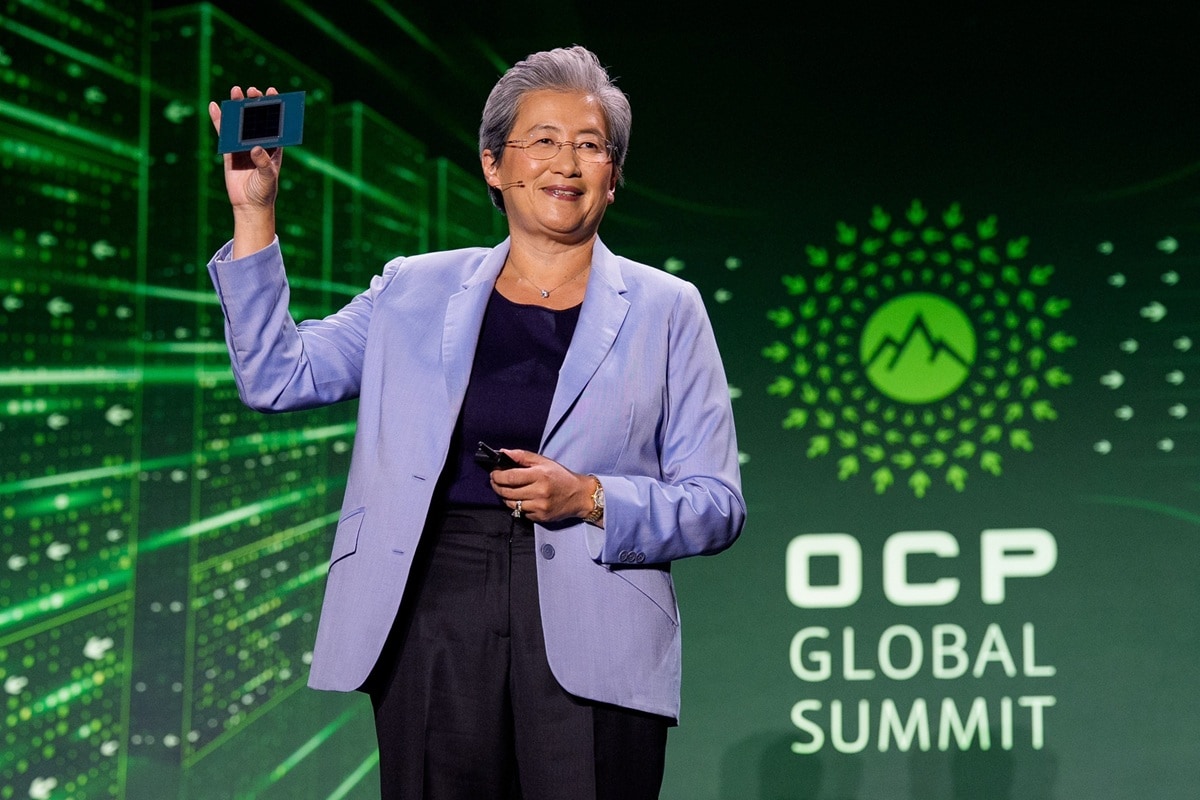
AMD and Meta have expanded their chip partnership: AMD confirmed on October 27, 2026 that its Helios rack-scale AI systems are now installed and being tested inside Meta's data centers, that AMD EPYC processors already run the compute behind Meta's Muse AI agent, and that Meta will deploy a custom AMD Instinct GPU built from the MI450 architecture. AMD is also investing $1 billion in Meta's equity offering as part of the deal. The update, posted to AMD's investor-relations newsroom, builds on the two companies' February 2026 agreement to deploy up to 6 gigawatts of AMD Instinct GPUs, and it is the clearest signal yet that AMD's silicon — not just Nvidia's — is now running in production inside one of the world's largest AI infrastructure buildouts.
- Announced: October 27, 2026, via AMD's investor-relations newsroom.
- Helios: AMD's rack-scale AI systems are installed and being tested at Meta, with broader deployment "in the near future."
- EPYC: Meta has deployed millions of AMD EPYC CPUs and is a lead customer for 6th Gen EPYC; a future generation codenamed "Verano" is in joint development.
- Instinct: AMD GPUs are already in production at Meta for training, ranking and recommendation; Meta helped define the MI450 architecture and will deploy a custom Instinct GPU that will inform future MI500-series chips.
- Networking/software: AMD Pensando networking, plus ROCm and PyTorch integration, with day-0 support for Meta's Muse Spark Open and Muse Glimmer models.
- Money: AMD will invest $1 billion in Meta's equity offering; no new gigawatt figure was given beyond the existing "gigawatt scale" framing.
What AMD and Meta actually announced
The news comes from a press release AMD filed to its investor-relations site, titled "AMD and Meta Advance Strategic Partnership to Power Meta's Superintelligence Infrastructure." It isn't a brand-new deal so much as a progress report and expansion of the companies' existing relationship: it confirms that hardware promised earlier in 2026 is now physically running at Meta, names the next generation of chips the two companies are co-designing, and adds a financial component — AMD putting $1 billion into Meta's own stock.
AMD frames the collaboration as spanning "CPUs, GPUs, networking, systems and software," which matches the five product lines named in the release: EPYC server processors, Instinct GPUs, Pensando networking silicon, Helios rack-scale systems, and the ROCm software stack that ties them together. That is a broader, more vertically integrated pitch than a single chip sale — AMD is positioning itself as a full-stack infrastructure supplier for Meta's AI buildout, not just a GPU vendor.
Helios rack-scale systems are now running at Meta
The headline hardware claim is that AMD Helios — the company's rack-scale AI system, which bundles Instinct GPUs, EPYC CPUs and Pensando networking into a single liquid-cooled rack built to Meta's Open Rack Wide mechanical standard — is installed and actively being tested inside Meta's infrastructure. AMD says broader deployment is expected "in the near future," though it did not give a rack count, a site location, or a firm date for that wider rollout in this release.
Helios itself was co-developed with Meta through the Open Compute Project, the open-hardware consortium Meta helped found, and was first shown publicly at the OCP Global Summit. Having Meta run early production units is a meaningful proof point for AMD: Helios is the system AMD is counting on to compete with Nvidia's rack-scale platforms for the largest AI training and inference clusters, and an early, named hyperscale customer validates that the rack-level engineering — power, cooling, networking — works at scale, not just on a slide.
EPYC CPUs power Meta's Muse agent, with "Verano" next
On the CPU side, AMD says Meta has deployed millions of EPYC processors across multiple generations and is a lead customer for 6th Gen EPYC, the generation AMD has previously said carries the codename "Venice" (see AMD's EPYC server processor lineup). The release adds that EPYC capacity underpins the computing environment behind Muse, Meta's AI agent, and that AMD and Meta are now collaborating on a future EPYC generation code-named "Verano" — the first time that codename has surfaced publicly in an AMD release.
Server CPUs rarely make headlines the way GPUs do, but they still do the unglamorous work of orchestrating storage, networking and data pipelines around every GPU cluster, and "lead customer" status on 6th Gen EPYC means Meta is shaping how that chip performs in its own racks before it ships broadly. For background on where AMD's CPU roadmap is headed next, see our coverage of AMD's Zen 6 architecture plans, which underpin EPYC's client-side counterpart.
Instinct MI450 today, MI500-series on the roadmap
AMD Instinct GPUs are already in production use at Meta for training, ranking and recommendation workloads — the release doesn't specify which Instinct generation handles which workload today, but it does say Meta was an "early definition customer" for the Instinct MI450 architecture, the generation AMD has built around its next-gen CDNA-based compute and HBM4 memory for rack-scale AI training (part of AMD's broader Instinct accelerator lineup). As part of that work, Meta will deploy a custom Instinct GPU tailored to its own workloads, and AMD says the collaboration is already informing the design of future MI500-series GPUs.
That's a notable sequencing: Meta isn't just buying MI450 parts off a roadmap AMD built in isolation — it helped define the architecture, gets a workload-specific variant of it, and is feeding requirements into the generation after that. AMD has used nearly identical language ("early definition customer," custom silicon) to describe its relationship with OpenAI, which suggests this kind of co-design arrangement is becoming AMD's standard model for its largest AI customers, not a one-off for Meta.
Pensando networking, plus ROCm and PyTorch
The release also calls out AMD Pensando, the networking silicon AMD acquired in 2022, as part of the Meta collaboration — Pensando's data processing units (DPUs) and switch silicon are the networking layer that ties Helios racks together and to the rest of a data center. On the software side, AMD and Meta say they've worked to make Instinct GPUs usable "out of the box" through ROCm, AMD's open GPU computing stack, and that the companies have contributed improvements to PyTorch and Triton — the two most widely used open-source frameworks for training and running AI models — as well as to ROCm itself. The release specifically cites joint work optimizing Meta's recommendation models on Instinct MI350X GPUs, AMD's current-generation data-center accelerator.
This software layer matters because it's historically been Nvidia's biggest moat: CUDA's maturity, not raw chip performance, is the main reason many AI teams default to Nvidia GPUs. Every improvement AMD and Meta make to ROCm, PyTorch and Triton in production — rather than in a lab benchmark — chips away at that advantage for AMD's next customer, too, since most of that code is open source.
Day-0 support for Meta's Muse models
AMD says it provided "day-0" support for two of Meta's newer open AI models on its own hardware: Muse Spark Open runs on Instinct GPUs, and Muse Glimmer runs on Ryzen AI PCs and Radeon GPUs — meaning both models were tuned to run on AMD silicon from the moment Meta released them, rather than getting AMD support added later. From a hardware-desk perspective, the detail that matters is the client-side half of that claim: AMD is positioning ordinary Ryzen AI laptops and Radeon graphics cards, not just data-center Instinct GPUs, as the on-device companion to Meta's cloud AI stack. That's a second avenue for AMD silicon into Meta's AI ecosystem beyond the data center, even as the model work itself sits with the AI desk.
AMD's $1 billion stake in Meta
Beyond chips, AMD says in its release that it will invest $1 billion in Meta's equity offering — AMD buying a stake in Meta, structured through an equity offering rather than an open-market purchase. The release does not disclose the price, share count, or vesting terms of that investment, and AMD's own cautionary language around the announcement notes that actual outcomes (including around that investment and the pace of the broader rollout) could differ from what's described. It's worth noting this mirrors a pattern already visible elsewhere in Meta's AI buildout: Meta has also taken on hardware-tied equity arrangements with other chip and compute partners. Our earlier look at Nvidia's own multi-billion-dollar Muse investment covers a similar, separately announced equity-and-compute arrangement from the GPU side.
How this fits the February 2026 deal
None of this is happening in a vacuum. In February 2026, AMD and Meta signed a definitive multi-year, multi-generation agreement for Meta to deploy up to 6 gigawatts of AMD Instinct GPUs, with the first gigawatt of shipments expected in the second half of 2026 using the Helios rack architecture. Meta described that deal, announced on its own newsroom, as part of a "portfolio-based approach" to compute that mixes outside silicon — AMD and others — with Meta's in-house MTIA chips.
The October 27 update doesn't restate that 6-gigawatt figure; it uses the vaguer phrase "gigawatt scale" and focuses on confirming that hardware from the February agreement is now actually installed and running, plus adding the new EPYC "Verano" codename, the MI450 custom-GPU detail, and the $1 billion investment. Read together, the two releases describe a deal that started as a capacity commitment on paper in February and has, by late October, turned into physical Helios racks running real Meta workloads.
AMD's product stack inside Meta's infrastructure
Here's how the individual pieces AMD named in the October 27 release map onto Meta's infrastructure, based on the details AMD disclosed:
| AMD technology | Role at Meta | Status as of October 27, 2026 |
|---|---|---|
| Helios (rack-scale system) | Combines Instinct GPUs, EPYC CPUs and Pensando networking in a liquid-cooled rack | Installed and being tested; broader deployment planned "in the near future" |
| EPYC (6th Gen / "Venice") | Server CPUs powering compute environments behind Meta's Muse AI agent | Millions already deployed; Meta is a lead customer for 6th Gen EPYC |
| EPYC "Verano" (future gen) | Next-generation EPYC CPU, jointly shaped with Meta | In collaborative development; no ship date given |
| Instinct MI350X | Current-gen GPU used to optimize Meta's recommendation models | In production for training/ranking/recommendation |
| Instinct MI450 (custom variant) | Workload-tuned GPU based on the MI450 architecture Meta helped define | Meta is an early definition customer; custom GPU to be deployed |
| Instinct MI500-series (future) | Next-gen GPU architecture informed by the MI450/Meta collaboration | In roadmap/design stage; no launch date given |
| Pensando | Networking silicon (DPUs/switching) linking Helios racks together | Named as part of the networking collaboration |
| ROCm + PyTorch/Triton | Software stack making Instinct GPUs usable "out of the box"; day-0 support for Muse models | Active, ongoing joint contributions to open-source code |
Why this matters for AMD's AI chip business
AMD has spent the last two years trying to convince the market that it can be a credible, large-scale alternative to Nvidia in AI data-center chips, and investors have been watching customer commitments as the clearest evidence of that. We covered how that strategy has started showing up in the numbers in our report on AMD's Q3 2026 earnings and data-center revenue growth; a named hyperscaler running production Helios racks, deploying a custom Instinct GPU, and taking an equity stake in the customer itself is exactly the kind of commitment that supports that narrative, since it's harder to walk back than a non-binding capacity pledge.
It's also a signal about where AMD sees its competitive edge: not just "faster chip," but a full rack-to-software stack — CPU, GPU, networking and open-source frameworks — co-designed with a customer big enough to actually stress-test all of it in production. That's the same playbook Nvidia has run with its own rack-scale systems and CUDA ecosystem, and AMD running even a slice of Meta's real AI infrastructure on Helios, EPYC and Instinct is evidence the company can execute that playbook at hyperscale, not just describe it in a roadmap slide.
What's next
AMD did not attach a firm calendar date to the "broader deployment" of Helios at Meta, nor to the ship date for the custom MI450-based GPU, the EPYC "Verano" generation, or the MI500-series chips the collaboration is informing — all of those remain roadmap items rather than confirmed shipping products. The terms of AMD's $1 billion investment in Meta's equity offering also haven't been detailed beyond the headline figure. Expect more specifics, including possible rack counts, additional data-center sites, or firmer EPYC and Instinct ship dates, at AMD's next quarterly earnings call or its next AI-focused event; we'll update this story as AMD or Meta disclose more.
Frequently asked questions
What did AMD and Meta announce on October 27, 2026?
AMD said its Helios rack-scale AI systems are installed and being tested at Meta, that AMD EPYC CPUs power the compute behind Meta's Muse AI agent, that Meta will deploy a custom AMD Instinct GPU based on the MI450 architecture, and that AMD will invest $1 billion in Meta's equity offering.
Is AMD's Helios rack system already running at Meta?
AMD says initial Helios rack-scale systems are installed and being tested at Meta, with broader deployment expected in the near future. AMD did not disclose a rack count or site location.
What is the AMD Instinct MI450, and how is Meta involved?
The MI450 is AMD's next-generation Instinct GPU architecture. Meta was an early definition customer for MI450 and will deploy a custom Instinct GPU built on it; AMD says the work is also informing its future MI500-series GPUs.
How much is AMD investing in Meta?
AMD said it will invest $1 billion in Meta's equity offering. The company has not disclosed the share price, number of shares, or vesting terms involved.
How does this relate to the AMD-Meta 6-gigawatt GPU deal from February 2026?
This October 2026 update builds on a February 2026 agreement for Meta to deploy up to 6 gigawatts of AMD Instinct GPUs. The new release confirms that Helios hardware from that deal is now installed and running, and adds the EPYC 'Verano' codename, the MI450 custom-GPU detail, and the $1 billion investment.
What is EPYC 'Verano'?
Verano is the codename AMD gave to a future generation of EPYC server CPUs that it is developing collaboratively with Meta, following the current 6th Gen EPYC ('Venice') generation.
Sources
- AMD Investor Relations: AMD and Meta Advance Strategic Partnership to Power Meta's Superintelligence Infrastructureir.amd.com
- AMD Newsroom: AMD, Meta Advance Partnership to Power Meta's Infrastructurenewsroom.amd.com
- Meta Newsroom: Meta and AMD Partner for Long-Term AI Infrastructure Agreementabout.fb.com
- AMD: Instinct Acceleratorsamd.com
- AMD: EPYC Server Processorsamd.com
Mara Lindqvist edits the hardware desk. She covers graphics cards, processors, memory and storage, the foundries and chip designers behind them, and what the numbers on a spec sheet mean for people choosing a PC. Specifications in her stories come from manufacturer spec pages and datasheets.