AMD Zen 6 Release Date and Specs: What's Confirmed So Far
AMD's Zen 6 architecture is shipping in EPYC Venice server chips on TSMC 2nm. Here's what AMD has confirmed about specs, cores, and release timing for desktop and mobile.
AMD's next CPU architecture, Zen 6, is already shipping in server form. AMD's EPYC "Venice" processors, the first products built on Zen 6 cores, launched at the company's Advancing AI 2026 event on July 22-23, 2026, and are built on TSMC's 2nm (N2) process. AMD has not published an official release date for the Ryzen desktop and laptop chips that will use Zen 6, and leak-based reporting on those parts is contradictory, with some outlets now pointing to 2027 rather than 2026. Here is what AMD itself has confirmed, what responsible outlets have reported as AMD's own claims, and what is still just a leak.
What is AMD Zen 6?
Zen 6 is the CPU core architecture that succeeds Zen 5 across AMD's EPYC server, Ryzen desktop, and Ryzen mobile lines. AMD first laid out a Zen 6 roadmap at its 2025 Financial Analyst Day on November 11, 2025, and then put the architecture into shipping silicon for the first time with the EPYC 9006 "Venice" server family, formally launched at AMD's Advancing AI 2026 event in San Francisco on July 22-23, 2026.
Unlike a single monolithic design, Zen 6 ships in at least two core variants that AMD mixes and matches depending on the product: a standard Zen 6 core tuned for maximum per-core performance, and a denser Zen 6c core tuned for core count and efficiency. That split carries over the approach AMD used with Zen 5 and Zen 5c in the current "Turin" EPYC generation.
AMD Zen 6 release date: what's actually confirmed
The release-date picture depends heavily on which product line is being asked about:
Reported, not AMD-confirmed: Mainstream server SKUs (SP8 socket) are expected in the first half of 2027; the 3D V-Cache "Venice-X" and LPDDR-equipped "Verano" variants are expected in the second half of 2027, per outlet coverage of the launch.
Unconfirmed by AMD, contested in reporting: Desktop Ryzen ("Olympic Ridge") and mobile Ryzen ("Medusa Point"/"Medusa Halo") timing. Some 2026 leak coverage expects these in 2026; more recent reports point to 2027, citing delays tied to TSMC's N2-family node lineup.
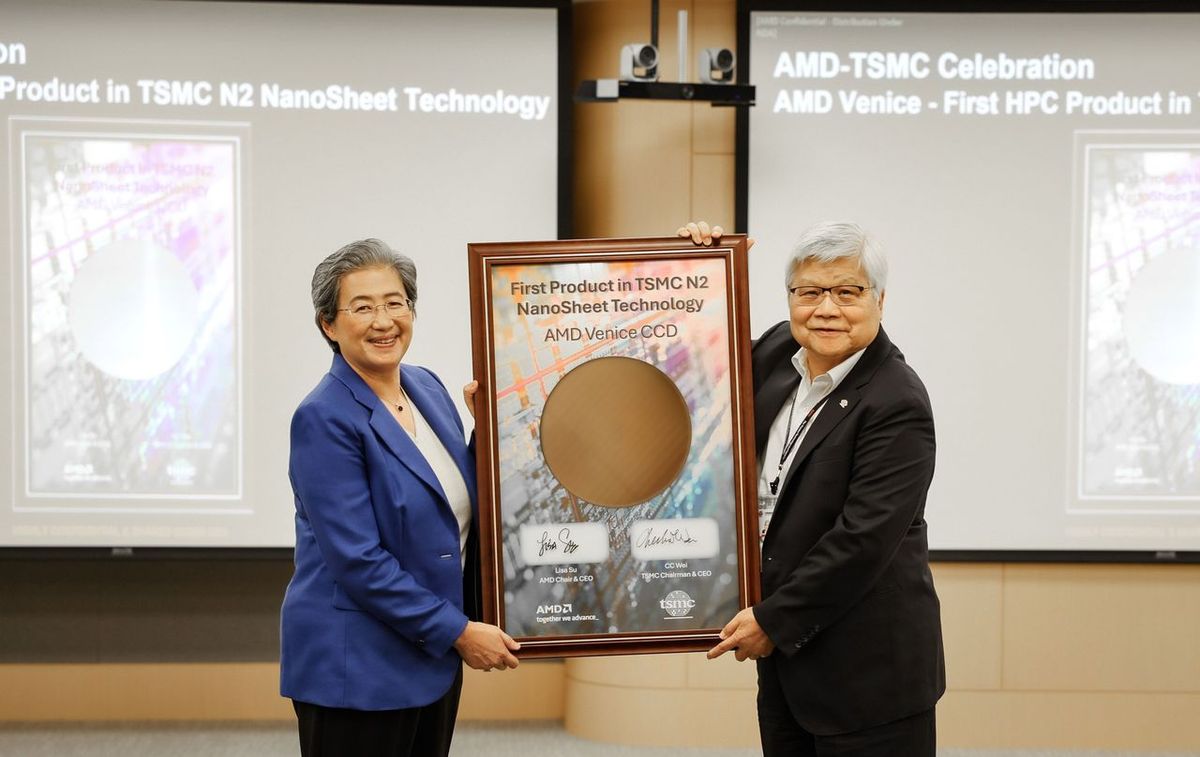
AMD's own newsroom confirmed the first step of this timeline back on May 21, 2026, when the company announced that "Venice" had begun production ramp at a TSMC fab in Taiwan on the 2nm process, with AMD calling it "the first high-performance computing product in the industry" to reach that milestone. AMD Chair and CEO Dr. Lisa Su said the ramp "marks an important step forward" for the company's AI infrastructure roadmap, in a release that also quoted TSMC Chairman and CEO Dr. C.C. Wei. Notably, that AMD release and an earlier one from April 2025 confirming AMD's first TSMC N2 product silicon milestone both describe Venice as AMD's "next-generation" or "6th Gen" EPYC chip without using the "Zen 6" brand name directly. The Zen 6 name and the architectural details attached to it come from AMD's Financial Analyst Day roadmap and from the Advancing AI 2026 launch event itself, as reported by attending press.
For anyone shopping for a laptop today, the practical takeaway is simple: no consumer Ryzen laptop or desktop chip built on Zen 6 has launched as of this writing. Zen 6 so far exists only in EPYC server silicon.
What process node does Zen 6 use?
Zen 6's headline manufacturing change is the move to TSMC's N2 (2-nanometer-class) process for compute dies, paired with a TSMC N6 process for the input/output die on the EPYC "Venice" chips, according to AMD's own production-ramp announcement and outlet coverage of the Advancing AI launch. That makes Venice, by AMD's own description, the first high-performance computing product in the industry to reach production on TSMC's 2nm node. AMD's Financial Analyst Day roadmap coverage also framed Zen 6 overall as the company's first CPU family to move production to N2, a generational jump from the N3-class process used for the current Zen 5 "Turin" EPYC chips.
AMD has also named a planned successor to Venice, called "Verano," described in AMD's own May 2026 release as a follow-on 6th Gen EPYC processor also built on TSMC 2nm, aimed at performance-per-dollar-per-watt leadership for cloud and AI workloads and expected to add LPDDR memory support. AMD gave no launch or production date for Verano.
Zen 6 vs. Zen 6c: the core-count split explained
As with the current Zen 5 generation, AMD is not shipping a single Zen 6 core design. Coverage of AMD's Financial Analyst Day roadmap describes two variants:
- Zen 6 — the standard, performance-oriented core, used where AMD wants maximum per-core and per-thread speed.
- Zen 6c — a denser core designed for higher core counts and better efficiency per die, used where AMD wants to maximize total core count within a given power and area budget.
In the shipping EPYC "Venice" lineup, that split is visible in the product stack itself: AMD's standard Zen 6-based EPYC chips top out at up to 96 cores and 192 threads at clock speeds reported as high as 5GHz, while the Zen 6c-based dense variant scales up to a flagship 256 cores and 512 threads, according to outlet coverage of the July 2026 launch (AMD has not published these exact figures on a dedicated product page at the time of writing). AMD's CTO, Mark Papermaster, has been quoted across pre-launch coverage describing Zen 6 as bringing higher IPC (instructions per clock), lower power draw, and expanded AI-acceleration support compared with Zen 5 — though specific IPC percentage figures have not been independently verified against AMD's own published benchmarks for this article.
EPYC "Venice": the first Zen 6 chips to ship
EPYC "Venice," AMD's 6th-generation EPYC server family, is the first product built on Zen 6 cores and the first to reach the market. Based on coverage of AMD's July 2026 Advancing AI launch, the lineup includes:
- A flagship EPYC 9996 part with up to 256 cores and 512 threads, up to 1,024MB of L3 cache, and a reported price around $14,900 for the top SKU.
- 16 channels of DDR5 memory per socket, supporting both DDR5-8000 and MRDIMM at 12,800 MT/s, for memory bandwidth AMD and outlets reported at up to 1.6TB/s per socket — roughly 2.6x the 614GB/s AMD's prior-generation "Turin" EPYC chips supported, according to StorageReview's coverage of the launch.
- PCIe Gen 6 support at 64 GT/s per lane, which outlets covering the launch described as a first for a server CPU.
- A secondary SP8 socket platform aimed at mainstream 1P/2P server configurations, reported for availability in the first half of 2027.
- "Venice-X," a 3D V-Cache variant with up to 1,152MB of L3 cache, and "Verano," a planned LPDDR5X-equipped variant using field-replaceable SOCAMM2 modules — both reported for the second half of 2027.
On performance, AMD's own marketing claims for Venice — reported by outlets covering the launch — include more than an 80% improvement in performance and efficiency and over 30% higher thread density compared with the current "Turin" (Zen 5) generation. That figure differs somewhat from an earlier "more than 70%" productivity-and-efficiency claim attributed to AMD's November 2025 Financial Analyst Day roadmap slides, a discrepancy likely explained by AMD refining its estimates between the roadmap preview and the final July 2026 launch, though AMD has not published a reconciliation of the two figures. As with any vendor-supplied benchmark, these percentages describe AMD's own internal testing methodology and have not been independently verified for this article.
Server-side OEM adoption is already underway: Dell showed its next-generation PowerEdge lineup built around EPYC "Venice" at Dell Technologies World 2026, including the R9815 (single-socket, 2U) and R9825 (dual-socket, 3U) rack servers and the liquid-cooled, high-density M9825 module built for Dell's IR7000 rack systems, according to ServeTheHome's coverage of the event. That coverage reported second-half-2026 availability for those platforms; check Dell's own PowerEdge product pages for current ordering status.
Desktop Ryzen "Olympic Ridge": what's rumored, not confirmed
AMD has not announced a Zen 6 desktop Ryzen chip or given it an official name. The codename circulating in leaks and in AMD's own compatibility documentation — spotted by hardware-enthusiast outlets rather than published in a press release — is "Olympic Ridge," expected to continue on the AM5 socket and reportedly positioned as a future Ryzen desktop generation (unofficially discussed in leak coverage as "Ryzen 10000-series," though AMD has not confirmed that naming).
Leaked specifications, sourced from hardware leakers rather than AMD, point to Olympic Ridge topping out around 24 cores and 48 threads, built from Zen 6 chiplets with up to 12 cores per compute die — double the 6-core-per-CCD design AMD uses in current Ryzen desktop chips. None of these core counts have been confirmed by AMD.
Timing is the most contested part of the desktop story. Earlier 2026 leak coverage expected Olympic Ridge to launch within 2026, in line with the broader Zen 6 rollout. More recent reporting says the desktop launch may slip into 2027, with some outlets citing reported delays on the TSMC N2-family node variants AMD may use for client chips. AMD has issued no official statement on desktop Zen 6 timing, so readers comparing Olympic Ridge against Intel's roadmap — including Intel's Panther Lake chips — should treat any specific 2026 or 2027 date for desktop Ryzen as a leak, not an AMD commitment.
Mobile Ryzen "Medusa Point" and "Medusa Halo"
On the laptop side, the codenames attached to Zen 6 mobile chips are "Medusa Point" (mainstream mobile), "Medusa Halo" (higher-end APU with a larger integrated GPU), and "Gator Range" (described in leak coverage as the highest-performance mobile tier). As with Olympic Ridge, AMD's own product-compatibility documentation and Linux kernel enablement patches have surfaced references to these codenames and their target sockets (AM5 for some desktop-adjacent variants, FP10 for mobile), which outlets have reported as AMD effectively confirming the existence and platform assignment of these chips — but not their core counts, clock speeds, or NPU specifications.
No laptop OEM — not Dell, HP, Lenovo, Microsoft, ASUS, nor Samsung — has announced a shipping or upcoming laptop built on a Zen 6 mobile chip as of this writing. Given that even EPYC "Venice," the first shipping Zen 6 product, only reached market in July 2026, and that desktop Zen 6 timing is already in dispute, a Zen 6-based Ryzen laptop realistically sits further out on AMD's roadmap. Shoppers deciding between an upcoming Copilot+ PC today and waiting for Zen 6 mobile should plan around current Zen 5-based Ryzen AI chips, not Zen 6, for any near-term purchase.
AI features and performance claims: separating AMD's numbers from leaks
AMD's public comments about Zen 6 lean heavily on three themes: higher IPC, better power efficiency, and expanded AI acceleration. CTO Mark Papermaster has been quoted in coverage of both the Financial Analyst Day roadmap and the Advancing AI launch emphasizing that Zen 6 EPYC targets "leadership x86" performance while also improving AI-workload performance — a framing AMD has used to argue that enterprises with deep x86 software investments don't need to abandon that ecosystem to run AI infrastructure workloads.
Ahead of the official launch, a GCC compiler patch — not an AMD announcement — surfaced several new instruction set extensions associated with Zen 6, including AVX512_FP16, AVX_NE_CONVERT, AVX_IFMA, AVX512_BMM, and AVX_VNNI_INT8, as reported by WccfTech. Outlets reported these as aimed at accelerating machine-learning workloads directly on the CPU. Because this detail comes from a compiler code change rather than an AMD press release or product page, it should be treated as credible but unofficial until AMD publishes its own instruction-set documentation.
On raw performance, AMD's benchmark claims for the EPYC 9996 flagship — as reported by outlets covering the Advancing AI launch — include SPECrate 2017 scores roughly 50% higher than AMD's own prior-generation "Turin" flagship, and company-reported advantages of roughly 2x to 3x over competing chips in various cloud-native and HPC workloads. These are AMD's own benchmark claims, run under AMD's own test conditions, and have not been independently verified for this article; actual gains will vary by workload.
Zen 6 vs. Zen 5 vs. rumored Zen 6 desktop: spec comparison
| Chip / codename | Core type | Process node | Max cores / threads | Max L3 cache | Status |
|---|---|---|---|---|---|
| EPYC 9005 "Turin" (prior gen) | Zen 5 / Zen 5c | TSMC N3-class | Up to 192 cores / 384 threads | Up to 384MB | Shipping since 2024 |
| EPYC 9006 "Venice" (flagship, SP7) | Zen 6c (dense) | TSMC N2 (2nm) compute die + N6 I/O die | Up to 256 cores / 512 threads | Up to 1,024MB | Launched July 2026 (AMD-confirmed) |
| EPYC 9006 "Venice" (standard, SP7) | Zen 6 | TSMC N2 | Up to 96 cores / 192 threads | Not reported | Launched July 2026 (AMD-confirmed) |
| EPYC 9006 "Venice" (SP8 platform) | Zen 6 / Zen 6c | TSMC N2 | 8 to 128 cores (reported) | Not reported | Reported H1 2027 — not AMD-confirmed |
| Ryzen "Olympic Ridge" (desktop) | Zen 6 (rumored) | Rumored TSMC N2-class | Up to 24 cores / 48 threads (leaked, unconfirmed) | Not reported | Timing disputed: 2026 vs. 2027 — leak only, no AMD date |
| Ryzen "Medusa Point" (mobile) | Zen 6 / Zen 6c (rumored) | Rumored hybrid node | Not confirmed | Not reported | No AMD timing given; no OEM laptops announced |
Figures above marked "AMD-confirmed" rely on AMD's own newsroom releases and launch-event reporting for Venice; everything marked "rumored" or "leaked" comes from third-party leak coverage and compatibility-document sightings, not AMD statements.
Which products and OEMs use Zen 6 so far?
As of October 2026, Zen 6 silicon exists only in server form, under AMD's EPYC "Venice" (9006 series) branding. Confirmed or reported server adoption includes:
- Dell: PowerEdge R9815, R9825, and the liquid-cooled M9825 module for Dell's IR7000 rack systems, shown at Dell Technologies World 2026, per event coverage reporting second-half-2026 availability.
- AMD's own reference platforms: AMD has described "Helios" as a rack-scale AI infrastructure platform using EPYC "Venice" host processors alongside its Instinct accelerators, per coverage of AMD's AI infrastructure announcements.
No consumer laptop or desktop OEM — including Dell, HP, Lenovo, Microsoft Surface, ASUS, or Samsung — has announced a Zen 6-based Ryzen product. Anyone searching for "Zen 6 laptops" today will not find one on the market; the nearest comparable near-term laptop silicon news is on Intel's side, with its competing next-gen architecture, or on Apple's side with rumored M6 chips for the next MacBook Pro.
What's next: Zen 7 and the road ahead
AMD's Financial Analyst Day roadmap also gave the first official mention of Zen 7, described in coverage as the "next real" architectural leap after Zen 6, targeted at a future process node beyond N2. AMD gave no release window for Zen 7 at that event, and outlets note the company has disclosed far less detail about it than about Zen 6. Expect AMD to treat Zen 7 the way it has treated Zen 6: a roadmap mention and server-first rollout well ahead of any consumer Ryzen product carrying the name.
For Zen 6 itself, the near-term calendar to watch is the SP8 server platform (reported for the first half of 2027), followed by whatever AMD decides to say officially about desktop "Olympic Ridge" and mobile "Medusa Point" timing — neither of which AMD has committed to a date for as of this writing.
Bottom line
AMD Zen 6 is real and already shipping, but only in EPYC "Venice" server chips, which AMD itself confirmed are built on TSMC's 2nm process and which formally launched at Advancing AI 2026 in July. Everything else — exact IPC gains, desktop "Olympic Ridge" specs and dates, mobile "Medusa Point" laptops, and even the exact wording of AMD's own performance claims — currently rests on a mix of AMD's own (sometimes inconsistent) marketing figures and third-party leaks. Treat any specific 2026 desktop or laptop release date you see online as a leak until AMD's own newsroom says otherwise.
Frequently asked questions
Is AMD Zen 6 out yet?
Yes, in server form. AMD's EPYC "Venice" processors, the first Zen 6-based chips, launched at Advancing AI 2026 on July 22-23, 2026, built on TSMC's 2nm process. No desktop or laptop Zen 6 chip has launched yet.
What process node does AMD Zen 6 use?
TSMC's N2 (2nm-class) process for compute dies, paired with TSMC N6 for the I/O die on EPYC "Venice," according to AMD's own newsroom announcements.
What's the difference between Zen 6 and Zen 6c?
Zen 6 is AMD's standard, performance-focused core; Zen 6c is a denser core built for higher core counts and efficiency. AMD mixes both inside the EPYC "Venice" lineup, the same approach it used with Zen 5 and Zen 5c.
When will AMD Zen 6 desktop (Olympic Ridge) and laptop chips (Medusa Point) launch?
AMD hasn't given an official date for either. Leak-based reports disagree, with some pointing to 2026 and more recent coverage suggesting 2027; treat any specific date as unconfirmed until AMD's newsroom says otherwise.
How many cores does Zen 6 support?
In the shipping EPYC "Venice" lineup, standard Zen 6 cores scale to up to 96 cores per socket, and the denser Zen 6c cores scale to a flagship 256 cores and 512 threads, per outlet coverage of AMD's July 2026 launch. Rumored desktop core counts (up to 24 cores) are leaks, not AMD-confirmed.
What laptops use AMD Zen 6?
None yet. As of this writing, no OEM — including Dell, HP, Lenovo, Microsoft, ASUS, or Samsung — has announced a laptop built on a Zen 6 chip; Zen 6 exists only in EPYC server silicon so far.
Sources
- AMD Newsroom – Production Ramp of EPYC 'Venice' on TSMC 2nmnewsroom.amd.com
- AMD Newsroom – First TSMC N2 Product Silicon Milestonenewsroom.amd.com
- AMD Investor Relations – 2025 Financial Analyst Dayir.amd.com
- Wikipedia – Zen 6en.wikipedia.org
- Wikipedia – TSMCen.wikipedia.org
Mara Lindqvist edits the hardware desk. She covers graphics cards, processors, memory and storage, the foundries and chip designers behind them, and what the numbers on a spec sheet mean for people choosing a PC. Specifications in her stories come from manufacturer spec pages and datasheets.