XREAL AURA Release Date, Price and Specs: Orders Are Live
Google and XREAL just launched AURA, the first wired Android XR glasses, with orders open in the US, Canada and Korea starting at $1,099.
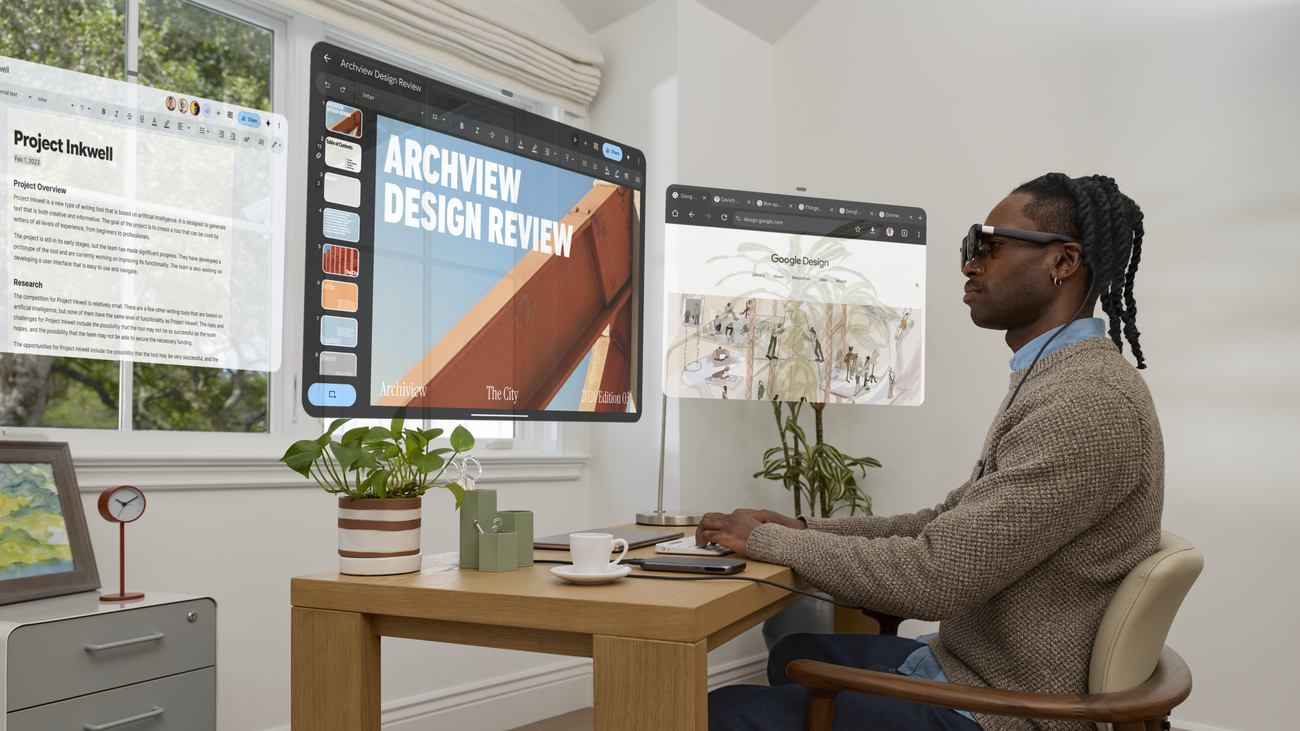
XREAL AURA, the first wired XR glasses built on Google's Android XR platform, is now open for orders in the United States, Canada and South Korea, with Japan following on November 2. Launch pricing starts at $1,099 for the 12GB/256GB model through the end of 2026, and units begin shipping in mid-November.
- Announced: October 28, 2026, jointly by Google and XREAL
- Orders open: October 28 in the US, Canada and Korea; November 2 in Japan
- Price: $1,099 (12GB/256GB) or $1,299 (16GB/512GB) through year-end
- Shipping: Mid-November 2026
- Chip: Qualcomm Snapdragon Reality Elite, debuting in AURA's compute puck
- Buy from: xreal.com/aura or Best Buy in the US
What is XREAL AURA?
AURA is a pair of transparent, optical see-through glasses that run Android XR, Google's operating system for headsets and glasses. Unlike the Samsung Galaxy XR headset that launched the platform, AURA is a wired, glasses-first device: the lenses themselves weigh under 95 grams, while the processing, battery and connectivity live in a separate "compute puck" that attaches by cable. Google and XREAL announced the device together on October 28, with Shahram Izadi, Google's VP and GM of XR, calling it "a totally new way to use Android XR."
The glasses were first shown as a prototype called Project Aura at Google I/O 2026, then given a fuller public unveiling in June at the Augmented World Expo, before this week's launch made them orderable with firm pricing and ship dates for the first time.
Release date and availability
Orders for AURA opened October 28, 2026, through XREAL's own store at xreal.com/aura and through Best Buy in the United States. Canada and South Korea opened the same day; Japan opens November 2. XREAL says shipments begin in mid-November. The product is restricted to buyers 18 and older, requires account setup during onboarding, and businesses looking to deploy AURA at scale are pointed to Google's Android Enterprise resources rather than the consumer storefront.
| Detail | XREAL AURA |
|---|---|
| Announced | October 28, 2026 |
| Orders open | Oct. 28 (US, Canada, Korea); Nov. 2 (Japan) |
| Ships | Mid-November 2026 |
| Price (12GB/256GB) | $1,099 through end of 2026 (list $1,279) |
| Price (16GB/512GB) | $1,299 through end of 2026 (list $1,499) |
| Where to buy | xreal.com/aura, Best Buy (US) |
| Platform | Android XR |
| Chip | Qualcomm Snapdragon Reality Elite |
Price and configurations
AURA ships in two memory tiers. The 12GB RAM/256GB storage configuration launches at $1,099, down from a $1,279 list price, and the 16GB/512GB configuration launches at $1,299, down from $1,499. XREAL says that pricing holds "through the end of the year," which leaves open the possibility of a price increase once the launch window closes. Anyone who already put down a reservation deposit gets a credit toward the hardware price difference: $180 for the base configuration or $200 for the higher-storage model.
For context, that price lands AURA well below standalone mixed-reality headsets like Samsung's Galaxy XR, reflecting the fact that AURA offloads its battery and heavy processing into the tethered puck rather than packing everything into the glasses themselves.
Specs: display, tracking and the puck
The glasses use a Sony Micro-OLED display pushing 1920x1200 resolution per eye at up to 120Hz and 1,050 nits of peak brightness, across a 70-degree field of view at 32 pixels per degree. Five levels of electrochromic dimming let the lenses go from fully transparent to a private, blacked-out screen. Spatial tracking comes from 26 world-facing cameras feeding 6DoF anchoring and hand tracking, processed through XREAL's own X1S spatial coprocessor for a claimed 3-millisecond motion-to-photon latency. The glasses come in two nose-pad/IPD fits: M (60-66mm) and L (66-72mm).
All of the heavy computing sits in the puck, which weighs 265 grams and is built around Qualcomm's new Snapdragon Reality Elite platform — a chip Qualcomm announced earlier in 2026 as its highest-end XR silicon, rated for up to 48 TOPS of on-device AI processing. The puck carries 12GB or 16GB of RAM, 256GB or 512GB of UFS 4.0 storage depending on configuration, a 4,455mAh (34.84Wh) battery, and active fan cooling. It connects to the glasses over a USB-C/USB 3.1 cable and has a second USB-C port for charging or DisplayPort video input at up to 57W, which is what enables the laptop-mirroring feature described below. Connectivity includes Wi-Fi 6/6E, Bluetooth 5.3, and multi-constellation GPS/GNSS (GPS, GLONASS, Galileo, QZSS, BeiDou). Audio runs through Bose-tuned spatial speakers with a four-microphone array, and input options span hand tracking, voice, the puck's own touchpad, and paired Bluetooth keyboards, mice or game controllers.
| Spec | Detail |
|---|---|
| Glasses weight | Under 95g |
| Display | Sony Micro-OLED, 1920x1200 per eye, up to 120Hz, 1050 nits |
| Field of view | 70° at 32 PPD |
| Tracking | 26 cameras, 6DoF, hand tracking, 3ms latency (X1S coprocessor) |
| Puck chip | Qualcomm Snapdragon Reality Elite (48 TOPS AI) |
| Memory/storage | 12GB/256GB or 16GB/512GB UFS 4.0 |
| Puck battery | 4,455mAh / 34.84Wh |
| Connectivity | Wi-Fi 6/6E, Bluetooth 5.3, multi-constellation GPS |
How Gemini works on AURA
Google is positioning Gemini as AURA's main interface layer. Because the glasses are see-through, Gemini on Android XR can take in both the physical room in front of the wearer and whatever app windows are open in their field of view, then hold a natural back-and-forth conversation about either. Google's own example: a wearer can have Google Maps open in one window and simply ask Gemini about nearby places without switching apps or typing a search. Gemini can also tidy up and rearrange open windows on request, brainstorm about something the wearer is looking at, or flag what to focus on next, whether that's an item in the room or content on a virtual screen. The feature set echoes what Google has been rolling Gemini into elsewhere in the Android lineup, including the Personal Intelligence features Gemini recently picked up in Android Auto.
Work and productivity features
AURA's pitch for work use centers on screen real estate. Wearers can open, resize and freely arrange multiple app windows in the space around them rather than being limited to a phone or laptop display. A feature called Wired Mirroring lets a laptop plug into the puck over a USB-C cable that supports video output; the laptop's screen then appears as its own resizable window in the glasses, with no companion software to install, and the content is visible only to the person wearing the glasses — useful on a plane or in a shared office. Google notes that a handful of features, including the Peacock streaming app, are limited to US accounts at launch.
Entertainment and media
For media, the electrochromic lenses can dim to turn the glasses into a private, cinema-style screen, then automatically clear up again if someone walks over to talk to the wearer. A "Spatial view" feature converts ordinary 2D photos, videos and games into 3D with a single tap, and Google says that conversion now runs at a higher resolution than before. A window-follow mode keeps open apps anchored in front of the wearer, while a mini-view mode shrinks windows to the edge of vision while walking. Google Photos is getting a dedicated spatial gallery for browsing a photo library in 3D later this year. On the content side, AURA supports YouTube and Google TV's immersive 180-degree, 360-degree and 3D video libraries, plus a handful of new XR-native films timed to launch: Nevatars (co-directed by Andy Serkis and Josh Nelson Youssef), Galapagos: The Last Eden (narrated by Margot Robbie, from Atlantic Studios), and a filmed performance of San Francisco Ballet's Nutcracker.
Gaming on AURA
Because AURA runs Android XR, it has access to the thousands of mobile and tablet games already on Google Play, and the puck's DisplayPort input means wearers can also stream games from a handheld console or PC over Wired Mirroring. Other apps, like a walkthrough video or a chat window, can run alongside a game in a separate pane. Google says Gemini can also offer contextual hints during play without the wearer needing to put a controller down. A small slate of games built specifically for XR comes from Owlchemy Labs and Resolution Games, and Google has confirmed that both Fallout Factions and Project Hail Mary: Journey Among the Stars are coming to AURA.
Platform and partners
AURA is the newest device in the Android XR family that Google and Qualcomm have been building out since the platform's debut with Samsung's Galaxy XR headset. Google says more than 150 apps have already been built specifically for Android XR, on top of standard Google Play app compatibility. XREAL is the hardware and co-launch partner on AURA itself, while Qualcomm's Snapdragon Reality Elite — announced earlier this year as the company's highest-end XR chip, with a claimed 48 TOPS of on-device AI performance — makes its commercial debut inside AURA's puck.
Setup and account requirements
AURA is restricted to buyers who are 18 or older, and Google requires a one-time setup process tied to a compatible Google account before the glasses and puck will pair and run apps. That mirrors how Samsung's Galaxy XR headset was set up when it launched Android XR, and it means AURA isn't a plug-and-play accessory you can hand to a child or set up anonymously out of the box. Businesses that want to roll AURA out to employees are directed away from the consumer storefront entirely: Google points IT buyers to its Android Enterprise blog for device-management and scaled-deployment guidance, rather than having them order individual units through xreal.com or Best Buy the way a consumer would.
AURA vs. Galaxy XR and other smart glasses
AURA's closest sibling on paper is Samsung's Galaxy XR, the standalone headset that launched Android XR in the first place, but the two devices are built for different jobs. Galaxy XR is a self-contained, fully immersive headset with its own battery and compute built into the unit you wear on your face; AURA splits that same job between a pair of 95-gram glasses and a separate 265-gram puck connected by cable, which keeps the part touching your face light but means you're always tethered to the puck in your pocket or on a desk. That split design is also what lets AURA undercut Galaxy XR on price, since the most power- and heat-intensive components don't have to fit inside the glasses themselves.
Compared with lighter "AI glasses" style products that mostly handle voice assistants, notifications and a camera, AURA sits a tier up: it has a full see-through display across both lenses, 6DoF spatial tracking, and enough compute via the puck's Snapdragon Reality Elite chip to run real windowed apps, games and laptop mirroring rather than just overlaying simple text or translation prompts.
| XREAL AURA | Samsung Galaxy XR | |
|---|---|---|
| Form factor | Glasses + wired compute puck | Standalone headset |
| Weight (worn) | Under 95g (glasses only) | All-in-one, worn as one unit |
| Platform | Android XR | Android XR |
| Chip | Qualcomm Snapdragon Reality Elite | Qualcomm Snapdragon XR platform |
| Starting price | $1,099 (launch, 12GB/256GB) | Higher, standalone headset pricing |
What this means
AURA is the clearest signal yet that Google wants Android XR to cover more than one hardware shape. Samsung's Galaxy XR is a fully self-contained headset aimed at living-room and immersive use; AURA bets that a lighter, glasses-first design tethered to a separate compute puck is a more comfortable way to wear a screen for hours at a time, whether that's for work, travel or gaming. At $1,099 to start, it's also priced well under most standalone mixed-reality headsets, which should make it the more accessible entry point into the platform for buyers who were put off by Galaxy XR's cost. Whether AURA's "fall in, fall out" private-screen pitch actually works outside a demo is the next thing to watch, and with shipments landing in mid-November, actual owner feedback should start showing up within a few weeks of this launch.
Frequently asked questions
When does XREAL AURA ship?
Orders opened October 28, 2026 in the US, Canada and South Korea, with Japan following on November 2. XREAL says units begin shipping in mid-November 2026.
How much does XREAL AURA cost?
Launch pricing is $1,099 for the 12GB/256GB model and $1,299 for the 16GB/512GB model, both through the end of 2026, down from list prices of $1,279 and $1,499.
What chip does XREAL AURA use?
The compute puck runs Qualcomm's new Snapdragon Reality Elite platform, the chip's first commercial device, rated for up to 48 TOPS of on-device AI processing.
Is XREAL AURA a standalone headset?
No. AURA is wired: the glasses handle the display and tracking, while a separate compute puck connected by cable holds the battery, chip and storage.
Can I mirror my laptop to XREAL AURA?
Yes. A feature called Wired Mirroring lets you plug a laptop into the puck's USB-C port and view its screen as a private, resizable window that only you can see.
Where can I buy XREAL AURA?
Through XREAL's own store at xreal.com/aura or through Best Buy in the United States, with Canada, South Korea and Japan ordering directly from XREAL.
Sources
- Google: XREAL AURA — wired XR glasses announcementblog.google
- XREAL: AURA product and pricing pagexreal.com
- XREAL: Project Aura at Google I/O 2026xreal.com
- Qualcomm Newsroom: Snapdragon Reality Elite announcementqualcomm.com
- Wikipedia: Android XRen.wikipedia.org
Nadia Osei covers mobile and consumer gadgets for Pandromeda: smartphones, tablets, smartwatches, earbuds and smart-home devices. She tracks launches, software updates and pricing across Apple, Google, Samsung and the rest, and builds comparisons from the manufacturers' published specifications.


