Samsung 9100 Pro vs WD Black SN8100: Which Gen5 SSD Wins?
Two flagship Gen5 NVMe drives, one head-to-head: rated specs, measured performance, endurance, thermals and pricing by capacity, so you know which one to buy.
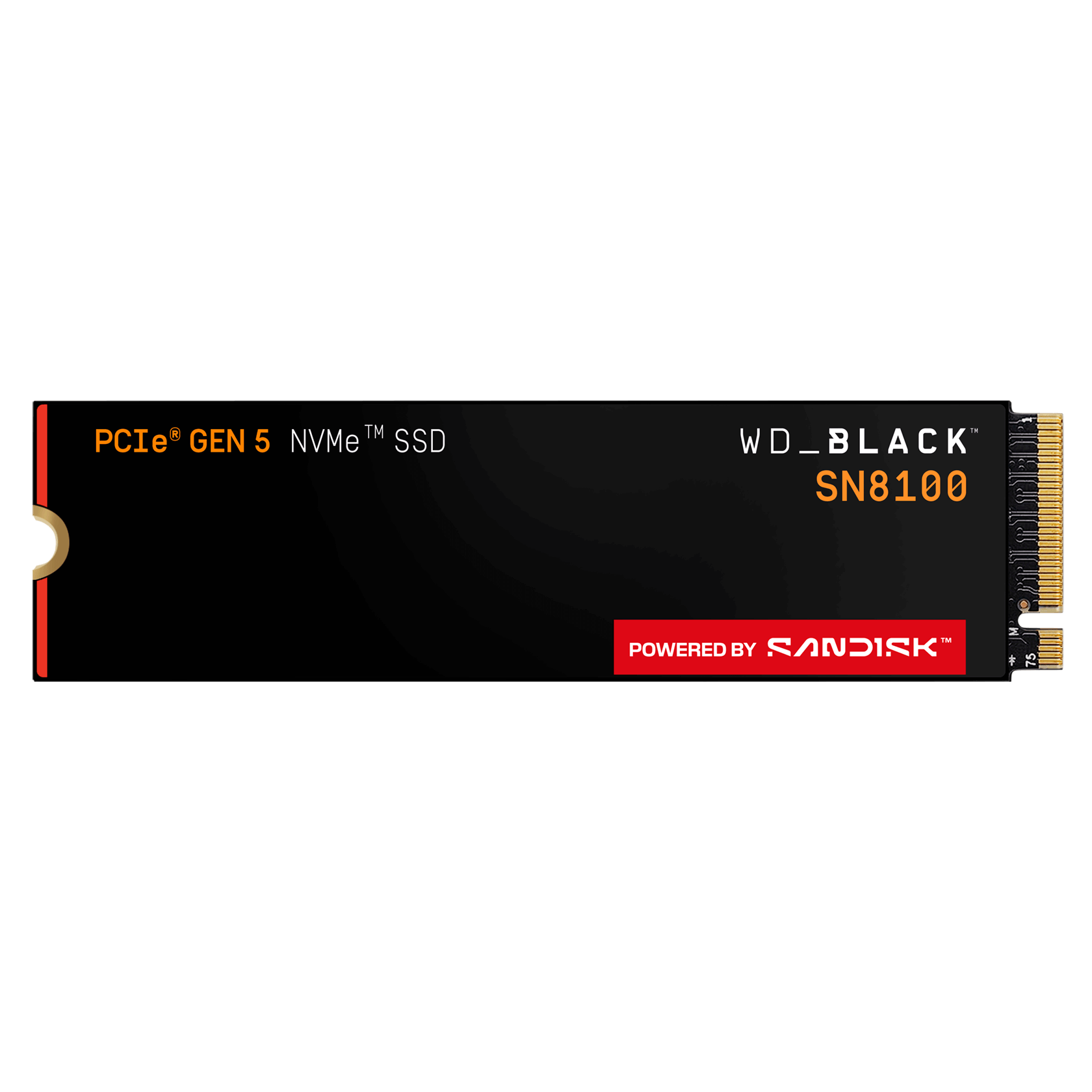
If you only read one number, read this: both the Samsung 9100 Pro and the WD Black SN8100 are rated to hit roughly 14,700-14,900 MB/s of sequential read speed, but they get there differently, and the gap that actually matters shows up in sequential write speed on the 1TB model, random performance, and price. The WD Black SN8100 writes faster at every capacity except 8TB and costs less at launch pricing; the Samsung 9100 Pro writes more consistently across its lineup and, in independent testing, tends to run a touch cooler. Neither is a bad buy. Which one is the right buy depends on what you're building and how much capacity you need.
Both drives are PCIe 5.0 x4, NVMe 2.0 M.2 2280 SSDs aimed at the same buyer: gamers and creators building a flagship desktop who want the fastest consumer storage available without stepping into enterprise pricing. We pulled every spec in this article directly from Samsung's own 9100 Pro datasheet and Samsung.com, and from SanDisk's own WD_BLACK SN8100 product page and launch press release (SanDisk now owns and sells the WD_BLACK line). Where we reference how the drives actually perform outside a spec sheet, we've flagged it clearly as independently measured, not manufacturer-rated.
- Best for pure performance: WD Black SN8100 at 2TB and 4TB — faster rated sequential write (14,000 MB/s vs. 13,400 MB/s) and higher rated random read IOPS (2.3M vs. 2,200K) at those capacities.
- Best value / best for 1TB buyers / best thermals: Samsung 9100 Pro — rated faster than WD's own 1TB model on both sequential write and random read/write, more consistent performance across its whole lineup, and a reputation in independent reviews for running cooler.
- Endurance and warranty: identical on paper — both are rated 600/1,200/2,400/4,800 TBW across 1TB/2TB/4TB/8TB, backed by 5-year limited warranties.
The quick take, expanded
Neither SSD is the clear winner across the board, which is why this comparison exists instead of a simple "buy this one" verdict. The WD Black SN8100 posts higher rated sequential write and random read numbers at 2TB and 4TB, and SanDisk's launch pricing undercut Samsung's official site pricing by a wide margin. The Samsung 9100 Pro counters with a more uniform spec sheet — its write speed barely moves between the 2TB and 8TB models — and a thermal reputation that matters if you're not planning to buy the heatsink version. If you write large files constantly (video editing, large AI model loading) the SN8100's write-speed advantage is real. If you mostly read, game, or want one drive that behaves predictably no matter which capacity you pick, the 9100 Pro's flatter spec curve is the safer bet.
Specs at a glance: Samsung 9100 Pro vs WD Black SN8100
The table below lists manufacturer-rated specifications only, pulled directly from Samsung's official datasheet and SanDisk's official WD_BLACK SN8100 product page. Pricing reflects Samsung's current direct-from-manufacturer listing and SanDisk's official launch MSRP for the bare (no-heatsink) drive; see the pricing section below for context on why those two numbers aren't directly comparable.
| Capacity | Drive | Seq. Read | Seq. Write | Random Read | Random Write | TBW | Warranty | Price |
|---|---|---|---|---|---|---|---|---|
| 1TB | Samsung 9100 Pro | 14,700 MB/s | 13,300 MB/s | 1,850K IOPS | 2,600K IOPS | 600 TB | 5-yr limited | $339.99 |
| 1TB | WD Black SN8100 | 14,900 MB/s | 11,000 MB/s | 1.6M IOPS | 2.4M IOPS | 600 TB | 5-yr limited | $179.99 |
| 2TB | Samsung 9100 Pro | 14,700 MB/s | 13,400 MB/s | 1,850K IOPS | 2,600K IOPS | 1,200 TB | 5-yr limited | $679.99 |
| 2TB | WD Black SN8100 | 14,900 MB/s | 14,000 MB/s | 2.3M IOPS | 2.4M IOPS | 1,200 TB | 5-yr limited | $279.99 |
| 4TB | Samsung 9100 Pro | 14,800 MB/s | 13,400 MB/s | 2,200K IOPS | 2,600K IOPS | 2,400 TB | 5-yr limited | $1,359.99 |
| 4TB | WD Black SN8100 | 14,900 MB/s | 14,000 MB/s | 2.3M IOPS | 2.4M IOPS | 2,400 TB | 5-yr limited | $549.99 |
| 8TB | Samsung 9100 Pro | 14,800 MB/s | 13,400 MB/s | 2,200K IOPS | 2,600K IOPS | 4,800 TB | 5-yr limited | $2,719.99 |
| 8TB | WD Black SN8100 | 14,900 MB/s | 13,200 MB/s | 2.2M IOPS | 2.4M IOPS | 4,800 TB | 5-yr limited | Not published at launch |
A few things jump out immediately. WD's rated sequential read number is higher at every capacity, but by a trivial 1-2% margin that won't be noticeable outside a benchmark app. The real separation is in sequential write: the SN8100's 1TB model is actually slower on paper than Samsung's 1TB model (11,000 MB/s vs. 13,300 MB/s), because SanDisk's SLC write cache, which the company calls nCache 4.0, is proportionally smaller on the entry capacity. At 2TB and up, the SN8100 pulls ahead on write speed and stays there through 4TB, before dropping slightly again at 8TB.
Rated vs. measured sequential performance
Samsung's datasheet numbers were measured on an AMD Ryzen 9 7950X test bench running FIO 3.33 under Linux, with Intelligent TurboWrite (Samsung's SLC caching layer) active — in other words, best-case numbers under controlled lab conditions, which is standard practice and worth knowing before you compare them to numbers from a review site running a different test rig. SanDisk's figures for the SN8100 are described in its own materials as being "based on internal testing" and vary by host device, usage conditions, and drive capacity.
Independent testing has found that both drives land close to their rated sequential numbers in CrystalDiskMark and similar synthetic benchmarks, especially on larger test files that exceed the SLC cache. Where outlets differ is on sustained performance once that cache is exhausted: some reviewers have measured the Samsung holding a flatter write curve across a large sustained transfer, while others have found the WD pulling ahead in burst and random-heavy workloads. Neither drive is immune to the universal Gen5 SSD caveat — once you write past the SLC cache on either drive, sustained write speed on the underlying TLC NAND drops well below the rated peak, which is normal for a cache-accelerated consumer SSD and not unique to either brand.
Random read/write and real-world responsiveness
Random 4K performance is where the WD Black SN8100 has its clearest rated advantage at the 2TB and 4TB capacities: 2.3 million IOPS random read versus Samsung's 2,200K (2.2 million) at 4TB, and a more pronounced gap at 1TB (1.6 million for WD vs. 1,850K for Samsung, where Samsung is actually ahead). Random write is rated identically close, at 2.4 million IOPS for WD against 2,600K (2.6 million) for Samsung across the board — Samsung's edge there.
In practice, random IOPS differences this small rarely translate into a noticeable difference for gaming load times or everyday desktop responsiveness; both drives are fast enough that your CPU, RAM, and the game or application itself become the bottleneck long before the SSD does. Independent testing generally confirms this: reviewers who've run both drives through game-load and file-copy benchmarks tend to report differences measured in fractions of a second, not something you'd feel while actually using the machine.
Endurance (TBW) and warranty
This is the one category where the two drives are, on paper, identical. Samsung rates the 9100 Pro at 600 TBW (terabytes written) for the 1TB model, scaling linearly to 1,200 TBW at 2TB, 2,400 TBW at 4TB, and 4,800 TBW at 8TB, backed by a 5-year limited warranty that ends at whichever comes first: the time period or the TBW ceiling. SanDisk rates the WD Black SN8100 at the exact same TBW figures per capacity — 600/1,200/2,400/4,800 TB — also under a 5-year limited warranty, with TBW calculated using the JEDEC client workload standard (JESD219).
For context, 600 TBW on a 1TB drive means writing roughly 330GB a day, every day, for five years before you'd hit the ceiling — a workload far beyond what any gaming or general productivity use case will produce. Unless you're doing constant heavy video editing, running a local AI training pipeline, or using the drive as a cache for enterprise-adjacent workloads, endurance is not a meaningful differentiator between these two drives.
Thermals and cooling design
Samsung rates the 9100 Pro for operation between 0°C and 70°C, measured by the drive's own S.M.A.R.T. temperature sensor, and explicitly recommends proper airflow; it's sold in both bare and heatsink-equipped versions, with the 8TB model's larger PCB (it meets the PCI-SIG D5 mechanical spec) running a taller heatsink by default. SanDisk rates the SN8100 for a wider 0°C to 85°C operating range and also sells both a bare drive and a version with what the company describes as its lowest-profile Gen5 heatsink yet, built from anodized aluminum with customizable RGB lighting and no fan required.
Independent testing has found that heatsink choice matters more than brand here: both drives, run bare in a poorly ventilated case, will throttle under sustained heavy writes, while either drive with its heatsink installed (or mounted under a motherboard's own M.2 shield) tends to hold its rated speeds for longer. Some reviewers have measured the Samsung running marginally cooler at idle and under moderate load; others have found the WD's thinner heatsink design just as effective once airflow is adequate. If your motherboard already has a beefy M.2 heatsink built in, this distinction mostly disappears — buy the bare drive and save the $20-30 heatsink premium either brand charges.
Pricing by capacity
Here's where the two drives diverge most sharply, and where context matters. SanDisk's official launch pricing for the bare WD Black SN8100 was $179.99 for 1TB, $279.99 for 2TB, and $549.99 for 4TB, with heatsink versions running $20 more at each capacity; the 8TB model's launch pricing wasn't included in the original press materials. Samsung's current listed pricing on Samsung.com, by contrast, runs $339.99 for 1TB, $679.99 for 2TB, $1,359.99 for 4TB, and $2,719.99 for 8TB — roughly double SanDisk's launch MSRP at every matching capacity.
That gap is wider than it looks in practice. Manufacturer direct-site pricing is frequently a list price that retailers discount against, and NAND flash pricing has been volatile throughout 2026 — our coverage of this year's memory price increases applies to NAND as much as DRAM, and both manufacturers' street prices move with that market. Treat the table above as a same-source snapshot for comparing the two drives against each other, not as a prediction of what you'll pay at a retailer this week. If you're trying to decide whether now is even the right time to buy, our 2026 SSD buying guide covers that question directly.
Which one should you buy?
If your workload is write-heavy — large video files, big game installs you're constantly rewriting, or anything that pushes sustained sequential writes — the WD Black SN8100 is the stronger rated choice at 2TB and 4TB, and it undercuts Samsung's pricing meaningfully at launch MSRP. If you're buying the 1TB capacity specifically, the math flips: Samsung's 1TB model is rated faster on sequential write and random read than WD's 1TB model, making the 9100 Pro the better small-capacity pick despite its higher list price.
If you want the safer, more predictable drive across the whole lineup, or you're buying without a case fan budget to spare, the Samsung 9100 Pro's flatter performance curve and reputation for running cooler make it the lower-risk option. If you're chasing the best price-to-performance ratio at 2TB or 4TB and don't mind a 1TB model with comparatively modest write speed, the SN8100 is the one to shortlist.
In short: SN8100 for pure rated performance per dollar at 2TB and 4TB; 9100 Pro for consistency, thermals, and the 1TB tier specifically.
What's next
Both companies are expected to keep expanding their Gen5 lineups rather than replace these drives outright — Samsung's 9100 Pro only added its 8TB model in a later datasheet revision, and SanDisk shipped the SN8100's 8TB and heatsink variants after the initial 1TB/2TB/4TB launch, suggesting both companies treat these as platforms they'll keep filling out rather than one-and-done releases. Watch for firmware updates on both sides that target sustained write consistency, since that's the one area independent reviewers consistently flag as the difference between a great spec sheet and a great real-world drive. And if NAND pricing keeps climbing through the rest of 2026, expect the gap between launch MSRP and shelf price on both of these drives to keep closing rather than widening.
Frequently asked questions
Which is faster, the Samsung 9100 Pro or the WD Black SN8100?
It depends on capacity. At 2TB and 4TB, the WD Black SN8100 is rated faster on sequential write (14,000 MB/s vs. 13,400 MB/s) and random read IOPS (2.3 million vs. 2,200K). At 1TB, the Samsung 9100 Pro is rated faster on sequential write, random read, and random write. Sequential read is nearly identical on both drives at every capacity.
Do the Samsung 9100 Pro and WD Black SN8100 have the same endurance rating?
Yes. Both are rated for the same TBW (terabytes written) at matching capacities: 600 TBW at 1TB, 1,200 TBW at 2TB, 2,400 TBW at 4TB, and 4,800 TBW at 8TB, each backed by a 5-year limited warranty.
Do I need to buy the heatsink version of either drive?
Only if your motherboard doesn't already include its own M.2 heatsink. Both Samsung and SanDisk sell bare and heatsink-equipped versions of their drives; if your board has built-in M.2 cooling, the bare drive saves roughly $20-30 per capacity without a meaningful performance penalty.
Which capacity offers the best value between the two drives?
Based on official pricing, SanDisk's launch MSRP for the WD Black SN8100 undercuts Samsung's current direct-site pricing at every matching capacity, most notably at 2TB and 4TB. Manufacturer list pricing moves with retail discounts and NAND market conditions, so compare current street prices before buying.
Are these drives compatible with older PCIe slots or the PlayStation 5?
Yes to both. Samsung lists the 9100 Pro as compatible with client PCs and the PlayStation 5, and both the 9100 Pro and WD Black SN8100 are PCIe Gen5 x4 NVMe 2.0 drives that are backward compatible with PCIe Gen4 and Gen3 slots, running at the lower generation's speed.
Sources
- Samsung NVMe SSD 9100 PRO Datasheet (Rev. 2.0)download.semiconductor.samsung.com
- Samsung 9100 PRO product page (Samsung.com)samsung.com
- SanDisk WD_BLACK SN8100 SSD product pagesandisk.com
- SanDisk press release: WD_BLACK SN8100 NVMe SSD launchsandisk.com
Mara Lindqvist edits the hardware desk. She covers graphics cards, processors, memory and storage, the foundries and chip designers behind them, and what the numbers on a spec sheet mean for people choosing a PC. Specifications in her stories come from manufacturer spec pages and datasheets.