Crucial T710 vs Samsung 9100 Pro: Which Gen5 SSD Should You Buy?
Two of 2026's fastest PCIe Gen5 NVMe SSDs go head-to-head on speed, endurance, and price, so you know which one fits your build and budget.
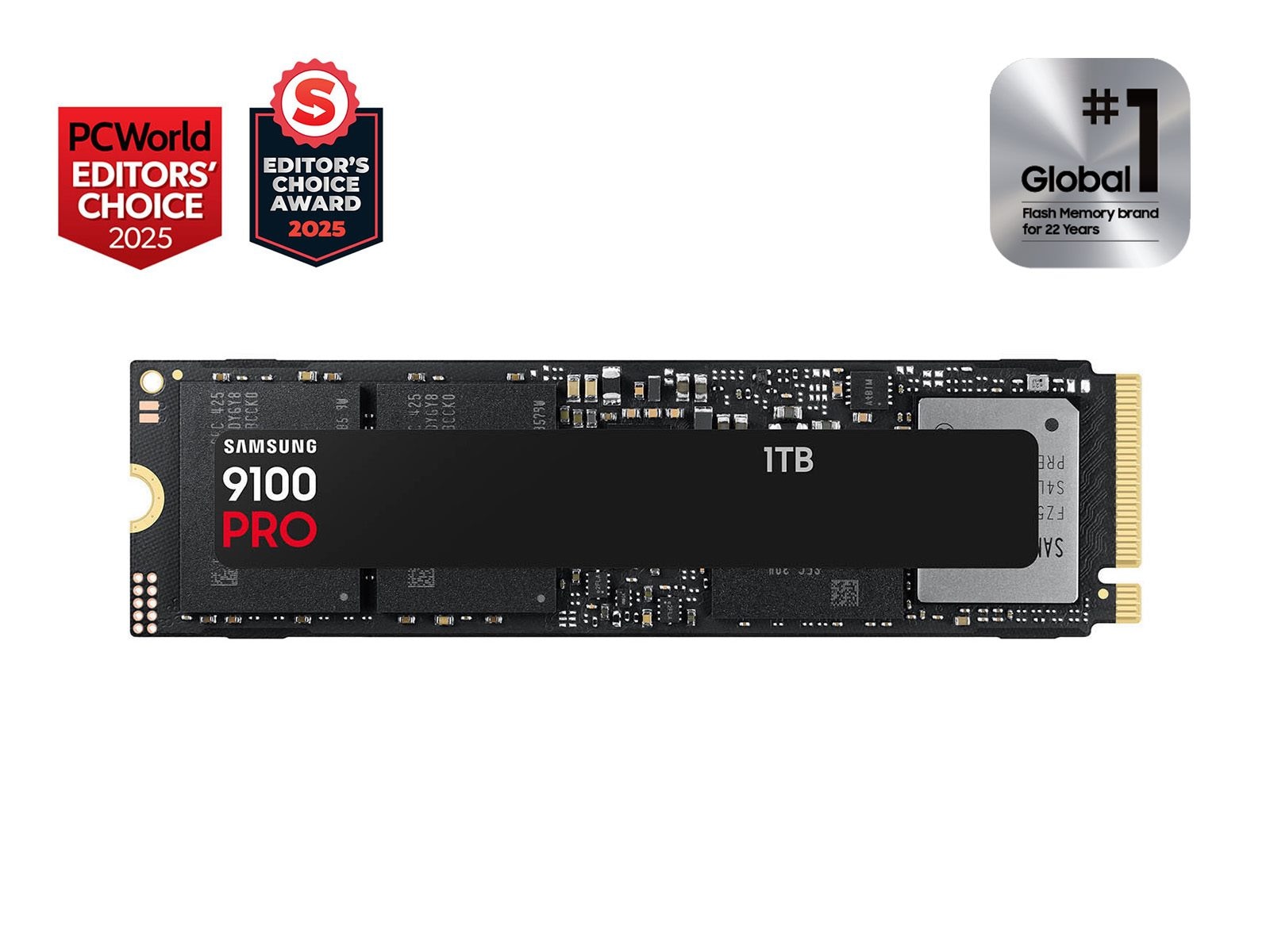
Short answer: if you want the single fastest, highest-capacity Gen5 drive and don't mind paying Samsung's premium, get the Samsung 9100 Pro — it's the only one of the two sold in an 8TB size and it edges out the Crucial T710 on peak sequential read speed. If you want effectively the same real-world performance for less money and don't need more than 4TB, the Crucial T710 is the smarter buy, since it launched at roughly half Samsung's current price per terabyte and matches Samsung's endurance rating almost exactly. Below is the full capacity-by-capacity breakdown, using each company's own published specifications.
- Both drives are PCIe 5.0 x4, NVMe 2.0, M.2 2280 SSDs rated for roughly 14,500–14,900 MB/s sequential reads.
- Samsung's 9100 Pro ships in 1TB, 2TB, 4TB and 8TB; Crucial's T710 tops out at 4TB.
- Both carry 5-year limited warranties with essentially identical TBW endurance ratings per terabyte.
- As of November 24, 2026, Samsung's own store lists the 9100 Pro 1TB at $339.99 — more than Crucial's 2025 launch price of $179.99 for the T710 1TB, though current T710 street pricing has risen too amid the broader 2026 NAND shortage.
- Both are offered with and without a factory heatsink.
Two Gen5 drives built for the same buyer
The Samsung 9100 Pro and the Crucial T710 both arrived as their makers' flagship PCIe Gen5 consumer SSDs, and both target the same shopper: someone building or upgrading a high-end PC in 2026 who wants to actually use the bandwidth a Gen5 motherboard slot offers. Samsung's 9100 Pro launch announcement pitched it as the brand's fastest consumer drive yet, built around an in-house controller and Samsung's own V-NAND TLC. Crucial's T710, built around a Silicon Motion SM2508 controller paired with Micron's G9 TLC NAND, launched a few months earlier in 2025 as Crucial's first drive to break past 14 GB/s. Eighteen months later, both are mature, firmware-patched products rather than launch-day gambles, which is exactly why they keep showing up together in buyer searches.
If you're also cross-shopping WD's competing Gen5 drive, we've separately covered how the 9100 Pro stacks up against the WD Black SN8100. This piece focuses specifically on the Samsung-vs-Crucial matchup, since it's the pairing most PC builders are actually weighing right now.
Specs at a glance
The table below pulls directly from Samsung's official 9100 Pro datasheet (Rev. 2.0) and Crucial's published T710 product specifications.
| Spec | Samsung 9100 Pro | Crucial T710 |
|---|---|---|
| Interface | PCIe 5.0 x4, NVMe 2.0 | PCIe 5.0 x4, NVMe 2.0 |
| Form factor | M.2 2280 | M.2 2280 |
| Capacities | 1TB, 2TB, 4TB, 8TB | 1TB, 2TB, 4TB |
| Controller | Samsung in-house controller | Silicon Motion SM2508 |
| NAND | Samsung V-NAND TLC (V8) | Micron G9 TLC NAND |
| Seq. read (up to) | 14,700 MB/s (1–2TB) / 14,800 MB/s (4–8TB) | ~14,900 MB/s (1TB) / ~14,500 MB/s (2–4TB) |
| Seq. write (up to) | 13,300 MB/s (1TB) / 13,400 MB/s (2–8TB) | ~13,700 MB/s (1TB) / ~13,800 MB/s (2–4TB) |
| TBW endurance | 600 / 1,200 / 2,400 / 4,800 TB (1/2/4/8TB) | 600 / 1,200 / 2,400 TB (1/2/4TB) |
| Warranty | 5-year limited | 5-year limited |
| Heatsink option | Yes (separate SKU) | Yes (+$20 at launch) |
| Price (1TB) | $339.99 (Samsung.com, Nov. 2026) | $179.99 (launch MSRP, 2025) |
Sequential speed: closer than the marketing numbers suggest
On paper, Samsung's headline number is 14,800 MB/s sequential read on the 4TB and 8TB 9100 Pro models, per its official datasheet, with the 1TB and 2TB versions rated slightly lower at 14,700 MB/s. Crucial's published figures for the T710 run the opposite direction: the 1TB model is rated for the highest read speed at roughly 14,900 MB/s, while the 2TB and 4TB models settle closer to 14,500 MB/s. Write speeds follow a similar pattern — Samsung caps out at 13,400 MB/s on its larger drives, while Crucial's larger capacities are rated a bit higher, around 13,800 MB/s.
In practice, this means neither drive has a clean, decisive sequential-speed win across every capacity. If you're buying the 1TB size specifically, Crucial's rated numbers are a touch higher. If you're buying 4TB or above, Samsung's rated read speed edges ahead, and it's the only one of the two that scales up to 8TB at all. For most desktop workloads — game load times, large file transfers, scratch-disk editing — the difference between roughly 14,500 and 14,900 MB/s on paper is not something you'll notice day to day; both drives are well past the point where sequential bandwidth is the bottleneck for a typical gaming or creative PC.
Random I/O tells a similar story where data is available. Samsung's datasheet rates the 9100 Pro at up to 1,850,000 random read IOPS (1–2TB) and 2,200,000 random read IOPS (4–8TB), with random writes topping out at 2,600,000 IOPS across the line. Crucial does not publish a directly comparable capacity-by-capacity random-IOPS table alongside its sequential figures, so we're not going to invent a number here to force an apples-to-apples row — if random-IOPS-heavy workloads (databases, certain AI inference caches) are your specific use case, Samsung's published figures give you something concrete to plan around, while Crucial's published materials simply don't make an equivalent claim either way.
Endurance and warranty: nearly identical on paper
This is the category where the two drives line up almost exactly. Samsung's datasheet rates the 9100 Pro at 600 TBW (terabytes written) for the 1TB model, scaling linearly to 1,200 TBW at 2TB, 2,400 TBW at 4TB, and 4,800 TBW at 8TB. Crucial's published TBW figures for the T710 follow the same 600-TBW-per-terabyte ratio: 600 TBW at 1TB, 1,200 TBW at 2TB, and 2,400 TBW at 4TB. Both companies back their drives with a 5-year limited warranty that runs out whichever comes first — five years of ownership or the rated TBW ceiling.
For context, 600 TBW on a 1TB drive works out to roughly 328GB of writes every single day for five years straight before you'd hit the limit — a workload far beyond what gaming, everyday productivity, or even most content-creation setups will produce. Unless you're running sustained, heavy write workloads (large-scale video ingest, certain AI training/caching pipelines, or enterprise-adjacent use), endurance shouldn't be the deciding factor between these two drives.
Pricing reality heading into Black Friday 2026
Price is where the picture gets more complicated than a simple side-by-side, mostly because of what's happening to SSD pricing industry-wide right now. As of November 24, 2026, Samsung's own US store lists the 9100 Pro at $339.99 for 1TB, $679.99 for 2TB, and $1,359.99 for 4TB — figures pulled directly from the live product pages on Samsung.com. That's a steep climb from where Gen5 drives were priced at launch in early 2025 — you can check Samsung's live pricing yourself on its official 9100 Pro product page.
Crucial's launch pricing for the T710, when it debuted in 2025, was $179.99 for 1TB, $279.99 for 2TB, and $549.99 for 4TB, with the heatsink version running about $20 more per capacity. We were not able to independently confirm Crucial's current, up-to-the-minute 2026 pricing directly from crucial.com for this piece, so treat the 2025 figures as a baseline rather than today's shelf price — but every signal in the market points the same direction: NAND flash contract prices have spiked sharply through 2026, and SSD prices across virtually every brand have followed. We've covered that dynamic in depth, including why it's hitting shoppers particularly hard right before the Black Friday shopping window. The practical takeaway: whichever drive you choose, don't assume today's price is a floor, and don't wait too long if you've found a deal that beats either company's current list price.
Heatsinks and compatibility
Both drives ship in heatsink and bare (no-heatsink) versions, and the choice matters more on a Gen5 drive than it did on previous generations. Samsung sells the 9100 Pro with a separate SKU for its heatsink version, while Crucial's T710 heatsink variant historically carried about a $20 premium over the bare drive at each capacity. If your motherboard already includes an M.2 heatsink or active cooling shroud over its primary Gen5 slot — common on most higher-end boards sold since 2024 — the bare version of either drive is the better buy, since you'd otherwise be stacking two heatsinks. If you're installing into a slot with no cooling at all, or into a PlayStation 5's expansion bay, the factory-heatsink version is the safer choice on either drive, since sustained Gen5 workloads can trigger thermal throttling without adequate cooling.
Both are standard M.2 2280 NVMe drives, so compatibility comes down to your motherboard's or console's Gen5 M.2 slot support rather than anything proprietary to either brand.
Do you actually need PCIe Gen5 in 2026?
If you're not already set on a Gen5 drive, it's worth a quick gut check before spending Gen5 money. PCIe 5.0 roughly doubles the per-lane bandwidth of PCIe 4.0, which is what lets both of these drives post sequential numbers north of 14 GB/s versus the roughly 7 GB/s ceiling of most Gen4 flagships. That bandwidth is genuinely useful for large sequential transfers — game installs, video export, big dataset loading — but it does very little for everyday responsiveness, which is governed more by random read latency than peak sequential throughput. We go into more detail on the heat, compatibility, and real-world tradeoffs of the standard in our PCIe Gen5 SSD explainer, which is worth a read if this is your first Gen5 purchase.
Which one should you buy?
If capacity matters most: Samsung wins by default, since the 9100 Pro is the only drive here available at 8TB. If you specifically want 1TB and care about rated sequential speed on paper, Crucial's numbers are marginally higher at that capacity. If you want the lowest cost per terabyte and don't need more than 4TB, Crucial's launch MSRP structure undercut Samsung's current pricing significantly, and even with 2026 NAND-shortage inflation factored in, Crucial drives have historically tracked a bit cheaper than Samsung's at equivalent capacities. If brand-reliability track record and the broadest retail availability matter most to you, Samsung's larger footprint and wider SKU lineup (including the 8TB option) make the 9100 Pro the safer default pick for buyers who don't want to shop around.
For gaming specifically — the use case driving most of the search interest in this comparison — either drive is overkill in the best possible way: both will load games, well past the point where a PS5 or a Gen5-equipped gaming PC can tell the difference in everyday play. The decision in that scenario really comes down to price and capacity, not the roughly 2–3% gap between their rated sequential speeds.
What to do next
Check your motherboard's manual to confirm which M.2 slot actually runs at full PCIe 5.0 x4 — on many boards only the primary slot does, and it may share bandwidth with other components. Decide on capacity first (1TB, 2TB, or 4TB covers nearly every mainstream build; only step up to Samsung's 8TB if you have a specific need for it), then compare live pricing at each company's own store before buying, since both companies' prices move with the broader 2026 NAND shortage. If your board or case doesn't already shroud the M.2 slot in a heatsink, buy the heatsink version of whichever drive you choose rather than adding a third-party one afterward.
Frequently asked questions
Is the Crucial T710 or the Samsung 9100 Pro faster?
It depends on capacity. Crucial's 1TB T710 is rated for a slightly higher sequential read speed (around 14,900 MB/s) than Samsung's 1TB 9100 Pro (14,700 MB/s), but Samsung's 4TB and 8TB 9100 Pro models are rated higher (14,800 MB/s) than Crucial's 4TB T710 (around 14,500 MB/s). Neither gap is large enough to be noticeable in everyday use.
Do I need a heatsink for either drive?
Both the 9100 Pro and T710 are sold in heatsink and bare versions. If your motherboard's M.2 slot already has a built-in heatsink or shroud, buy the bare version. If it doesn't, or you're installing into a PlayStation 5 expansion slot, choose the heatsink version to avoid thermal throttling under sustained workloads.
Will the Samsung 9100 Pro or Crucial T710 work in a PS5?
Both are standard PCIe 5.0 M.2 2280 NVMe drives, which is the form factor PS5 expansion storage requires, though actual PS5 compatibility also depends on firmware and Sony's own approved-drive guidance at the time of purchase, which both companies track on their support pages.
Which drive has better endurance?
They're nearly identical. Both are rated at 600 TBW per terabyte of capacity — 600 TBW at 1TB, 1,200 TBW at 2TB, and 2,400 TBW at 4TB — with 5-year limited warranties from both Samsung and Crucial.
Why is the Samsung 9100 Pro so much more expensive right now?
Samsung's own store listed the 9100 Pro 1TB at $339.99 as of November 24, 2026, well above its original launch pricing. That increase lines up with a broader 2026 NAND flash shortage that has pushed SSD prices up across most brands heading into Black Friday, not something specific to Samsung's drive alone.
Is PCIe Gen5 overkill for gaming in 2026?
For most gamers, yes — current games rarely saturate even PCIe Gen4 bandwidth, let alone Gen5. The 9100 Pro and T710 make more sense if you also do large-file creative work, frequent big game installs, or want headroom for future PCIe Gen5 motherboards, rather than for game-loading speed alone.
Sources
- Samsung NVMe SSD 9100 PRO Datasheet, Rev. 2.0 (official)download.semiconductor.samsung.com
- Samsung 9100 PRO 1TB official product pagesamsung.com
- Samsung Newsroom: 9100 PRO series announcementnews.samsung.com
- Crucial T710 official product pagecrucial.com
- Wikipedia: PCI Expressen.wikipedia.org
Mara Lindqvist edits the hardware desk. She covers graphics cards, processors, memory and storage, the foundries and chip designers behind them, and what the numbers on a spec sheet mean for people choosing a PC. Specifications in her stories come from manufacturer spec pages and datasheets.