NVIDIA, Microsoft Launch Agentic AI PCs: RTX Spark Ships Oct. 16
A joint San Francisco event paired RTX Spark’s October 16 ship date with Microsoft’s new agent-hosting layer, MXC, and a first look at DGX Station for Windows.
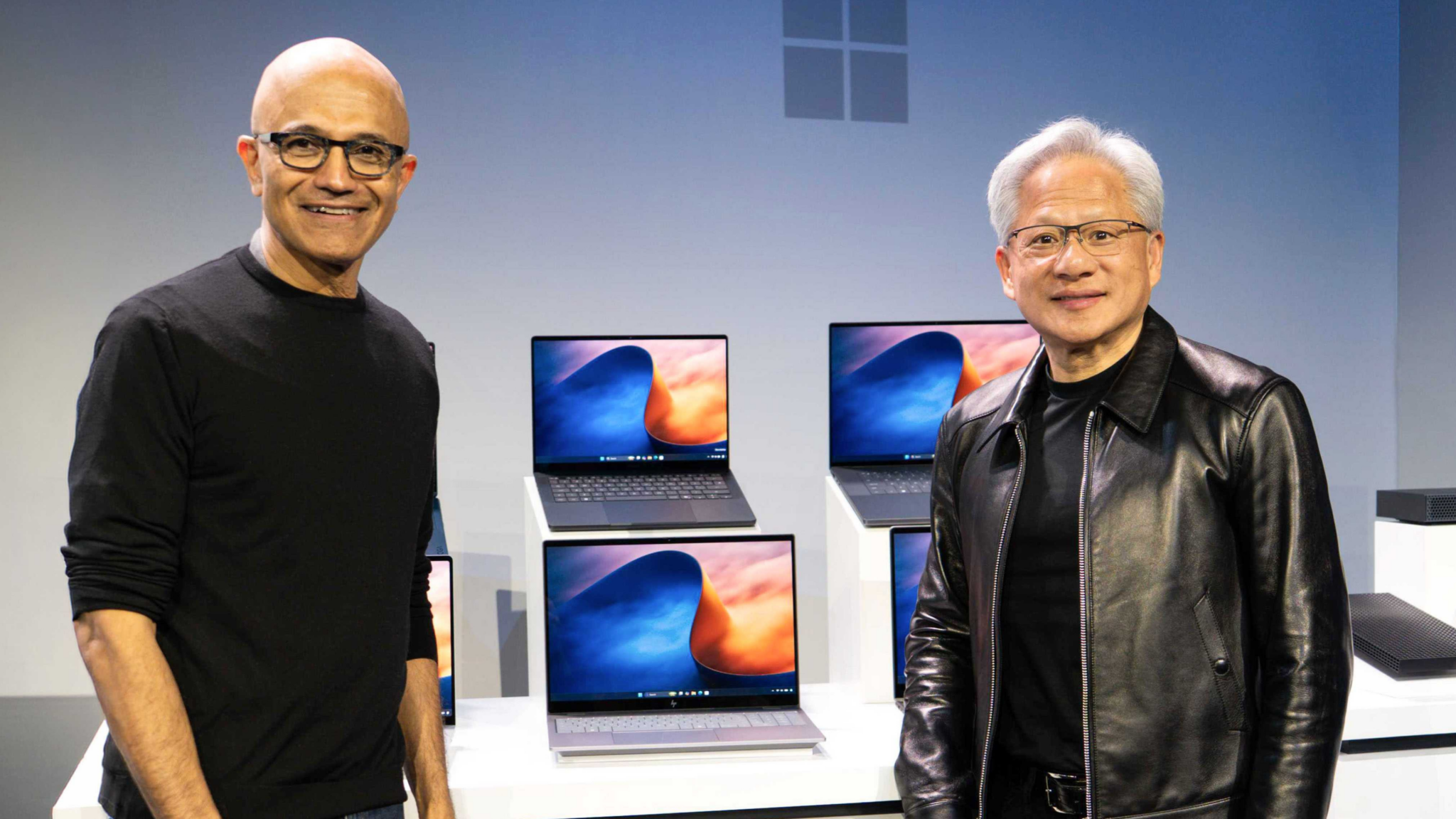
NVIDIA and Microsoft used a joint San Francisco event on October 7, 2026 to turn RTX Spark from a chip announcement into a shipping product line and a software platform: preorders for RTX Spark laptops from eight PC makers opened the same day, the machines start arriving October 16, and Microsoft used the stage to switch on Microsoft Execution Containers (MXC) — OS-level plumbing that lets AI agents run persistently and safely in the background on Windows — while NVIDIA previewed a Windows version of its deskside DGX Station supercomputer.
- Event: NVIDIA + Microsoft joint event, San Francisco, October 7, 2026 — Jensen Huang and Satya Nadella on stage together
- Preorders: RTX Spark laptops, opened October 7, 2026; devices ship October 16, 2026
- Desktops: RTX Spark compact desktops go on sale November 2026
- New software: Microsoft Execution Containers (MXC) reached general availability on Windows 11, October 7, 2026
- New hardware preview: NVIDIA DGX Station for Windows — GB300 Grace Blackwell Ultra Desktop Superchip, 748GB coherent memory, up to 20 petaFLOPS FP4 — no price or ship date yet
- Price confirmed: Microsoft's own Surface Laptop Ultra with RTX Spark lists at $2,599.99 for preorder
The announcement: NVIDIA and Microsoft share a stage for Windows' agentic era
The October 7 event was framed by both companies as a sequel to a three-decade relationship, not a new partnership. In a fireside chat moderated by Sriram Krishnan, NVIDIA founder and CEO Jensen Huang told the crowd, "If not for Windows there would be no GeForce" — a reminder that NVIDIA's entire consumer graphics business grew up alongside Microsoft's operating system. But the news wasn't nostalgia. Huang and Microsoft CEO Satya Nadella used the appearance to lay out what both companies are calling the "agentic AI PC" era: a Windows machine that doesn't just run AI-accelerated apps, but hosts autonomous software agents that persist, act, and remember, locally, on the device in front of you.
Huang put it this way: "What happens in the era of agents, when the agent is on your computer? It is now your personal assistant." Nadella's framing centered on security rather than raw capability: "We needed to make the desktop the most secure place for agents to execute." That line matters because it's the throughline connecting the hardware news (RTX Spark) to the software news (MXC) — Microsoft's pitch is that agents need a place to live on your PC that's walled off, observable, and governable, not just fast.
Pavan Davuluri, Microsoft's EVP of Windows and Devices, handled the platform specifics, including a claim that's central to the RTX Spark pitch: "You can run models on this laptop that simply don't fit on a traditional machine." For context on what RTX Spark actually is as silicon, Pandromeda's earlier coverage of confirmed RTX Spark laptop models has the full OEM-by-OEM breakdown; this piece focuses on what's new since then — the Microsoft platform push and the concrete shipping timeline.
What is Microsoft Execution Containers (MXC)?
The single biggest software announcement of the day was that Microsoft Execution Containers reached general availability on Windows 11 on October 7, 2026. MXC is not a feature of one app — it's OS-level infrastructure that lets AI agents run safely and persistently in the background under Windows' own control, rather than as a one-off script that dies when you close a window. According to Microsoft's own description of the rollout, organizations can define exactly which files and networks an agent is allowed to touch, with those policies enforced at runtime, and containment can be implemented through process and session isolation, a lightweight Linux layer called WSLc, full virtual machines, or Windows 365 for Agents for cloud-hosted containment.
Huang's assessment, delivered at the event, was blunt: "MXC is going to revolutionize how agents are built and deployed." Microsoft says a first wave of agent makers already support it, including OpenAI's Codex, GitHub Copilot, OpenClaw, Replit, LM Studio, NVIDIA's own OpenShell, and Unsloth AI, with Anthropic's Claude Code, Box, and Perplexity named as expected to follow. Meta's Muse for Windows — described as a personal AI agent — is slated to arrive as a native Windows app with MXC integration built in.
Microsoft frames the security model around three pillars: containment (what an agent can touch), identity (which agent did what), and manageability (policy and oversight) — the latter handled through Agent 365 and Intune, which let IT administrators set policy, monitor risk, and govern agents running across a fleet of machines. This is the piece of the announcement that's genuinely new since Pandromeda's last RTX Spark coverage: it's Microsoft's answer to "where does an always-on AI agent actually live on my PC," and it ships independently of any particular piece of silicon.
RTX Spark, briefly: the hardware the agentic pitch runs on
RTX Spark itself isn't new news — Pandromeda covered the spec reveal and the laptop lineup separately — but the headline numbers are worth restating because they're the reason Microsoft can make an "agentic PC" argument at all. Per NVIDIA's press release, RTX Spark pairs a Blackwell RTX GPU with up to 6,144 CUDA cores and an NVIDIA Grace CPU with up to 20 cores, connected at 600GB/s, for a combined 1 petaflop of FP4 AI performance and up to 128GB of unified memory, running NVIDIA's full CUDA software stack rather than a cut-down mobile variant.
The practical upshot, per NVIDIA's blog, is that a laptop-class machine can run Qwen 3.8 Flash Next, a 125-billion-parameter model, entirely locally — no cloud round-trip, no data leaving the device. That's the technical basis for Davuluri's "models that simply don't fit on a traditional machine" claim, and it's also why NVIDIA and Microsoft are pitching RTX Spark laptops as creator and developer machines rather than pure gaming hardware, even though NVIDIA's materials also promise 1440p gaming above 100fps with DLSS 5, Reflex, and G-Sync on the same silicon.
| Spec | RTX Spark (laptop) | DGX Station for Windows (preview) |
|---|---|---|
| GPU | Blackwell RTX, up to 6,144 cores | GB300 Grace Blackwell Ultra Desktop Superchip |
| CPU | NVIDIA Grace, up to 20 cores | NVIDIA Grace (integrated in superchip) |
| Unified/coherent memory | Up to 128GB | 748GB |
| AI compute (FP4) | 1 petaFLOP | Up to 20 petaFLOPS |
| CPU-GPU link | 600GB/s | 900GB/s (NVLink-C2C) |
| OS | Windows 11 | Windows 11 (preview); Linux via WSL |
| Status | Shipping — preorders live | Preview only, sign-up for updates |
Preorder and ship dates: what you can actually buy, and when
This is the part that's immediately actionable. RTX Spark laptop preorders opened October 7, 2026 — the same day as the event — with devices shipping October 16, 2026. That timeline applies across the announced partner lineup: Acer, ASUS, Dell, HP, Lenovo, Microsoft, MSI, and Gigabyte. Compact RTX Spark desktops, a second form factor built for always-on background agents rather than portability, go on sale in November 2026.
Microsoft's own entry, the Surface Laptop Ultra, now has a confirmed price: Microsoft's product page lists it for preorder at $2,599.99, with up to 128GB of unified memory shared between CPU and GPU (the addressable GPU share depends on configuration and workload, per Microsoft's own footnote). Microsoft's separate device, the Surface RTX Spark Dev Box, ships to U.S. customers in November 2026 rather than the October 16 laptop wave — a distinction Pandromeda's Dev Box coverage breaks down in more detail.
NVIDIA DGX Station for Windows: a preview, not a product yet
The more speculative news item is DGX Station for Windows — NVIDIA's first deskside AI supercomputer built for Windows rather than Linux-only, as prior DGX Station hardware has been. NVIDIA's own DGX Station product page describes it as putting "a trillion-parameter AI supercomputer on every enterprise desk," built around the GB300 Grace Blackwell Ultra Desktop Superchip — a Blackwell Ultra GPU and Grace CPU connected over NVLink-C2C at 900GB/s. NVIDIA's spec sheet lists 748GB of coherent memory, split between 252GB of HBM3e GPU memory at 7.1TB/s and 496GB of LPDDR5X CPU memory at 396GB/s, and up to 20 petaFLOPS of FP4 AI compute — enough, NVIDIA says, to run trillion-parameter-scale models locally.
Davuluri's framing of the desktop machine leaned into the contrast with cloud rental: "Capabilities that once required renting a cluster, now in a deskside supercomputer." Crucially, Windows support doesn't mean NVIDIA is abandoning Linux AI workflows on this hardware — existing Linux toolchains remain reachable through WSL, so the Windows version is additive rather than a replacement. What's not yet known: price, a firm ship date, or final partner availability. NVIDIA and Microsoft are only taking sign-ups for notification at this stage, with partners including Dell and HP named for "later in 2026" availability per Microsoft's own blog post — later than the RTX Spark laptop wave, and still without a firm date.
How RTX Spark compares to Apple's MacBook Pro, according to Microsoft
Microsoft used its own September 2026 internal testing to make a direct comparison against Apple's MacBook Pro 16-inch with an M5 Pro chip and 64GB of memory. Per Microsoft's Windows Experience Blog post, Microsoft claims RTX Spark hardware delivers up to 2.1x faster time-to-first-token, 4.3x faster AI image generation, and 6.2x faster AI video generation versus that MacBook Pro configuration. These are Microsoft's own vendor-supplied benchmark figures rather than independently verified results, and Microsoft's own disclosure notes results vary by configuration — worth keeping in mind as a first-party claim rather than a settled fact, but it's the clearest quantified performance claim either company has put on the record for RTX Spark so far.
Running local AI models: the Qwen 3.8 Flash Next example
NVIDIA's chosen proof point for "real work, not a demo" is Qwen 3.8 Flash Next, a 125-billion-parameter model that NVIDIA says matches many cloud-hosted models on intelligence while running entirely on-device, with no data sent to the cloud. That's the use case MXC is built to support at the OS level: an agent built on a model like this one needs somewhere to persist in the background, with policy-enforced access to files and networks, rather than running as an ephemeral foreground process — which is precisely the gap Microsoft says MXC closes.
Which laptop makers are shipping RTX Spark devices
The confirmed partner list for the October 16 shipping wave is Acer, ASUS, Dell, HP, Lenovo, Microsoft, MSI, and Gigabyte — eight OEMs across a single launch window, a broader simultaneous rollout than most new NVIDIA mobile platforms get. Pandromeda's full laptop-by-laptop roundup covers individual model names and configurations in more depth; what's new since that piece published is the confirmed October 7 preorder date and October 16 ship date applying uniformly across that partner list, rather than staggered per-OEM availability.
Why this matters: Windows is positioning itself as the agentic AI platform
Strip away the hardware specifics and the event's real subject was positioning: Microsoft wants Windows — not macOS, not a cloud dashboard — to be where autonomous AI agents actually execute, persist, and get governed by IT policy. That's a different pitch than "faster AI PC chip." MXC, Agent 365, and Microsoft Security are the governance layer; RTX Spark and DGX Station for Windows are the hardware tier that makes a 125-billion-parameter (or larger) local model practical to run continuously rather than as an occasional burst. Nadella's "most secure place for agents to execute" line is the thesis statement for the whole event, and Huang's own closing argument — that the PC remains "the ultimate tool" even in an agentic era — is NVIDIA signing on to that thesis rather than pitching a rival cloud-first vision.
What happens next
The near-term calendar is concrete: RTX Spark laptops from the eight named OEMs ship October 16, 2026; RTX Spark compact desktops follow in November 2026; and the Surface RTX Spark Dev Box ships to U.S. customers in November 2026 as well. Beyond that, the timeline gets vaguer by design. DGX Station for Windows has no price or firm release date — NVIDIA and Microsoft are only collecting sign-ups for notification, with partner availability (Dell, HP, and others) pointed at "later in 2026." On the software side, GitHub's HydraFusion model-routing feature is due to reach local models on Windows as an experimental preview in the GitHub Copilot app, Copilot CLI, and Visual Studio Code later in October 2026, and Microsoft says broader Copilot+ PC hybrid-intelligence features — local context, local actions, and local models — will begin rolling out "in the coming months," with timing varying by device, market, and silicon. Further out, Microsoft has also pointed to Call of Duty arriving on RTX Spark hardware in 2027, a signal that NVIDIA and Microsoft expect the platform to carry mainstream gaming workloads alongside its AI-agent pitch, not just creator and developer tasks.
Frequently asked questions
When can I preorder an NVIDIA RTX Spark laptop?
RTX Spark laptop preorders opened October 7, 2026, the same day as NVIDIA and Microsoft's joint San Francisco event, across partners including Acer, ASUS, Dell, HP, Lenovo, Microsoft, MSI, and Gigabyte.
When do RTX Spark laptops actually ship?
RTX Spark laptops begin shipping October 16, 2026. RTX Spark compact desktops follow with a November 2026 on-sale date, and Microsoft's Surface RTX Spark Dev Box ships to U.S. customers in November 2026.
What is Microsoft Execution Containers (MXC)?
MXC is OS-level infrastructure in Windows 11, generally available as of October 7, 2026, that lets AI agents run safely and persistently in the background. It lets organizations define which files and networks an agent can access, enforced at runtime, with containment options including process isolation, WSLc, virtual machines, and Windows 365 for Agents.
What is NVIDIA DGX Station for Windows?
It's NVIDIA's first deskside AI supercomputer built for Windows rather than Linux-only, previewed on October 7, 2026. It runs the GB300 Grace Blackwell Ultra Desktop Superchip with 748GB of coherent memory and up to 20 petaFLOPS of FP4 compute, aimed at trillion-parameter-scale local models. No price or ship date has been announced; NVIDIA and Microsoft are only taking sign-ups for notification.
How much does the RTX Spark-powered Surface Laptop Ultra cost?
Microsoft's own product page lists the Surface Laptop Ultra for preorder at $2,599.99, with up to 128GB of unified memory shared between the CPU and GPU.
What is Qwen 3.8 Flash Next and why does NVIDIA mention it?
Qwen 3.8 Flash Next is a 125-billion-parameter AI model that NVIDIA says RTX Spark hardware can run entirely locally, without sending data to the cloud, as a proof point for the platform's local-AI and agentic capabilities.
Sources
- NVIDIA Newsroom — NVIDIA, Microsoft Press Release (Oct. 7, 2026)nvidianews.nvidia.com
- NVIDIA Blog — Local AI, RTX Spark and the Microsoft Windows Eventblogs.nvidia.com
- Windows Experience Blog — Building Windows for Hybrid Intelligenceblogs.windows.com
- NVIDIA DGX Station Product Pagenvidia.com
- Microsoft Surface Laptop Ultra Product Pagemicrosoft.com
Mara Lindqvist edits the hardware desk. She covers graphics cards, processors, memory and storage, the foundries and chip designers behind them, and what the numbers on a spec sheet mean for people choosing a PC. Specifications in her stories come from manufacturer spec pages and datasheets.