Surface RTX Spark Dev Box: Specs, Price and Release Date
Microsoft confirmed specs for its Nvidia RTX Spark-powered developer mini PC, but still hasn't announced a price or exact release date.
Microsoft's Surface RTX Spark Dev Box, a palm-sized developer workstation built around Nvidia's RTX Spark chip, got renewed attention this week after Microsoft's Windows and Surface event in San Francisco put its RTX Spark hardware lineup back in the spotlight. The Dev Box itself was actually unveiled months earlier, at Microsoft Build in June 2026, and more than four months later Microsoft still hasn't announced a price. Here is everything that is actually confirmed—128GB of unified memory, up to 1 petaflop of AI compute, and local models as large as 120 billion parameters—versus what outlets are guessing.
- Chip: Nvidia RTX Spark superchip (Blackwell GPU + Arm CPU)
- CPU: up to 20 Arm cores
- GPU: up to 6,144 Blackwell CUDA cores
- Memory: 128GB LPDDR5X unified, widely reported up to 112GB addressable by the GPU
- AI compute: up to 1 petaflop (FP4), runs models up to roughly 120B parameters
- Cooling: aluminum chassis doubles as the heatsink, up to 100W
- Price: not announced by Microsoft; outlets are guessing $3,000–$3,500
- Availability: later in 2026, US only, exclusively at microsoft.com
What Microsoft actually announced
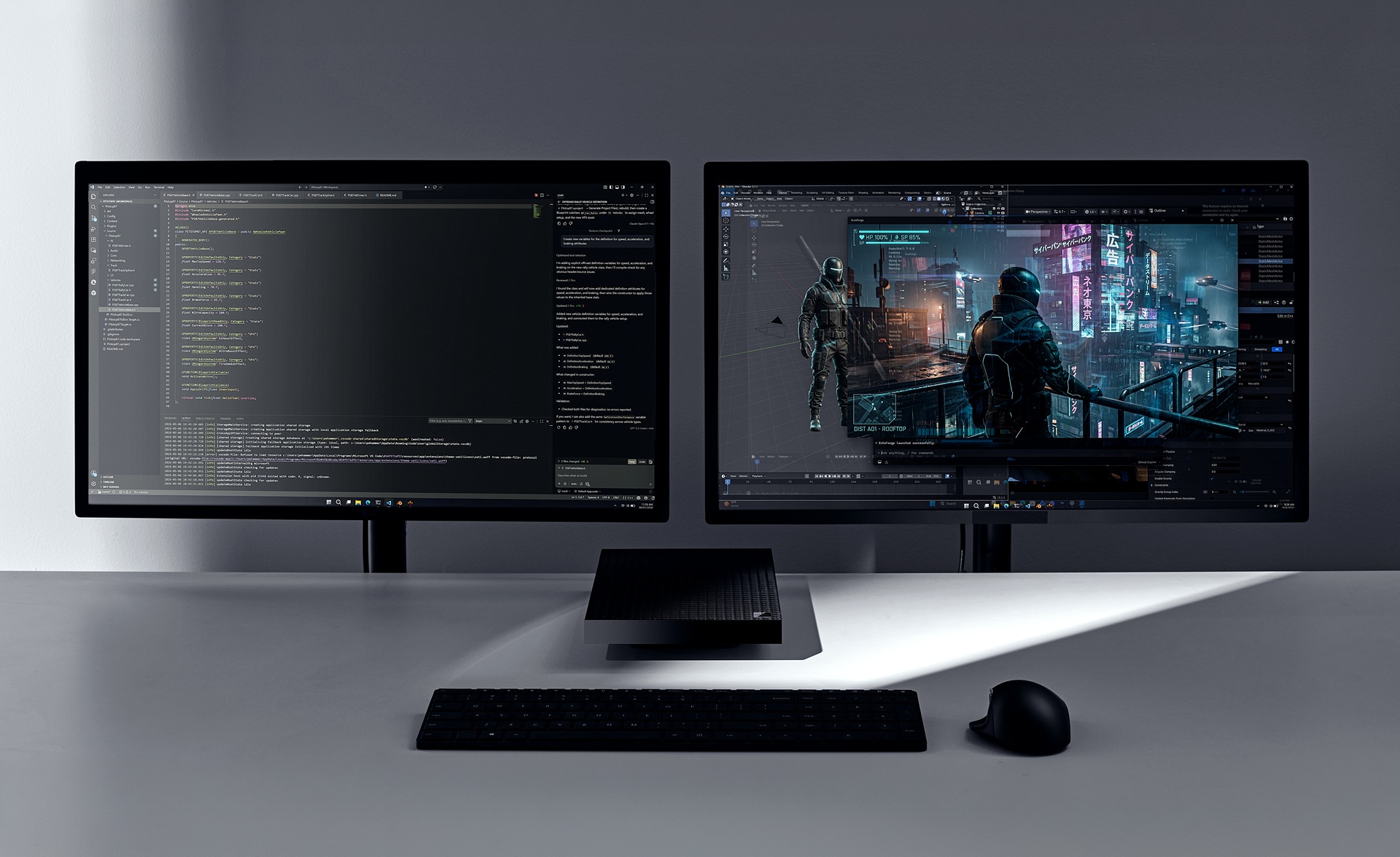
The Surface RTX Spark Dev Box is the desktop sibling to the Surface Laptop Ultra, which took center stage at Microsoft's Windows and Surface event this week, where CEO Satya Nadella and Nvidia CEO Jensen Huang pitched RTX Spark-powered devices for the "agentic Windows" era Microsoft has been promoting all year. The Dev Box itself isn't new—Microsoft unveiled it back in June 2026 at Microsoft Build—but it's part of the same RTX Spark hardware push this week's event reinforced. Where the Laptop Ultra is a portable workstation, the Dev Box is a fixed desktop appliance: no screen, no keyboard, just a compact aluminum box meant to sit between two monitors and do the compute-heavy work of fine-tuning and running local AI models.
Microsoft's own announcement, published on the Windows blog, frames the device plainly as "a purpose-built Windows AI developer box that puts up to 1 petaflop of AI compute directly on the desk." That framing matters: Microsoft is not selling this as a general-purpose mini PC. It is selling it as a local alternative to renting cloud GPU time for model fine-tuning and inference—the same pitch Nvidia makes for its own DGX Spark and the one Apple makes, implicitly, for the Mac Studio.
The RTX Spark chip inside it
Both devices—Microsoft's Dev Box and Nvidia's own DGX Spark—are built around the same silicon: the RTX Spark superchip, which pairs a Blackwell-generation RTX GPU with an Arm-based CPU over Nvidia's NVLink-C2C interconnect. Nvidia's own product page lists the top configuration at up to 6,144 Blackwell CUDA cores and up to a 20-core Arm CPU, alongside 4th-generation RT cores and 5th-generation Tensor cores. That top-tier configuration is the one Microsoft is using in the Dev Box, rather than the smaller 5,120-core, 18-core variant Nvidia also lists for thinner laptops.
Nvidia's page describes RTX Spark as "the most power-efficient RTX chip ever made" and says CUDA "runs natively" on it—a notable detail, since it means the Dev Box can run existing CUDA-based AI tooling without the Arm-vs-x86 compatibility headaches that have dogged other Windows-on-Arm hardware. That compatibility is also why Microsoft is positioning the box specifically at developers rather than general consumers: the value proposition depends on software that already expects an Nvidia GPU and CUDA underneath it.
Memory and AI performance
The headline spec is memory. The Dev Box ships with a fixed 128GB of LPDDR5X, shared between the CPU and GPU rather than split into separate system RAM and VRAM pools. Nvidia's spec page confirms the same ceiling for the top RTX Spark configuration and states that it supports "models up to 120B parameters with 1M context" running locally. Several outlets, including Tom's Hardware, report that roughly 112GB of that pool can be allocated directly to the GPU for model weights, leaving the rest for the CPU and OS—though neither Microsoft's nor Nvidia's own pages spell out that exact split, so treat the 112GB figure as a well-corroborated estimate rather than an official number.
On compute, Nvidia rates the chip at up to 1 petaflop of FP4 AI performance, and Microsoft repeats that figure in its own materials. That number is a theoretical peak using Nvidia's lowest-precision FP4 format with sparsity enabled, the same methodology Nvidia uses to market its other Blackwell-based products, so it is best read as a ceiling rather than a benchmark of real-world throughput on a specific model. Microsoft's pitch is less about raw numbers and more about keeping large models entirely on local hardware: the company says the Dev Box can fine-tune models that previously required a cloud GPU instance, running entirely on a developer's desk.
| Spec | Surface RTX Spark Dev Box |
|---|---|
| Chip | Nvidia RTX Spark superchip |
| CPU cores | Up to 20 Arm cores |
| GPU | Up to 6,144 Blackwell CUDA cores |
| Memory | 128GB LPDDR5X unified (reportedly ~112GB addressable by GPU) |
| AI compute | Up to 1 petaflop (FP4) |
| Local model size | Up to ~120B parameters |
| Thermal design | Up to 100W, aluminum chassis as heatsink |
| Ports | 2x USB-C, 1x USB-A, HDMI, Ethernet, headphone jack |
| OS | Windows 11 Pro, developer-configured image |
| Price | Not announced |
| Availability | Later in 2026, US only, microsoft.com |
Design and cooling
Microsoft gave the Dev Box an unusual two-tier aluminum shell—reviewers have described it as a stepped or "ziggurat" shape, with a wider base layer under a narrower top section. The entire top surface is perforated with what Microsoft says are roughly 1,000 ventilation holes (Tom's Hardware's own count from the press photos came in closer to 840, for what it's worth). The point of the design is thermal: Microsoft is using the solid aluminum body itself as the primary heatsink, rather than relying on a conventional fan-and-heatpipe setup, with air moving through natural convection out the top.
Microsoft rates the system for sustained operation at up to 100W, which the company has described as its first official power guidance for an RTX Spark device, and which sits below the roughly 140W some RTX Spark configurations are rated for at the chip level. That gap suggests the Dev Box is tuned for quieter, sustained desk use rather than squeezing out every available watt—a reasonable tradeoff for a fanless design, though it does mean sustained, maximum-load workloads may run below the chip's theoretical ceiling.
Ports and connectivity
Connectivity is minimal by design. Reporting from the event, corroborated by Microsoft's own images and ServeTheHome's hands-on look at the hardware, lists two USB-C ports, one USB-A port, one HDMI output, one Ethernet jack, and a combined headphone/audio jack—all on the rear of the unit. That is noticeably sparser than Nvidia's own DGX Spark, which adds extra USB-C ports and networking-focused ConnectX-7 QSFP connectors aimed at clustering multiple units together. The Dev Box's port selection signals it is meant to sit as a single desktop unit connected to a monitor, keyboard, and network—not stacked into a multi-node AI cluster the way Nvidia's own hardware can be.
Software that ships preinstalled
Microsoft is pre-loading the Dev Box with what it calls a custom-tuned Windows 11 Pro image rather than a stock install. According to Microsoft's announcement, the box arrives with Visual Studio Code, GitHub Copilot, Git, Python, and Node.js already installed, alongside PowerShell 7 set as the default shell. WSL 2 comes configured out of the box with GPU passthrough and native CUDA support, so developers can run Linux-based AI tooling against the Nvidia GPU without manually wiring up drivers. Microsoft also lists its AI Toolkit for VS Code, Windows ML with TensorRT support, and Microsoft Foundry among the preinstalled stack, plus Secured-core PC protections, BitLocker, and Microsoft Defender, with Entra ID and Intune support for organizations that want to manage fleets of these as developer machines rather than one-off desk toys.
That out-of-the-box configuration is arguably as important to Microsoft's pitch as the silicon itself. The company is explicitly targeting developers who would otherwise spend a day configuring WSL, CUDA drivers, and Python environments before writing a line of model code, and promising that the Dev Box skips that setup entirely.
Price: still not confirmed
Microsoft has not announced a price for the Surface RTX Spark Dev Box. It didn't announce one when it unveiled the device at Build in June, and it still hasn't more than four months later. Every number circulating online right now—including figures in the $3,000 to $3,500 range that some outlets have floated—is speculation based on comparable hardware like Nvidia's own DGX Spark and Apple's Mac Studio, not a figure from Microsoft. Surface chief Andrew Hill has only said Microsoft intends to sell the machine directly to consumers, according to PCWorld's reporting on the announcement; he did not give a number. Readers searching for a confirmed price should treat anything short of an official Microsoft listing as a guess, and we'll update this piece the moment Microsoft publishes one.
Release date and availability
Microsoft says the Surface RTX Spark Dev Box will be available "later this year" in the United States, sold exclusively through microsoft.com—there is no retail or OEM-partner distribution plan announced, and no mention yet of international markets. Microsoft has not published an exact release date, and multiple outlets have noted the device is still pending regulatory certification in the US, which could affect timing. There is currently no public pre-order list; Microsoft's device page only offers a notification sign-up for when it ships.
How it compares to the Mac Studio, DGX Spark, and Ryzen AI PCs
The Dev Box enters a small but increasingly crowded category of desktop boxes built for running AI models locally rather than in the cloud. Apple's Mac Studio has occupied this niche for creative and technical users for years on the strength of its unified memory architecture; we've compared its current M5 Max and M5 Ultra configurations in detail here. Nvidia's own DGX Spark, built on the same RTX Spark silicon, targets a similar audience but leans harder into clustering multiple units for larger workloads via its extra networking ports. And on the Windows side, AMD's Ryzen AI Max platform has already staked out ground in this space, a matchup we broke down in our Ryzen AI Max vs. DGX Spark buying guide.
What differentiates the Dev Box from all three isn't raw performance—on paper, it shares its core chip with Nvidia's own DGX Spark—but the software layer Microsoft is wrapping around it. A developer who wants an RTX Spark machine that behaves like a standard, fully-licensed Windows 11 Pro desktop with CUDA, WSL, and GitHub Copilot ready to go on first boot has a different starting point than one buying Nvidia's own Linux-based DGX OS, or Apple's macOS environment on a Mac Studio.
What's next
The open questions are the ones that actually determine whether this device is a good buy: price, exact ship date, and independent performance testing against real local-AI workloads rather than Nvidia's FP4 peak-compute marketing figure. Microsoft has committed only to "later this year" for US availability through microsoft.com, with no confirmed date, no confirmed price, and no word yet on whether international markets or additional configurations (such as a lower-memory, lower-price tier) are coming. We'll update this article as Microsoft firms up pricing, a ship date, or additional specs, and we'll follow up with hands-on coverage once review units are available.
Frequently asked questions
What is the Surface RTX Spark Dev Box?
It's a compact desktop developer PC from Microsoft built around Nvidia's RTX Spark chip, aimed at running and fine-tuning AI models locally instead of in the cloud. It has no screen or keyboard and is meant to connect to external monitors.
How much does the Surface RTX Spark Dev Box cost?
Microsoft has not announced a price. Some outlets have speculated $3,000 to $3,500 based on comparable hardware like Nvidia's DGX Spark, but that is not an official Microsoft figure.
When does the Surface RTX Spark Dev Box release?
Microsoft says it will be available later in 2026 in the United States, exclusively through microsoft.com. No exact date has been confirmed, and multiple reports say the device is still pending regulatory certification.
What are the Surface RTX Spark Dev Box specs?
It uses Nvidia's RTX Spark superchip with up to 20 Arm CPU cores and up to 6,144 Blackwell CUDA cores, paired with 128GB of LPDDR5X unified memory, up to 1 petaflop of AI compute, and a passive 100W aluminum-chassis cooling design.
Can the Surface RTX Spark Dev Box run large AI models locally?
Yes. Nvidia's own RTX Spark product page says the platform's 128GB of unified memory can run models up to roughly 120 billion parameters with a 1 million token context locally.
How is the Dev Box different from Nvidia's own DGX Spark?
Both use the same RTX Spark chip, but the Dev Box ships with a configured Windows 11 Pro developer image including VS Code, GitHub Copilot, WSL 2 and PowerShell 7, and has fewer ports, while DGX Spark runs Nvidia's own Linux-based OS and adds networking ports for clustering multiple units together.
Sources
- Microsoft Windows Blog: Surface RTX Spark Dev Box announcementblogs.windows.com
- Nvidia: RTX Spark Superchip product pagenvidia.com
- Tom's Hardware: Microsoft debuts Surface RTX Spark Dev Boxtomshardware.com
- ServeTheHome: Microsoft to join the AI dev mini PC marketservethehome.com
- PCWorld: Microsoft's powerful RTX Spark mini PC will be sold to consumerspcworld.com
Mara Lindqvist edits the hardware desk. She covers graphics cards, processors, memory and storage, the foundries and chip designers behind them, and what the numbers on a spec sheet mean for people choosing a PC. Specifications in her stories come from manufacturer spec pages and datasheets.