Intel GPU D270: Specs, Availability and What It's For
Intel's new data-center inference GPU line pairs LPDDR5X memory capacity with a 350-watt, air-cooled PCIe design aimed at AI inference, not gaming.
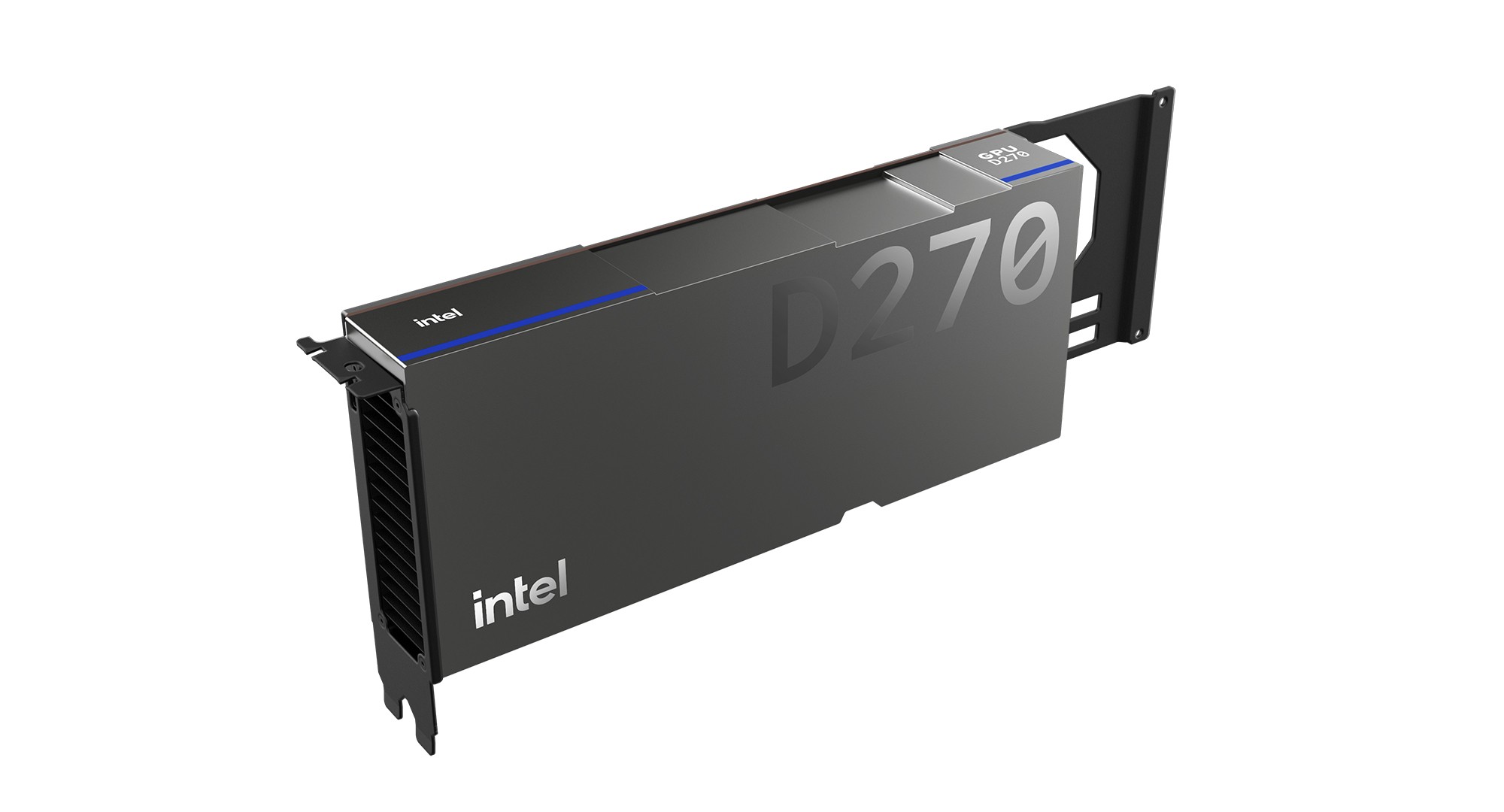
Intel used the Open Compute Project (OCP) Global Summit in San Jose on October 12, 2026, to formally detail its new data-center inference GPU line, the Intel GPU D-series, built around a first model widely reported as the D270. According to Intel's own announcement, the card is built on Intel's Xe3P architecture and combines up to 480 GB of LPDDR5X memory, 1.5 TB/s of memory bandwidth and 1.3 petaflops of FP8 compute inside a 350-watt, air-cooled, standard PCIe card — a deliberately memory-heavy, lower-power design aimed at AI inference rather than gaming or training.
Key facts
- Name: Intel GPU D-series (first model reported as the D270), formerly code-named Crescent Island
- Architecture: Intel Xe3P
- Memory: Intel's own PCIe card ships with 160 GB LPDDR5X; Intel's design lets ODM partners build cards with up to 480 GB
- Bandwidth: 1.5 TB/s
- Compute: 1.3 petaflops of dense FP8
- Power: 350-watt envelope, air-cooled, standard PCIe form factor
- Serving claims: up to 300 billion parameters on one card, over 1 trillion parameters across an 8-GPU system
- Status: customer sampling underway; no general availability date or pricing announced by Intel
What Intel Announced at OCP 2026
The announcement came via a press release titled "Intel Accelerates Open Infrastructure for the Agentic AI Era", published on Intel's newsroom and investor relations site on the first day of the 2026 OCP Global Summit, which ran October 12–15 at the San Jose McEnery Convention Center. Intel is listed as a Diamond sponsor of the event, and the company says it has made 116 contributions to OCP since 2011, including a new one this year to the Open Adapter Card workgroup, which is working on a standardized sub-rack accelerator card form factor.
Two product lines anchored the announcement. The first is the Intel GPU D-series, the production name for the chip Intel had previously code-named Crescent Island and first teased at last year's OCP Summit. The second is a set of new rack designs built around Intel's Xeon 6+ processors, several of which use the Open Compute Project's Open Rack v3 (ORv3) standard. Intel framed both as pieces of a broader "open, heterogeneous AI infrastructure" pitch, pairing general-purpose Xeon compute with purpose-built acceleration for what it calls agentic AI — multi-step inference workflows that involve retrieval, reasoning, orchestration, tool use and execution rather than a single forward pass.
Nicolas Dubé, corporate vice president of Intel's Data Center Systems and Solutions Group, summed up the pitch in Intel's official announcement: "Open models are expanding the options enterprises have for deploying AI. To realize their full potential, organizations need infrastructure that can match different workloads with the right intelligence, right compute resources and right economics. That's what we mean by 'put every prompt in its place.'" Dubé delivered a keynote of the same name on October 13.
Intel GPU D270: Specs and Architecture
Intel's own release does not spell out shader or matrix-engine counts, and it does not use the "D270" model number anywhere in its text — it refers to the product only as "Intel GPU D-series." The D270 name, along with widely circulated figures such as 32 Xe3P cores and 256 XMX matrix engines, comes from trade-press coverage of Intel's briefings and should be treated as reported rather than as Intel's own confirmed figure until Intel publishes a model-level spec sheet.
What Intel does confirm directly: the chip is built on its Xe3P GPU architecture, it ships in a standard PCIe form factor with air cooling, and it runs within a 350-watt power envelope — low enough that it doesn't require the specialized rack power or liquid-cooling infrastructure that denser AI accelerators typically need. Intel also says the card shares a "common Xe software foundation" with the rest of its GPU lineup, so software built for other Intel Xe GPUs should port across with limited rework.
That positioning — conventional PCIe slot, air cooling, no graphics pipeline to speak of — distinguishes the D-series from Intel's consumer and workstation Arc GPUs. Intel has been explicit that this card is not designed for 3D rendering or gaming; every design choice described in its release, from the memory type to the power envelope, points at inference throughput and capacity rather than graphics performance.
Memory and Performance: Why LPDDR5X Instead of HBM
The headline technical choice is memory. Rather than using high-bandwidth memory (HBM) stacks, which dominate on flagship AI training and inference accelerators but are expensive and supply-constrained, Intel built the D-series around LPDDR5X — the memory type more commonly found in laptops and phones. Per Intel's release, its own branded PCIe card carries 160 GB of LPDDR5X, while its board design "enables partners to build ODM-branded cards with flexible options up to 480 GB." That means the 480 GB figure quoted widely in the press refers to the ceiling that Intel's reference design permits partners to build, not necessarily the specification of the card Intel itself ships.
On that memory, Intel states 1.5 TB/s of bandwidth and 1.3 petaflops of dense FP8 compute. Combined, Intel says this lets a single D-series card serve models with up to 300 billion parameters, and lets an eight-GPU system serve more than 1 trillion parameters. Intel positions this explicitly for "large language models, long-context workloads and concurrent inference services," with target applications spanning multi-tenant AI serving to robotics and other latency-sensitive workloads. Intel has not published independent benchmark results alongside these figures, and this article does not add any — the parameter-count and throughput claims above are Intel's own, not third-party measurements.
The logic is a bet on capacity and cost per deployed gigabyte over raw peak throughput: more memory per card means fewer cards (and less networking and power overhead) are needed to hold a given model in memory for inference, even if each card's compute ceiling is lower than a flagship training chip's.
How It Compares to Nvidia and AMD's Inference Accelerators
Intel is not claiming to match the flagship accelerators that Nvidia and AMD sell for the largest AI training and inference clusters, and nothing in Intel's release suggests otherwise. The comparison that matters is architectural, not a benchmark-for-benchmark one.
Nvidia's current data-center GPU generation, marketed under the Rubin platform, is built around high-bandwidth memory (HBM) and is designed into dense, liquid-cooled rack-scale systems such as the DGX Rubin NVL8 — Nvidia's own materials describe that system as built for training, post-training and inference together. AMD's Instinct accelerator family is likewise built on HBM memory, paired with AMD's CDNA architecture and Infinity Fabric interconnects, according to AMD's own product page. Both approaches favor maximum bandwidth and compute density, at the cost of higher power draw per card and a dependency on liquid cooling and specialized rack infrastructure at scale.
Intel's D-series takes the opposite trade-off: ordinary LPDDR5X memory instead of HBM, a 350-watt envelope that fits in standard air-cooled servers, and a single PCIe card rather than a tightly coupled multi-GPU module. The result, by Intel's own account, is lower peak compute than flagship HBM-based accelerators, but higher memory capacity per card at a lower power and infrastructure cost — a pitch aimed squarely at inference and serving workloads rather than at training the largest frontier models. Pandromeda previously covered how Nvidia opened its Vera Rubin rack architecture to the industry via OCP, which is a useful point of contrast: Nvidia and AMD are scaling up rack-level, liquid-cooled systems, while Intel's pitch here is explicitly about avoiding that infrastructure overhead.
Xeon 6+ Racks: The CPU Half of the Pitch
Intel paired the GPU announcement with new Xeon-based rack designs built with ecosystem partners. The company says select Xeon 6+ configurations "scale beyond 46,000 cores per rack at 133.45 kW total rack power," and that many of these designs use the Open Compute Project's Open Rack v3 (ORv3) standard to simplify integration into existing open data-center infrastructure.
Intel's argument is that as inference work shifts from single forward passes to "agentic" workflows — retrieval, reasoning, tool use, orchestration — general-purpose CPU compute becomes more important, not less, because something has to orchestrate those steps, manage I/O and keep accelerators fed with work. Anil Nanduri, vice president of AI Products and GTM for Intel's Data Center Group, framed the GPU piece of that pitch directly: "Inference is becoming the defining AI workload, and enterprises need infrastructure that delivers the right performance at the right cost. With Intel GPU D-series, we're focused on making high-capacity inference practical to deploy and economical to scale."
| Spec | Intel GPU D-series (per Intel's Oct. 12, 2026 release) |
|---|---|
| Architecture | Intel Xe3P |
| Code name | Crescent Island |
| Reported model name | D270 (reported by trade press; not named in Intel's release) |
| Memory type | LPDDR5X |
| Memory (Intel reference card) | 160 GB |
| Memory (partner ODM boards) | Up to 480 GB |
| Memory bandwidth | 1.5 TB/s |
| Compute (dense FP8) | 1.3 petaflops |
| Power envelope | 350 W |
| Form factor / cooling | Standard PCIe card, air-cooled |
| Single-card model capacity | Up to 300 billion parameters |
| 8-GPU system model capacity | More than 1 trillion parameters |
| Status (as of Oct. 17, 2026) | Customer sampling underway; no GA date or price announced |
OEM Partners and Availability Timeline
Intel's release says it is "collaborating with a broad ecosystem of OEMs, ODMs, neoclouds, independent software vendors, appliance providers and AI-native companies" to bring the D-series to production, but it does not name any specific partner companies in the text. Several trade outlets covering the briefing have reported that server makers including Dell, HPE, Lenovo, Supermicro and ASUS are among the companies receiving early D-series samples; Intel's own release does not confirm this list by name, so it should be read as reported rather than as an Intel-confirmed partner roster.
On timing, Intel's release states only that "customer sampling" is underway as of October 12, 2026 — it gives no general-availability date and no pricing. Press coverage of Intel's briefings has suggested broader availability is being targeted for 2027, but that date does not appear in Intel's own press materials and should likewise be treated as a reported target rather than a confirmed roadmap commitment. Intel previously said, when it first revealed the Crescent Island project at the 2025 OCP Summit, that customer sampling was expected in the second half of 2026 — a target the October 2026 announcement appears to be fulfilling on schedule.
Intel is also using the launch to push its software story: the release highlights "Day 0" support work for emerging open models, citing Meta's Muse Glimmer model as a recent example, and points to its AI for Enterprise Agent Toolkit — already deployable on Xeon processors — as a foundation it plans to extend to the new GPUs.
Why It Matters for the AI Infrastructure Market
The inference side of the AI infrastructure market has become its own distinct battleground, separate from the race to build ever-larger training clusters. As more enterprises deploy open-weight models rather than renting access to a single frontier model, the cost of simply holding those models in GPU memory and serving many concurrent requests against them has become a real bottleneck — one shaped as much by memory capacity and power budgets as by raw floating-point throughput.
Intel's bet with the D-series is that a large slice of that market doesn't need — and can't afford, in power or capital terms — the liquid-cooled, HBM-based accelerators built for frontier-model training. By targeting a standard air-cooled server slot, a 350-watt budget and commodity LPDDR5X memory, Intel is trying to make a case on total cost of ownership and deployment simplicity rather than peak performance, while leaning on the same kind of purpose-built silicon approach Pandromeda has covered elsewhere, including in explaining what dedicated AI accelerator hardware like NPUs actually does. Whether that bet pays off depends heavily on two things Intel hasn't yet disclosed: price, and real-world, independently verified inference performance once the hardware ships in volume.
What Happens Next
For now, the Intel GPU D-series exists as a disclosed set of specifications and a sampling program, not a shipping, purchasable product. The near-term milestones to watch are: independent benchmark results once sampling partners can publish them, an official Intel model-level spec sheet (which would confirm or correct the D270 naming and core counts currently circulating only in trade press), a firm general-availability date, and pricing. Intel's own messaging points to 2027 as the likely window for broader availability, based on the cadence of its sampling disclosures, but the company has not committed to a specific date in its public materials as of this writing. Pandromeda will update this story as Intel publishes additional product-level documentation or confirms a launch date and price.
Frequently asked questions
What is the Intel GPU D-series?
The Intel GPU D-series is Intel's new line of data-center GPUs built for AI inference, announced at the OCP Global Summit on October 12, 2026. It was previously known by the code name Crescent Island and is built on Intel's Xe3P architecture, combining up to 480GB of LPDDR5X memory with 1.5TB/s of bandwidth and 1.3 petaflops of FP8 compute in a 350-watt, air-cooled PCIe card.
What is the Intel GPU D270?
The D270 is the name widely reported by trade press for the first model in Intel's GPU D-series. Intel's own October 12, 2026 press release does not use the model number D270, referring to the product only as the Intel GPU D-series, so the specific name should be treated as reported rather than officially confirmed until Intel publishes model-level documentation.
How much memory does the Intel GPU D-series have?
Per Intel's own announcement, Intel's branded PCIe card carries 160GB of LPDDR5X memory, while Intel's board design allows partners to build ODM-branded cards with up to 480GB. The 480GB figure reported in the press refers to that partner-card ceiling, not necessarily Intel's own shipping configuration.
Is the Intel GPU D-series for gaming?
No. Intel has positioned the D-series purely as a data-center inference accelerator, not a graphics or gaming GPU. It is designed for serving large language models, long-context workloads and concurrent inference services, with no indication of a dedicated 3D graphics pipeline.
When will the Intel GPU D-series be available?
Intel's own release says customer sampling with OEMs, ODMs, neoclouds and software partners is underway as of October 12, 2026, but it does not give a general-availability date or pricing. Press coverage has reported broader availability is being targeted for 2027, though that date has not been confirmed in Intel's own materials.
How does the Intel GPU D-series compare to Nvidia and AMD accelerators?
Nvidia's Rubin platform and AMD's Instinct accelerators are both built around high-bandwidth memory (HBM) and are typically deployed in liquid-cooled, multi-GPU rack systems. Intel's D-series instead uses LPDDR5X memory in a single air-cooled PCIe card within a 350-watt envelope, trading some peak compute for lower power, simpler deployment and high memory capacity per card.
Sources
- Intel Newsroom: Intel Accelerates Open Infrastructure for the Agentic AI Era (Oct. 12, 2026)intel.com
- Intel Investor Relations: official press release textintc.com
- Open Compute Project: 2026 OCP Global Summit event pageopencompute.org
- Intel Newsroom: Intel to Expand AI Accelerator Portfolio with New GPU (Oct. 14, 2025)intel.com
- Nvidia: Rubin data-center GPU platformnvidia.com
- AMD: Instinct accelerators product pageamd.com
Mara Lindqvist edits the hardware desk. She covers graphics cards, processors, memory and storage, the foundries and chip designers behind them, and what the numbers on a spec sheet mean for people choosing a PC. Specifications in her stories come from manufacturer spec pages and datasheets.