AMD MI450 vs Nvidia Vera Rubin: What's Actually Confirmed
AMD confirmed 432GB HBM4 and 20 TB/s on MI450; Nvidia confirmed 50 petaflops and NVLink 6 on Rubin. Here is what both companies have verified versus what is still rumor.
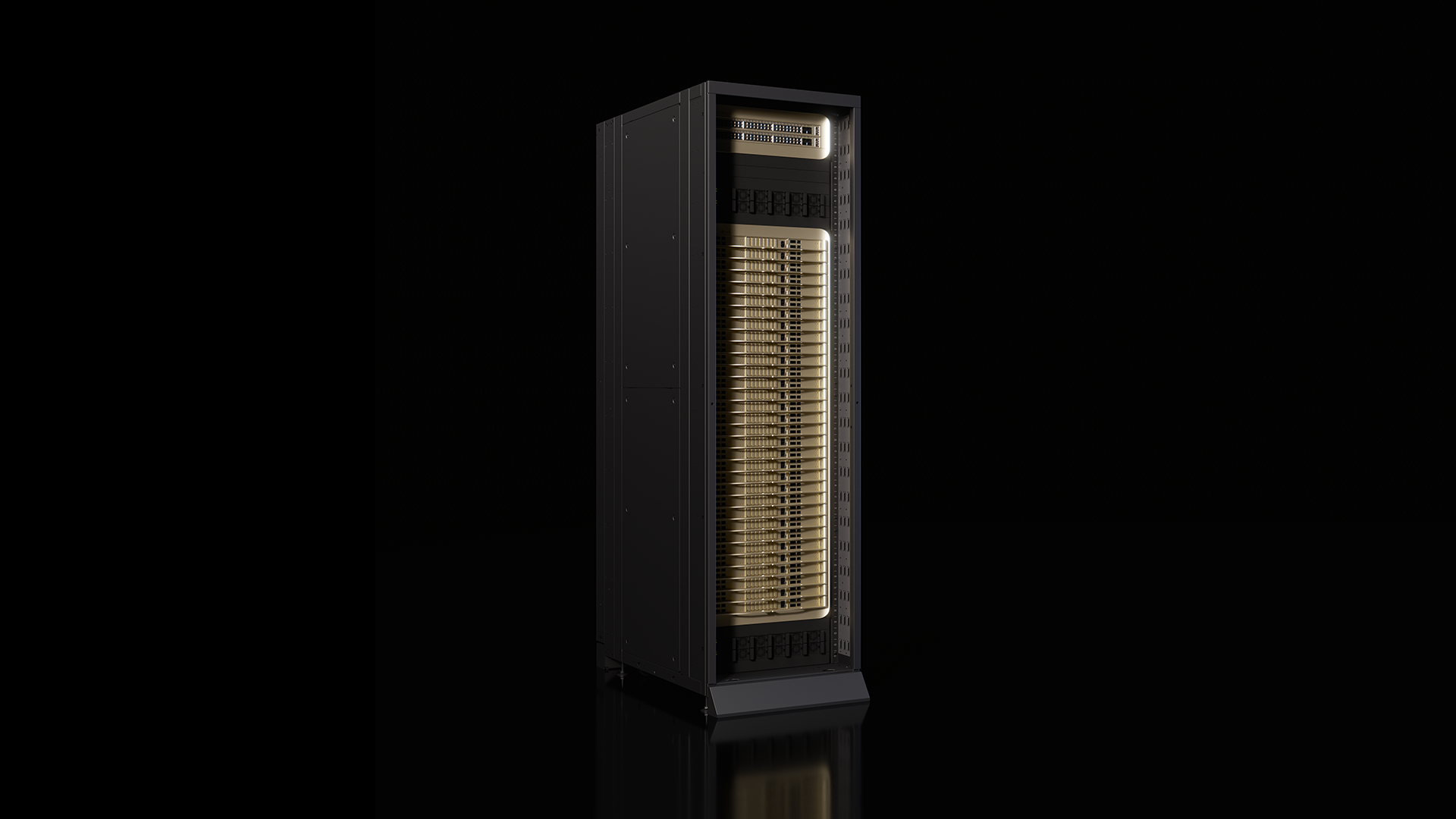
AMD's Instinct MI450 and Nvidia's Vera Rubin platform have never been directly compared on this site before, and head-to-head, the honest answer is: both companies have officially confirmed real numbers for memory, bandwidth, and rack-scale design, but the FLOPS figures, transistor counts, and exact memory specs that fuel most "who wins" headlines are still leaks, analyst estimates, or AMD/Nvidia marketing claims rather than independently verified benchmarks. Here's what AMD and Nvidia have actually put their names to, and what's still rumor.
- Confirmed (AMD): MI450 GPU with up to 432GB HBM4 and 20 TB/s memory bandwidth; 72-GPU liquid-cooled "Helios" racks; Oracle committing to 50,000 MI450 GPUs starting Q3 2026.
- Confirmed (Nvidia): Rubin GPU at 50 petaflops NVFP4 inference compute with 3.6 TB/s NVLink 6 per GPU; Vera CPU with 88 Arm "Olympus" cores; NVL72 racks pairing 72 Rubin GPUs with 36 Vera CPUs; Vera Rubin NVL72 generally available on Oracle Cloud Infrastructure as of October 27, 2026.
- Still rumored: Rubin's exact HBM4 capacity (widely reported as 288GB per GPU, unconfirmed by Nvidia), Rubin's transistor count (~336 billion, from leaked teardown estimates), and most head-to-head FLOPS comparisons between the two chips.
What AMD and Nvidia Have Actually Confirmed
Both companies are racing to ship next-generation AI accelerators in the second half of 2026, and both have gone public with real customers and real numbers — just not the same numbers. AMD's confirmed figures come from its own investor-relations and newsroom releases tied to specific deals, chiefly the October 2025 Oracle supercluster announcement and the October 2026 expanded Meta partnership. Nvidia's confirmed figures come from its January 2026 CES unveiling of the six-chip Rubin platform, its May 2026 "full production" announcement, and the October 2026 Oracle Cloud Infrastructure general-availability release. Neither company has published a formal side-by-side spec sheet against the other, which is exactly why most "MI450 vs Vera Rubin" chatter online leans on supply-chain leaks to fill the gaps.
AMD Instinct MI450: Confirmed Specs and the Helios Rack
AMD's clearest official numbers for the MI450 Series GPU come from its October 14, 2025 newsroom announcement with Oracle. That release states each MI450 Series GPU offers up to 432GB of HBM4 memory and 20 TB/s of memory bandwidth, enough, AMD says, for customers to "train and infer models that are 50 percent larger than previous generations entirely in-memory." AMD also confirmed its "Helios" rack design packs 72 GPUs per rack in a dense, liquid-cooled, double-wide enclosure built around Meta's Open Rack Wide (ORW) standard, with each GPU able to pair with up to three 800 Gbps AMD Pensando "Vulcano" AI NICs for scale-out networking.
On the customer side, Oracle committed to an initial deployment of 50,000 AMD Instinct MI450 Series GPUs starting in Q3 2026, as the first hyperscaler offering a publicly available MI450-based AI supercluster. AMD's more recent expanded Meta partnership, detailed in an AMD investor-relations release dated October 27, 2026, confirms that Meta was an "early definition customer" for the MI450 architecture, that Helios racks are already installed and being tested at Meta, and that a broader rollout is coming "in the near future" — though AMD gave no new GPU count or date for that expansion. Notably, that release gives zero new numeric specs for MI450 itself; it's a customer and investment update, not a spec sheet.
What AMD has not officially confirmed: FP4 or FP8 FLOPS figures for MI450. Numbers like 40 petaflops FP4 and 20 petaflops FP8 per GPU circulate widely in supply-chain and analyst coverage, and some outlets use the name "MI455X" for the specific Helios-bound SKU rather than "MI450" — but AMD's own press materials for the Oracle and Meta deals consistently use "MI450 Series" without those FLOPS figures. Treat the compute-throughput numbers as industry estimates until AMD publishes them directly.
Nvidia Vera Rubin: Confirmed Specs and the NVL72 Rack
Nvidia's firmest numbers come from its January 5, 2026 CES announcement unveiling the six-chip Rubin platform: the Vera CPU, Rubin GPU, NVLink 6 switch, ConnectX-9 SuperNIC, BlueField-4 DPU, and Spectrum-6 Ethernet switch. Nvidia confirmed the Rubin GPU delivers 50 petaflops of NVFP4 compute for AI inference, built around a third-generation Transformer Engine, and that each GPU carries 3.6 TB/s of sixth-generation NVLink bandwidth. The Vera CPU was confirmed at 88 custom "Olympus" Arm cores with full Armv9.2 compatibility and NVLink-C2C connectivity to the GPU side.
At rack scale, Nvidia's own materials describe the Vera Rubin NVL72 as combining 72 Rubin GPUs with 36 Vera CPUs, connected over NVLink, as part of a broader five-rack "AI factory" architecture that also includes Nvidia's Groq 3 LPU/LPX, BlueField-4 storage racks, and Spectrum-6 Ethernet racks. Nvidia's May 31, 2026 announcement confirmed the platform was "ramping into full production," with production shipments beginning "this fall," and named a long list of system builders — including Dell, HPE, Lenovo, Supermicro, Foxconn, and Wistron — as already in full-scale production of Vera Rubin hardware.
The most concrete deployment milestone is Nvidia and Oracle's October 27, 2026 announcement that Vera Rubin NVL72 systems and Vera CPUs are now generally available on Oracle Cloud Infrastructure, with OpenAI named as an early-access customer for Vera CPUs on OCI. Oracle and Nvidia also confirmed plans to expand OCI's Vera Rubin superclusters to "multi-gigawatt scale," though no capacity figure, timetable, or price was disclosed for that expansion — it is a stated intention, not a shipped product.
What Nvidia has not officially confirmed in the releases reviewed here: HBM4 capacity per Rubin GPU, HBM4 bandwidth, and transistor count. The widely cited 288GB-per-GPU figure and bandwidth numbers in the 19–22 TB/s range come from industry analysts and supply-chain coverage reconstructing Nvidia's product pages, not from Nvidia's press releases themselves — and those secondary reports don't even agree with each other on the exact bandwidth number, which is itself a sign the figure hasn't been locked down publicly.
Side-by-Side: AMD MI450 vs Nvidia Vera Rubin
The table below marks every cell as either officially confirmed by AMD or Nvidia, or (rumored) where it comes from analyst estimates, supply-chain leaks, or unofficial teardown reports. Where AMD and Nvidia measure different things (AMD publishes raw memory bandwidth; Nvidia publishes compute throughput) the gap in the table reflects what each company chose to disclose, not a missing advantage.
| Spec | AMD Instinct MI450 | Nvidia Rubin (Vera Rubin) |
|---|---|---|
| Memory type | HBM4 (confirmed) | HBM4 (confirmed as memory type; capacity unconfirmed) |
| Memory capacity per GPU | Up to 432GB (confirmed, AMD newsroom) | ~288GB (rumored — not in Nvidia's releases) |
| Memory bandwidth per GPU | 20 TB/s (confirmed, AMD newsroom) | 19–22 TB/s (rumored, figures vary by source) |
| GPU-to-GPU interconnect | Not disclosed in official releases reviewed | NVLink 6, 3.6 TB/s per GPU (confirmed) |
| Headline compute figure | ~40 PFLOPS FP4 (rumored, supply-chain estimate) | 50 PFLOPS NVFP4 inference (confirmed) |
| CPU partner | EPYC "Venice" (6th Gen), confirmed as Meta's lead CPU | Vera CPU, 88 Arm "Olympus" cores (confirmed) |
| Rack configuration | 72 GPUs per "Helios" rack (confirmed) | 72 Rubin GPUs + 36 Vera CPUs per NVL72 rack (confirmed) |
| Transistor count | Not disclosed | ~336 billion (rumored, teardown/analyst estimate) |
| Named launch customer | Oracle: 50,000 GPUs from Q3 2026 (confirmed) | Oracle: NVL72 + Vera CPU GA Oct. 27, 2026 (confirmed) |
| Status as of Nov. 2026 | Sampling to customers; Helios running at Meta; broad shipments H2 2026 (confirmed) | Full production since May 2026; shipping to OCI and system-builder partners (confirmed) |
What's Still Rumored or Unconfirmed
Three categories of claims around this matchup are not yet nailed down by either company's own statements:
- Head-to-head FLOPS comparisons. Nvidia has published a FP4 inference figure for Rubin (50 petaflops); AMD has not published an equivalent figure for MI450 in the releases checked for this piece. Any chart online putting AMD's number next to Nvidia's is filling in AMD's side with a leaked or estimated figure, commonly cited around 40 petaflops FP4 by supply-chain analysts — treat that comparison as directional, not verified.
- Rubin's memory specs. The 288GB HBM4 and roughly 22 TB/s bandwidth figures that populate most spec-comparison charts trace back to industry teardown and supply-chain reporting, not an Nvidia press release. Some of that secondary coverage even reports the figures shifting between archived versions of Nvidia's own product pages (one report cites a drop from 22 TB/s to 19.2 TB/s bandwidth), which is itself a sign these numbers aren't finalized publicly.
- Product naming overlap. Some supply-chain coverage refers to the Helios-bound AMD part as "MI455X" rather than "MI450," while AMD's own Oracle and Meta press releases consistently say "MI450 Series." Until AMD clarifies the naming on the record, treat "MI450" and "MI455X" references in third-party coverage as describing the same Helios-generation accelerator family.
Customers and Deployment Commitments
Both chips already have named hyperscale customers attached to real numbers, which is unusual for products this early in their ramp. AMD's confirmed anchor customer is Oracle, with 50,000 MI450 GPUs committed starting Q3 2026, plus Meta as an "early definition customer" running Helios racks in test deployment today. Nvidia's confirmed anchor customer for this specific platform generation is also Oracle, which brought Vera Rubin NVL72 and Vera CPUs to general availability on Oracle Cloud Infrastructure on October 27, 2026, with OpenAI named as an early-access Vera CPU user. Nvidia additionally lists a long roster of system-building partners — Dell, HPE, Lenovo, Supermicro, Foxconn, Wistron, and others — as already in full-scale Vera Rubin production, a breadth of named integrator partners AMD's Helios releases don't yet match in official text.
Oracle backing both platforms is worth sitting with for a moment: the same hyperscaler has publicly committed to tens of thousands of MI450 GPUs and to general availability of Vera Rubin NVL72, which suggests Oracle's AI infrastructure build-out is multi-vendor rather than a bet on one architecture — a pattern increasingly common across hyperscalers weighing supply risk alongside raw performance.
Shipping Timelines: Who Ships First
On paper, Nvidia currently has the lead in confirmed shipping status. Nvidia said Vera Rubin reached "full production" on May 31, 2026, with production shipments beginning that fall, and by October 27, 2026 the platform was generally available to Oracle Cloud customers. AMD's MI450 timeline, per its own releases, has Oracle's 50,000-GPU supercluster beginning in Q3 2026, with Meta's Helios racks described as "installed and being tested" as of the October 27, 2026 update — language that stops short of the "generally available" status Nvidia claimed for Rubin on the same day. Both companies describe further scale-up (AMD's "near future" Meta expansion, Nvidia and Oracle's "multi-gigawatt scale" Supercluster plan) without committing to dates or GPU counts, so neither company's next milestone has a confirmed deadline yet.
Performance Claims in Context
Both companies have made comparative performance claims, but they're comparing to their own prior generation, not to each other. Nvidia says the full Vera Rubin platform delivers "10x agent throughput at scale" versus its previous-generation Grace Blackwell platform, and a separate Nvidia blog post on the Vera CPU specifically claims up to 1.6x more AI agents per watt and 2x faster agent speed than "the fastest/most efficient x86 CPU" in internal comparisons — those are Nvidia's own benchmarking claims, not independently verified third-party results. AMD's public Oracle and Meta materials don't include an equivalent generation-over-generation performance multiplier for MI450 against MI355X or MI300X; any "10x" figures connecting MI450 to older AMD chips that circulate online come from event commentary and analyst coverage rather than the newsroom releases checked for this piece. Readers comparing "AMD says Nx faster" to "Nvidia says Nx faster" should note neither number is an apples-to-apples third-party benchmark against the competing chip.
Which Chip Matters More, and For Whom
For buyers choosing between Helios-based MI450 clusters and Vera Rubin NVL72 racks today, the confirmed facts point to a few practical differences rather than a single winner. AMD's confirmed 432GB-per-GPU memory capacity is the largest number either company has put in writing, which matters most for training or serving unusually large models in-memory — AMD explicitly frames this as enabling models "50 percent larger" than prior-generation hardware. Nvidia's confirmed 50-petaflops NVFP4 inference figure, paired with the breadth of system-builder partners already shipping Vera Rubin hardware and Oracle's immediate general availability, points to a platform further along in ecosystem readiness as of this moment. Buyers prioritizing memory headroom per GPU have AMD's number in hand; buyers prioritizing documented inference throughput and being able to buy a rack today have Nvidia's. Everything past that — which chip is "faster" in a true head-to-head, which has better power efficiency, which wins on cost per token — remains unverified by either company against the other's hardware, as of this writing.
What's Next
Watch for three things to move this comparison from "partially confirmed" to fully resolved: AMD publishing official FP4/FP8 throughput figures for MI450 (likely tied to its next earnings call or a dedicated Advancing AI update), Nvidia confirming exact HBM4 capacity and bandwidth for Rubin on its own product pages rather than leaving those numbers to third-party teardowns, and either company publishing — or a neutral party running — a direct head-to-head benchmark rather than generation-over-generation claims against their own prior chips. Until then, both sets of confirmed numbers above are real, but they're not yet comparable in the way most "MI450 vs Vera Rubin" headlines imply. A useful parallel is the ongoing uncertainty around next-generation CPU platforms covered in AMD's own roadmap disclosures around its 6th Gen EPYC "Venice" silicon, which — like Rubin's memory specs — is still filling in some of its own numbers as 2026 progresses, built on the same leading-edge TSMC manufacturing capacity that both AMD and Nvidia depend on for these chips.
Frequently asked questions
Is AMD's Instinct MI450 officially released yet?
Not broadly. AMD has confirmed MI450 is sampling to customers, with Oracle committed to an initial 50,000-GPU supercluster starting Q3 2026 and Meta running Helios racks in test deployment as of AMD's October 27, 2026 update, per AMD's own newsroom and investor-relations releases.
What memory does the AMD MI450 have, officially?
AMD's newsroom confirms up to 432GB of HBM4 per GPU with 20 TB/s of memory bandwidth, announced alongside its October 2025 Oracle supercluster deal.
Is Nvidia's Vera Rubin shipping yet?
Yes, at least to Oracle. Nvidia and Oracle confirmed Vera Rubin NVL72 and Vera CPU general availability on Oracle Cloud Infrastructure on October 27, 2026, after Nvidia said the platform reached full production in May 2026.
Does Nvidia's Rubin GPU really have 288GB of HBM4?
That specific figure is not in Nvidia's own press releases reviewed for this piece. It is a widely repeated analyst and supply-chain estimate; Nvidia has officially confirmed Rubin uses HBM4 memory and delivers 50 petaflops of NVFP4 compute, but has not published a per-GPU memory capacity number in those releases.
Which chip has more confirmed memory bandwidth, MI450 or Rubin?
AMD has published a firm number for MI450: 20 TB/s per GPU. Nvidia has not published an equivalent HBM4 bandwidth figure for Rubin in its own releases; the 19-22 TB/s range cited online comes from secondary, non-Nvidia sources.
Are MI450 and Vera Rubin aimed at the same customers?
There is overlap. Oracle has committed to both an MI450-based supercluster and Vera Rubin NVL72 general availability, suggesting hyperscalers are building multi-vendor AI infrastructure rather than standardizing on a single chipmaker.
Sources
- AMD Newsroom: Oracle, AMD Expand Partnership to Help Customers Achieve Next-Gen AI Scalenewsroom.amd.com
- AMD Investor Relations: AMD and Meta Advance Strategic Partnership to Power Meta's Superintelligence Infrastructureir.amd.com
- NVIDIA Investor Relations: NVIDIA Kicks Off the Next Generation of AI With Rubininvestor.nvidia.com
- NVIDIA Newsroom: Vera Rubin Ramps Into Full Production to Power Agentic AI Factories Worldwidenvidianews.nvidia.com
- NVIDIA Investor Relations: NVIDIA and Oracle Expand NVIDIA Vera Rubin to Multi-Gigawatt Scaleinvestor.nvidia.com
- NVIDIA Blog: Vera Delivers the Best of Both Worldsblogs.nvidia.com
Mara Lindqvist edits the hardware desk. She covers graphics cards, processors, memory and storage, the foundries and chip designers behind them, and what the numbers on a spec sheet mean for people choosing a PC. Specifications in her stories come from manufacturer spec pages and datasheets.