Samsung Q3 2026 Earnings: Record $80B Profit Confirmed
Samsung's final Q3 2026 results confirm the record $80B operating profit it guided on Oct. 8 — with the memory chip division alone generating 99% of it.
Samsung Electronics confirmed on October 29 that its third-quarter 2026 operating profit came in at KRW 107.4 trillion (roughly $80 billion), landing almost exactly on the preliminary guidance it issued three weeks earlier and making Samsung, in the company's own words, "the world's first tech company to exceed KRW 100 trillion in quarterly operating profit." Consolidated revenue reached KRW 195.3 trillion, another all-time high, up 14% from the second quarter.
The full release, which Samsung's October 8 guidance did not include, shows the quarter was carried almost entirely by one business. The Device Solutions (DS) semiconductor division alone posted KRW 106.5 trillion in operating profit — about 99% of the company's total — as the Memory Business set record quarterly revenue and profit on DRAM, NAND and HBM4 sales for AI servers. Nearly everywhere else, including mobile, TV and appliances, Samsung lost money in the quarter.
Samsung's Final Q3 2026 Numbers, Confirmed
Samsung's newsroom release states the headline figures plainly: consolidated revenue of KRW 195.3 trillion and consolidated operating profit of KRW 107.4 trillion for the quarter ended September 30, 2026. Both are quarterly records for the company. Operating profit is up roughly 780% from the KRW 12.2 trillion Samsung reported for the third quarter of 2025, when the memory market was still recovering from its downturn.
Unlike the October 8 announcement, which Samsung issues under Korean disclosure rules before its external audit is complete and without a division-level breakdown, the October 29 release is the full, audited-basis earnings report, delivered alongside Samsung's quarterly earnings call and by-division commentary on the quarter ahead.
- Consolidated revenue: KRW 195.3 trillion, up 14% quarter-on-quarter
- Consolidated operating profit: KRW 107.4 trillion, a company record
- DS (chip) Division operating profit: KRW 106.5 trillion — about 99% of total profit
- DX Division (mobile, TV, appliances): combined operating loss of KRW 0.8 trillion
- Samsung Display (SDC): KRW 1.1 trillion operating profit
- Q3 capital expenditure: KRW 29 trillion; Q3 dividend: KRW 30 trillion
Guidance vs. Actual: What Changed Since October 8
Samsung's October 8 pre-earnings guidance, filed with its investor relations disclosures, projected consolidated sales of approximately KRW 195 trillion and operating profit of approximately KRW 107.4 trillion, with Samsung noting at the time that Korean disclosure rules do not allow the company to publish those estimates as a range, only as a single midpoint figure, and that the numbers were issued before its external audit was finished.
Three weeks later, the audited, final numbers landed essentially on top of that guidance — a rare case of a preliminary estimate holding up almost exactly once the books were closed. What the October 8 release could not show, because Samsung does not break out business-unit results in preliminary guidance, is how lopsided the profit mix actually was.
| Metric | Oct. 8 preliminary guidance | Oct. 29 final results |
|---|---|---|
| Consolidated revenue | ~KRW 195 trillion | KRW 195.3 trillion |
| Consolidated operating profit | ~KRW 107.4 trillion | KRW 107.4 trillion |
| DS Division revenue | Not disclosed | KRW 147.1 trillion |
| DS Division operating profit | Not disclosed | KRW 106.5 trillion |
| DX Division result | Not disclosed | Operating loss of KRW 0.8 trillion |
| Samsung Display (SDC) operating profit | Not disclosed | KRW 1.1 trillion |
| Q3 dividend | Not disclosed | KRW 30 trillion (KRW 4,601/share) |
The Memory Business Generated Almost the Entire Profit
Per Samsung's release, the DS Division posted KRW 147.1 trillion in consolidated revenue and KRW 106.5 trillion in operating profit for the quarter, a 15% quarter-on-quarter sales increase. Within DS, Samsung said its Memory Business "achieved another record-breaking quarter by managing its product mix, with a focus on AI products, amid capacity constraints," with "strong demand momentum for servers" pushing market prices higher "across all applications" — DRAM and NAND alike.
Samsung's own wording leaves little ambiguity about the driver: continued, robust AI-application demand, with the company saying it "significantly scaled up sales of HBM4 on the back of industry-leading product competitiveness while proactively addressing growing demand for server SSDs." For context, the chip division's KRW 106.5 trillion in operating profit is nearly nine times what the entire company earned in the third quarter of 2025.
HBM4 and the Nvidia Vera Rubin Connection
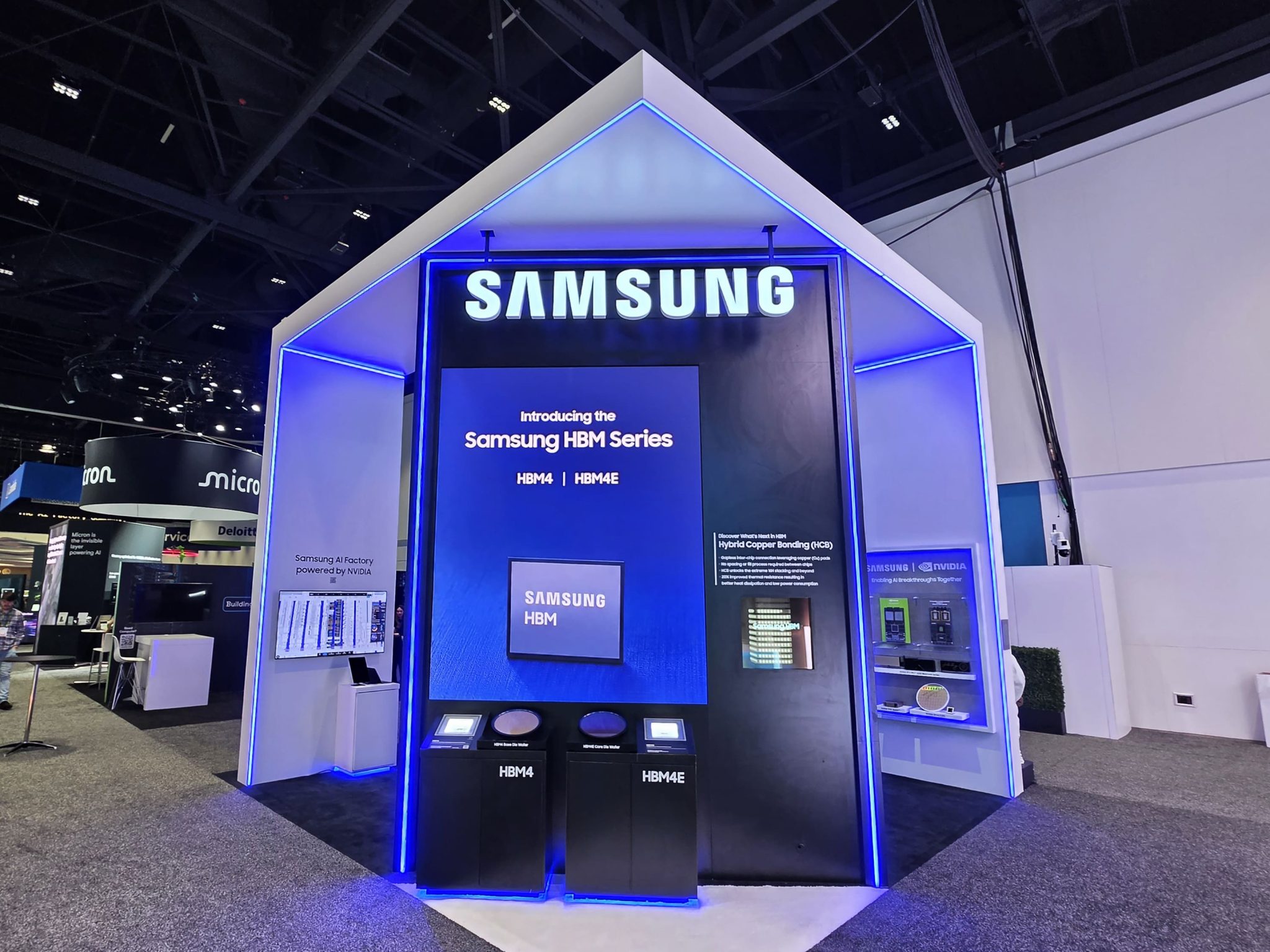
Samsung's Q3 earnings release does not name specific customers, but the company's own semiconductor newsroom has been explicit about where its sixth-generation HBM4 is headed. At NVIDIA's GTC 2026 conference, Samsung Semiconductor said its HBM4 is "now in mass production and is designed for the NVIDIA Vera Rubin platform," delivering processing speeds of 11.7 gigabits per second — above the 8Gbps industry standard — and showcased its next-generation HBM4E, rated at 16Gbps per pin and 4.0 terabytes per second of bandwidth, for Vera Rubin's eventual successor.
That HBM4 ramp lines up directly with what Samsung described in its Q3 results: a memory business prioritizing AI-application products even "amid capacity constraints," and a Q4 2026 outlook built around "new CPU and GPU platform-related products." Samsung said it plans to keep growing HBM, server DRAM and SSD sales into 2027, when it expects "AI infrastructure capital expenditure to reach a historic level as the AI ecosystem expands" and AI-driven demand to "far exceed the industry supply" versus 2026.
Foundry, System LSI and Samsung Display
The rest of the DS Division also improved. Samsung said its Foundry Business "experienced a notable revenue and earnings improvement on HBM base-die sales growth and expanded advanced-node sales," along with new 2nm orders from hyperscale customers, and is targeting double-digit revenue growth in Q4 on new mobile products and 4nm NPU production ramp-up. The System LSI Business grew on system-on-chip and image-sensor production for new H2 device launches.
Samsung Display Corporation (SDC), reported separately from DS, posted KRW 8.0 trillion in consolidated revenue and KRW 1.1 trillion in operating profit for the quarter, with the small-and-medium display business improving on "solid demand for high-end mobile products" and the large-display business growing on gaming-monitor sales.
Mobile, TV and Appliances Lost Money Even as Chips Set Records
Outside of semiconductors, Samsung's device businesses had a rough quarter. The Device eXperience (DX) Division as a whole posted a combined operating loss of KRW 0.8 trillion despite an 8% quarter-on-quarter revenue increase. Samsung broke that down into two pieces:
- MX and Networks: KRW 37.7 trillion in combined revenue and an operating loss of KRW 0.6 trillion. Samsung said earnings rose quarter-on-quarter "with an improved flagship sales mix" from new foldable launches, but fell year-on-year "due to cost pressures." The Networks Business specifically saw earnings decline on "lower North American and high-margin software sales."
- VD and DA (TVs and appliances): a combined KRW 13.9 trillion in revenue and an operating loss of KRW 0.2 trillion. Samsung attributed the TV business's revenue decline to "the conclusion of major sporting events," while the appliance business's earnings fell on higher raw-material and logistics costs, partly offset by B2B and subscription growth.
Harman, Samsung's audio and automotive electronics unit, was a bright spot within DX, posting improved earnings on expanded audio and automotive sales plus what Samsung described as "a boost from non-recurring U.S. tariff refunds."
Capital Expenditure: Where the Windfall Is Going
Samsung's capital spending jumped alongside its profit. Third-quarter capital expenditure reached KRW 29 trillion, up KRW 12.2 trillion quarter-on-quarter and KRW 19.8 trillion year-on-year, with KRW 27.2 trillion of that going to the DS Division and KRW 1.1 trillion to SDC. Cumulative capex for January through September reached KRW 56.9 trillion, and Samsung now expects full-year 2026 capital expenditure of approximately KRW 84.4 trillion, including roughly KRW 76.8 trillion for DS and KRW 3.9 trillion for SDC.
Samsung said DS investment is aimed at "new fabs and other infrastructure to meet strong AI and HPC demand," including the ramp of its new fab in Taylor, Texas, which the Foundry Business expects to begin operations in 2027. SDC's spending, by contrast, is focused on upgrading existing production lines rather than new capacity.
Dividend and Shareholder Returns
Samsung declared a third-quarter cash dividend of KRW 4,601 per common share and KRW 4,601 per preferred share, totaling KRW 30 trillion. Of an estimated KRW 90–110 trillion in total shareholder returns planned for 2026, Samsung said KRW 35 trillion has already been completed or committed, leaving an estimated KRW 55–75 trillion still to come through a mix of dividends and what the company called "a substantial share repurchase and cancellation program." Samsung said it is weighing how much of that buyback to direct toward preferred shares, given "growing market interest in the price gap between common and preferred shares," with the final 2026 shareholder-return plan to be set at a board meeting in late January 2027.
Samsung's Q4 2026 and 2027 Outlook
Samsung's own forward commentary is almost entirely about AI memory. For Q4, the company expects "industry-wide competition for AI leadership to drive continued AI infrastructure investment," with demand growth centered on new CPU and GPU platforms and rising QLC SSD demand tied to "the expansion of personal AI agent services" — the same demand curve for AI-capable hardware that's reshaping product categories well beyond data centers, from AI-focused laptops to edge devices.
Looking further out, Samsung said it expects 2027 AI infrastructure capital expenditure industry-wide to "reach a historic level" and for AI-driven demand to outpace supply, with its Memory Business aiming to "lead the high-end market" through multi-year supply contracts. The Foundry Business, meanwhile, is targeting 2027 growth led by 4nm and 2nm nodes on AI and high-performance-computing demand, while the Memory Business plans to keep increasing HBM, server DRAM and SSD output to match it.
How This Fits the Wider Memory Market
Samsung's results land in the same window as other memory makers' own record quarters. Rival SK Hynix reported its own profit surge for Q3 2026, driven by the same AI-server memory demand — DRAM, NAND and HBM — that Samsung cited for its chip division. Together, the two companies' results confirm that the AI memory boom that began lifting guidance across the industry earlier this year has now shown up in full, audited quarterly numbers from Korea's two largest chipmakers, not just preliminary estimates.
What's notable in Samsung's case specifically is how concentrated the profit became. A year ago, in Q3 2025, Samsung's DS Division posted KRW 7.0 trillion in operating profit on KRW 33.1 trillion in revenue — solid, but a fraction of the rest of the company. A year later, DS alone generated more operating profit in a single quarter than the entire company had ever reported in any prior quarter, while mobile, TV and appliances combined lost money. That's a materially different earnings mix than the diversified-conglomerate story Samsung has told for most of its history, and it's one that ties the company's near-term fortunes more tightly than ever to AI memory demand holding up through 2027.
What's Next
The near-term things to watch: whether Samsung's HBM4 shipments keep scaling through Q4 as it works through what it describes as capacity constraints, how much of its roughly KRW 76.8 trillion planned 2026 DS capex actually lands versus the Taylor, Texas fab and existing Korean lines, and what the board decides in late January 2027 about the remaining KRW 55–75 trillion in shareholder returns and the common-versus-preferred buyback split. Samsung's next scheduled disclosure is its fourth-quarter and full-year 2026 earnings guidance, typically issued in the second week of January, followed by full results in late January.
This article draws on Samsung Electronics' own October 29, 2026 earnings release, its October 8, 2026 preliminary guidance disclosure, and Samsung Semiconductor's GTC 2026 announcement on HBM4 and its NVIDIA Vera Rubin partnership — all linked throughout above.
Frequently asked questions
What was Samsung's final Q3 2026 operating profit?
KRW 107.4 trillion (about $80 billion), confirmed in Samsung's October 29, 2026 earnings release — in line with the preliminary guidance Samsung issued on October 8.
How much of Samsung's Q3 2026 profit came from memory chips?
Nearly all of it. The Device Solutions (DS) Division, home to Samsung's memory business, posted KRW 106.5 trillion of the company's KRW 107.4 trillion total operating profit, or about 99%.
Did Samsung's final results beat or miss its October 8 guidance?
They landed essentially in line. Guidance projected about KRW 195 trillion in revenue and KRW 107.4 trillion in operating profit; final results were KRW 195.3 trillion in revenue and KRW 107.4 trillion in operating profit.
Why did Samsung's mobile and TV businesses lose money in Q3 2026?
The Device eXperience (DX) Division posted a combined KRW 0.8 trillion operating loss. Samsung cited cost pressures in its mobile business and the end of major sporting events hurting TV sales.
How is HBM4 connected to Nvidia's Vera Rubin platform?
Samsung Semiconductor said at NVIDIA's GTC 2026 conference that its HBM4 memory is now in mass production and designed for Nvidia's Vera Rubin AI platform, part of the AI-server demand Samsung credited for its record memory profit.
What dividend did Samsung declare for Q3 2026?
KRW 4,601 per common share and KRW 4,601 per preferred share, totaling KRW 30 trillion, as part of an estimated KRW 90-110 trillion in total 2026 shareholder returns.
Sources
- Samsung Newsroom: Samsung Electronics Announces Third Quarter 2026 Resultsnews.samsung.com
- Samsung Electronics IR: 3Q 2026 Pre-Earnings Guidance Disclosuresamsung.com
- Samsung Newsroom: Samsung Electronics Announces Earnings Guidance for Third Quarter 2026news.samsung.com
- Samsung Semiconductor Newsroom: Samsung Unveils HBM4E, Showcasing NVIDIA Partnership at GTC 2026news.samsungsemiconductor.com
Mara Lindqvist edits the hardware desk. She covers graphics cards, processors, memory and storage, the foundries and chip designers behind them, and what the numbers on a spec sheet mean for people choosing a PC. Specifications in her stories come from manufacturer spec pages and datasheets.