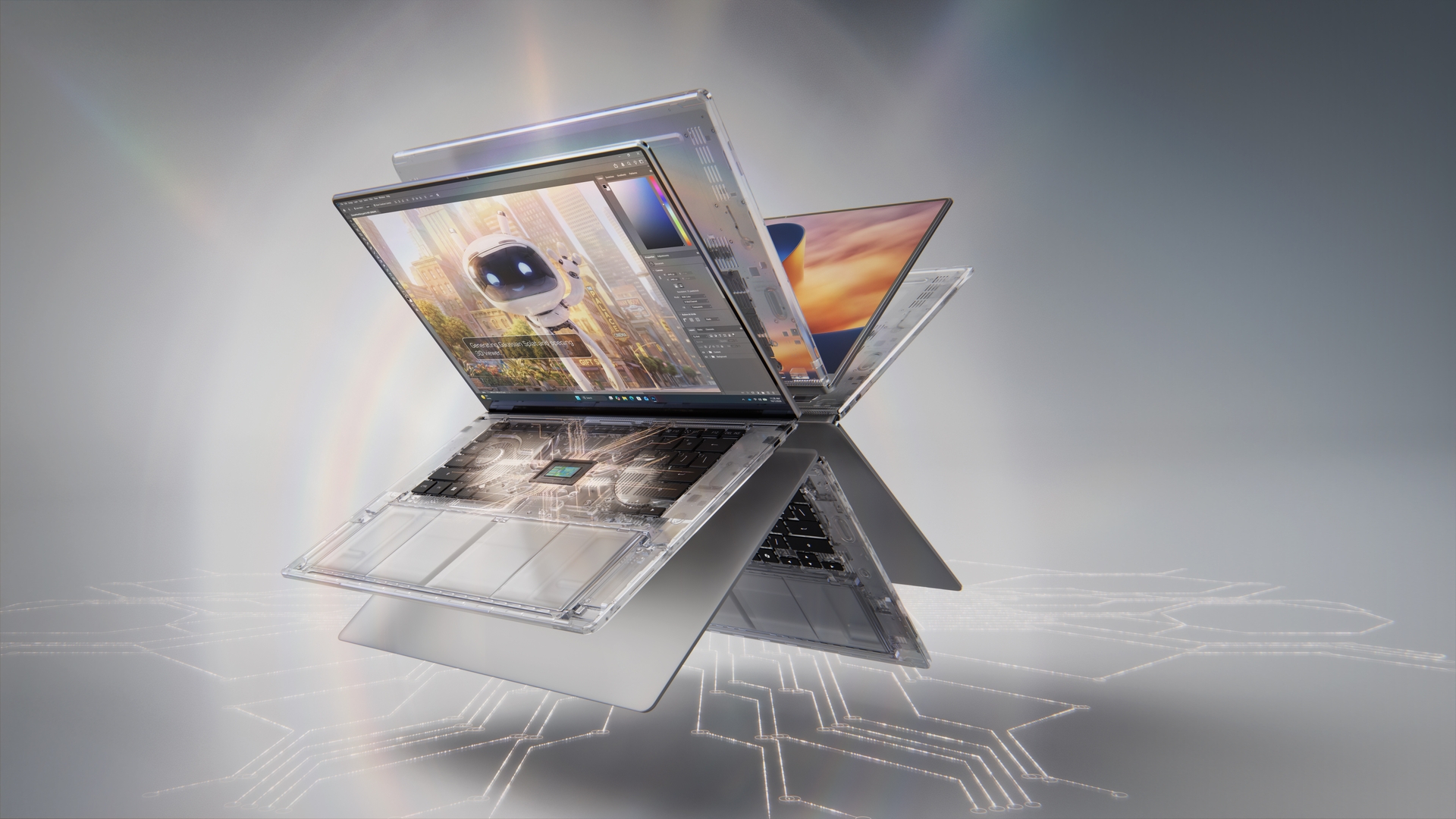
Surface Laptop vs MacBook Air M5: Full Spec Comparison
Microsoft's 13.8-inch and 15-inch Surface Laptop against Apple's M5 MacBook Air, spec for spec, sourced straight from each maker's own pages.
Pick the 13.8-inch or 15-inch Surface Laptop if you want a touchscreen, USB-A and microSD ports, and a $1,199.99 starting price on Windows 11; pick the MacBook Air if you want Apple's M5 chip, a lighter chassis, and macOS, starting at $1,099. Both are current-generation, non-flagship thin-and-light laptops from their makers, and the spec sheets below are pulled directly from Microsoft's and Apple's own published pages.
The Core Difference in One Line
This is a Windows-on-Arm ultraportable against Apple Silicon's volume laptop. Microsoft's current Surface Laptop lineup — the 13.8-inch and 15-inch models, not the separate Surface Laptop Ultra flagship with Nvidia RTX Spark graphics — runs on Qualcomm Snapdragon X2 chips. Apple's MacBook Air, in its 13-inch and 15-inch sizes, runs on the M5 chip Apple introduced in March 2026. Neither machine is the top-of-range model from its maker; both are the mainstream, most-bought size/price tier, which is why they're worth comparing directly.
Chip and Performance
Per Microsoft's own tech-specs page, the 13.8-inch and 15-inch Surface Laptop ship with a choice of the 10-core Snapdragon X2 Plus or the 12-core Snapdragon X2 Elite — both Arm-based Qualcomm chips with an integrated NPU for Copilot+ PC features. Microsoft's June 2026 announcement of the refreshed lineup cited "up to 58% more graphics performance" over the prior generation, without giving a competing-chip comparison. Microsoft's own listings for these two sizes do not show an Intel Core Ultra configuration; Snapdragon X2 is the only processor family on the current 13.8-inch and 15-inch spec pages, and the Snapdragon X2 Elite is reserved for the higher configurations of both sizes, per the same tech-specs page.
Apple's MacBook Air uses the M5, a 10-core CPU paired with a GPU of up to 10 cores, each with what Apple calls a Neural Accelerator. Apple's newsroom announcement says M5 delivers 153GB/s of unified memory bandwidth, a 28% increase over the previous M4 generation, and frames the chip update around on-device AI workloads such as local image generation and faster Apple Intelligence tasks. Apple's product page lists an 8-core GPU as the base configuration on the entry 13-inch model, stepping up to the full 10-core GPU on higher configurations and on the 15-inch.
Display and Design
The Surface Laptop keeps its touchscreen across both sizes: a 13.8-inch 2304×1536 HDR PixelSense panel at 201 ppi, or a 15-inch 3270×2180 panel at 262 ppi, both running at 120Hz. The MacBook Air has no touch input on either size. Its 13-inch Liquid Retina display is 2560×1664 at 224 ppi, and the 15-inch is 2880×1864, also 224 ppi; Apple rates both at 500 nits of brightness with P3 wide color and True Tone, per Apple's specs page.
Weight favors Apple at every comparable size: the 13-inch MacBook Air is 2.7 lb (1.23 kg) and the 15-inch is 3.3 lb (1.51 kg), against the Surface Laptop's 2.96 lb (1342 g) for the 13.8-inch and 3.67 lb (1664 g) for the 15-inch.
| Spec | Surface Laptop (13.8" / 15") | MacBook Air (13" / 15", M5) |
|---|---|---|
| Chip | Snapdragon X2 Plus (10-core) or Snapdragon X2 Elite (12-core) | Apple M5, 10-core CPU, up to 10-core GPU |
| RAM (configurable up to) | 64GB | 32GB (16GB / 24GB / 32GB options) |
| Storage | Not individually published by Microsoft; test units shipped 512GB | 512GB to 4TB |
| Display | 13.8": 2304×1536, 120Hz, 201ppi, touch 15": 3270×2180, 120Hz, 262ppi, touch | 13": 2560×1664, 224ppi 15": 2880×1864, 224ppi No touch |
| Battery life (maker's own test) | 13.8": up to 20h video / 16h web 15": up to 19h video / 14h web | Both sizes: up to 18h video streaming / 15h wireless web |
| Weight | 13.8": 2.96 lb (1342g) 15": 3.67 lb (1664g) | 13": 2.7 lb (1.23kg) 15": 3.3 lb (1.51kg) |
| Starting price (US) | 13.8": $1,199.99 15": $1,399.99 | 13": $1,099 15": $1,299 |
| Ports | 2×USB-C/USB4, USB-A 3.2, 3.5mm jack, Surface Connect (+microSD on 15") | 2×Thunderbolt 4, MagSafe 3, 3.5mm jack |
| Colors | Platinum, Black, Violet, Dune, Jade (13.8" only) | Sky Blue, Silver, Starlight, Midnight |
Camera, Audio, and Biometrics
Microsoft markets the Surface Laptop's webcam heavily: its June 2026 announcement describes the 13.8-inch model's camera as "No.1 ranked laptop camera" by DXOMARK at the time of launch, and the product page pairs it with Omnisonic speakers tuned for Dolby Atmos and Bluetooth LE Audio support. Sign-in differs by size: Microsoft's tech-specs page lists Windows Hello fingerprint sign-in on the 13-inch model and Windows Hello face authentication on both the 13.8-inch and 15-inch. A color-matched keyboard and, on select configurations, a "next-gen haptic touchpad" round out the input side, per Microsoft's product page.
Apple's MacBook Air page specifies a 12-megapixel camera with Center Stage, which keeps a subject framed during video calls, plus a Desk View mode that shows a top-down view of a workspace. Audio runs through speakers that support Spatial Audio and Dolby Atmos, backed by a three-mic array for call clarity. Apple's sign-in method is Touch ID on the keyboard rather than a camera-based system. On wireless, Apple's new N1 chip adds Wi-Fi 7 and Bluetooth 6, and Microsoft's Surface Laptop spec page also lists Wi-Fi 7 support, so both machines match on wireless standards even though the chips implementing them are different.
Memory and Storage
Microsoft's FAQ for the Surface Laptop states memory is configurable up to 64GB, well above anything Apple offers on the MacBook Air. Apple's own specs page lists 16GB, 24GB, or 32GB unified memory depending on the configuration, tied to which GPU core count you choose. On storage, Apple is the more transparent of the two: its newsroom release confirms the base MacBook Air now starts at 512GB (double the prior generation's entry tier) and configures up to 4TB. Microsoft does not publish discrete SSD capacity tiers for the Surface Laptop on its current spec page; the only storage figure given is the 512GB used in Microsoft's own battery-test units, so shoppers need to check configuration options at checkout rather than on the spec sheet.
For a deeper look at how unified-memory designs like Apple Silicon differ from traditional expandable RAM, see our explainer on CXL and memory pooling.
Battery Life
Both companies publish battery figures from in-house tests that use different methodologies, so the numbers aren't directly comparable, but they're each company's own stated best case. Microsoft claims up to 20 hours of local video playback on the 13.8-inch Surface Laptop and up to 19 hours on the 15-inch, dropping to 16 and 14 hours respectively under Microsoft's web-browsing test. Apple claims up to 18 hours of video streaming and up to 15 hours of wireless web browsing on both MacBook Air sizes, tested with 1080p content played locally in the Apple TV app and in Safari. The Surface Laptop's headline number is higher, but it's measured against a looping local-video test rather than streaming, so the two aren't an apples-to-apples (so to speak) read of real-world runtime.
Pricing and Configurations
Current US starting prices, straight from each maker's site: Surface Laptop 13.8-inch at $1,199.99 and 15-inch at $1,399.99, per Microsoft's product page. MacBook Air 13-inch at $1,099 and 15-inch at $1,299, per Apple's March 2026 newsroom announcement (education pricing is lower on both sizes). Worth noting: Microsoft's own June 2026 launch post for this Surface Laptop generation listed an MSRP starting at $1,599 at the time of release, meaning the current $1,199.99 entry price reflects a price cut since launch rather than the original ask.
At every matched price point, Apple's MacBook Air undercuts or matches the Surface Laptop's equivalent size by $100–$200, based on the official starting prices above.
Ports and Connectivity
The Surface Laptop carries more legacy connectivity: two USB-C/USB4 ports, a USB-A 3.2 port, a 3.5mm headphone jack, and Microsoft's proprietary Surface Connect charging port, with a microSD reader added on the 15-inch. The MacBook Air is Thunderbolt-only aside from charging and audio: two Thunderbolt 4 ports, a MagSafe 3 charging port, and a 3.5mm headphone jack, on both sizes, per Apple's specs page. Neither laptop includes an HDMI port natively. If your workflow depends on discrete GPU muscle that neither of these integrated-graphics ultraportables offers, our comparison of Intel Arc Pro and Radeon AI Pro workstation cards covers that separate category.
Design, Materials, and Sustainability
Both companies lean on recycled-materials claims for these specific laptops. Microsoft's Surface Laptop product page states the enclosure's A Cover and C Bucket use 64% recycled aluminum alloy, with 100% recycled rare earth metals in the magnets and recycled cobalt in the battery cell, figures the page attributes to third-party validation by UL Solutions. Apple's MacBook Air environment section claims the laptop is "made with 55% recycled material by weight" overall, with 100% recycled cobalt in the battery, states the device is "manufactured with 50% renewable electricity," and notes the packaging is 100% fiber-based. Both are maker-reported figures rather than independently audited numbers either company links to directly from the product page.
Color options differ in count and naming: the Surface Laptop ships in Platinum, Black, Violet, and Dune across both sizes, with Jade offered only on the 13.8-inch, per Microsoft's product page. The MacBook Air ships in Sky Blue, Silver, Starlight, and Midnight on both sizes, per Apple's MacBook Air tech specs page.
Windows vs macOS: What You're Actually Buying Into
Beyond the spec sheet, the two machines run entirely different platforms with their own app ecosystems. The Surface Laptop ships as a Microsoft-branded Copilot+ PC running Windows 11, with the on-device AI features that designation implies tied to the Snapdragon NPU. Microsoft's June 2026 announcement also touted the 13.8-inch model's webcam as the top-ranked laptop camera by DXOMARK at the time of that release. The MacBook Air runs macOS and ships with Apple Intelligence features built around the M5's Neural Accelerator-equipped GPU cores, per Apple's newsroom post. Choosing between them is as much a software and ecosystem decision as a hardware one; this piece sticks to the specs Microsoft and Apple have each published rather than weighing in on either platform's software.
Which One Should You Buy
If you need a touchscreen, a USB-A port, a microSD slot, or configurable memory above 32GB, the Surface Laptop is the only one of the two that offers any of those. If weight, maximum storage headroom, and a sharper per-inch display at a lower starting price matter more, the MacBook Air wins on Apple's own published numbers. Buyers already inside the Windows or macOS ecosystem will likely find that pull stronger than any single spec line in the table above.
What to Watch Next
Watch each maker's own spec and store pages for configuration-level detail neither currently publishes in full — Microsoft's exact SSD tiers for the Surface Laptop, and Apple's per-configuration GPU core counts for the entry 13-inch MacBook Air. Both companies update these pages directly rather than issuing new press releases for configuration tweaks, so the official tech-specs and product pages linked throughout this article remain the most current source for either machine.
Frequently asked questions
Does the current Surface Laptop come with an Intel chip, or only Snapdragon?
Based on Microsoft's own tech-specs page, the current 13.8-inch and 15-inch Surface Laptop ship exclusively with Qualcomm Snapdragon X2 Plus or Snapdragon X2 Elite processors. Microsoft's listings for these two sizes do not show an Intel Core Ultra option.
Is this the same laptop as the Surface Laptop Ultra?
No. The Surface Laptop Ultra is a separate, higher-end SKU that Microsoft announced with Nvidia RTX Spark discrete graphics, aimed at a different buyer than the mainstream 13.8-inch and 15-inch Surface Laptop covered here.
What is the starting price for each laptop?
Per Microsoft's product page, the Surface Laptop starts at $1,199.99 for the 13.8-inch and $1,399.99 for the 15-inch. Per Apple's newsroom, the MacBook Air starts at $1,099 for the 13-inch and $1,299 for the 15-inch.
Which laptop has longer battery life?
Each maker's own test methodology differs, so the figures aren't directly comparable. Microsoft claims up to 20 hours of local video playback on the 13.8-inch Surface Laptop; Apple claims up to 18 hours of video streaming on either MacBook Air size.
Does either laptop have a touchscreen?
Yes for the Surface Laptop, on both the 13.8-inch and 15-inch models, per Microsoft's tech-specs page. No MacBook Air configuration includes a touchscreen, per Apple's specs page.
How much RAM can each laptop be configured with?
The Surface Laptop is configurable up to 64GB, per Microsoft's FAQ. The MacBook Air tops out at 32GB unified memory, per Apple's MacBook Air tech specs page.
Sources
- Microsoft Surface Laptop — Tech Specsmicrosoft.com
- Microsoft Surface Laptop product pagemicrosoft.com
- Windows Blog: Introducing the Next Surface Pro and Surface Laptopblogs.windows.com
- Apple: MacBook Airapple.com
- Apple: MacBook Air Tech Specsapple.com
- Apple Newsroom: Apple introduces the new MacBook Air with M5apple.com
Mara Lindqvist edits the hardware desk. She covers graphics cards, processors, memory and storage, the foundries and chip designers behind them, and what the numbers on a spec sheet mean for people choosing a PC. Specifications in her stories come from manufacturer spec pages and datasheets.