SK Hynix Profit Jumps 632% to Record High in Q3 2026
SK hynix reported record Q3 2026 revenue and operating profit, up 632% year over year, as HBM4 shipments and AI memory demand surged.
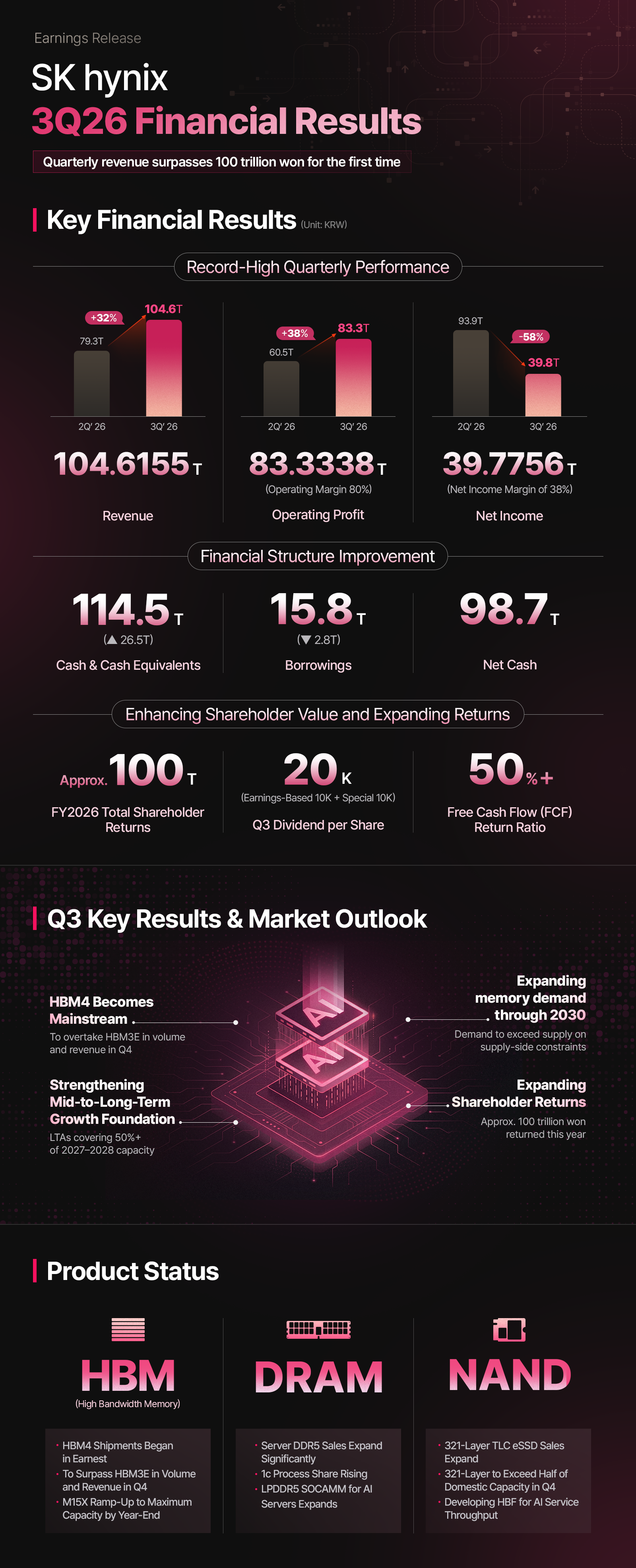
SK hynix reported Q3 2026 revenue of ₩104.62 trillion and operating profit of ₩83.33 trillion, both company records, as the Korean memory maker's preliminary results showed quarterly sales topping ₩100 trillion for the first time. Operating profit jumped 38% from Q2 2026 and 632% from a year earlier, driven by surging HBM4 shipments and record-high server DRAM and NAND demand, according to SK hynix's own October 28 earnings release and a corresponding Form 6-K filed with the U.S. Securities and Exchange Commission.
- Revenue: ₩104.62 trillion (+32% QoQ, +328% YoY) — first time above ₩100 trillion in a single quarter
- Operating profit: ₩83.33 trillion (+38% QoQ, +632% YoY); operating margin 80%, up from 76% in Q2 2026
- Net income: ₩39.78 trillion (-58% QoQ, +216% YoY); net margin about 38%
- Net cash: ₩98.7 trillion, as cash holdings rose to ₩114.5 trillion
- FY2026 planned shareholder returns: approximately ₩100 trillion in dividends and buybacks combined
The figures are preliminary and unaudited — SK hynix's release and its SEC filing history both note the numbers "may differ from the final results" pending the completion of an independent audit. They nonetheless mark the sixth consecutive quarter in which the company has set new records for both revenue and operating profit, extending a run that analysts tracking FnGuide consensus data had flagged ahead of the report. Going into the release, that consensus had penciled in roughly ₩76.96 trillion in operating profit; the ₩83.33 trillion actually reported came in well above it.
The headline numbers: revenue, profit, and margin
SK hynix's operating margin reached 80% in Q3 2026, up three percentage points from Q2's 76% and 33 points above the 47% margin it posted in Q3 2025. The company attributed the jump mainly to "increased sales of high value-added products" — company shorthand for HBM and other premium DRAM and NAND lines that carry higher prices than commodity memory. Revenue and operating profit both roughly quadrupled versus a year earlier, and operating profit alone grew faster than revenue in percentage terms, a sign that the product mix shift toward HBM and enterprise SSDs is doing more for profitability than volume growth alone.
| Metric (consolidated, K-IFRS) | Q3 2026 | Q2 2026 | Q3 2025 | QoQ | YoY |
|---|---|---|---|---|---|
| Revenue | ₩104.62 trillion | ₩79.32 trillion | ₩24.45 trillion | +32% | +328% |
| Operating profit | ₩83.33 trillion | ₩60.54 trillion | ₩11.38 trillion | +38% | +632% |
| Operating margin | 80% | 76% | 47% | +3pp | +33pp |
| Net income | ₩39.78 trillion | ₩93.92 trillion | ₩12.60 trillion | -58% | +216% |
At recent exchange rates of roughly ₩1,380 to ₩1,430 per U.S. dollar, Q3 revenue of ₩104.62 trillion converts to approximately $73 billion to $76 billion — a rough conversion for context, since SK hynix's release does not publish a dollar figure.
Why net income fell even as profit jumped
The one figure moving in the opposite direction from the rest of the report is net income, which dropped 58% quarter over quarter to ₩39.78 trillion even as revenue and operating profit both rose by double digits. The explanation is not a Q3 problem — it is that Q2 2026's net income of ₩93.92 trillion was unusually high relative to that quarter's ₩60.54 trillion in operating profit, a gap that points to a large one-off, below-the-operating-line item in SK hynix's Q2 2026 results rather than a deterioration in Q3's underlying business. SK hynix's release does not break out the specific driver of that Q2-to-Q3 swing, but the company separately disclosed in the same release that "most of the gains realized this year from the Kioxia investment will go to shareholders," which points to sizable investment-related gains recognized at some point in 2026. Measured against operating profit and revenue — the lines that most directly reflect chip sales and pricing — Q3 2026 was unambiguously SK hynix's strongest quarter on record.
HBM4 shipments and the AI memory supercycle
SK hynix said HBM4 shipments "began in earnest" during the third quarter and that it expects the newer standard to overtake HBM3E in both shipment volume and revenue in Q4 2026. HBM — high bandwidth memory stacked and packaged for use alongside AI accelerators — has been the single biggest swing factor in SK hynix's results since Nvidia and other AI chip makers began qualifying it as a core component of their training and inference platforms. The company's framing in this release goes beyond one or two large customers: it describes a "virtuous cycle" in which AI adoption is broadening from early large buyers to enterprises and national-level programs, with memory demand in the near term led by enterprise and personal AI, and in the mid-to-long term by physical AI applications such as autonomous driving and robotics. On the consumer side, that broadening demand for AI capability is already visible in products like Nvidia's RTX Spark-equipped laptops, which pair AI-accelerated features with more memory-hungry workloads than prior generations.
SK hynix's own outlook is notably confident: it expects memory demand to outpace supply "through 2030," citing the difficulty of scaling leading-edge manufacturing processes and the long lead times required to bring new fab capacity online.
DRAM and NAND: where the rest of the growth is coming from
Outside of HBM, SK hynix pointed to significant growth in server DDR5 sales and a rising share of output on its 1c (10-nanometer-class, sixth-generation) DRAM process, which it plans to accelerate further in 2027 alongside increased sales of LPDDR5 in SOCAMM form factor for AI servers. On the NAND side, sales of 321-layer TLC enterprise SSDs expanded, and the company expects that layer count to account for more than half of its domestic NAND capacity by Q4 2026. SK hynix also said it is developing HBF (high bandwidth flash) to increase throughput for AI service workloads, a newer initiative that extends the company's AI memory strategy beyond DRAM-based HBM into NAND-based high-bandwidth products.
Long-term supply deals lock in 2027 and 2028 capacity
SK hynix disclosed that it has signed long-term agreements (LTAs) with 14 major customers, including global cloud service providers, covering more than 50% of its planned 2027–2028 production capacity. These agreements typically run around five years and use a market-linked pricing mechanism within agreed price ranges, rather than fixed prices — a structure that gives SK hynix revenue visibility while still letting pricing move with the broader memory market. Locking in the majority of multi-year capacity with large AI infrastructure buyers is a notable shift from the more spot-market-driven pricing dynamics that have periodically caused sharp swings in memory company earnings.
Capex, M15X, and the Yongin ramp
On the investment side, SK hynix said its M15X fab is being ramped to maximum capacity by the end of 2026 specifically to increase HBM4 output, and that Yongin Phase 1 is set to begin full-scale operation in 2027, after which the company expects domestic and overseas infrastructure investment to rise significantly. SK hynix said it will "flexibly adjust the scale and timing" of that investment based on customer demand, product competitiveness, profitability, and investment efficiency — language suggesting the company intends to keep capital spending responsive to how durable AI memory demand proves to be, rather than committing to a fixed, multi-year capex schedule regardless of market conditions.
Record profit, record shareholder returns
SK hynix is pairing record earnings with record capital returns. For full-year 2026, the company is targeting total shareholder returns of approximately ₩100 trillion, made up of cash dividends of ₩30 trillion or more and share buybacks and cancellations of ₩60 trillion or more — a figure that includes the ₩40 trillion buyback program the company announced in August and said it completed the week before the Q3 release. SK hynix reiterated a policy of returning 50% or more of free cash flow to shareholders.
For the third quarter specifically, SK hynix declared a dividend of ₩14 trillion, or ₩20,000 per share, split between a ₩10,000 regular dividend and a ₩10,000 special dividend. It also authorized a ₩20 trillion Q3 buyback, of which ₩10 trillion is designated for cancellation and roughly ₩10 trillion is earmarked for employee compensation and excluded from the headline shareholder-return total. The company said dividends will continue to track operating results, that significant investment gains will be returned via special dividends, and that buybacks will continue on a quarterly basis. Separately, SK hynix said it has discontinued its review of a potential IPO for Solidigm, the SSD business it controls, citing market conditions.
Balance sheet: cash pile nearly doubles
SK hynix's cash and cash equivalents rose to ₩114.5 trillion, up ₩26.5 trillion from Q2 2026, while total borrowings fell ₩2.8 trillion to ₩15.8 trillion. That combination pushed net cash — cash minus borrowings — to ₩98.7 trillion, a sharp strengthening of the balance sheet that gives the company more room to fund both its expanded capex plans and its enlarged shareholder-return commitments without relying as heavily on new debt.
What SK hynix is signaling for Q4 2026 and 2027
SK hynix's release did not include numeric guidance for the fourth quarter, but its qualitative commentary points toward continued momentum: HBM4 overtaking HBM3E in both volume and revenue, 321-layer NAND exceeding half of domestic capacity, and M15X reaching maximum capacity by year-end. For 2027, the company said it expects "a further step up" in both revenue and profit, alongside significantly higher investment levels as Yongin Phase 1 comes online and the 1c DRAM process ramps faster. Combined with LTAs already covering more than half of 2027–2028 capacity, SK hynix's own framing suggests it is planning for the current AI memory cycle to extend well beyond this year rather than treating 2026 as a one-off peak.
Industry context: AI demand reshaping memory and storage earnings
SK hynix, a Korean memory chipmaker majority-owned by SK Group, posted results that arrive amid a broader pattern of AI-driven infrastructure spending lifting earnings across memory and storage suppliers. Hard-drive maker Seagate, for instance, recently posted its own record profit on surging AI-related hard drive demand, underscoring that the current data center buildout is pulling in storage vendors well beyond the GPU and HBM makers that get most of the attention. For SK hynix specifically, the scale of the swing is notable: operating profit of ₩11.38 trillion in Q3 2025 to ₩83.33 trillion in Q3 2026 is roughly a sevenfold increase in a single year, reflecting how quickly HBM pricing and volumes have moved since AI accelerator demand became the dominant driver of memory company results.
Where SK hynix stands in the HBM race
SK hynix has held the leading position in HBM revenue share since the market took off alongside Nvidia's AI accelerator ramp, with third-party research firms such as Counterpoint Research putting its share of the HBM market at roughly half, ahead of Samsung and Micron, in estimates for recent quarters. SK hynix's own Q3 2026 release does not disclose an HBM-specific market-share figure — it reports consolidated financial results rather than segment-level share data — so that competitive positioning should be read as third-party analysis rather than a number the company itself confirmed. What the company did confirm is that it has secured long-term agreements covering more than half of its 2027–2028 production capacity with 14 major customers, a figure that speaks to demand visibility even if it does not translate directly into a market-share percentage.
What's next
SK hynix's Q3 2026 figures are preliminary; the company and its SEC filing both flag that final, audited results could differ once the independent audit is complete, with any material changes typically disclosed in a follow-up filing or the company's annual report. Investors and industry watchers will be looking for three things in the months ahead: whether HBM4 shipment volumes in Q4 actually overtake HBM3E as SK hynix projects, how the ₩20 trillion-plus in quarterly buybacks and dividends affects the stock given the company's now-₩98.7 trillion net cash position, and whether rival Samsung Electronics — which competes directly with SK hynix in both HBM and conventional DRAM — reports a comparably strong quarter when it discloses its own results. SK hynix's full, audited financial statements and any further detail on 2027 capital spending plans are expected in subsequent regulatory filings and investor communications.
Frequently asked questions
What were SK hynix's actual Q3 2026 earnings results?
SK hynix reported preliminary Q3 2026 revenue of ₩104.62 trillion and operating profit of ₩83.33 trillion, both company records, per its October 28, 2026 earnings release and a matching SEC Form 6-K filing. Net income was ₩39.78 trillion.
How does Q3 2026 compare to the previous quarter?
Revenue rose 32% and operating profit rose 38% quarter over quarter from Q2 2026, when SK hynix reported ₩79.32 trillion in revenue and ₩60.54 trillion in operating profit. Operating margin improved to 80% from 76%.
Why did SK hynix's net income fall even though profit rose?
Net income dropped 58% quarter over quarter to ₩39.78 trillion because Q2 2026's net income of ₩93.92 trillion included a large one-off gain below the operating-profit line, not because Q3's core chip business weakened. Operating profit and revenue, which reflect chip sales directly, both hit new records in Q3.
What is driving SK hynix's record results?
SK hynix cited surging HBM4 shipments, higher server DDR5 DRAM sales, and growth in 321-layer NAND enterprise SSDs, all tied to AI data center demand. It expects HBM4 to surpass HBM3E in both volume and revenue in Q4 2026.
How much is SK hynix returning to shareholders in 2026?
SK hynix is targeting roughly ₩100 trillion in total FY2026 shareholder returns, combining cash dividends of ₩30 trillion or more and buybacks/cancellations of ₩60 trillion or more, including a ₩40 trillion buyback completed in October.
Are SK hynix's Q3 2026 results final?
No. Both the company's release and its SEC filing describe the figures as preliminary and unaudited, noting they may differ from final results once an independent audit is completed.
Sources
- SK hynix — 3Q26 Business Results press release (Oct 28, 2026)news.skhynix.com
- SK hynix Inc. — SEC Form 6-K, preliminary Q3 2026 resultssec.gov
- SK hynix — 2Q26 Business Results press releasenews.skhynix.com
- SEC EDGAR — SK hynix Inc. filing historysec.gov
- Wikipedia — SK Hynixen.wikipedia.org
Mara Lindqvist edits the hardware desk. She covers graphics cards, processors, memory and storage, the foundries and chip designers behind them, and what the numbers on a spec sheet mean for people choosing a PC. Specifications in her stories come from manufacturer spec pages and datasheets.