Ryzen 9 9950X3D vs Ryzen 7 9850X3D: Which Gaming CPU to Buy
Both use 3D V-Cache on AM5, but one chip is built for gaming alone and the other for gaming plus heavy multi-threaded work.
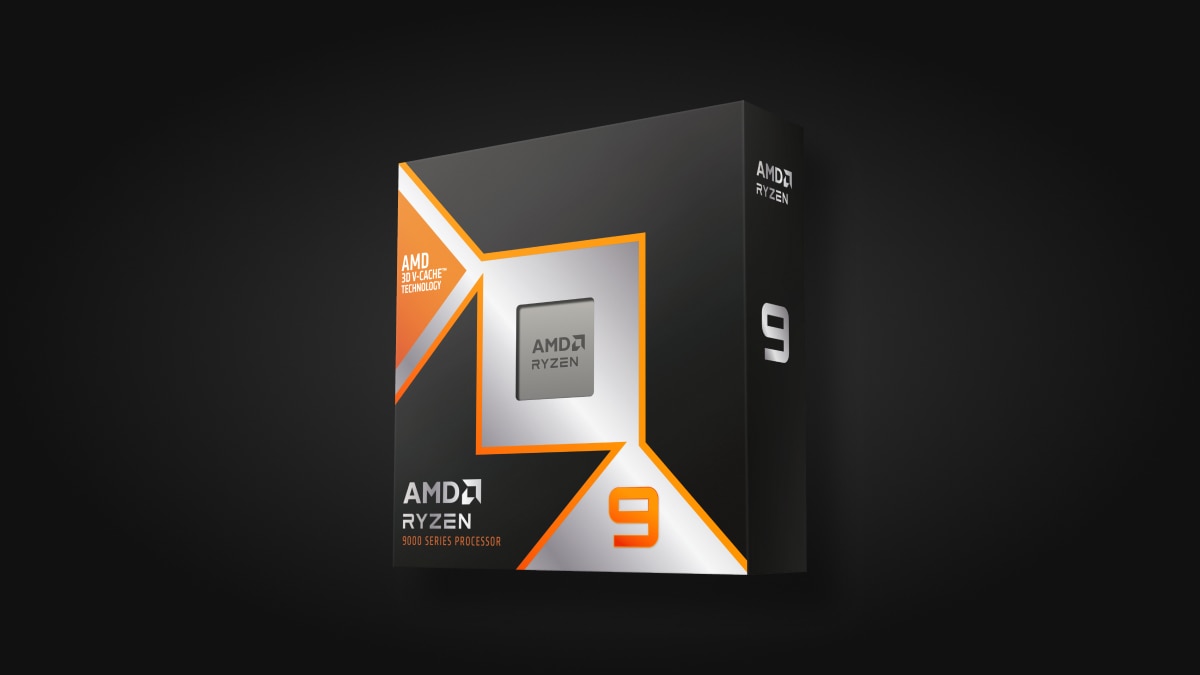
The Ryzen 9 9950X3D is AMD's 16-core, 32-thread flagship with 144MB of total cache and a 170W TDP, launched at $699; the Ryzen 7 9850X3D is an 8-core, 16-thread chip with 104MB of cache and a 120W TDP, launched at $499. Both use AMD's 3D V-Cache and the same AM5 socket, and both are marketed as gaming CPUs first. For pure frame rates, the 9850X3D's higher 4.7GHz base clock closes most of the gap despite half the cores; the 9950X3D only pulls ahead once a workload actually uses all 16 cores, for streaming, rendering or heavily multi-threaded production work alongside gaming. Here's the full spec, price and use-case breakdown.
- Ryzen 9 9950X3D: 16C/32T, 4.3GHz base / up to 5.7GHz boost, 144MB total cache, 170W TDP, AM5 socket. Launched Q1 2025 at $699.
- Ryzen 7 9850X3D: 8C/16T, 4.7GHz base / up to 5.6GHz boost, 104MB total cache, 120W TDP, AM5 socket. Launched January 2026 at $499.
- Bottom line: the 9850X3D is AMD's gaming-focused value pick; the 9950X3D earns its $200 premium only when you also do heavily multi-threaded work alongside gaming.
Ryzen 9 9950X3D at a glance
The Ryzen 9 9950X3D is AMD's current desktop flagship, built on the "Zen 5" architecture with 3D V-Cache stacked on one of its two core chiplets. Per AMD's own product specification page, it ships with 16 cores and 32 threads, a 4.3GHz base clock, a boost clock of up to 5.7GHz, 128MB of L3 cache (144MB total with L2), a 170W default TDP, and support for the AM5 socket. AMD's own CES 2025 launch materials claimed the 9950X3D runs about 20% faster on average than Intel's then-flagship Core Ultra 9 285K at 1080p "High" settings, and roughly 8% faster than the previous-generation Ryzen 9 7950X3D in games like Hogwarts Legacy and Starfield — vendor figures that should be read as AMD's own claims rather than independently verified benchmarks.
Ryzen 7 9850X3D at a glance
The Ryzen 7 9850X3D is a narrower, more gaming-focused chip announced roughly a year later at CES 2026. AMD's official specs page lists 8 cores and 16 threads, a 4.7GHz base clock, a boost clock of up to 5.6GHz, 96MB of L3 cache (104MB total), and a 120W TDP on the same AM5 socket. In its own CES 2026 announcement, AMD describes the 9850X3D as "the fastest gaming processor" in its lineup and says it builds on the Ryzen 7 9800X3D with a 400MHz higher boost clock. AMD's launch materials claimed roughly 27% faster gaming performance than Intel's Core Ultra 9 285K — again, a vendor claim rather than an independently verified figure.
Specs side by side
| Spec | Ryzen 9 9950X3D | Ryzen 7 9850X3D |
|---|---|---|
| Cores / Threads | 16C / 32T | 8C / 16T |
| Base clock | 4.3GHz | 4.7GHz |
| Max boost clock | Up to 5.7GHz | Up to 5.6GHz |
| L2 cache | 16MB | 8MB |
| L3 cache | 128MB | 96MB |
| Total cache | 144MB | 104MB |
| TDP | 170W | 120W |
| Socket | AM5 | AM5 |
| Launch date | Q1 2025 | January 2026 |
| Launch price | $699 | $499 |
The clock speeds are closer than the core counts suggest: the 9850X3D's 4.7GHz base is actually 400MHz higher than the 9950X3D's 4.3GHz, and its boost clock trails by only 100MHz. That's the single biggest reason the two chips trade blows in game benchmarks despite one having twice the cores — most games still can't meaningfully use more than 8 fast cores, so the 9850X3D's higher clocks and 3D V-Cache do most of the work a game needs.
Gaming performance: where the extra cores stop mattering
Both chips use AMD's 3D V-Cache, which stacks extra L3 cache directly on top of a compute die so the processor can keep more of a game's working data close to the cores instead of waiting on system memory — the same technology that's made every X3D-branded Ryzen chip since the 5800X3D dominate gaming benchmarks regardless of core count. Because most current games are built to scale across roughly 6 to 8 fast cores rather than 16, the 9850X3D's single CCD, higher clocks and full 96MB of L3 cache give it nearly all of the gaming benefit of the pricier chip. AMD itself doesn't lean on 16-core gaming claims for the 9950X3D the way it does for productivity — its own launch materials pointed to average frame-rate gains in the 8-20% range depending on the comparison point, not a dramatic gap over the cheaper 8-core part.
For a look at how the 9950X3D compares against Intel's current flagship rather than AMD's own lineup, see our Core Ultra 9 285K vs Ryzen 9 9950X3D comparison. And if you're deciding between the 9850X3D and its direct predecessor rather than the flagship, our Core Ultra 7 270K Plus vs Ryzen 7 9800X3D vs 9850X3D breakdown covers that three-way match-up in detail.
It's worth being precise about what "fastest gaming CPU" claims actually mean in practice: they're almost always an average across a test suite of a dozen or more games at a specific resolution and settings, not a guarantee that either chip wins every single title. Titles that are heavily GPU-bound — anything running at 4K with ray tracing maxed out, for instance — tend to narrow the gap between any two modern CPUs, X3D or not, because the graphics card becomes the bottleneck rather than the processor. The clearest wins for either chip show up at 1080p or 1440p with a high-end GPU, where the CPU actually gets to be the limiting factor AMD's benchmarks are measuring.
Where the 9950X3D pulls ahead: multi-threaded work
The gap that actually justifies the 9950X3D's $200 premium shows up outside games. With double the cores and threads, it's the clear choice for video encoding, 3D rendering, compiling large codebases, or any workload that scales cleanly across 16 cores rather than 8 — tasks the 9850X3D, as a gaming-first part, simply isn't built to lead on. If you're also considering AMD's newer dual-chiplet flagship, the Ryzen 9 9950X3D2 Dual Edition, which stacks 3D V-Cache on both CCDs for 208MB of total cache, our 9950X3D2 vs 9950X3D comparison breaks down when that even-pricier chip is worth the jump instead.
Platform and memory requirements
Both chips drop into the same AM5 socket, so the platform decision is identical either way: a 600- or 800-series AMD motherboard with a BIOS updated for 3D V-Cache support, and DDR5 memory. That's a meaningful point in both chips' favor if you're upgrading from an older Ryzen 9000 or 7000 build rather than starting fresh — there's no motherboard re-purchase required to go from, say, a non-X3D Ryzen 9000 chip to either of these. AMD has also been consistent in its own marketing that these chips don't need exotic, expensive memory kits to hit their rated performance; the 3D V-Cache does the heavy lifting that would otherwise require faster RAM, which keeps the total platform cost down compared with a memory-sensitive CPU.
How we got here: AMD's X3D lineage
3D V-Cache itself debuted on the Ryzen 7 5800X3D in 2022, and AMD has shipped a new X3D flagship or gaming-focused variant at a steady cadence ever since. The Ryzen 9 9950X3D arrived first, at CES 2025, as part of the same launch wave as the Ryzen 9 9900X3D. The Ryzen 7 9850X3D followed almost exactly a year later, at CES 2026, explicitly framed by AMD as the successor to the Ryzen 7 9800X3D rather than a new tier — the "850" naming slots it between the 9800X3D and the Ryzen 9 chips rather than replacing either outright. That means all three chips — 9800X3D, 9850X3D and 9950X3D — currently coexist in AMD's lineup at different price points, rather than older chips simply being discontinued the moment a new one ships.
Price and value
At launch, AMD priced the Ryzen 9 9950X3D at $699 and the Ryzen 7 9850X3D at $499 — a $200 gap that roughly matches the gap in core count and cache rather than in day-to-day gaming performance. For a build focused purely on frame rates, that makes the 9850X3D the better dollar-for-dollar pick: you're paying a 40% premium for the 9950X3D's extra cores and cache, but seeing nowhere near a 40% jump in the games both chips are actually used for. The math only flips if your PC also needs to carry real multi-threaded workloads, where the 9950X3D's doubled core count and 40MB of extra cache translate directly into faster render and compile times.
Both chips have been on the market long enough — the 9950X3D since early 2025, the 9850X3D since January 2026 — that retail prices routinely move away from MSRP during sales events, including the Black Friday period in late November. Neither AMD's product pages nor its press releases list current retail pricing, so treat the $699 and $499 figures above as launch MSRP, not necessarily today's shelf price, and check a retailer directly for what either chip actually costs before buying.
Which should you buy?
Buy the Ryzen 7 9850X3D if gaming is the only workload that matters and you want to spend less while still getting AMD's newest 3D V-Cache silicon and a higher base clock than the flagship. Buy the Ryzen 9 9950X3D if your PC also needs to handle heavy multi-threaded work — streaming while gaming, video editing, 3D rendering or compiling — where the extra eight cores and 40MB of cache earn back their $200 premium. Neither chip is a poor choice for gaming alone; the decision mostly comes down to whether anything other than games will ever load up all 16 of the 9950X3D's cores.
- Buy the 9850X3D if: you're building or upgrading a gaming-only PC and want to spend $200 less without giving up AMD's latest 3D V-Cache gains.
- Buy the 9950X3D if: you stream, render, edit video or compile code alongside gaming, and need the extra eight cores for those tasks specifically — not for games.
- Consider the 9800X3D instead if: budget matters more than the 9850X3D's modest clock bump, since the two chips perform within a few percent of each other in most games.
Who each chip actually suits
Think about the Ryzen 7 9850X3D as the chip for a dedicated gaming rig with a clear budget ceiling: it's the newest, highest-clocked 8-core X3D part AMD sells, at a price that leaves more of the build's budget for the GPU — usually the part that matters more for frame rates at higher resolutions anyway. The Ryzen 9 9950X3D is better thought of as a workstation-that-also-games chip: if the same machine needs to encode video, run a local AI model, compile a large project or host a dedicated game server while you play, the extra eight cores stop being optional and start being the reason you bought that specific CPU.
What next
Both chips have since been joined by newer siblings in AMD's lineup — the dual-cache Ryzen 9 9950X3D2 Dual Edition for the flagship tier, and the original Ryzen 7 9800X3D remains on shelves as a cheaper, slightly slower alternative to the 9850X3D. Street prices on both chips fluctuate with retailer promotions throughout the year, so check current listings before buying rather than assuming launch MSRP still applies. For the current, authoritative specification sheets, AMD's own pages for the Ryzen 9 9950X3D and the Ryzen 7 9850X3D remain the most current reference.
Frequently asked questions
Is the Ryzen 9 9950X3D better than the Ryzen 7 9850X3D for gaming?
Only slightly, and not consistently. The 9850X3D has a higher 4.7GHz base clock and nearly the same boost clock, so most games show a small gap between the two chips despite the 9950X3D having twice the cores.
What is the price difference between the two CPUs?
AMD launched the Ryzen 9 9950X3D at $699 and the Ryzen 7 9850X3D at $499, a $200 gap. Current retail prices can differ from these launch MSRPs.
Do the 9950X3D and 9850X3D use the same motherboard?
Yes. Both use the AM5 socket and DDR5 memory, so either chip drops into the same compatible motherboards with an updated BIOS.
How much cache does each chip have?
The Ryzen 9 9950X3D has 144MB of total cache (128MB L3 plus 16MB L2). The Ryzen 7 9850X3D has 104MB total (96MB L3 plus 8MB L2).
Which chip is better for streaming or video editing?
The Ryzen 9 9950X3D, because its 16 cores and 32 threads scale better across heavily multi-threaded workloads like encoding and rendering than the 9850X3D's 8 cores.
Is the Ryzen 7 9850X3D worth it over the older 9800X3D?
The 9850X3D adds a 400MHz higher boost clock over the 9800X3D, per AMD. The performance gap in games is typically small, so budget-conscious buyers may prefer whichever chip is cheaper at the time of purchase.
Sources
- AMD — Ryzen 9 9950X3D product specificationsamd.com
- AMD — Ryzen 7 9850X3D product specificationsamd.com
- AMD Newsroom — CES 2026: AMD Expands AI Leadership Across Client, Graphics and Commercial (announces Ryzen 7 9850X3D)amd.com
- AMD Newsroom — CES 2025: AMD Announces New Graphics and Gaming Products (announces Ryzen 9 9950X3D)amd.com
Mara Lindqvist edits the hardware desk. She covers graphics cards, processors, memory and storage, the foundries and chip designers behind them, and what the numbers on a spec sheet mean for people choosing a PC. Specifications in her stories come from manufacturer spec pages and datasheets.