Core Ultra 7 270K Plus vs Ryzen 7 9800X3D vs 9850X3D: Specs and Price
Intel’s 24-core 270K Plus costs far less than AMD’s X3D gaming chips. We line up the official specs, prices and platform differences to show which one fits your build.
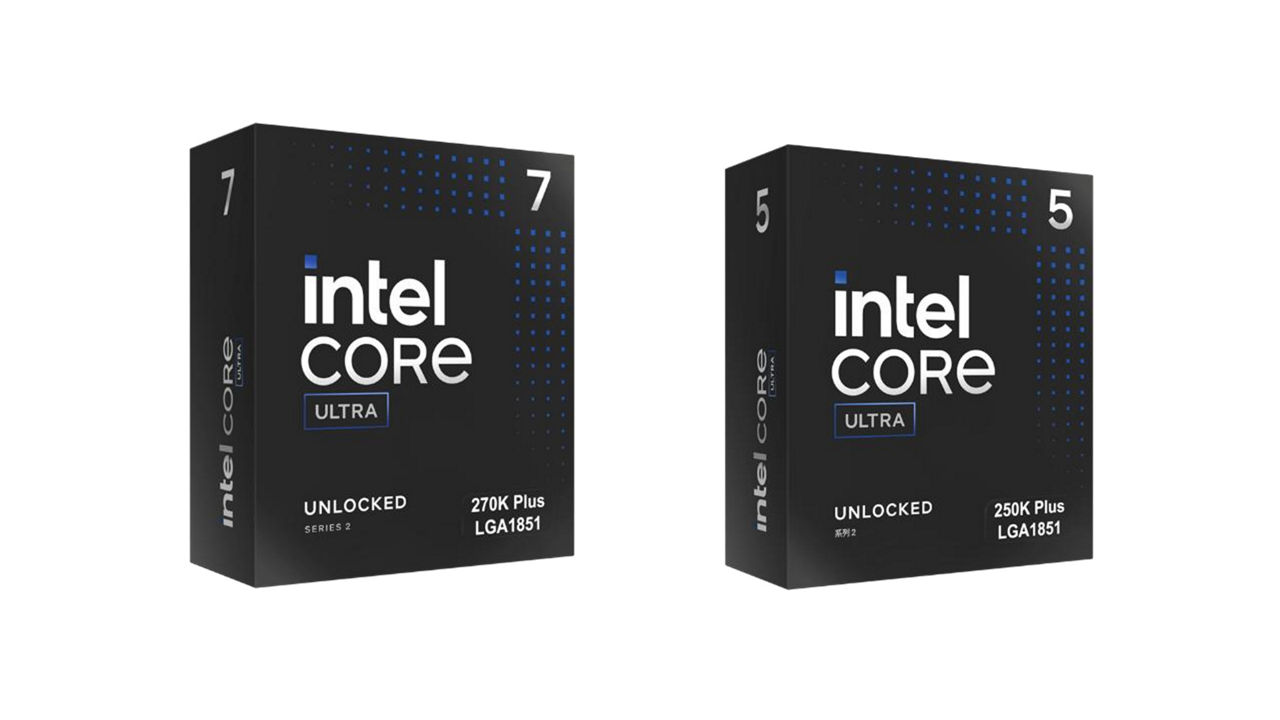
The Intel Core Ultra 7 270K Plus and AMD’s Ryzen 7 9800X3D and 9850X3D are the three processors most gaming-PC builders are choosing between in autumn 2026. On paper the Intel chip has three times the cores (24 versus 8), faster official memory support and a built-in NPU, while the two AMD chips carry 96MB of stacked L3 cache and much higher launch prices: Intel’s suggested price for the 270K Plus starts at $299, against $479 and $499 for the AMD parts at launch.
Key facts
- Core Ultra 7 270K Plus: 24 cores / 24 threads, up to 5.5GHz, 36MB L3 + 40MB L2, 125W base / 250W turbo, LGA1851, from $299 (Intel suggested price)
- Ryzen 7 9800X3D: 8 cores / 16 threads, up to 5.2GHz, 96MB L3 + 8MB L2, 120W TDP, AM5, $479 launch price
- Ryzen 7 9850X3D: 8 cores / 16 threads, up to 5.6GHz, 96MB L3 + 8MB L2, 120W TDP, AM5, $499 launch price
- Memory: Intel supports DDR5-7200 officially; AMD lists DDR5-5600 for two DIMMs
- Launch dates: 9800X3D November 7, 2024; 9850X3D January 29, 2026; 270K Plus March 26, 2026
Core Ultra 7 270K Plus vs Ryzen 7 9800X3D vs 9850X3D: full specs
Every figure below comes from the manufacturers’ own specification pages: Intel’s Core Ultra 7 270K Plus spec sheet and AMD’s product pages for the Ryzen 7 9800X3D and Ryzen 7 9850X3D.
| Spec | Intel Core Ultra 7 270K Plus | AMD Ryzen 7 9800X3D | AMD Ryzen 7 9850X3D |
|---|---|---|---|
| Architecture | Arrow Lake refresh (Core Ultra 200S Plus) | Zen 5 with 2nd-gen 3D V-Cache | Zen 5 with 2nd-gen 3D V-Cache |
| Cores / threads | 24 (8P + 16E) / 24 | 8 / 16 | 8 / 16 |
| Max boost | 5.5GHz (P-core max 5.4GHz) | Up to 5.2GHz | Up to 5.6GHz |
| Base clock | 3.7GHz P-core / 3.2GHz E-core | 4.7GHz | 4.7GHz |
| L3 cache | 36MB | 96MB | 96MB |
| L2 cache | 40MB | 8MB | 8MB |
| Power | 125W base / 250W max turbo | 120W default TDP | 120W default TDP |
| CPU process | TSMC N3B | TSMC 4nm (6nm I/O die) | TSMC 4nm (6nm I/O die) |
| Socket | LGA1851 | AM5 | AM5 |
| Official memory speed | Up to DDR5-7200 | DDR5-5600 (2 DIMMs), DDR5-3600 (4 DIMMs) | DDR5-5600 (2 DIMMs), DDR5-3600 (4 DIMMs) |
| Max memory | 256GB | 256GB | 256GB |
| PCIe lanes | 24 (PCIe 5.0 and 4.0) | 28 total / 24 usable, PCIe 5.0 | 28 total / 24 usable, PCIe 5.0 |
| Integrated graphics | Intel Graphics, 4 Xe-cores, 2GHz | AMD Radeon Graphics, 2 cores, 2.2GHz | AMD Radeon Graphics, 2 cores, 2.2GHz |
| NPU | Intel AI Boost, 13 TOPS (INT8) | None | None |
| Cooler in box | — | Not included (liquid cooler recommended) | Not included (liquid cooler recommended) |
| Launch | March 26, 2026 | November 7, 2024 | January 29, 2026 |
| Launch price (US) | From $299 (Intel suggested); $339–$349 RCP | $479 SEP | $499 SEP |
How much do they cost?
Intel’s Core Ultra 200S Plus launch announcement on March 11 put the Core Ultra 7 270K Plus at a suggested price “starting at $299,” with retail availability from March 26, 2026. Intel’s product database separately lists a Recommended Customer Price of $339–$349; Intel’s RCP is a bulk list figure rather than the shelf price, so expect retail listings near the lower end.
AMD’s October 2024 launch release for the Ryzen 7 9800X3D set its suggested etailer price (SEP) at $479. For the 9850X3D, AMD announced a $499 SEP in January 2026, a week before its January 29 launch, as reported at the time. Retail prices for all three move frequently, so treat those as launch reference points rather than today’s street prices.
Even at launch prices, the gap is significant: the Intel chip is $180 cheaper than the 9800X3D and $200 cheaper than the 9850X3D on suggested pricing. That money can go towards a better graphics card, which usually matters more for frame rates at 1440p and 4K.
Which is faster for gaming?
Both companies claim the gaming crown, and neither claim is independent. Here is exactly what each one says:
- AMD on the 9850X3D: AMD’s CES 2026 release calls it “the newest and fastest gaming processor in the Ryzen 9000X3D lineup” with “up to 27% better gaming performance compared to the Intel Core Ultra 9 285K.” Note the comparison is against Intel’s previous flagship, not the 270K Plus.
- AMD on the 9800X3D: At launch AMD claimed “up to an average 8% gaming performance improvement” over its previous generation and “up to an average 20% faster than the competition.”
- Intel on the 270K Plus: Intel says the 200S Plus chips deliver “up to 15% geomean faster gaming performance versus existing Core Ultra Series 2 desktop processors” and calls them the “fastest desktop gaming processors Intel has ever built.”
The architectural reason AMD leads in many games is the 96MB L3 cache. AMD stacks a 64MB 3D V-Cache die beneath the processor die, and cache-sensitive games benefit from keeping more data close to the cores. Intel’s answer is more cores, higher official memory speeds and a large 40MB L2. Independent results vary by game, resolution and graphics card, and any CPU gap narrows once a game becomes GPU-bound at 1440p or 4K.
The practical takeaway: if your only goal is the highest possible frame rate at 1080p with a top-end graphics card, the X3D chips are the parts AMD positions for that job, and their large cache is the reason. If you play at higher resolutions, the difference shrinks and the price gap becomes harder to justify.
Which is better for streaming, rendering and multitasking?
This is where the Intel chip’s core count matters. The 270K Plus has 24 cores (eight performance cores and 16 efficient cores), while both AMD chips have eight cores with simultaneous multithreading for 16 threads. Intel claims “up to 103% better multithread performance compared to competing CPUs” and “nearly double the content creation performance of our competitor” for the 200S Plus family. These are Intel’s own figures, measured against what it calls “competing CPUs,” so wait for independent testing in the specific apps you use.
For workloads that scale across many cores — video encoding, 3D rendering, code compilation, running several apps while streaming — the 270K Plus is the stronger chip on specification. The AMD parts are designed around gaming first, and AMD’s own positioning of the X3D line reflects that.
The Intel chip also includes a 13 TOPS NPU for on-device AI features, which neither AMD desktop chip has. That NPU is too small to matter for running large language models (a graphics card does that job, as our guide to running AI models locally with Ollama explains), but it is there for lighter on-device AI features in Windows and apps.
Memory, motherboards and upgrade paths
Memory
Intel officially supports DDR5-7200 on the 270K Plus, up from DDR5-6400 on the original Core Ultra 200S chips, and its launch release says an Intel “200S Boost” BIOS profile supports 8,000 MT/s memory overclocking. AMD’s pages list DDR5-5600 with two single- or dual-rank DIMMs and DDR5-3600 with four. Many builders run faster kits using AMD EXPO profiles, but AMD treats that as memory overclocking, which its product warranty does not cover. If you are setting up a new build, our explainer on how to check RAM speed and enable XMP or EXPO covers the BIOS steps.
Motherboards
- Intel: The 270K Plus uses LGA1851 and, according to Intel, is compatible with all 800-series chipset motherboards.
- AMD: Both X3D chips use AM5 and are listed as compatible with A620, B650, B650E, X670, X670E, B840, B850, X870 and X870E boards.
AM5 has been AMD’s desktop socket since 2022 and already spans two Ryzen generations, which gives it a longer track record for drop-in upgrades.
Cooling and power
The 270K Plus is rated for 125W base power and up to 250W at maximum turbo, so it needs a capable air cooler or AIO under sustained all-core loads. AMD rates both X3D chips at a 120W default TDP, ships them without a cooler and recommends liquid cooling “for optimal performance.”
What about the cheaper Core Ultra 5 250K Plus?
If the budget is tighter, Intel launched a second chip alongside the 270K Plus. According to Intel, the Core Ultra 5 250K Plus has 18 cores (six performance cores and 12 efficient cores), a suggested price starting at $199 and the same March 26 retail date, with a 250KF Plus variant that drops the integrated graphics. Both 200S Plus chips get what Intel describes as “up to 900MHz die-to-die frequency increase” over the Core Ultra 5 245K and Core Ultra 7 265K they replace, plus the same DDR5-7200 memory support.
That makes the 250K Plus a $280–$300 cheaper alternative to the AMD X3D pair at launch prices. It will not match the X3D chips in cache-heavy games, but for a mid-range build paired with a mainstream graphics card, the savings can fund a meaningful GPU upgrade. AMD’s cheaper options sit further down its range; our look at the Ryzen 5 5500F and Ryzen 5 7500 covers AMD’s budget end.
| Chip | Cores / threads | Suggested launch price |
|---|---|---|
| Intel Core Ultra 5 250K Plus | 18 (6P + 12E) / 18 | From $199 |
| Intel Core Ultra 7 270K Plus | 24 (8P + 16E) / 24 | From $299 |
| AMD Ryzen 7 9800X3D | 8 / 16 | $479 |
| AMD Ryzen 7 9850X3D | 8 / 16 | $499 |
Ryzen 7 9800X3D vs 9850X3D: is the newer chip worth $20 more?
The two AMD chips are nearly identical. Both have eight Zen 5 cores, 16 threads, 96MB of L3 cache, a 4.7GHz base clock and a 120W TDP. The only specification difference is boost clock: up to 5.6GHz on the 9850X3D against 5.2GHz on the 9800X3D. AMD describes the newer chip as building “on the legacy of the Ryzen 7 9800X3D with a 400MHz higher boost clock.”
At launch prices of $479 and $499, the $20 premium for the 9850X3D is easy to justify. At current street prices, check both: the older 9800X3D may be discounted, and a 400MHz boost difference translates into a modest real-world gain in games that are limited by CPU clock speed.
Which should you buy?
| If you… | Pick | Why |
|---|---|---|
| Want the highest 1080p frame rates with a flagship GPU | Ryzen 7 9850X3D | Highest boost clock plus 96MB L3; AMD’s fastest gaming CPU claim |
| Want X3D gaming performance for a little less | Ryzen 7 9800X3D | Same cores and cache, 400MHz lower boost |
| Game at 1440p/4K and also stream, edit or render | Core Ultra 7 270K Plus | 24 cores, DDR5-7200 support, lower price leaves budget for the GPU |
| Already own an 800-series Intel board | Core Ultra 7 270K Plus | Drop-in upgrade on LGA1851 |
| Already own an AM5 board | Ryzen 7 9800X3D or 9850X3D | Drop-in upgrade on AM5 |
Bottom line
The Core Ultra 7 270K Plus is the value and all-rounder choice: more cores, faster official memory support and a suggested price $180–$200 below AMD’s X3D launch prices. The Ryzen 7 9800X3D and 9850X3D remain the specialist gaming picks thanks to their 96MB cache, and the 9850X3D is the one to buy if you want the highest clocks. Whichever you choose, make sure the savings (or the extra spend) is weighed against your graphics card, because at 1440p and above the GPU usually decides your frame rate.
Frequently asked questions
Is the Core Ultra 7 270K Plus better than the Ryzen 7 9800X3D?
It depends on the workload. The 270K Plus has 24 cores and costs less, which suits streaming, rendering and multitasking, while the 9800X3D’s 96MB L3 cache is built for gaming, especially at 1080p with a high-end GPU.
How much does the Core Ultra 7 270K Plus cost?
Intel’s suggested price starts at $299, according to its March 11, 2026 launch announcement. Intel’s product database lists a Recommended Customer Price of $339–$349.
What is the difference between the Ryzen 7 9800X3D and 9850X3D?
The only specification difference is boost clock: up to 5.6GHz on the 9850X3D versus 5.2GHz on the 9800X3D. Both have 8 cores, 16 threads, 96MB of L3 cache and a 120W TDP.
What motherboard does the 270K Plus need?
The Core Ultra 7 270K Plus uses the LGA1851 socket, and Intel says it is compatible with all 800-series chipset motherboards.
What memory speed do these CPUs support?
Intel lists up to DDR5-7200 for the 270K Plus. AMD lists DDR5-5600 with two DIMMs and DDR5-3600 with four for both the 9800X3D and 9850X3D.
Sources
- Intel Core Ultra 7 270K Plus specificationsintel.com
- Intel: Intel Announces New Core Ultra 200S Plus Series Desktop Processorsintel.com
- AMD Ryzen 7 9800X3D product specificationsamd.com
- AMD Ryzen 7 9850X3D product specificationsamd.com
- AMD: The Gaming Legend Continues — Ryzen 7 9800X3D launch releaseamd.com
- AMD: CES 2026 announcements including Ryzen 7 9850X3Damd.com
Mara Lindqvist edits the hardware desk. She covers graphics cards, processors, memory and storage, the foundries and chip designers behind them, and what the numbers on a spec sheet mean for people choosing a PC. Specifications in her stories come from manufacturer spec pages and datasheets.