Framework Desktop vs Steam Machine: Which Should You Buy?
A spec-by-spec look at AMD's flexible Framework Desktop against Valve's SteamOS-only Steam Machine, comparing chips, memory, pricing, and upgrade room.
If you want one small PC that can run any OS, scale up to 128GB of memory, and double as a local AI workstation, the Framework Desktop is the better buy; if you want the cheapest possible way onto the TV with a controller-first, zero-setup experience, Valve's Steam Machine wins on price and simplicity. Both are small-form-factor AMD boxes that arrived in 2026 chasing the living-room PC, but they are built for different jobs, and the spec sheets make that obvious fast.
- Framework Desktop (300 Series): AMD Ryzen AI Max 385 or Max+ 395, 32-128GB soldered LPDDR5x, bring-your-own OS (Windows 11, Linux, or SteamOS-style setups like Bazzite), from $1,139.
- Steam Machine: semi-custom AMD Zen 4 CPU + RDNA 3 GPU, fixed 16GB DDR5 + 8GB GDDR6, SteamOS only, from $1,049.
- Framework wins on flexibility, RAM ceiling, and upgradability. Steam Machine wins on entry price and plug-and-play TV gaming.
Why these two keep getting cross-shopped
Search interest in "Framework Desktop vs Steam Machine" has climbed because both machines occupy roughly the same shelf space and price bracket, and both promise to replace a bulky gaming tower with something that sits under a TV or on a desk. Framework's product started life as a laptop chip, the AMD Ryzen AI Max (codename Strix Halo), repackaged into a 4.5-liter mini-ITX desktop. Valve's Steam Machine is a purpose-built, Valve-designed console-style PC that shipped in mid-2026 running SteamOS exclusively. They share an AMD silicon heritage and a similar footprint, but Framework sells an open PC you configure yourself, while Valve sells a sealed appliance.
Framework Desktop: specs and pricing
The mainstream Framework Desktop line (AMD's "300 Series") ships in two chip tiers, per Framework's own specs page. The Ryzen AI Max 385 is an 8-core/16-thread part paired with a 32-CU Radeon 8050S GPU and is sold only with 32GB of soldered LPDDR5x-8000 memory. The Ryzen AI Max+ 395 steps up to 16 cores/32 threads and a 40-CU Radeon 8060S GPU, offered with 64GB or 128GB of the same LPDDR5x-8000 memory over a 256-bit bus. On the 128GB configuration, Framework allocates up to 96GB of that pool to the GPU as graphics-addressable memory, which is the basis for its "run large local AI models" marketing.
Framework has also just launched a separate workstation-class variant: the Ryzen AI Max+ PRO 495 ("400 Series"), a 16-core/32-thread chip with up to 192GB of LPDDR5X-8533 memory, sold DIY starting at $6,799 or prebuilt with Fedora 44 KDE Plasma starting at $7,449. That SKU is a different market tier entirely — it's not the box most people are weighing against a $1,049 Steam Machine — so the rest of this comparison focuses on the 300 Series.
Pricing on the 300 Series has moved repeatedly through 2026. Framework's own blog on memory pricing confirms a January 2026 repricing driven by rising LPDDR5x costs from its memory suppliers, with further adjustments in the following months as the memory shortage continued. As of that cycle, the 32GB configuration (Ryzen AI Max 385) rose to $1,139, the 64GB configuration to $1,639, and the 128GB configuration — described by Framework as its most popular tier — rose the most, to $2,459, because it requires eight separate memory chips. Framework has said it only passes along its own cost increases and has honored original pricing on pre-orders placed before each hike.
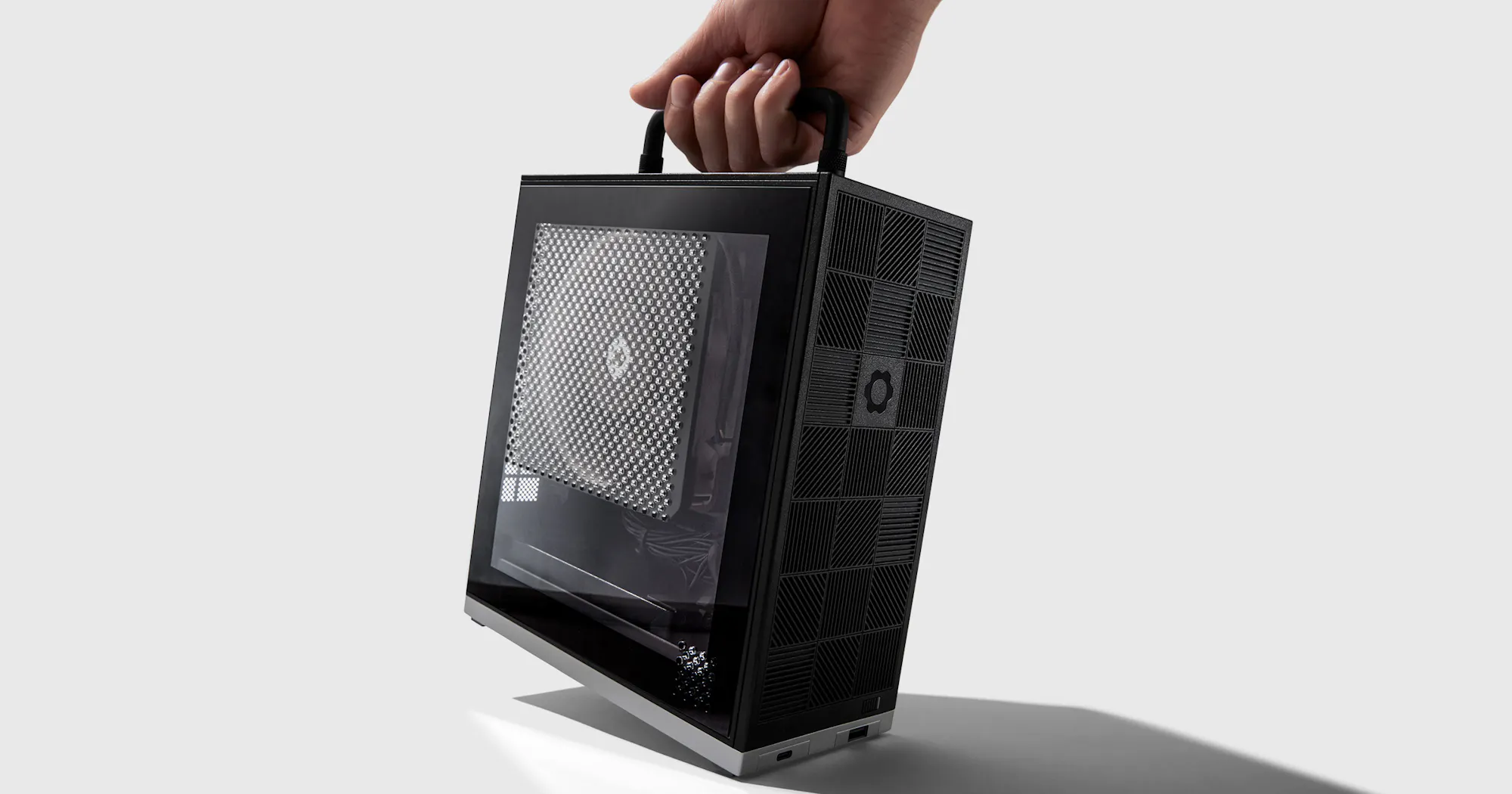
Physically, the Framework Desktop is a 4.5-liter mini-ITX case measuring 96.8 x 205.5 x 226.1mm and weighing 3.1kg. Connectivity includes HDMI 2.1, two DisplayPort 2.1 outputs, two USB4 Type-C ports, two USB-A 3.2 Gen 2 ports, 5Gbit Ethernet, Wi-Fi 7, a 3.5mm jack, and two front expansion-card bays that take the same swappable Expansion Cards as Framework's laptops. There's also an internal PCIe x4 slot. Framework ships the Desktop with no OS preinstalled; the company publishes its own install guides for Windows 11 and for Linux distributions including Fedora and Bazzite, and buyers can install essentially anything that runs on x86 hardware, including SteamOS-adjacent builds.
Steam Machine: specs and pricing
Valve's Steam Machine, announced in November 2025 and released in June 2026, is built around a semi-custom AMD chip rather than an off-the-shelf part. The CPU is a six-core/12-thread Zen 4 design clocked up to 4.8GHz at a 30W TDP, and the GPU is a semi-custom RDNA 3 design with 28 compute units clocked up to 2.45GHz at a 110W TDP, backed by 8GB of dedicated GDDR6 VRAM. System memory is fixed at 16GB of DDR5. Storage comes as a 512GB or 2TB M.2 2230 SSD, with an internal M.2 2280 expansion slot and a microSD card reader for additional storage. For a deeper breakdown of the hardware, see Pandromeda's Steam Machine specs explainer.
The case measures 156 x 152 x 162.4mm and weighs 2.6kg — notably smaller and lighter than the Framework Desktop. Ports include two USB-A 3.2 Gen 1 ports and a microSD slot on the front, plus a USB-C 3.2 Gen 2 port, two more USB-A ports, Gigabit Ethernet, DisplayPort 1.4, and HDMI 2.0 on the back, along with Wi-Fi 6E, Bluetooth 5.3, and a built-in 2.4GHz radio for pairing Valve's redesigned Steam Controller. The Steam Machine runs SteamOS 3.x, Valve's Arch Linux-based operating system, exclusively — there is no Windows option and no documented path to a different OS at launch.
Pricing starts at $1,049 for the 512GB model without a controller, or $1,128 bundled with the new Steam Controller. The 2TB model starts at $1,349, or $1,428 with the controller. Valve sold the console through a randomized reservation queue rather than ordinary pre-orders, citing both anti-scalping concerns and component costs — including the same memory-market pressure that pushed Framework's prices up. Full detail on that pricing structure is on Valve's own Steam Machine hardware page.
Framework Desktop vs Steam Machine: spec-for-spec
| Spec | Framework Desktop (300 Series) | Valve Steam Machine |
|---|---|---|
| CPU | AMD Ryzen AI Max 385 (8C/16T) or Max+ 395 (16C/32T) | Semi-custom AMD Zen 4, 6C/12T, up to 4.8GHz |
| GPU | Radeon 8050S (32 CU) or Radeon 8060S (40 CU), integrated | Semi-custom AMD RDNA 3, 28 CU, up to 2.45GHz |
| System memory | 32GB, 64GB or 128GB soldered LPDDR5x-8000 (shared CPU/GPU) | 16GB DDR5 (fixed) + 8GB dedicated GDDR6 VRAM |
| Storage | User-supplied M.2 (not included on DIY edition) | 512GB or 2TB NVMe SSD + microSD, included |
| Operating system | None preinstalled; Windows 11, Linux (Fedora, Bazzite, etc.) officially supported | SteamOS 3.x only |
| Dimensions / weight | 96.8 x 205.5 x 226.1mm, 4.5L, 3.1kg | 156 x 152 x 162.4mm, 2.6kg |
| Key ports | HDMI 2.1, 2x DP 2.1, 2x USB4-C, 2x USB-A, 5Gbit Ethernet, Wi-Fi 7 | HDMI 2.0, DP 1.4, USB-C 3.2, 3x USB-A, Gigabit Ethernet, Wi-Fi 6E |
| Starting price | $1,139 (32GB) | $1,049 (512GB, no controller) |
| Top configuration (this tier) | $2,459 (128GB) | $1,428 (2TB + controller) |
| Upgradability | PCIe x4 slot, swappable Expansion Cards, user-chosen storage | One internal M.2 2280 slot, microSD; RAM and GPU fixed |
Gaming: what the specs suggest
Neither company has published directly comparable first-party benchmarks against the other's box, so this section sticks to what the spec sheets support rather than any lab numbers. The Framework Desktop's Radeon 8060S GPU (40 compute units) outweighs the Steam Machine's 28-CU RDNA 3 GPU on paper, and Framework markets the 395 configuration for 1440p gaming. The Steam Machine's GPU is specced closer to a laptop-class RDNA 3 part and is tuned by Valve specifically for SteamOS and Proton compatibility, with FSR upscaling support called out on Valve's hardware page for hitting higher output resolutions on a TV. In practice, the Steam Machine's advantage is software integration — it boots straight into Steam's console-like Big Picture-style interface — while the Framework Desktop's advantage is raw GPU headroom and the freedom to run Windows if a particular game or anti-cheat system doesn't work under Linux.
Local AI workloads
This is the category where the two machines aren't really competing. Framework explicitly positions the 128GB Ryzen AI Max+ 395 configuration as a local-AI box, leaning on the large unified memory pool (up to 96GB of which can be addressed by the GPU) to run large language models entirely on-device without cloud compute. The Steam Machine's 16GB of system RAM and 8GB of VRAM are sized for games, not for hosting large models locally — Valve has made no local-AI claims for the device, and its memory footprint would struggle with the model sizes Framework is marketing toward. If local AI inference is part of the use case, the Framework Desktop is the only one of the two built for it.
Pricing and what you actually get
At the entry level, the Steam Machine is cheaper: $1,049 gets a complete, storage-included console that's ready to play games on a TV out of the box. The equivalent-tier Framework Desktop, the $1,139 32GB configuration, ships without storage or an OS, so the real out-the-door cost is higher once you add an SSD and either a Windows license or time spent installing Linux. Framework's price has also been a moving target all year — its own blog documents repeated increases through 2026 tied to LPDDR5x memory costs, including the jump from $1,999 to $2,459 on the 128GB tier. Valve has pointed to the same industry-wide memory-cost pressure as a factor in Steam Machine pricing and limited initial stock. Neither company controls the memory market, but Framework's model (user-chosen memory tier, frequent repricing) exposes buyers to that volatility more directly than Valve's fixed four-SKU lineup does.
Who should buy which
Buy the Framework Desktop if you want a general-purpose small-form-factor PC: one that can run Windows for game compatibility or productivity, scale memory up to 128GB for local AI or heavy multitasking, and accept internal parts (storage, Expansion Cards) over time. It's the pick for someone who wants one flexible box rather than a dedicated games console. For readers comparing it against similarly premium RAM-flexible rivals, Pandromeda has also covered the 192GB Ryzen AI Max+ PRO 495 variant in more detail.
Buy the Steam Machine if the goal is the lowest-friction path to PC gaming on a television: a sealed, Valve-tuned appliance with no OS decisions to make, a included controller option, and a lower entry price. It is not upgradable in any meaningful way beyond storage, and it cannot run Windows or non-Steam software stacks the way a general PC can. Readers who are also weighing it against Sony's console can see Pandromeda's Steam Machine vs PS5 Pro comparison for that angle.
What's next
Both products are likely to keep moving. Framework has signaled that 2026's memory market remains volatile and that further Desktop price changes are possible, and the company has already expanded the line upward with the 192GB PRO 495 workstation tier. Valve, meanwhile, is still working through its randomized reservation queue for Steam Machine units, and wider availability (plus any software updates to SteamOS's Proton compatibility layer) will shape how the console performs against PC alternatives over the next few quarters. Buyers choosing between the two today are really choosing between an open platform that will keep evolving in hardware configurations, and a fixed console platform that will evolve mainly through software.
Frequently asked questions
Which is cheaper, the Framework Desktop or the Steam Machine?
The Steam Machine is cheaper at entry: $1,049 for the 512GB model without a controller. The least expensive Framework Desktop configuration, the 32GB Ryzen AI Max 385, starts at $1,139 and does not include storage or an operating system, so its real out-the-door cost is higher.
Can the Framework Desktop run Windows?
Yes. Framework ships the Desktop with no OS preinstalled, but the company publishes official install guides for Windows 11 as well as Linux distributions including Fedora and Bazzite.
Can the Steam Machine run Windows or other operating systems?
No. The Steam Machine runs SteamOS 3.x exclusively, and Valve has not documented any supported path to installing Windows or another OS on it.
How much RAM does each device have?
The Framework Desktop offers 32GB, 64GB, or 128GB of soldered LPDDR5x memory shared between CPU and GPU (and up to 192GB on the separate PRO 495 workstation variant). The Steam Machine has a fixed 16GB of DDR5 system memory plus 8GB of dedicated GDDR6 VRAM.
Why did the Framework Desktop's price go up in 2026?
Framework's own blog attributes repeated 2026 price increases to rising LPDDR5x memory costs from its suppliers, with the 128GB configuration affected most, rising from $1,999 to $2,459.
Is the Framework Desktop or Steam Machine better for local AI?
The Framework Desktop is built for this use case. Its 128GB configuration allocates up to 96GB of unified memory to the GPU for running large AI models locally, while the Steam Machine's 16GB of RAM and 8GB of VRAM are sized for gaming, not local AI workloads.
Sources
- Framework Desktop specs — frame.workframe.work
- Framework blog: memory pricing updatesframe.work
- Valve: Steam Machine hardware pagestore.steampowered.com
- Wikipedia: Steam Machine (2026)en.wikipedia.org
- Framework Desktop product pageframe.work
Mara Lindqvist edits the hardware desk. She covers graphics cards, processors, memory and storage, the foundries and chip designers behind them, and what the numbers on a spec sheet mean for people choosing a PC. Specifications in her stories come from manufacturer spec pages and datasheets.