Steam Machine Explained: Price, Release Date, and Specs
Valve’s SteamOS living-room console is here. Here’s the official release date, price for every configuration, full specs, and how it stacks up against PS5 and Steam Deck.
The Steam Machine is Valve's SteamOS-powered living-room console, released on June 29, 2026, priced from $1,049 for the 512GB model to $1,428 for the top 2TB-plus-controller bundle. It runs on a semi-custom AMD Zen 4 and RDNA 3 chip that Valve says delivers roughly six times the horsepower of the Steam Deck, plugs into a TV like any other console, and plays the same Steam library — including thousands of Proton-compatible Windows games — without a separate gaming PC.
Steam Machine at a glance
- Release date: June 29, 2026
- Price: $1,049 (512GB) to $1,428 (2TB + Steam Controller)
- Chip: Semi-custom AMD Zen 4 CPU + RDNA 3 GPU (28 CUs)
- Memory / storage: 16GB DDR5 RAM, 512GB or 2TB SSD
- OS: SteamOS, TV-optimized, same Steam library as Deck and PC
- How to get one: Reservation queue via Valve's Steam Machine hub
What Is the Steam Machine?
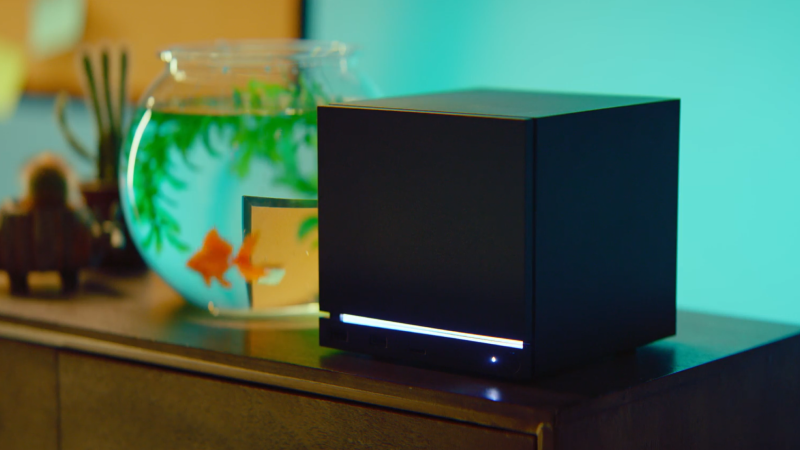
The Steam Machine is Valve's second attempt at a dedicated living-room gaming console, and this time it's built around the same SteamOS foundation that made the Steam Deck a hit. Where the original 2015 "Steam Machines" were a loose family of PCs built by third-party manufacturers like Alienware and Zotac — running an earlier, rougher version of SteamOS and largely abandoned by 2018 — the 2026 Steam Machine is a single Valve-designed box: a roughly cube-shaped device that connects to a TV or monitor and runs a TV-optimized version of SteamOS instead of Windows.
Think of it as a Steam Deck for the couch. It uses the same Steam library, the same Proton compatibility layer for running Windows-only games on Linux, and the same "Verified" and "Playable" compatibility ratings Valve already built for the Deck — but with a much bigger, desktop-class chip inside, and no screen or battery to worry about. Valve confirmed the Steam Machine alongside a new Steam Controller and the Steam Frame VR headset, all of which share the same SteamOS ecosystem, according to the company's official launch announcement on the Steam news hub.
The timing matters. Steam Deck's 2022 launch proved there was real demand for SteamOS as a Windows alternative, and it gave Valve years to mature Proton's game compatibility before betting on a second, more powerful device. The Steam Machine inherits all of that groundwork rather than starting from scratch, which is a large part of why Valve is positioning it as a sibling to the Deck instead of a totally separate product line.
Steam Machine Release Date
The Steam Machine released on June 29, 2026, following a reservation-based rollout rather than a traditional simultaneous on-shelf launch. Instead of an open pre-order, Valve required customers to sign up for a queue ahead of time; eligibility was limited to Steam accounts in good standing that had made a purchase on Steam before April 27, 2026. Valve then randomized the order of that queue on June 25, 2026, and began emailing invitations to purchase the week of June 29, continuing through the rest of the year as more units become available. That reservation-and-invitation process is documented directly on the Steam Machine hub page, and it means "release date" for any individual buyer can mean anything from launch week to a later invitation email, depending on when they signed up and which configuration they chose.
Steam Machine Price and Configurations
Valve sells the Steam Machine in two storage tiers, each available with or without a bundled Steam Controller. All four configurations use identical internals — the only difference is the SSD size and whether a controller is included.
| Configuration | Storage | Controller Included | Price (USD) |
|---|---|---|---|
| Steam Machine 512GB | 512GB SSD | No | $1,049 |
| Steam Machine 512GB + Controller | 512GB SSD | Yes | $1,128 |
| Steam Machine 2TB | 2TB SSD | No | $1,349 |
| Steam Machine 2TB + Controller | 2TB SSD | Yes | $1,428 |
That $1,049 starting price landed higher than many expected for a device Valve had originally hoped to price closer to the Deck. Both storage tiers ship with a microSD slot for expandable storage, and the internal SSD itself can be swapped for a larger M.2 2280 drive, so the storage tier you pick at checkout isn't necessarily permanent.
Steam Machine Specs: CPU, GPU, RAM, and Storage
Every Steam Machine configuration uses the same semi-custom AMD silicon, which is where most of the price premium over the Deck comes from. Full specs, as listed on Valve's own hub page:
| Component | Steam Machine |
|---|---|
| CPU | Semi-custom AMD Zen 4, 6 cores / 12 threads, up to 4.8GHz, 30W TDP |
| GPU | Semi-custom AMD RDNA 3, 28 compute units, 2.45GHz max sustained clock, 110W TDP |
| Memory | 16GB DDR5 RAM + 8GB GDDR6 video memory |
| Storage | 512GB or 2TB internal SSD (M.2 2230), expandable via M.2 2280 and microSD |
| Connectivity | 2x2 Wi-Fi 6E, Bluetooth 5.3, Gigabit Ethernet, DisplayPort 1.4, HDMI 2.0, 1x USB-C, 4x USB-A |
| Dimensions / weight | 156 x 152 x 162.4mm, 2.6kg |
| Operating system | SteamOS |
Valve pairs that hardware with output up to 4K resolution, and the RDNA 3 GPU's 8GB of dedicated GDDR6 video memory sits separately from the system's 16GB of DDR5 RAM — a split that mirrors how a discrete graphics card works in a full-size gaming PC, rather than the shared-memory setup used on Steam Deck. Valve's own marketing pegs the result at "over six times the horsepower" of the Deck's Zen 2/RDNA 2 APU.
SteamOS, Proton, and Game Compatibility
The single biggest difference between the Steam Machine and a traditional console isn't the hardware — it's the operating system. SteamOS is a Linux-based OS with a console-style interface layered on top, but underneath it's still a PC operating system. That means the Steam Machine can, in principle, run any game in a player's existing Steam library, not just titles built specifically for it. Native Linux games run directly; the much larger pool of Windows-only games runs through Proton, Valve's compatibility layer that translates Windows API calls on the fly.
Valve rates every game in the Steam catalog against Deck and Steam Machine hardware using the same "Verified," "Playable," and "Unsupported" tiers it introduced for Deck in 2022, so buyers can check compatibility before purchasing rather than discovering issues after the fact. Because SteamOS is still fundamentally a PC platform, it also supports things closed consoles don't: third-party storefronts and launchers installed through desktop mode, mod tools, and a real file system underneath the console-style interface. The tradeoff is that a small slice of games — particularly ones with kernel-level anti-cheat that hasn't been ported to Linux — remain unsupported, the same limitation Steam Deck owners have lived with for years.
Steam Machine vs. PS5, PS5 Pro, and Steam Deck
The Steam Machine competes less on raw specs than on what it lets you do: buy a game once on Steam and play it on a TV, a handheld, or a desktop PC, all with the same save files and library. Here's how it stacks up against the living-room consoles it's most often compared to.
| Device | Starting Price | Storage | Library / OS | Form Factor |
|---|---|---|---|---|
| Steam Machine | $1,049 | 512GB–2TB | Steam / SteamOS | Living-room console |
| Steam Deck OLED | $649 | 512GB–1TB | Steam / SteamOS | Handheld |
| PS5 (Digital) | $599.99 | ~1TB | PlayStation Store | Living-room console |
| PS5 Pro | $899.99 | 2TB | PlayStation Store | Living-room console |
Sony raised US prices on its own lineup earlier in 2026, and its PlayStation Blog price update puts the PS5 Digital Edition at $599.99 and PS5 Pro at $899.99 — both still cheaper than any Steam Machine configuration. What the Steam Machine trades that price gap for is an open PC library instead of a closed console storefront: it plays the same games you already own on Steam, supports mods and third-party storefronts the way a PC does, and isn't locked to PlayStation exclusives. The PS5 Pro's official product page leans on its 2TB built-in SSD, Wi-Fi 7, and AI-driven PSSR upscaling as its core pitch, while Valve's pitch is closer to "everything the Deck can do, at four to six times the performance." For a closer look at how Sony's two current consoles differ from each other, see our PS5 vs. PS5 Pro breakdown.
Steam Controller and Input Options
The Steam Machine's optional bundle partner is Valve's new Steam Controller, which pairs directly to the console through a built-in wireless adapter — no separate USB dongle required. Buyers who skip the controller bundle can still use any Bluetooth or wired gamepad, including an Xbox or PlayStation controller, since SteamOS handles third-party input the same way it does on Steam Deck and on PC. Keyboard and mouse also work over USB or Bluetooth for games and desktop-mode tasks that need precise input.
Who Should Buy a Steam Machine
The Steam Machine makes the most sense for people already invested in a Steam library who want a quiet, console-sized box under the TV instead of a full gaming PC. If you already own a Steam Deck and love SteamOS but want 4K output and console-class frame rates without building a PC, the Steam Machine is a direct upgrade path — you keep the same library, save files, and Proton compatibility, just with far more headroom for demanding, newer titles. Valve's own Steam Deck store page makes that shared-ecosystem pitch explicit: buy a game once, and it follows you between handheld and living room.
It's a weaker pick if your primary interest is PlayStation or Xbox exclusives, since those still aren't available on Steam, or if $1,049-plus is more than you want to spend on hardware that's roughly comparable in raw power to a mid-range gaming laptop rather than a top-tier desktop rig. Households that mostly play multiplayer shooters with strict kernel-level anti-cheat should also check compatibility ratings first, since a handful of those titles still don't run on SteamOS. Anyone weighing a handheld instead of a console-sized box should look at how Steam Deck stacks up against Windows-based rivals in our Steam Deck OLED comparison against the ROG Xbox Ally handhelds, since the tradeoffs between SteamOS and Windows show up there too.
How to Pre-Order or Buy a Steam Machine
Because the Steam Machine launched through a reservation queue rather than open retail stock, buying one isn't as simple as adding it to a cart. The process, as Valve lays it out on the official Steam Machine store page:
- Sign in to a Steam account that has made at least one purchase before April 27, 2026, and is in good standing.
- Choose which configuration(s) you want to sign up for — you can join the queue for more than one model if you're flexible on storage size or the controller bundle.
- Wait for the randomized queue draw; if you're allocated a reservation slot, Valve emails an invitation with a window to complete the purchase.
- If you don't get an invitation in the first wave, you stay in the queue, since Valve says it expects to keep sending invitation emails through the rest of the year as supply increases.
There's currently no walk-in retail alternative — every unit ships through this same reservation system directly from Valve.
What's Next for Steam Machine
Valve has been explicit that supply will stay constrained for a while, with invitation waves continuing throughout the rest of 2026 rather than a single mass restock. Expect the reservation queue to remain the only way to buy one for the foreseeable future, alongside continued SteamOS updates that improve game compatibility ratings over time, the same way Steam Deck's "Verified" library has grown since 2022. The Steam Machine also shares its software base with Valve's Steam Frame VR headset and the new Steam Controller, both announced at the same time, so updates to one piece of that ecosystem — controller firmware, SteamOS releases, Proton compatibility fixes — are likely to keep landing across all three devices together. For background on the console and its predecessor family, Wikipedia's Steam Machine (2026) entry tracks the device's full announcement and launch timeline.
Frequently asked questions
How much does the Steam Machine cost?
Valve prices the Steam Machine from $1,049 for the 512GB model without a controller up to $1,428 for the 2TB model bundled with a Steam Controller. The 512GB-plus-controller bundle is $1,128, and the 2TB model without a controller is $1,349.
When did the Steam Machine release?
The Steam Machine released June 29, 2026. Valve sold it through a reservation queue rather than open retail stock: sign-ups closed June 25, 2026, when the queue order was randomized, and invitation emails to purchase began going out that same week.
What are the Steam Machine's specs?
It uses a semi-custom AMD Zen 4 CPU (6 cores/12 threads, up to 4.8GHz), a semi-custom AMD RDNA 3 GPU (28 compute units), 16GB of DDR5 RAM, 8GB of GDDR6 video memory, and either 512GB or 2TB of SSD storage.
Is the Steam Machine more powerful than a PS5?
Valve markets the Steam Machine as roughly six times more powerful than Steam Deck, not as a direct PS5 comparison. Its RDNA 3 GPU and Zen 4 CPU are newer architectures than the PS5's, but Valve has not published head-to-head benchmarks against PS5 or PS5 Pro, so treat direct performance comparisons as unconfirmed until independently tested.
Do I need a Steam Controller to use the Steam Machine?
No. Any Bluetooth or wired gamepad works, including Xbox and PlayStation controllers, since SteamOS handles third-party input the same way Steam Deck and Steam on PC do. Keyboard and mouse are also fully supported.
How do I buy a Steam Machine?
Sign up for Valve's reservation queue on the official Steam Machine page using a qualifying Steam account. If you're selected in the randomized draw, Valve emails an invitation with a window to complete the purchase directly through Steam.
Sources
- Steam Machine official hub (specs, storage, reservation process)store.steampowered.com
- Valve's official Steam Machine launch announcementstore.steampowered.com
- Steam Deck official store pagestore.steampowered.com
- PlayStation Blog: PS5 and PS5 Pro price changesblog.playstation.com
- PS5 Pro official product pageplaystation.com
- Wikipedia: Steam Machine (2026)en.wikipedia.org
Jonah Reyes leads Pandromeda's gaming coverage: console and handheld hardware, release dates, pricing changes, patch notes and the business moves behind the biggest franchises. He sources every date and price from the platform holders and publishers themselves, and says plainly when something is still only a rumour.