Framework Desktop: Ryzen AI Max+ PRO 495, 192GB Memory
Framework's first desktop PC runs AMD's newest "Gorgon Halo" chip with up to 192GB of unified memory, aimed at local AI workloads too big for a laptop.
Quick facts
- Chip: AMD Ryzen AI Max+ PRO 495 ("Gorgon Halo") — 16 Zen 5 cores / 32 threads, Radeon 8065S graphics (40 compute units)
- Memory: Up to 192GB of unified LPDDR5X-8533 on a 256-bit bus (32GB/64GB/128GB/192GB options across the Desktop line)
- Configs: DIY Edition (bring your own storage and OS) and a Fedora-preloaded Pre-built Edition
- Price (192GB, confirmed on frame.work): $6,799 for the DIY Edition, $7,449 for the Pre-built Edition, before tax and duties
- Shipping: Framework's own configurator lists its initial batches as shipping in November, with both listed batches showing as sold out at time of writing
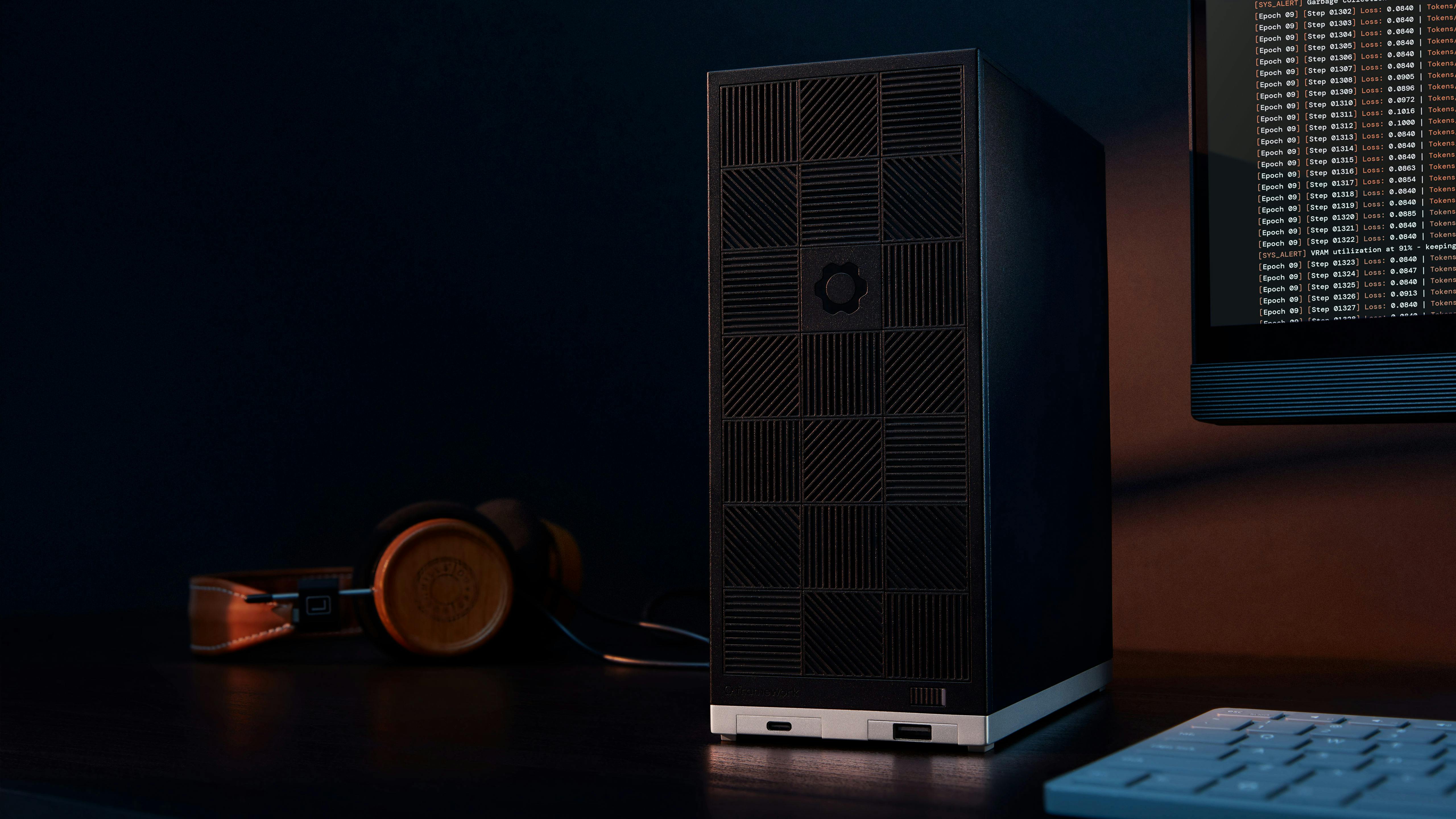
Framework, the Oregon-based right-to-repair PC maker best known for its modular laptops, has built its first desktop computer. The Framework Desktop is a 4.5-liter mini workstation built around AMD's newest Ryzen AI Max chip, the Ryzen AI Max+ PRO 495, and its headline feature is memory: a 192GB unified-memory configuration that Framework and AMD say is the largest capacity yet offered on this chip family, up from 128GB on the prior-generation Ryzen AI Max+ 395.
That jump matters because the Ryzen AI Max architecture shares a single pool of fast LPDDR5X memory between the CPU and integrated GPU, the same basic approach Apple uses with unified memory on its M-series chips. More shared memory means larger local AI models can be loaded onto a single small-footprint desktop without a discrete GPU, which is the use case Framework is leaning on hardest in its own marketing for this machine.
What the Framework Desktop actually is
The Framework Desktop is a small-form-factor PC, not a laptop — a distinct product line from the Framework Laptop 12 that the company shipped earlier. According to Framework's product page, the desktop measures 96.8mm (W) x 205.5mm (D) x 226.1mm (H), weighs 3.1kg, and has a 4.5-liter internal volume. Framework describes it as a "4.5L workstation," and it's built around a standard Mini-ITX mainboard and a FlexATX power supply, both of which the company says can be pulled out and reused in a different case if someone wants to build their own enclosure.
Cooling comes from a single 120mm CPU fan. Storage is handled by dual M.2 2280 NVMe slots, and there is one PCIe x4 slot that Framework says is physically open-ended on this configuration, meaning it can physically accept longer x8 or x16 cards without needing a riser, even though it still runs electrically at four lanes.
The chip: AMD Ryzen AI Max+ PRO 495 ("Gorgon Halo")
The Ryzen AI Max+ PRO 495 is AMD's newest high-end Ryzen AI Max part, and according to AMD's own product page it carries 16 Zen 5 CPU cores and 32 threads, with a base clock of 3.1GHz and a maximum boost clock of up to 5.2GHz. AMD lists 16MB of L2 cache and 64MB of L3 cache, a default TDP of 55W with a configurable TDP range of 45W to 120W, and says the chip is built on a TSMC 4nm FinFET process across three dies.
The integrated graphics are Radeon 8065S, with 40 compute units running at up to 3000MHz and support for DisplayPort 2.1 with UHBR20 bandwidth. AMD's spec sheet also lists an NPU rated at up to 55 TOPS, with up to 132 TOPS of overall platform AI throughput and up to 61 TFLOPS of FP16 AI compute when the CPU, GPU, and NPU are combined. On the memory side, AMD's page confirms the chip supports a 256-bit LPDDR5x memory bus with a maximum capacity of 192GB at LPDDR5x-8533 speeds — matching exactly what Framework lists for its reference configuration.
Up to 192GB of unified memory, and why it's the headline spec
Framework's memory table for the Desktop line shows a clear progression across the Ryzen AI Max family: the Ryzen AI Max 385 tops out at 32GB, the Ryzen AI Max+ 395 can be configured with 64GB or 128GB, and the new Ryzen AI Max+ PRO 495 is the only chip in the lineup offered with 192GB. Because the memory is unified and addressable by the GPU as VRAM, Framework's pitch is that a single compact desktop can now hold local AI models that previously needed either a multi-GPU workstation or a cloud instance — a question we've looked at more generally in our guide to how much VRAM you actually need in 2026.
On its product page, Framework cites a reference-configuration benchmark in which the 192GB Ryzen AI Max+ PRO 495 model ran DeepSeek V4.1 Flash at Q2 quantization using 163GB of the available memory, with a 2048-token context and a batch size of one. Framework does not publish tokens-per-second figures for this test, and says performance will vary with quantization, context length, and the inference runtime used, so treat the 163GB figure as a memory-footprint data point rather than a speed benchmark.
| Chip | Memory | Model run (Framework's example) | Quantization | Memory used |
|---|---|---|---|---|
| Ryzen AI Max 385 | 32GB | Qwen3.8-27B | UD-Q4_K_XL | 17.6GB |
| Ryzen AI Max+ 395 | 64GB | Qwen3.5-122B-A10B | Q3_K_S | 52.5GB |
| Ryzen AI Max+ 395 | 128GB | DeepSeek V4 Flash 0731 | UD-IQ2_XXS | 90.9GB |
| Ryzen AI Max+ PRO 495 | 192GB | DeepSeek V4.1 Flash Q2 | Q2 | 163GB |
Source: Framework, frame.work/desktop. Figures are Framework's own reference-configuration examples, not independent benchmarks.
Full spec sheet
| Spec | Framework Desktop (Ryzen AI Max+ PRO 495 config) |
|---|---|
| CPU | AMD Ryzen AI Max+ PRO 495, 16 Zen 5 cores / 32 threads, 3.1GHz base / up to 5.2GHz boost |
| GPU | Radeon 8065S, 40 compute units, up to 3000MHz |
| NPU | Up to 55 TOPS (up to 132 TOPS platform total) |
| Cache | 16MB L2 / 64MB L3 |
| TDP | 55W default, 45–120W configurable |
| Memory | 192GB LPDDR5X-8533, 256-bit bus, unified/soldered |
| Storage | 2x M.2 2280 NVMe slots |
| Expansion | 1x open-ended PCIe x4 slot; 2x front Framework Expansion Card slots |
| Rear I/O | 1x HDMI, 2x USB-C (USB4), 2x DisplayPort, 2x USB-A, 1x 5Gbit Ethernet, 3.5mm audio |
| Mainboard | Mini-ITX, removable |
| PSU | FlexATX |
| Cooling | 120mm CPU fan |
| Dimensions | 96.8mm (W) x 205.5mm (D) x 226.1mm (H) |
| Weight / Volume | 3.1kg / 4.5L |
| OS (Pre-built) | Fedora 44 KDE Plasma, pre-installed |
| OS (DIY) | User-supplied |
Source: Framework (frame.work/desktop and frame.work configurator pages) and AMD (amd.com).
Design, expansion cards, and the Mini-ITX mainboard
Framework is carrying its laptop-era modularity ideas into the desktop. The two front-facing slots use the same Expansion Card system from Framework's laptops, and according to the product page they can be fitted with USB-C (3.2 Gen 2), USB-A (3.2 Gen 1), a 3.5mm audio jack, microSD, full-size SD, 2.5Gbit Ethernet, or a 250GB/1TB storage card, letting an owner swap front-panel I/O without opening the case. Framework also says the Mini-ITX mainboard inside is designed to be pulled out and reused in a different enclosure, in keeping with the company's repairability positioning.
Ports and connectivity
Fixed rear I/O covers a single HDMI port, two USB-C ports running USB4, two DisplayPort outputs, two USB-A ports, a 5Gbit Ethernet jack, and a 3.5mm headphone jack. The lone internal PCIe x4 slot is pitched by Framework specifically at networking upgrades — the company gives the example of a 50Gbps RoCE network card, such as an Intel E810, for linking multiple Desktop units together.
Clustering multiple Framework Desktops together
Framework is explicitly marketing the Desktop as a building block for small local-AI clusters rather than only a standalone box. Its product page describes two ways to link units: USB4 for pipeline parallelism or running separate "agents" across machines, and the PCIe x4 slot paired with RoCE network cards for tensor parallelism. As an example, Framework's page describes four 192GB nodes wired together for a combined 768GB of addressable unified memory.
Pricing, configurations, and availability
Framework sells the Desktop in two editions. The DIY Edition ships without memory, storage, or an OS pre-installed, letting the buyer supply their own NVMe drives and operating system. The Pre-built Edition arrives ready to use with Fedora 44 KDE Plasma pre-installed. A separate volume-ordering path exists for business and bulk buyers through a contact form.
Framework does not publish pricing or shipping details on its main product overview page, so the figures below come from the company's own order configurators rather than the overview page itself. For the 192GB Ryzen AI Max+ PRO 495 configuration specifically, Framework's DIY Edition configurator lists a pre-order price of $6,799 before tax and duties, and the Pre-built Edition configurator lists $7,449 for the same memory tier. Both configurator pages describe a "Limited Batch 1," already marked sold out, and a "Limited Batch 2," both slated to ship in November; at the time of writing, both pages showed the 192GB configuration as out of stock, meaning new orders may need to wait for a future batch. Framework's configurators list only the 192GB tier for the Ryzen AI Max+ PRO 495 model — the 32GB, 64GB, and 128GB memory options on the Desktop line are tied to the lower Ryzen AI Max 385 and Ryzen AI Max+ 395 chips instead, not to the PRO 495.
DIY vs. Pre-built: which to choose
The practical difference comes down to how hands-on a buyer wants to be. The DIY Edition is for people who already have NVMe storage on hand, want to choose their own Linux distribution (or install Windows themselves), or simply want the lower up-front price before adding their own parts. The Pre-built Edition costs more but removes the installation step entirely, arriving with Fedora already configured — a reasonable default for anyone who wants to plug the Desktop in and start running local models or using it as a general workstation immediately.
How it fits next to Framework's other machines — and AMD's other chip
This is a different product from Framework's existing laptop line, and a different chip generation from the Ryzen AI Max+ 395 that the site has already covered in its comparison against Nvidia's DGX Spark. The 395 tops out at 128GB of memory; the new PRO 495 in the Desktop goes to 192GB, which is the real differentiator between the two generations rather than a change in CPU core count — both chips carry 16 Zen 5 cores, with the newer part picking up a higher boost clock, a larger integrated GPU, and the expanded memory ceiling. Buyers deciding between a Ryzen AI Max machine and a dedicated AI appliance like DGX Spark now have a third data point to weigh: a general-purpose Mini-ITX desktop that happens to also handle large local models, rather than a single-purpose AI box.
What's next
The immediate open questions are about supply. Framework's own configurators show its first two order batches for the 192GB configuration already sold out as of this writing, with November shipping dates attached to both, so the near-term story is less about new hardware announcements and more about how quickly Framework can refill stock. Framework has also signaled, through the clustering features built into this machine, that it sees networked Desktop units as a cheaper on-ramp into larger local-AI setups than buying a single very expensive workstation GPU — whether that holds up in practice will depend on real-world throughput numbers that neither Framework nor AMD has published yet. Framework has not said whether lower-memory PRO 495 configurations or additional chip options are planned for the Desktop line beyond the 192GB launch tier.
Frequently asked questions
What is the Framework Desktop? It's Framework's first desktop PC, a 4.5-liter Mini-ITX machine built around AMD's Ryzen AI Max+ PRO 495 chip, sold in DIY and Pre-built editions.
How much memory does it support? Up to 192GB of unified LPDDR5X-8533 memory on a 256-bit bus, shared between the CPU and integrated GPU.
How much does it cost? Framework's own order configurators list $6,799 for the 192GB DIY Edition and $7,449 for the 192GB Pre-built Edition, both before tax and duties.
When does it ship? Framework's configurators list November shipping for its initial order batches; both listed batches show as sold out at the time of writing.
Can multiple units be networked together? Yes — Framework describes using USB4 or a PCIe-connected RoCE network card to link several Desktop units for larger AI workloads.
Is this the same chip as the Framework Laptop 12 or the Ryzen AI Max+ 395? No. The Laptop 12 is a different product line, and the Ryzen AI Max+ 395 is the prior-generation chip, limited to 128GB of memory versus 192GB on the new Ryzen AI Max+ PRO 495.
Frequently asked questions
What is the Framework Desktop?
It's Framework's first desktop PC, a 4.5-liter Mini-ITX machine built around AMD's Ryzen AI Max+ PRO 495 chip, sold in DIY and Pre-built editions.
How much memory does it support?
Up to 192GB of unified LPDDR5X-8533 memory on a 256-bit bus, shared between the CPU and integrated GPU.
How much does it cost?
Framework's own order configurators list $6,799 for the 192GB DIY Edition and $7,449 for the 192GB Pre-built Edition, both before tax and duties.
When does it ship?
Framework's configurators list November shipping for its initial order batches; both listed batches show as sold out at the time of writing.
Can multiple units be networked together?
Yes — Framework describes using USB4 or a PCIe-connected RoCE network card to link several Desktop units for larger AI workloads.
Is this the same chip as the Framework Laptop 12 or the Ryzen AI Max+ 395?
No. The Laptop 12 is a different product line, and the Ryzen AI Max+ 395 is the prior-generation chip, limited to 128GB of memory versus 192GB on the new Ryzen AI Max+ PRO 495.
Sources
Mara Lindqvist edits the hardware desk. She covers graphics cards, processors, memory and storage, the foundries and chip designers behind them, and what the numbers on a spec sheet mean for people choosing a PC. Specifications in her stories come from manufacturer spec pages and datasheets.

