Acer Predator Atlas 8 Release Date, Price and Specs
Acer's Intel Arc G3-powered handheld ships October 2026. UK pricing runs £999.99–£1,499.99; US and EU prices are not yet confirmed.
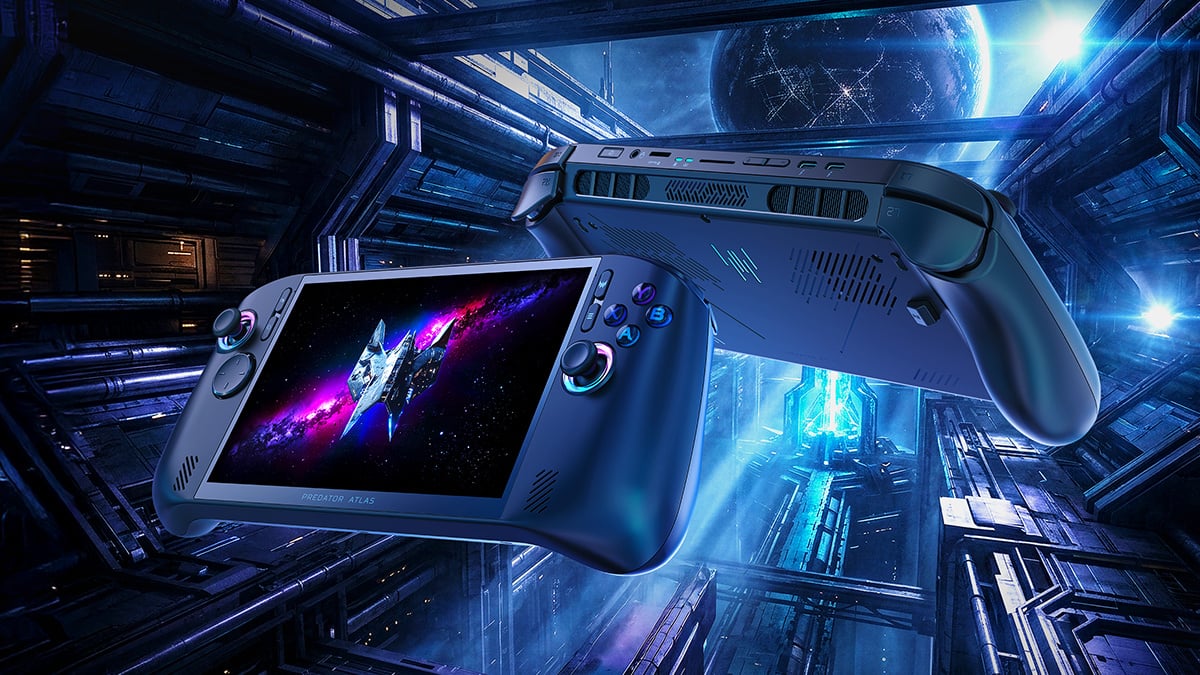
The Acer Predator Atlas 8 — Acer's first Predator-branded handheld gaming PC — is launching in October 2026 across North America, EMEA and Australia, built around Intel's new Arc G3 and Arc G3 Extreme chips. Acer has confirmed full UK pricing across four configurations, from £999.99 to £1,499.99, but as of this writing Acer has not yet published official US or EU prices for the Atlas 8.
Acer unveiled the Predator Atlas 8 (model PA08-I51) at Computex 2026, pitching it as a premium rival to Microsoft and Asus's ROG Xbox Ally lineup and Valve's Steam Deck OLED. It is the first handheld built on Intel's Panther Lake platform, pairing the Arc G3 or Arc G3 Extreme processor with an 8-inch, 120Hz touchscreen, a dual-fan cooling system with what Acer calls the industry's first metal cooling fan in a handheld, and up to an 80Wh battery. Below is everything Acer has confirmed so far about specs, pricing and availability, sourced from Acer's own press materials.
Acer Predator Atlas 8 release date
Acer says the Predator Atlas 8 will ship in October 2026 in North America, EMEA (Europe, Middle East and Africa) and Australia. Acer's press materials describe this as a global rollout window rather than a single fixed on-sale date, and the company has said that exact specifications, prices and availability will vary by region. UK retail listings and pre-order pages tied to that October window have already gone live, which is typically the strongest signal that a hard launch date is close.
This handheld arrives alongside the broader wave of Panther Lake-powered laptops, with Acer and other OEMs launching chip-and-device combinations together this cycle.
Acer Predator Atlas 8 price: what's confirmed and what isn't
Acer has confirmed UK pricing across four configurations, all tied to the chip, memory, storage and battery pairing in that specific SKU:
| Configuration | Chip / iGPU | RAM | Storage | Battery | UK price |
|---|---|---|---|---|---|
| Entry | Arc G3 / Arc B370 | 16GB LPDDR5x | 512GB PCIe Gen4 NVMe | 60Wh | £999.99 |
| Mid | Arc G3 / Arc B370 | 24GB LPDDR5x | 512GB PCIe Gen4 NVMe | 60Wh | £1,099.99 |
| Extreme | Arc G3 Extreme / Arc B390 | 24GB LPDDR5x | 1TB PCIe Gen4 NVMe | 80Wh | £1,299.99 |
| Extreme (top) | Arc G3 Extreme / Arc B390 | 32GB LPDDR5x | 1TB PCIe Gen4 NVMe | 80Wh | £1,499.99 |
US and EU pricing has not been officially announced by Acer as of this writing. Acer's own Predator Atlas 8 press release, distributed worldwide via PR Newswire in May 2026, stated only that "exact specifications, prices, and availability will vary by region" and did not list North American or EU dollar/euro figures. Treat any US dollar price you see elsewhere as a conversion or a leak, not an Acer-confirmed number, until Acer's US and EU stores list the device directly. We'll update this article the moment that happens.
- Announced: Computex 2026 (May 28, 2026)
- Model number: PA08-I51
- Launch window: October 2026
- Launch regions: North America, EMEA, Australia
- Confirmed pricing: UK only, £999.99–£1,499.99 across four configs
- Chip: Intel Arc G3 or Arc G3 Extreme (Panther Lake family)
Acer Predator Atlas 8 specs
The Predator Atlas 8 is built around Intel's new Arc G-series chips rather than the AMD silicon used in most rival handhelds, which is the headline differentiator Acer is leaning on. Here's the full official spec sheet, per Acer's press materials:
| Spec | Details |
|---|---|
| Display | 8-inch WUXGA (1920x1200), 16:10, 120Hz with VRR, 500 nits peak brightness, 100% sRGB, Corning Gorilla Glass Victus with DXC, 10-point touch |
| Chip options | Intel Arc G3 or Intel Arc G3 Extreme (Panther Lake family) |
| Graphics | Up to Intel Arc B390 iGPU (Arc B370 on the base chip) — ray tracing support and Intel XeSS 3 AI upscaling |
| Memory | Up to 32GB LPDDR5x (7467MT/s), varies by SKU |
| Storage | Up to 1TB PCIe Gen4 NVMe M.2 2280 SSD, expandable via UHS-II microSD |
| Battery | Up to 80Wh (4-cell Li-ion); 60Wh on lower-tier configs |
| Cooling | Predator AeroBlade dual-fan system with a metal fan (89 blades, 0.1mm thickness) and "Vortex Flow" tuning — Acer claims up to 10% more airflow than a plastic fan |
| Connectivity | 2x Thunderbolt 4, Wi-Fi 7, Bluetooth 5.4, 3.5mm audio jack, UHS-II microSD reader |
| OS / software | Windows 11 Home, Xbox full-screen experience, PredatorSense, bundled Xbox Game Pass trial |
| Weight | Under 810g (80Wh models) / 770g (60Wh models) |
Intel Arc G3 and Arc G3 Extreme: what's actually new here
The Arc G3 and Arc G3 Extreme are part of Intel's Panther Lake chip family, and the Predator Atlas 8 is one of the first handhelds built around them rather than AMD's Ryzen Z-series silicon that powers most of the current handheld market, including the Ally and Ally X. Acer is pitching the combination of Arc B390 graphics, ray tracing support and XeSS 3 upscaling as the thing that lets the Atlas 8 hold higher frame rates at the same wattage as a Ryzen-based rival. If you want the deeper dive into Panther Lake itself — die details, the rest of the launch lineup, non-handheld pricing — that's covered separately in our Panther Lake release date, price and specs guide; this article sticks to what's specific to the Atlas 8 handheld.
It's also worth noting Intel isn't only chasing handhelds with Panther Lake — the same chip family underpins a batch of new thin-and-light and AI-focused laptops that compete directly with Qualcomm's latest silicon, a fight we broke down in Snapdragon X2 Elite vs. Intel Core Ultra 300.
Predator AeroBlade cooling and the metal fan claim
Acer's standout engineering claim for the Atlas 8 is its cooling system. Predator AeroBlade combines two fans — one of which uses a metal blade assembly rather than the plastic fans found in every other gaming handheld on the market, according to Acer. The company says the metal fan's 89 blades, each just 0.1mm thick, deliver up to a 10% increase in airflow compared with a plastic equivalent, paired with what Acer calls "Vortex Flow" tuning to manage thermals under sustained load. In a device this size, sustained clocks under the Arc G3 Extreme's full power budget are the real test of whether that cooling claim holds up — something only independent hands-on testing after launch will settle.
Display, controls and software
The Atlas 8 uses an 8-inch WUXGA (1920x1200) panel at 120Hz with variable refresh rate support, 500 nits of peak brightness and Gorilla Glass Victus with an anti-fingerprint DXC coating — all above what most rival 7-inch handhelds offer, though it also means a larger, heavier chassis. Acer hasn't detailed the thumbstick and trigger hardware in as much depth as the display, but the device ships with PredatorSense for performance profiles and runs full Windows 11 with a Game Pass trial preloaded, rather than a locked-down console-style shell like Valve's SteamOS.
Software is one of the areas where buyers comparing handhelds should look closely. If you're cross-shopping against Microsoft and Asus's Xbox-branded handheld or Valve's SteamOS machine, our ROG Xbox Ally X20 vs. Ally X vs. Steam Deck OLED comparison covers how those software experiences differ in day-to-day use.
How the Atlas 8 fits the handheld market
Acer enters a handheld field that's gotten considerably more crowded and more expensive over the past year. At £1,499.99 for the top UK configuration, the Atlas 8 Extreme sits well above entry-level Ryzen-based handhelds and roughly in line with the priciest Xbox Ally and Steam Deck configurations. Acer's bet is that Arc G3 Extreme's ray tracing and XeSS 3 upscaling, plus the metal-fan cooling system, justify that premium for buyers who want a Windows handheld rather than a console-locked one. Whether that bet pays off will depend heavily on real-world battery life and sustained performance, neither of which Acer has published independently verifiable numbers for yet.
It's also worth remembering this is a new chip platform for handhelds specifically, distinct from the GPU-focused AI-PC push happening elsewhere in the market right now.
How to pre-order the Predator Atlas 8
UK buyers can register for priority pre-order through Acer's UK store and select retail partners, which is also where the four confirmed configurations and prices above were published. Acer has said North American, EMEA (outside the UK) and Australian availability will follow in October 2026, but has not yet opened pre-orders or listed pricing in those markets as of this writing. If you're in the US or EU, the most reliable move right now is to watch Acer's own regional store pages directly rather than relying on early price conversions, since currency-converted UK prices are not a reliable predictor of what Acer will actually charge once local pricing, tariffs and taxes are factored in.
Design, ergonomics and what you're carrying
At up to 810g with the 80Wh battery fitted, the Predator Atlas 8 is noticeably heavier than a 7-inch handheld like the Steam Deck OLED, and that extra mass comes directly from the bigger screen, the larger battery and the dual-fan cooling hardware Acer built around the Arc G3 Extreme. Acer hasn't published exact grip dimensions or thumbstick travel specs in the same detail as the rest of the spec sheet, which is typical for a pre-launch announcement; expect that level of ergonomic detail, along with independent measurements of in-hand comfort over long sessions, to surface once review units start shipping closer to the October 2026 launch.
The two Thunderbolt 4 ports are a notable inclusion for a handheld — they open the door to external GPU docks and high-speed storage in a way most rivals, which typically ship with a single USB-C port, don't match. Combined with Wi-Fi 7 and a UHS-II microSD slot, the Atlas 8's connectivity sheet reads closer to a thin-and-light laptop than a dedicated gaming console, which fits Acer's broader pitch that this is a full Windows PC first and a handheld-shaped one second.
Battery life: what Acer claims vs. what's unverified
Acer's marketing ties the Arc G3 Extreme's efficiency gains directly to the 80Wh battery, arguing the combination lets the top-end Atlas 8 run demanding titles for longer than earlier handhelds at similar chassis weight. Acer has not published specific hours-of-gameplay figures for any configuration, and nothing in the company's press materials quantifies real-world runtime at a given wattage or resolution. Battery life on handhelds varies enormously by game, power profile and screen brightness, so treat any number you see attached to the Atlas 8 before independent review units land as an estimate, not a confirmed figure from Acer.
Should you wait for the Predator Atlas 8?
If you're in the UK and want the most powerful configuration Acer has announced, the pricing and specs are already locked in: £1,499.99 gets you the Arc G3 Extreme, 32GB of RAM, a 1TB SSD and the 80Wh battery, with the entry £999.99 model trading down to the base Arc G3 chip, 16GB of RAM, a 512GB SSD and the smaller 60Wh battery. Outside the UK, there's genuinely nothing to act on yet — Acer hasn't opened pre-orders or confirmed pricing in the US or EU, so anyone shopping in dollars or euros is better off waiting for Acer's own regional announcement than trusting a converted UK price. Buyers who specifically want ray tracing and AI upscaling in a Windows handheld, rather than the AMD-based alternatives on the market today, are the clearest audience for this device; everyone else should wait for independent battery and performance testing once the October 2026 launch window arrives.
What's next
The two open questions are US/EU pricing and independent battery and thermal testing. Acer has committed to an October 2026 global launch window, so official North American and EU prices should land within the next few weeks as pre-orders open outside the UK. We'll update this article with confirmed US and EU pricing, plus any changes to the configuration lineup, as soon as Acer publishes them. Once review units are in hand, the next real test is whether the Arc G3 Extreme and the metal-fan cooling system can sustain their advertised performance away from Acer's own lab conditions.
Frequently asked questions
When does the Acer Predator Atlas 8 release?
Acer says the Predator Atlas 8 launches in October 2026 across North America, EMEA and Australia. UK pre-order and retail listings tied to that window are already live.
How much does the Acer Predator Atlas 8 cost?
UK pricing is confirmed across four configurations: £999.99 (Arc G3, 16GB RAM, 512GB SSD, 60Wh), £1,099.99 (Arc G3, 24GB RAM, 512GB SSD, 60Wh), £1,299.99 (Arc G3 Extreme, 24GB RAM, 1TB SSD, 80Wh) and £1,499.99 (Arc G3 Extreme, 32GB RAM, 1TB SSD, 80Wh). Acer has not yet announced official US or EU pricing.
What chip does the Predator Atlas 8 use?
It uses Intel's new Arc G3 or Arc G3 Extreme processors, part of the Panther Lake family, paired with an Arc B370 or Arc B390 integrated GPU with ray tracing and Intel XeSS 3 upscaling support.
What are the full specs of the Predator Atlas 8?
Key specs include an 8-inch WUXGA 120Hz VRR touchscreen, up to 32GB of LPDDR5x RAM, up to a 1TB PCIe Gen4 NVMe SSD, up to an 80Wh battery, dual-fan Predator AeroBlade cooling with a metal fan, dual Thunderbolt 4 ports, Wi-Fi 7 and Windows 11 with Xbox Game Pass.
Can I pre-order the Predator Atlas 8 in the US?
Not yet. Acer has only opened pre-order registration and confirmed pricing in the UK so far. US and EU availability is expected as part of the October 2026 launch window, but Acer hasn't published pricing or opened pre-orders in those regions as of this writing.
Is the Predator Atlas 8 the same as the Predator Atlas 7?
No. The Atlas 7 is a separate, smaller handheld in Acer's new Predator Atlas line; this article covers only the 8-inch Predator Atlas 8 and its specs and pricing.
Sources
- Acer: Predator Atlas 8 press release (PR Newswire)en.prnasia.com
- Acer Malaysia: Predator Atlas 8 product pageacer.com
- Acer Corner: Predator Atlas 8 reviewblog.acer.com
Mara Lindqvist edits the hardware desk. She covers graphics cards, processors, memory and storage, the foundries and chip designers behind them, and what the numbers on a spec sheet mean for people choosing a PC. Specifications in her stories come from manufacturer spec pages and datasheets.