Steam Frame Explained: Price, Release Date, and Specs
Valve's standalone VR headset: confirmed specs, reported price and release date, how streaming and standalone play work, and how it stacks up against Quest 3.
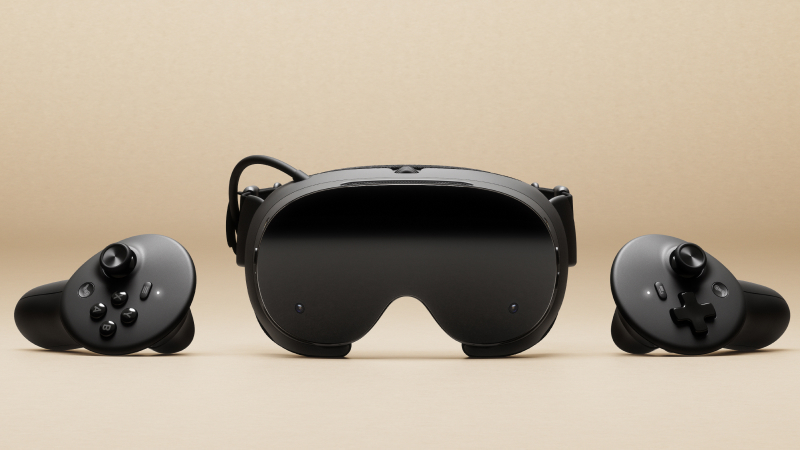
Steam Frame is Valve's standalone, wireless VR and gaming headset, unveiled alongside the Steam Machine living-room PC and a redesigned Steam Controller. It runs SteamOS on a Qualcomm Snapdragon 8 Gen 3 chipset with 16GB of RAM, comes in 256GB and 1TB storage tiers, and is built to do two things: stream a player's full Steam library wirelessly from a PC, and run a growing set of games standalone, on-device, with no PC required at all.
- What it is: Valve's standalone wireless VR/gaming headset, built around SteamOS and designed to work both on its own and streamed from a PC.
- Announced: November 12, 2025, alongside the Steam Machine and a new Steam Controller.
- Price: Not stated by Valve at announcement. A Steam pre-order/reservation listing that went live in September 2026 has been widely reported at roughly $1,059 (256GB) and $1,299 (1TB), each bundled with Half-Life: Alyx; treat these as reported figures rather than a locked-in Valve price until confirmed on Steam's own listing.
- Release: Valve originally said "early 2026." Its Steam Frame store listing opened for reservations in September 2026, with a release date widely reported as September 18, 2026.
- Chipset / memory: Qualcomm Snapdragon 8 Gen 3, 16GB LPDDR5X.
- Storage: 256GB or 1TB.
- Display: Dual 2160×2160 LCD panels, refresh rates up to 120Hz plus an experimental 144Hz mode.
- Tracking: Inside-out tracking and eye tracking; no hand tracking, no color passthrough.
What Is Steam Frame?
Steam Frame is Valve's replacement for the Valve Index, but built on a completely different premise. Where the Index was a wired PC-VR headset, Steam Frame is untethered: a self-contained computer worn on your face, running SteamOS, that can either stream your existing Steam library wirelessly from a gaming PC or Steam Machine, or run supported titles directly on its own Snapdragon chipset with no PC in the house at all.
Valve's own Steamworks hardware documentation describes it plainly: Steam Frame "is a standalone virtual reality headset designed primarily for low-latency streaming of player's Steam Library from a PC, while also supporting standalone experiences for both VR and Non-VR." That single sentence explains the whole strategy. Valve isn't trying to out-spec Meta on VR alone; it's trying to make one headset that can be a wireless PC-VR display, a portable non-VR gaming device, and a self-sufficient VR machine, depending on what's nearby.
Under the hood, Steam Frame keeps full compatibility with SteamVR and OpenXR, the same frameworks VR developers already target on PC. That means existing SteamVR titles don't need a separate "Frame" version to be streamed to the headset, and developers building native on-device experiences use the same OpenXR toolchain they would for any other headset.
Steam Frame Release Date: When Can You Buy It?
Valve announced Steam Frame on November 12, 2025, in the same reveal that introduced the Steam Machine and the new Steam Controller. At the time, Valve gave only a broad "early 2026" shipping window for all three products and did not commit to a specific date.
Steam's own Steam Frame reservation page went live in September 2026, and industry reporting around that reservation window has pointed to a release date of September 18, 2026. Because that date comes from coverage of Valve's pre-order rollout rather than a dated press statement we can quote directly, we're presenting it here as the widely reported launch date rather than an on-the-record Valve confirmation — check Steam's own Steam Frame store listing for the date Valve is currently showing before you buy.
Regional availability follows the pattern Valve already set with Steam Deck: the same core markets (United States, Canada, UK, EU, Australia) plus the additional regions Valve added for Steam Deck's KOMODO distribution partner — Japan, South Korea, Hong Kong, and Taiwan.
Steam Frame Price: What Will It Cost?
Valve did not announce pricing in November 2025. As with the release date, the numbers now circulating come from Steam's September 2026 pre-order listing rather than a dated Valve press statement: a 256GB model at roughly $1,059 and a 1TB model at roughly $1,299, with both configurations reportedly bundling a digital license for Half-Life: Alyx, Valve's flagship VR title. We haven't been able to independently confirm the exact live price shown on Valve's own listing, so treat these figures as reported rather than locked in, and check Steam's Steam Frame page directly for the current price before ordering.
For context, that would place Steam Frame well above Meta Quest 3's $499.99 (128GB) and $649.99 (512GB) launch prices — a gap that tracks with Steam Frame's role as a PC-streaming device with premium display and tracking hardware, rather than a mass-market standalone-first headset.
Steam Frame Specs: Chipset, Display, and Tracking
Valve disclosed most of Steam Frame's core hardware at the November 2025 reveal. Here's the full spec sheet as currently documented:
| Spec | Steam Frame |
|---|---|
| Chipset | Qualcomm Snapdragon 8 Gen 3 (ARM64) |
| Memory | 16GB LPDDR5X |
| Storage | 256GB or 1TB |
| Display | Dual 2160×2160 LCD panels (one per eye) |
| Refresh rate | Up to 120Hz, plus an experimental 144Hz mode |
| Lenses | Pancake lenses with physical IPD adjustment |
| Tracking | Inside-out tracking (multiple monochrome cameras) plus eye tracking with foveated rendering |
| Hand tracking | Not supported |
| Color passthrough | Not supported |
| Connectivity | Wi-Fi 7, Bluetooth, USB-C, PCIe expansion slot |
| Operating system | SteamOS (Arch Linux-based), ARM64 |
| Compatibility layers | SteamVR and OpenXR support for both streamed and native content |
Two things stand out next to competing standalone headsets. First, Steam Frame has no hand tracking and no color passthrough camera — it's built around controller-based input and VR-only (not mixed-reality) use, which is a deliberate scope decision rather than an oversight. Second, its eye tracking exists specifically to support foveated rendering, both for on-device games and — more importantly for Valve's streaming-first pitch — for foveated video streaming, where the headset asks a connected PC to send full detail only where your eyes are actually looking, cutting the bandwidth and PC GPU load needed for wireless PC VR.
The PCIe expansion slot is also worth flagging: Valve has published hardware specs for it so third-party accessory makers can build add-ons, which is how a color passthrough camera accessory has already surfaced from at least one hardware partner, without Valve needing to build color passthrough into the base headset itself.
Steam Frame Controllers
Steam Frame ships with its own dedicated motion controllers — a separate design from the new Steam Controller built for the Steam Machine and PC play. The Frame controllers are built for VR: they're ring-style, hand-held motion controllers with analog sticks, face buttons, and grip inputs, powered by standard AA batteries rather than a built-in rechargeable cell, which keeps you gaming during a long session by swapping batteries instead of waiting out a recharge.
Because Steam Frame has no hand tracking, these controllers aren't optional accessories the way Meta's hand tracking makes controllers skippable for some Quest apps — on Steam Frame, the controllers are the primary input method for essentially all VR content.
How Steam Frame Runs Games: SteamOS, Streaming, and Standalone Play
Steam Frame runs games in three distinct ways, and understanding the difference matters more than any single spec:
- Streaming from a PC or Steam Machine. This is Valve's primary use case. Over a dedicated Wi-Fi 7 connection (using a bundled wireless adapter on the PC side), Steam Frame streams your existing Steam library — VR and flatscreen games alike — from a PC or a Steam Machine in another room. Because the rendering happens on the PC, this mode isn't limited by the headset's Snapdragon chipset; it's limited by your PC's GPU and your Wi-Fi connection.
- Native standalone play. SteamOS on Steam Frame runs on ARM64, not x86, so native Windows and Linux PC games need translation. Valve handles this with Proton (its Windows compatibility layer, already used on Steam Deck) combined with FEX, an x86-to-ARM code translation layer, letting a subset of the Steam catalog run directly on the headset's own Snapdragon 8 Gen 3 — no PC required, but with real performance ceilings compared to a desktop GPU.
- Android app support. Steam Frame can also run Android APK titles through a compatibility layer (a fork of the Waydroid Android container Valve calls "Lepton"), extending its native library beyond SteamOS-native ARM builds.
Valve curates which games are certified to run well standalone through a "Great on Frame" labeling program on the Steam store — a VR and non-VR equivalent of the "Great on Deck" badge that already tells Steam Deck owners which games are verified to run well on that handheld. Titles get rated by how they perform natively on Steam Frame's own chipset, separate from whether they work fine when streamed from a PC (which is a much lower bar, since a PC is doing the actual rendering).
That distinction is the single most important thing to understand before buying Steam Frame: a "works on Steam Frame" answer depends entirely on whether you mean streamed from a gaming PC, or running natively on the headset's own hardware.
Storage Options: 256GB vs 1TB
Steam Frame comes in two storage configurations, 256GB and 1TB, mirroring the tiered approach Valve already uses on Steam Deck. Because streaming from a PC doesn't require installing a game locally, the storage tier mostly matters for how much of your library you want installed natively for standalone, PC-free play — VR titles and Proton/FEX-translated non-VR games both take up on-device storage the same way apps do on Steam Deck.
Steam Frame vs Meta Quest 3: How They Compare
Meta Quest 3 is the standalone headset most people already own, so it's the natural comparison point. The two devices solve a similar problem — wireless, headset-only VR — with different priorities: Quest 3 is built to be a strong standalone headset first, with PC streaming (via Meta's Air Link/Link software) as an optional extra; Steam Frame flips that emphasis, built primarily as a wireless PC-streaming display for your existing Steam library, with standalone play as a secondary, more limited mode.
| Spec | Steam Frame | Meta Quest 3 |
|---|---|---|
| Chipset | Qualcomm Snapdragon 8 Gen 3 | Qualcomm Snapdragon XR2 Gen 2 |
| RAM | 16GB LPDDR5X | 8GB LPDDR5 |
| Storage options | 256GB / 1TB | 128GB / 512GB |
| Display (per eye) | 2160×2160 LCD | 2064×2208 LCD |
| Hand tracking | Not supported | Supported |
| Color passthrough | Not supported (base unit) | Supported (4MP RGB camera) |
| Native OS / ecosystem | SteamOS (Arch Linux, ARM64) / Steam | Meta Horizon OS / Meta Quest Store |
| Primary use case | Wireless PC streaming, plus standalone via Proton/FEX | Standalone-first, with optional PC streaming |
| Launch price | Reported ~$1,059 / ~$1,299 (unconfirmed by Valve as of publication) | $499.99 / $649.99 |
On paper, Steam Frame has more RAM and a higher-tier chipset than Quest 3, plus double the entry-level storage. But Quest 3 supports hand tracking and color passthrough out of the box — both features Steam Frame's base hardware skips entirely, in favor of eye tracking and a PCIe expansion port for third-party accessories. The two headsets also plug into very different software worlds: Quest 3 is built around Meta's own Horizon OS and Quest Store, while Steam Frame is built around your existing Steam account and library, VR and non-VR alike. Which one makes more sense depends less on the spec sheet and more on which platform you're already invested in — Meta's mobile-first VR ecosystem, or your existing Steam library and, potentially, a Steam Machine to stream it from.
Who Steam Frame Is Actually For
Steam Frame's pitch is clearest if you already own a gaming PC — ideally one that can push VR-quality frame rates — and want a wireless way to use it from the couch or a VR play space, for both VR games and your regular flatscreen library. It's a weaker pitch if you don't own a capable PC at all, since standalone performance via Proton/FEX translation on a mobile chipset won't match dedicated console or PC hardware; for that kind of PC-free, plug-and-play gaming, shoppers comparing options like the Steam Deck OLED and its handheld rivals, or console options covered in our console comparison guide, may be a more direct fit than a VR headset.
For existing SteamVR users upgrading from a wired headset like the Valve Index, Steam Frame is a fairly direct answer: same SteamVR/OpenXR compatibility, no cable, and a bundled copy of Half-Life: Alyx to justify the jump.
Frequently Asked Questions
Is Steam Frame the same as the Steam Machine? No. Steam Machine is a living-room gaming PC console; Steam Frame is the VR headset. Valve announced both on the same day, designed to work together, but they're separate products with separate prices.
Do I need a PC to use Steam Frame? Not strictly — it can run some games natively via Proton and FEX translation on its own Snapdragon 8 Gen 3 chipset. But Valve's primary design goal is wireless streaming from a PC or Steam Machine, and that mode isn't limited by the headset's own chipset the way standalone play is.
Does Steam Frame have hand tracking? No. Valve's published specifications do not include hand tracking; input is handled through Steam Frame's dedicated motion controllers.
What's Next for Steam Frame
The biggest open question is simple: Valve still hasn't put an official price or release date on the record in a dated press statement, even with a reservation page reportedly live on Steam. Until Valve's own Steam Frame store listing shows a locked price and ships to customers, treat every number in circulation — including the ones in this piece — as reported rather than final, and check Steam's own listing before ordering. Beyond that, the "Great on Frame" certification program is still filling out, meaning the practical answer to "will my favorite game run on this thing?" will keep changing for months after launch as Valve and developers rate more titles for native, on-device play.
Frequently asked questions
Is Steam Frame the same as the Steam Machine?
No. Steam Machine is Valve's living-room gaming PC console, while Steam Frame is the standalone VR headset. Valve announced both on November 12, 2025, designed to work together, but they are separate products with separate prices.
How much does Steam Frame cost?
Valve did not announce a price at its November 2025 reveal. A Steam pre-order listing that appeared in September 2026 has been widely reported at roughly $1,059 for the 256GB model and $1,299 for the 1TB model, each bundled with Half-Life: Alyx, but this has not been independently confirmed as Valve's final, locked-in price.
When does Steam Frame release?
Valve originally said only "early 2026." Its Steam Frame reservation page went live on Steam in September 2026, and a release date of September 18, 2026 has been widely reported, though Valve has not put that date in a dated press statement we can quote directly.
Do I need a gaming PC to use Steam Frame?
Not strictly. Steam Frame can run some games natively on its Snapdragon 8 Gen 3 chipset via Proton and FEX translation. But Valve's primary design goal is wireless streaming from a PC or Steam Machine, which is not limited by the headset's own chipset the way standalone play is.
Does Steam Frame support hand tracking or color passthrough?
No. Valve's published specifications for Steam Frame do not include hand tracking or color passthrough; input runs through the headset's dedicated motion controllers, and tracking is limited to inside-out and eye tracking.
How does Steam Frame compare to Meta Quest 3?
Steam Frame uses a higher-tier Snapdragon 8 Gen 3 chipset with more RAM (16GB vs 8GB) and higher storage tiers (256GB/1TB vs 128GB/512GB), but Quest 3 supports hand tracking and color passthrough, which Steam Frame's base hardware does not. Quest 3 is also standalone-first, while Steam Frame is built primarily around streaming an existing Steam library.
Sources
- Valve Steamworks Documentation: Steam Framepartner.steamgames.com
- Steam Store: Steam Framestore.steampowered.com
- Steam Store: Steam Machinestore.steampowered.com
- Wikipedia: Steam Frameen.wikipedia.org
- Wikipedia: Meta Quest 3en.wikipedia.org
Jonah Reyes leads Pandromeda's gaming coverage: console and handheld hardware, release dates, pricing changes, patch notes and the business moves behind the biggest franchises. He sources every date and price from the platform holders and publishers themselves, and says plainly when something is still only a rumour.