GitHub Copilot Gets Gemini 4 Argon: Who Can Use It
GitHub rolled out Google’s Gemini 4 Argon to Copilot Pro+, Max, Business, and Enterprise on October 13, 2026 — here is who gets it and where.
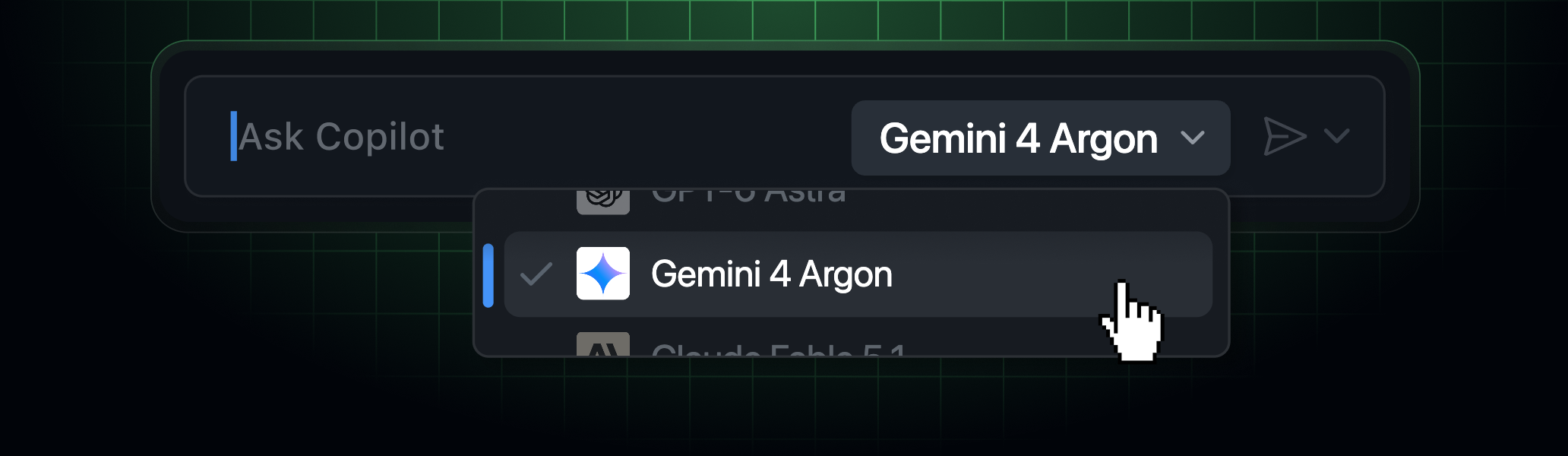
Gemini 4 Argon, Google’s latest coding-focused model, is now generally available inside GitHub Copilot. GitHub turned it on for Copilot Pro+, Max, Business, and Enterprise subscribers on October 13, 2026, and it shows up as a selectable option in the model picker across most of the places developers already use Copilot — not as a free upgrade for everyone. If you’re on Copilot Free or the base individual Pro plan, you won’t see it; GitHub has not extended this model down to those tiers.
The short version:
- Gemini 4 Argon went live in Copilot’s model picker on October 13, 2026.
- Available on Copilot Pro+, Max, Business, and Enterprise — not Free or base Pro.
- Works in VS Code, Visual Studio, JetBrains IDEs, Xcode, Eclipse, Copilot CLI, the coding agent, and the Copilot app.
- GitHub pitches it for long, complex agentic coding sessions, and says it beat earlier Gemini models on its internal coding benchmarks.
- Rollout is gradual — eligible users may not see the option immediately.
- Billed per token under usage-based billing, at promotional pricing through December 1, 2026.
What changed in GitHub Copilot on October 13
According to GitHub’s own changelog entry, Gemini 4 Argon moved to general availability inside Copilot on October 13, 2026. GitHub describes it as a model “designed for complex coding, agentic, and reasoning tasks,” and says it reviews its own output closely, including checking edge cases before it calls a task finished. That framing matters because it signals who the model is for: not quick autocomplete-style suggestions, but longer-running agent sessions where a model has to plan, write, test, and revise code over many steps without a developer babysitting every turn.
This is Copilot’s model lineup getting another entry, not a redesign of Copilot itself. Developers who already know how to switch models in VS Code’s model picker will use the same mechanism to try Gemini 4 Argon — it just appears as a new line in the list, assuming your plan qualifies.
It’s also worth being precise about what “generally available” means here. GitHub uses that phrase to mark the model as fully shipped rather than in a limited preview or waitlist — the kind of staged testing some models go through before every eligible customer can use them. General availability doesn’t mean every eligible account sees the option instantly, which is a separate point GitHub’s changelog addresses directly and that we cover further down. For a feature that’s meant to be part of daily coding work rather than an experimental add-on, that distinction between “shipped” and “rolled out to you specifically” is one developers evaluating it should keep in mind before assuming something is broken if the model picker looks unchanged.
Which Copilot plans get Gemini 4 Argon
GitHub’s changelog lists four eligible plans: Copilot Pro+, Max, Business, and Enterprise. Copilot Free and the entry-level individual Pro plan are not on that list, so if you’re paying for the base Pro tier, Gemini 4 Argon is one more reason some developers upgrade to Pro+ — alongside the other models that tier unlocks. Our rundown of what the free Copilot plan actually includes covers how that gap plays out for individual developers deciding whether to pay.
| Copilot plan | Gets Gemini 4 Argon? | Notes |
|---|---|---|
| Copilot Free | No | Not listed as eligible in GitHub’s announcement |
| Copilot Pro | No | Base individual tier is excluded |
| Copilot Pro+ | Yes | Included at general availability |
| Copilot Max | Yes | Included at general availability |
| Copilot Business | Yes | Subject to admin model policy settings |
| Copilot Enterprise | Yes | Subject to admin model policy settings |
Where you can select the model
GitHub’s changelog lists eight places where eligible subscribers can pick Gemini 4 Argon from the model picker: Visual Studio Code, Visual Studio, JetBrains IDEs, Xcode, Eclipse, Copilot CLI, the Copilot coding agent, and the Copilot app. That’s a broader spread than a typical model launch, covering both the editors developers write code in day to day and the more autonomous surfaces — the CLI and the coding agent — where a model built for long, independent runs is likely to matter most.
| Client | Where to switch models |
|---|---|
| Visual Studio Code | Copilot Chat model picker |
| Visual Studio | Copilot Chat model picker |
| JetBrains IDEs | Copilot Chat model picker |
| Xcode | Copilot Chat model picker |
| Eclipse | Copilot Chat model picker |
| Copilot CLI | Model selection flag/menu |
| Copilot coding agent | Agent configuration |
| Copilot app (mobile/desktop) | Model picker |
Why GitHub is pitching this for long agentic runs
GitHub’s stated rationale for adding Gemini 4 Argon centers on agentic coding — sessions where Copilot is given a task and works through it across many steps, rather than answering one prompt at a time. The changelog entry specifically calls out that the model checks its own work, including testing edge cases, before finishing a task. For developers who hand off bigger chunks of work to Copilot’s coding agent, that self-checking behavior is the pitch: fewer half-finished runs that need a human to catch obvious mistakes.
That positioning lines up with how Google has talked about this generation of Gemini models elsewhere — built for sustained reasoning rather than just fast single-turn replies — though GitHub’s changelog itself doesn’t link to a Google model page, so the detailed model card lives outside Copilot’s own documentation.
In practical terms, “agentic coding” inside Copilot usually means something like: open an issue, point the coding agent at it, and let the model figure out which files to change, write the code, run tests, and open a pull request with minimal back-and-forth. A model that loses track of the original goal partway through, or stops testing its own output, tends to produce pull requests that need heavy rework. GitHub’s framing suggests Gemini 4 Argon is being positioned specifically to reduce that failure mode on longer tasks, rather than to win on raw speed for short completions, which is the kind of request Copilot’s faster, lighter models are generally better suited to handle.
How Gemini 4 Argon performs, according to GitHub and others
GitHub says that in its early testing, Gemini 4 Argon “solved more tasks than previous Gemini models on every coding benchmark” the company used, with the largest gains showing up in Copilot CLI specifically. That’s a vendor claim about an internal comparison against earlier Gemini models, not an independently audited result, and GitHub’s changelog doesn’t publish the underlying scores.
Separately, third-party benchmark aggregators that track coding models across providers have reported Gemini 4 Argon trailing Anthropic’s Claude Opus 5.5 on at least one widely cited external benchmark, Terminal-Bench 4.0, with the exact gap varying depending on which test run and provider is cited. Those figures come from outside trackers rather than from GitHub or Google directly, so treat them as directional rather than definitive. Developers deciding between models for agent-heavy work may find our comparison of Copilot against Claude Code useful background, since it covers how different underlying models tend to behave on exactly this kind of long-running task.
Pricing and billing for Gemini 4 Argon
Copilot bills model usage in AI credits, where one AI credit equals $0.01 USD, according to GitHub’s models and pricing documentation. For Gemini 4 Argon, that documentation lists promotional rates of $2.00 per million input tokens, $0.10 per million cached input tokens, and $10.00 per million output tokens — pricing GitHub says is temporary and runs “until December 1, 2026.” GitHub classifies the model under its “Powerful” tier with a single default pricing level, rather than splitting cost by usage threshold.
GitHub’s changelog describes this more generally as billing “at provider list pricing under usage-based billing,” which is the broader billing model usage-based Copilot customers are already on for other premium models — your bill reflects how much you actually use the model, not a flat per-model fee.
How Business and Enterprise admins control rollout
For organizations, GitHub says Copilot Business and Enterprise administrators manage access to Gemini 4 Argon through the model policy settings in Copilot’s admin console — the same panel used to enable or disable any individual model org-wide. GitHub’s default behavior matters here: under its standard model-enablement setting, new models like this one are turned on automatically for an organization unless an admin has already switched off the global default for new models, or has gone in and explicitly disabled this specific model. In practice, that means some Business and Enterprise developers may see Gemini 4 Argon appear without any action from IT, while others will need an admin to flip it on — or may never see it if a model policy keeps it off deliberately.
Why you might not see it yet
GitHub’s changelog is explicit that the rollout is gradual: being on an eligible plan doesn’t guarantee the model shows up in your picker the moment you check. GitHub’s advice for anyone who doesn’t see it is simply to check back later. That’s a familiar pattern for Copilot model launches generally — general availability describes the feature shipping, not every account getting it simultaneously — so patience, or waiting a day or two before filing a support ticket, is the practical move if Gemini 4 Argon hasn’t appeared in your list yet despite an eligible plan.
How to switch to Gemini 4 Argon
Where it’s available, picking the model works the same way Copilot model switching already works: open the Copilot Chat panel in your editor of choice, click the model selector, and look for Gemini 4 Argon in the list. In Copilot CLI and the coding agent, the setting lives in each tool’s own model configuration rather than a chat dropdown. There’s no separate signup or opt-in beyond having an eligible plan and, for organizations, an admin not having blocked the model — it’s additive to the existing picker rather than a new feature you have to enable from scratch.
If you manage several projects and want to standardize which model a team uses for agent-heavy work, it’s worth checking each surface separately rather than assuming a choice made in VS Code carries over to the coding agent or the CLI. GitHub treats the model selection in each client as its own setting, so a developer who picks Gemini 4 Argon for chat in their editor may still be running a different default model when they kick off a coding agent session from a GitHub issue, unless they’ve set that surface to match.
What to watch next
The near-term questions worth tracking are whether GitHub extends Gemini 4 Argon down to base Pro or Free tiers the way it has eventually done with some earlier models, whether the promotional pricing holds past its stated December 1, 2026 cutoff or reverts to a higher list price, and how independent benchmark trackers settle on where the model lands relative to competing options as more real-world agentic coding results come in. GitHub’s own supported models documentation is the most reliable place to confirm current plan eligibility and rollout status as it’s updated, and GitHub has pointed developer feedback about the model to its Copilot community discussions on GitHub itself. For now, the practical takeaway is simple: check your plan, check your model picker, and if you’re not seeing it yet, check back — this is a staged rollout, not an all-at-once switch.
Frequently asked questions
Is Gemini 4 Argon available in GitHub Copilot?
Yes. GitHub made Gemini 4 Argon generally available in Copilot on October 13, 2026, for subscribers on Copilot Pro+, Max, Business, and Enterprise plans.
What GitHub Copilot plans include Gemini 4 Argon?
Copilot Pro+, Max, Business, and Enterprise plans can access Gemini 4 Argon. GitHub's announcement does not list Copilot Free or the base individual Pro plan as eligible.
Which editors and tools support Gemini 4 Argon?
GitHub lists Visual Studio Code, Visual Studio, JetBrains IDEs, Xcode, Eclipse, Copilot CLI, the Copilot coding agent, and the Copilot mobile and desktop app as places you can select the model.
How much does Gemini 4 Argon cost to use in Copilot?
GitHub's documentation lists promotional pricing of $2.00 per million input tokens, $0.10 per million cached input tokens, and $10.00 per million output tokens, billed in AI credits. GitHub says this promotional pricing runs until December 1, 2026.
Why can't I see Gemini 4 Argon in my Copilot model picker yet?
GitHub says the rollout is gradual, so eligible users may not see the option immediately even on a qualifying plan. GitHub's guidance is to check back later.
Can organization admins turn off Gemini 4 Argon?
Yes. Copilot Business and Enterprise admins can manage the model through the model policy settings in Copilot's admin console, including disabling it for their organization.
Sources
- GitHub Changelog: Gemini 4 Argon in GitHub Copilotgithub.blog
- GitHub Docs: Supported AI models in Copilotdocs.github.com
- GitHub Docs: Models and pricing for GitHub Copilotdocs.github.com
- GitHub Community: Copilot Conversationsgithub.com
Felix Moreau writes Pandromeda's software coverage and how-to guides. He covers Windows, macOS and Linux updates, the apps people rely on, emulators and developer tools, and turns official documentation into clear, numbered steps that work on the current version.