Gemini 4 Argon Arrives in GitHub Copilot
Google's newest frontier model, Gemini 4 Argon, is now selectable in GitHub Copilot on Pro+, Max, Business, and Enterprise plans -- its first public availability anywhere.
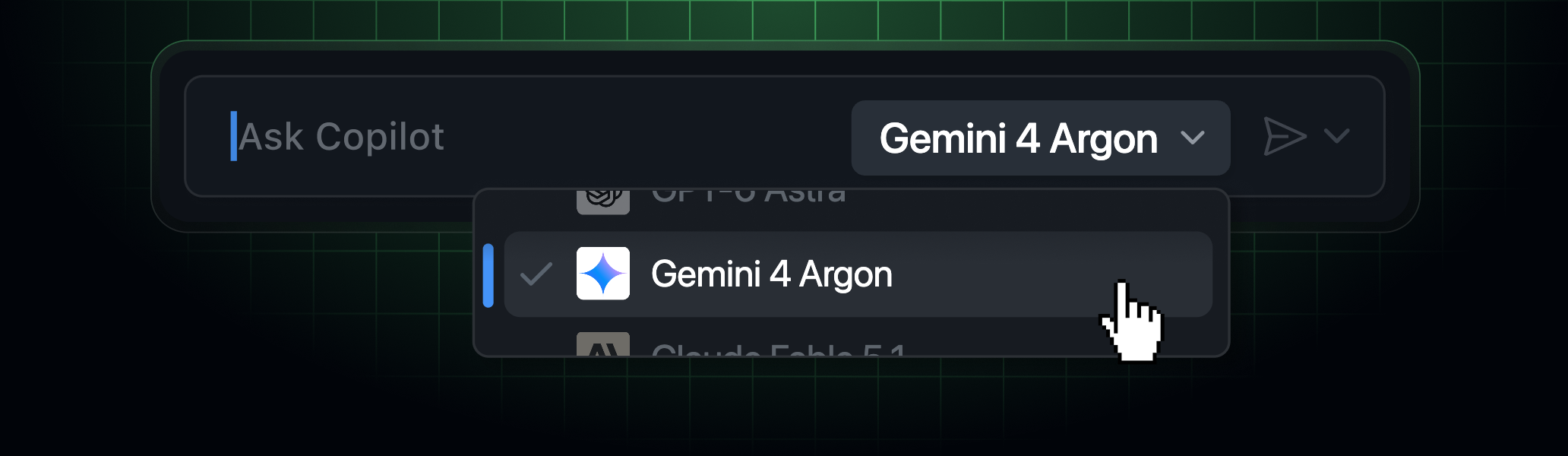
Gemini 4 Argon, Google's newest frontier model, is now generally available inside GitHub Copilot. As of October 13, 2026, developers on Copilot Pro+, Max, Business, and Enterprise plans can select the model from Copilot's picker in VS Code, Visual Studio, Copilot CLI, the Copilot coding agent, the Copilot app, JetBrains IDEs, Xcode, and Eclipse. It's the first place Gemini 4 — Google's model generation that follows the Gemini 3.x line — has shipped publicly anywhere, according to GitHub's own changelog.
Key facts
- What: Gemini 4 Argon, Google's newest frontier model, is generally available in GitHub Copilot's model picker.
- When: Rolled out October 13, 2026, gradually across accounts.
- Who gets it: Copilot Pro+, Max, Business, and Enterprise subscribers.
- Where: VS Code, Visual Studio, Copilot CLI, Copilot coding agent, Copilot app, JetBrains IDEs, Xcode, Eclipse.
- Billing: Usage-based, at provider list pricing, drawn from each plan's included credits or metered overage.
- Admin control: Business/Enterprise admins manage access through the model policy in Copilot settings; new models default to enabled unless disabled.
What actually shipped on October 13
GitHub's changelog describes Gemini 4 Argon as Google's newest frontier model, "designed for complex coding, agentic, and reasoning tasks." GitHub says that in its own early testing, the model solved more tasks than earlier Gemini models on every coding benchmark it ran, with the single biggest improvement showing up inside Copilot CLI, GitHub's terminal-based agent. GitHub also highlights a specific behavioral change: Argon checks its own work by testing edge cases before it finishes a task, rather than stopping as soon as code compiles or a test suite passes once.
That self-checking habit matters more than a leaderboard number for day-to-day use. A model that tries boundary conditions, malformed inputs, and failure paths before handing work back is closer to how a careful engineer reviews their own pull request than how an autocomplete tool finishes a line. GitHub frames this as a step toward more autonomous, agentic coding sessions rather than a bigger autocomplete model — the kind of shift this site has covered as part of the broader move toward AI agents that plan and verify their own work instead of just suggesting the next line.
It's worth being precise about what "generally available" means here. This is Gemini 4 Argon landing inside a third-party developer tool, not Google's own consumer surfaces. Google published its own announcement for Gemini 4 Argon the same day, describing broader availability across the Gemini API, Google Antigravity, the Gemini app, and AI Mode in Search for AI Ultra and Pro subscribers — but that consumer and API rollout is a separate story with its own mechanics and pricing, covered elsewhere. Today's piece is specifically about what changed for developers inside Copilot.
Where you can use Gemini 4 Argon in Copilot
Gemini 4 Argon shows up as a selectable model wherever Copilot already lets you choose between model families, rather than as a separate product. GitHub lists eight surfaces where it's rolling out:
| Surface | What it is |
|---|---|
| VS Code | Model picker in Copilot Chat and agent mode |
| Visual Studio | Copilot Chat model selector |
| Copilot CLI | Terminal-based agent; GitHub says gains here are the largest |
| Copilot coding agent | Autonomous agent that works on assigned issues/PRs |
| Copilot app | Standalone mobile/desktop Copilot app |
| JetBrains IDEs | IntelliJ, PyCharm, WebStorm, etc. |
| Xcode | Apple's IDE, via the Copilot extension |
| Eclipse | Via the Copilot plugin |
Eligibility runs by plan, not by surface: Copilot Pro+, Max, Business, and Enterprise subscribers can pick Gemini 4 Argon on any of the surfaces above once it reaches their account. Copilot Free and standard Pro are not on the list in GitHub's changelog. As with past model launches on Copilot — Gemini 3.1 Pro and 3.5 Flash shipped the same way earlier this year — GitHub is rolling access out gradually, so two developers on the same plan, in the same IDE, might see the option land on different days. If it isn't in your picker yet, GitHub's guidance is simply to check back later rather than assume something is broken.
The spread of surfaces is itself a signal of how GitHub now treats a new frontier model launch. A few years ago, a new model in Copilot meant a new option in one chat sidebar. Today it means a coordinated rollout across two full IDEs (VS Code and Visual Studio), three third-party editors (JetBrains, Xcode, Eclipse), a terminal agent, a standalone app, and the autonomous coding agent — eight distinct products updated in step with each other. That breadth is part of why GitHub, not Google, ended up being the first place Gemini 4 Argon appeared publicly at all: Copilot's model-picker architecture is built to absorb a new model across every surface at once rather than ship it into a single product first.
How Argon differs from earlier Gemini models in Copilot
GitHub has added Gemini models to Copilot in waves — Gemini 2.5 Pro, then Gemini 3 Pro in public preview, then Gemini 3.1 Pro and 3.5 Flash earlier in 2026. Each of those additions followed a similar pattern: a new option in the picker, a changelog post, and a gradual rollout gated by the same plan tiers and admin policies now governing Argon. What's different this time is the generational label. Gemini 3.x was an iteration on an existing generation; Gemini 4 is, per GitHub's own framing, a new frontier model from Google, not a point release. GitHub's changelog doesn't put a version number on what "frontier" means in benchmark terms beyond the claim that Argon beat earlier Gemini models on every coding benchmark GitHub tested — but the generational jump is why this launch reads differently from the steady cadence of Gemini point-releases that preceded it.
An agent-first pitch, not just a chat upgrade
GitHub's own framing leans heavily on agentic use rather than inline autocomplete. The emphasis on Copilot CLI gains and self-directed edge-case testing both point toward longer-running, more autonomous sessions — a developer handing off a multi-step task and getting back work that's already been stress-tested, rather than a single suggested line that still needs manual verification. That pitch matches where GitHub has been pushing Copilot generally over the past year, from the coding agent that picks up assigned issues to CLI workflows that chain multiple actions together. A model that's reported to test its own edge cases before declaring a task finished fits that direction more than it fits a simple chat-completion upgrade.
Why a new Gemini generation showing up in Copilot first is notable
Google has been shipping Gemini 3.x variants into Copilot for most of 2026 — Gemini 3 Pro arrived in public preview in December 2025, followed by Gemini 3.1 Pro and 3.5 Flash. Gemini 4 Argon is a full generational jump, and GitHub's changelog is the first public confirmation that it's shipped anywhere outside Google's own walls. That timing lines up with Google's own announcement of Gemini 4 Argon on the same day, which positions the model for deep, multi-step work in coding, finance, legal, cybersecurity, and science, and separately details its own benchmark claims, pricing tiers, and safety testing for Google's own surfaces.
For Copilot users, the practical upshot is choice. GitHub's model picker already spans Anthropic's Claude family, OpenAI's GPT models, and Google's Gemini models side by side, and Argon becomes the newest, highest-end Gemini option in that lineup. Model choice has become one of Copilot's main selling points against single-model competitors, a point this site has compared directly when weighing Copilot's pricing and model lineup against single-vendor tools like Claude Code. Adding a frontier-tier Gemini option doesn't change that structure, but it does raise the ceiling on what "pick Gemini" can mean inside Copilot.
How to turn it on — and off
For individual Pro+ and Max subscribers, there isn't a separate switch to flip: once Gemini 4 Argon reaches an account, it simply appears as an option in the model picker alongside the other available models, and a developer selects it like any other model for a given chat, agent session, or CLI run.
Business and Enterprise is where administrative control comes in. GitHub's documentation describes model availability as governed by policies set in Copilot settings — at the organization level, or at the enterprise level when an enterprise has locked a setting so organizations can't override it. Admins can explicitly enable or disable individual models, and there's a separate, broader policy that sets the default behavior for any model that hasn't been explicitly configured. GitHub's changelog for Gemini 4 Argon confirms the practical result of that default: new models are turned on automatically for Business and Enterprise users unless an admin has either disabled that specific model or switched off the global default-enabled setting. In other words, the rollout is opt-out, not opt-in, for organizations that haven't touched their model policy — so admins who want to vet a new frontier model before it reaches their teams need to act ahead of a launch like this one, not after.
What it costs to use
Gemini 4 Argon is billed under Copilot's usage-based billing model, at what GitHub calls "provider list pricing" — meaning Google's own per-token rates for the model, passed through rather than marked up or flattened into a single Copilot rate. GitHub's own pricing reference converts token usage into GitHub's internal billing units, with each plan carrying its own monthly allowance before metered usage kicks in; Business and Enterprise allowances pool per user at the billing-entity level. Exactly how many requests or tokens a given plan's included allowance covers for Argon specifically depends on the model's per-token rate, which GitHub's models-and-pricing documentation tracks model by model rather than fixing a flat cost for "using Gemini." Teams that want to budget for heavier agentic use — long Copilot CLI sessions or coding-agent runs that GitHub says benefit most from Argon — should check that pricing page before turning the model on broadly, rather than assuming it costs the same as a lighter Flash-tier model.
Choosing between Claude, GPT, and Gemini inside Copilot
Argon's arrival sharpens a question Copilot users already face: which model, for which job. GitHub doesn't rank its own model options against each other, and this site hasn't independently benchmarked Argon inside Copilot, so the honest answer is that model choice in Copilot remains task-dependent and provider-reported performance should be read as exactly that — the vendor's own numbers, not an independent test. What is true from GitHub's changelog is narrower and more useful: Argon's biggest reported gains, in GitHub's own early testing, were in Copilot CLI specifically, and its self-checking behavior is pitched at agentic, multi-step tasks rather than single-line completions.
That's consistent with how Copilot has positioned multi-model support generally — as a way to match a model's strengths to a task, whether that's a quick inline suggestion, a long agentic refactor, or a terminal-driven workflow, rather than committing a whole team to one vendor. Developers evaluating whether Copilot's growing model roster beats a single-model, agent-native tool have another angle to weigh now that Argon is in the mix; this site's look at how terminal agents and AI-native IDEs compare on their own terms covers that broader trade-off, which a new Gemini option inside Copilot doesn't resolve so much as add another variable to.
The rollout is gradual — don't panic if you don't see it yet
GitHub is explicit that this is a staged rollout, not a simultaneous flip for every eligible account. The changelog's guidance for anyone who doesn't see Gemini 4 Argon in their model picker yet is simply to check back later. For admins, the practical checklist is: confirm your plan is Pro+, Max, Business, or Enterprise; for Business/Enterprise, confirm the model policy hasn't been set to disable new models by default or Argon specifically; and expect the option to appear in the picker on its own once your account is included in the rollout, with no reinstall or extension update required.
What to watch next
A few threads are worth following from here. First, GitHub's own benchmark claims — "solved more tasks... on every coding benchmark," biggest gains in Copilot CLI — are early and self-reported; independent, third-party coding-benchmark results for Argon specifically inside Copilot haven't been published yet. Second, Google's own rollout of Gemini 4 Argon to its consumer and API surfaces is still in progress on Google's side, separate from the Copilot integration, and pricing or access details there may shift before they settle. Third, watch whether Anthropic or OpenAI respond with their own next-generation model drops into Copilot's picker — GitHub has shipped new frontier models from multiple providers into Copilot in quick succession over the past year, and Argon is unlikely to be the last.
Frequently asked questions
What is Gemini 4 Argon?
Gemini 4 Argon is Google's newest frontier AI model, designed for complex coding, agentic, and reasoning tasks. It became generally available inside GitHub Copilot on October 13, 2026.
Which GitHub Copilot plans include Gemini 4 Argon?
Copilot Pro+, Max, Business, and Enterprise plans can select Gemini 4 Argon from the model picker. It is not listed for Copilot Free or standard Pro.
Where can I use Gemini 4 Argon inside Copilot?
GitHub lists it as rolling out in VS Code, Visual Studio, Copilot CLI, the Copilot coding agent, the Copilot app, JetBrains IDEs, Xcode, and Eclipse.
How do I turn Gemini 4 Argon on or off for my organization?
Business and Enterprise admins manage model access through the model policy in Copilot settings. New models are enabled by default unless an admin disables that specific model or turns off the global default-enablement setting.
How is Gemini 4 Argon billed in Copilot?
It's billed under Copilot's usage-based billing at provider list pricing, drawn from each plan's included credits before metered overage, per GitHub's models-and-pricing documentation.
What if I don't see Gemini 4 Argon in my model picker yet?
GitHub says the rollout is gradual, so it may not reach every eligible account immediately. Its guidance is to check back later rather than assume something is broken.
Sources
- GitHub Changelog: Gemini 4 Argon in GitHub Copilotgithub.blog
- Google: Introducing Gemini 4 Argonblog.google
- GitHub Docs: Supported AI models in Copilotdocs.github.com
- GitHub Docs: Models and pricing for GitHub Copilotdocs.github.com
- GitHub Docs: Policies for GitHub Copilotdocs.github.com
Felix Moreau writes Pandromeda's software coverage and how-to guides. He covers Windows, macOS and Linux updates, the apps people rely on, emulators and developer tools, and turns official documentation into clear, numbered steps that work on the current version.