Warby Parker's Android XR Glasses: Preorder Date, Price, Specs
Warby Parker's earnings release set a November 12 preorder date for its Android XR Intelligent Eyewear. Price is unannounced — here's everything confirmed so far.
Warby Parker will start taking preorders for its first Android XR smart glasses on November 12, 2026, with deliveries beginning during the holiday season — but the company still hasn't said how much the frames will cost. The date comes straight from Warby Parker's own third-quarter earnings release, filed with the SEC on November 5, which is the first time the company has committed to a specific preorder day for the long-teased "Intelligent Eyewear" line it has been building with Google and Samsung.
Quick facts
- Preorders open: November 12, 2026 (confirmed by Warby Parker)
- Delivery: "during the holiday season," per Warby Parker co-CEO Dave Gilboa
- Price: not yet announced
- Who makes what: Google (Android XR software, Gemini), Samsung (hardware/chipset), Warby Parker and Gentle Monster (frames)
- Chip: Qualcomm Snapdragon AR1 Gen 1
- Battery: up to 9 hours per charge, plus up to 7 more full charges from the case, per Samsung
When do Warby Parker's Android XR glasses go up for preorder?
November 12, 2026. On Warby Parker's Q3 2026 earnings call, co-founder and co-CEO Dave Gilboa told investors: "One week from today, on November 12, we'll begin accepting pre-orders for our first Intelligent Eyewear collection," adding that the company plans on "delivering customer orders during the holiday season." That line, buried inside an earnings release otherwise focused on revenue and store counts, is the first hard date either Warby Parker or its partners have put on the glasses since they were unveiled at Google I/O back in May.
The filing doesn't specify a launch country list beyond "select markets," nor does it say whether preorders open in the U.S. only or more broadly. It also doesn't name a firm ship date — "holiday season" is as precise as Warby Parker has gotten so far.
How we got here: a quick timeline
The November 12 preorder date is the latest entry in a story that's been unfolding for about 18 months:
- May 2025: Google and Warby Parker first disclose their partnership, with Google committing up to $150 million — split between product development funding and an option to invest directly in Warby Parker.
- May 2026: Google and Samsung give the glasses their public debut at Google I/O, showing the first Gentle Monster and Warby Parker frame designs and targeting a fall 2026 launch in "select markets."
- July 2026: Samsung shows updated frame designs and confirms hardware details — the Snapdragon AR1 Gen 1 chip and battery figures — at Galaxy Unpacked in London, still without a price or ship date.
- October 2026: Leaked images and spec sheets, credited to leaker SammyGuru, start circulating via Droid Life and 9to5Google, naming specific Warby Parker frames and pointing to a November launch.
- November 5, 2026: Warby Parker confirms, in its own earnings release, that preorders open November 12 with holiday-season delivery — the first company-sourced date on the record.
What is Android XR "Intelligent Eyewear," exactly?
Intelligent Eyewear is the branding Google, Samsung, and their design partners are using for the first wave of Android XR-powered glasses — normal-looking eyeglasses and sunglasses with a camera, microphones, speakers, and enough onboard compute to run Google's Gemini assistant hands-free. It's Google's answer to Meta's Ray-Ban smart glasses line, built the same way Android has always scaled: Google supplies the software platform, a hardware partner (Samsung, in this case) builds the silicon and electronics, and established eyewear brands design frames people will actually want to wear.
Warby Parker and Gentle Monster are the two launch design partners. Google first disclosed the Warby Parker tie-up in a securities filing describing a deal worth up to $150 million — up to $75 million toward product development and commercialization, plus up to $75 million in a potential equity investment tied to collaboration milestones. For a wider look at how Android XR fits together with Google's other hardware, our explainer on the Android XR platform breaks down the software side in more depth.
Samsung and Google gave the glasses their public debut at Google I/O in May 2026, then showed updated frame designs from both brands at Galaxy Unpacked in London that July. Pricing and an exact release date were withheld at both events.
What's actually confirmed about the hardware
Most of the spec sheet still hasn't been published in full, but Samsung's own newsroom has confirmed more than outside reporting has. Here's what Samsung has put its name to, as of its July 22, 2026 press release:
| Spec | Confirmed detail |
|---|---|
| Chipset | Qualcomm Snapdragon AR1 Gen 1 Platform |
| Battery life | Up to 9 hours per charge, plus up to 7 additional full charges from the charging case |
| Camera | Built-in camera for visual context (resolution not disclosed) |
| Assistant | Google Gemini, via Android XR |
| Phone requirement for Gemini features | Must be signed into a Samsung and Google account, connected to a compatible Samsung Galaxy AI phone with data/internet |
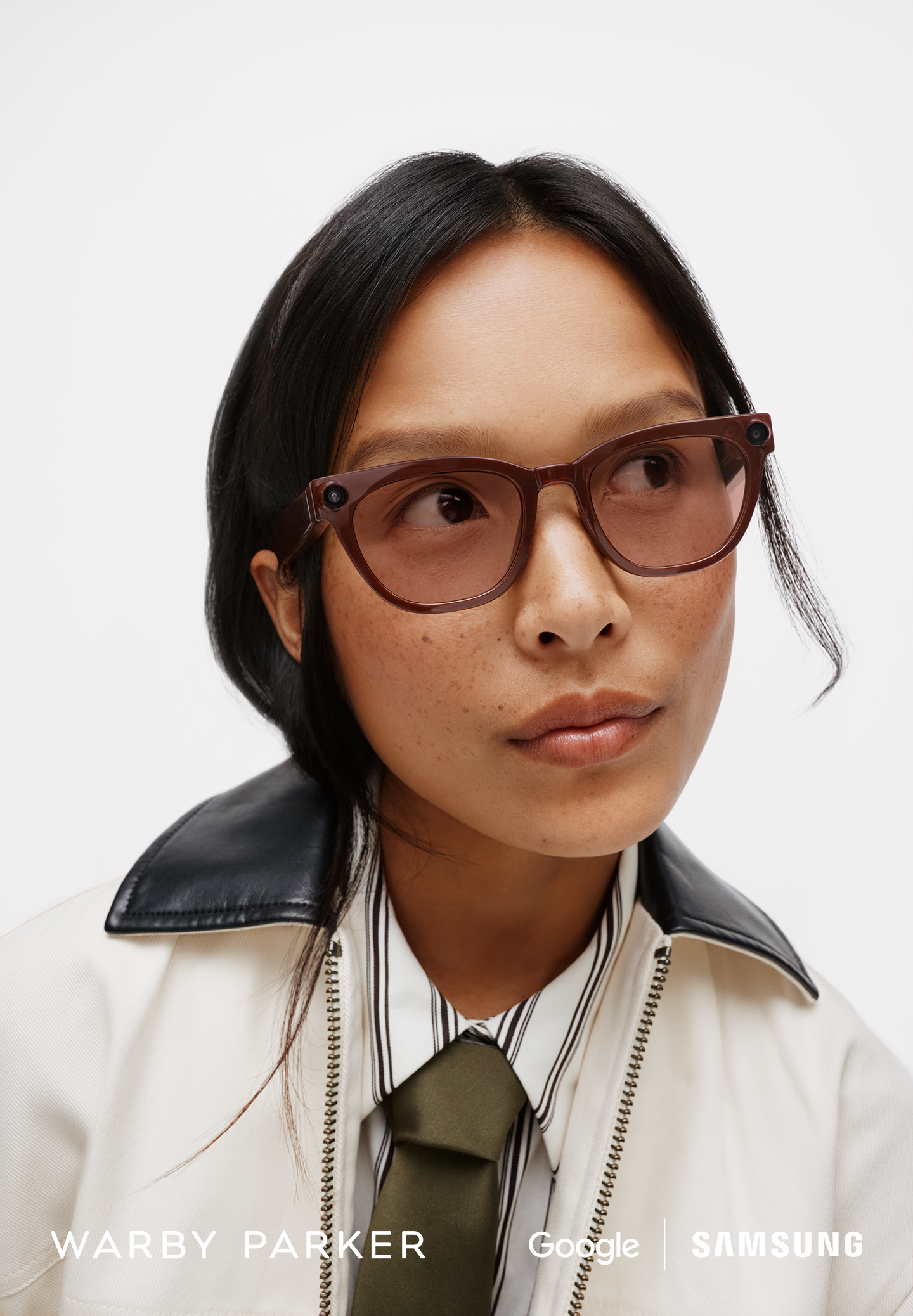
| Frame partners | Gentle Monster (slim black frame) and Warby Parker (brown frame with an upswept brow line) |
Samsung describes five "key experiences" it's building into the glasses: summarizing long messages and reading them aloud, live translation, voice and gesture control, capturing whatever the wearer is looking at (a whiteboard or a meeting, for instance) and organizing it into Notes, turn-by-turn navigation help, and sharing a live point-of-view feed during a call. All of it is designed to run without the wearer pulling out a phone.
"Google and Samsung have a shared vision to bring helpful and context-aware intelligence into everyday life," said Sameer Samat, President of the Android Ecosystem at Google, in Samsung's July release. "Built on the Android XR platform, the intelligent eyewear blends world-class designs with Gemini's advanced assistance that naturally responds to what you see, delivering all-day, hands-free help."
Samsung's Mobile eXperience COO, Won-Joon Choi, framed it as a natural next step for the company's hardware lineup: "Intelligent eyewear creates a new point of interaction, bringing more personalized AI assistance naturally into the moments that make up everyday life."
Warby Parker's side of the design
Samsung's official description of the Warby Parker model is narrow but specific: "a subtly upswept brow line in a rich brown hue, creating a refined, versatile shape perfect for everyday settings." Warby Parker co-CEO Dave Gilboa described the design goal in similar terms back in May: "Eyewear is deeply personal, which is why every detail matters when integrating advanced technology into frames people wear every day. Our Intelligent Eyewear is designed to feel intuitive, combining Warby Parker's signature design with precision optics and exceptional comfort to help people stay focused on the moments in front of them."
Outside leaks have gone further than either company has officially confirmed. A frame leak credited to SammyGuru and reported by Droid Life in October names three Warby Parker frames — Alden, Reid, and Wren — across roughly 10 total color and lens combinations, alongside six unnamed Gentle Monster styles. That report is explicit that this came from a leak, not an announcement, so treat the specific frame names as unconfirmed until Warby Parker publishes its own lineup.
Do you need a Samsung phone to use them?
For the headline Gemini features, yes — at least based on what Samsung has published. A footnote on Samsung's July press release spells out the requirement plainly: Gemini-powered features require being "signed into Samsung and Google account, and be connected to a compatible Samsung Galaxy AI phone with data/internet." That's a tighter requirement than how Google has talked about Android XR generally, and it lines up with how Samsung sells its other Galaxy AI features — as ecosystem perks rather than universal Android features.
Earlier, less-official coverage of the May 2026 reveal suggested the glasses would work across both Android and iPhone for basic functions, but neither Google nor Samsung's own newsroom posts confirm iPhone support, and Samsung's footnote specifically calls out a Galaxy phone. Until Warby Parker or Samsung publishes a compatibility page, assume the full Gemini experience is Galaxy-first and treat broader iPhone support as unconfirmed.
How much will they cost?
Nobody official has said. Warby Parker's November 5 earnings release names a preorder date but no price, and its 10-Q for the quarter only notes that 2026 guidance includes "a modest contribution from Intelligent Eyewear" along with associated launch costs — language aimed at investors, not shoppers. Samsung's two press releases, from May and July, are equally silent on pricing. Any dollar figure you see attached to these specific frames right now is speculation, including comparisons to Meta's Ray-Ban Display or Ray-Ban Meta glasses, which are separate products from a separate company.
If Warby Parker follows its usual playbook — prescription glasses with multiple lens options bundled into one price — expect the final number to land well above its standard optical frames, which start around $95, given the added camera, speakers, microphones, and Snapdragon hardware inside. Warby Parker's own 10-Q filing for the quarter notes that its free cash flow for Q3 2026 was negative $2.0 million, which the company attributes partly to "launch investments" tied to Intelligent Eyewear — a sign of how much the company has already sunk into getting this line ready, even before a single unit ships.
How the November 12 preorder is expected to work
Warby Parker hasn't published preorder mechanics yet — no signup page, no reservation list, and no confirmation of which countries can order on day one. Gilboa's comments on the earnings call describe a straightforward preorder-to-holiday-delivery window rather than a staged rollout, but the company has not said whether preorders will be limited by region, by frame style, or by prescription type. Anyone wanting to be first in line should watch Warby Parker's own newsroom and its retail stores, which already offer in-person demo appointments for the glasses ahead of launch.
Gentle Monster's preorder timing is a separate open question. Samsung's releases have covered both brands together at every public reveal, but Warby Parker's earnings release only speaks for Warby Parker's own collection — it doesn't confirm that Gentle Monster's frames open for preorder on the same day.
What's still a rumor, not a fact
A few widely repeated specs are not yet official. A leak reported by 9to5Google in October, also credited to SammyGuru, lists 2GB of RAM, 64GB of storage, a 12MP camera shooting 3K video at 30fps, two speakers, four microphones, and a frame weight around 41 grams. None of those figures appear in Samsung's own press materials, so they should be read as pre-launch leaks rather than specifications. The same leak's claim of a November launch window has since been overtaken by Warby Parker's own confirmed November 12 preorder date — a useful reminder that leaked timing can be directionally right while still being a leak.
Why this launch matters
This is the first time any of the three companies has put a calendar date on paper for Android XR glasses reaching real customers, roughly 18 months after Google and Warby Parker first announced their partnership. It also puts Google's wearable push on a collision course with Meta, which has had Ray-Ban-branded smart glasses on shelves since 2023 and has continued to iterate on display and camera features. Samsung, meanwhile, is extending the Android XR platform it introduced with the Galaxy XR headset — if you're weighing that mixed-reality headset against Apple's rival device, our Galaxy XR vs. Vision Pro comparison covers the full spec and price breakdown.
What to watch next
Three things are worth tracking between now and November 12: whether Warby Parker publishes pricing before preorders open or reveals it at checkout, whether Gentle Monster's frames get the same November 12 preorder window, and whether Samsung or Google issues their own confirmation to fill in the gaps Warby Parker's earnings release left open — country availability, exact ship dates, and a full spec sheet. Until one of the three companies posts an official price or spec page, treat anything more specific than what's listed above as speculation.
Frequently asked questions
When do preorders open for Warby Parker's Android XR glasses?
November 12, 2026, according to Warby Parker's own Q3 2026 earnings release filed with the SEC on November 5. Co-CEO Dave Gilboa said deliveries will follow "during the holiday season."
How much do Warby Parker's Android XR glasses cost?
Warby Parker, Samsung, and Google have not announced a price as of November 6, 2026. Any specific dollar figure circulating online ahead of preorders is unconfirmed.
What chip is inside the glasses?
A Qualcomm Snapdragon AR1 Gen 1 Platform, according to Samsung's official July 2026 press release.
What's the battery life?
Samsung says up to 9 hours of active use per charge, plus up to 7 additional full charges from the included charging case.
Do the glasses work with iPhone?
Samsung's own materials don't confirm broad iPhone support. A footnote in its press release says Gemini-powered features require a compatible Samsung Galaxy AI phone signed into both a Samsung and Google account, so treat iPhone compatibility as unconfirmed.
Which frame brands are launching first?
Warby Parker and Gentle Monster are the two confirmed design partners. Samsung describes Warby Parker's frame as having "a subtly upswept brow line in a rich brown hue," and Gentle Monster's as a slim black frame.
Sources
- Warby Parker Q3 2026 earnings release (SEC 8-K, Nov. 5, 2026)sec.gov
- Samsung Newsroom: Samsung Brings Galaxy Ecosystem to Everyday Eyewear (July 22, 2026)news.samsung.com
- Samsung Newsroom: Samsung and Google Give First Look at New Intelligent Eyewear (May 2026)news.samsung.com
- Warby Parker/Google partnership announcement (SEC 8-K exhibit, 2025)sec.gov
Nadia Osei covers mobile and consumer gadgets for Pandromeda: smartphones, tablets, smartwatches, earbuds and smart-home devices. She tracks launches, software updates and pricing across Apple, Google, Samsung and the rest, and builds comparisons from the manufacturers' published specifications.