iPhone Duo vs iPhone 18 Pro Max: Which Should You Buy?
Apple’s foldable iPhone Duo costs $700 more than the iPhone 18 Pro Max. Here’s what you get and give up for that premium — straight from Apple’s own specs.
The short answer: the iPhone 18 Pro Max is the better all-round phone for almost everyone, with a longer-lasting battery, a genuine optical zoom camera and a $700 lower starting price, while the iPhone Duo is the one to buy only if a folding, tablet-sized inner screen is something you specifically want and are willing to pay a premium for. Apple has never put these two phones side by side in its own marketing — the iPhone Duo is compared to its own predecessor, and the iPhone 18 Pro Max is compared to the iPhone 17 Pro Max — so everything below comes from matching each phone’s own official specification page and press release against the other’s.
iPhone Duo vs iPhone 18 Pro Max, at a glance
- Price: iPhone Duo starts at $1,999; iPhone 18 Pro Max starts at $1,299 — a $700 gap, before accessories.
- Screens: Duo has two OLED panels (5.4-inch outer, 7.6-inch inner, folding); Pro Max has one fixed 6.9-inch OLED.
- Cameras: Pro Max has a true 4x optical telephoto lens; Duo’s “2x Telephoto” is a crop of its main sensor, not a separate lens.
- Battery: Pro Max rates up to 30 hours of typical use and 45 hours of video playback; Duo rates up to 24 hours typical use and 31–44 hours of video playback depending on which screen you use.
- Weight: Duo is 254g closed; Pro Max is 249g — closer than most people expect.
- Durability: Both are IP68-rated with Ceramic Shield 2 on the front glass; the Duo adds a titanium foldable frame, where the Pro Max uses an aluminum unibody.
Price and storage: a $700 gap either way
Apple’s iPhone Duo starts at $1,999 in the US for 256GB, scaling up through 512GB, 1TB and 2TB configurations, according to Apple’s own announcement. The iPhone 18 Pro Max starts at $1,299 for 256GB and is offered in the same four storage tiers — 256GB, 512GB, 1TB and 2TB — per Apple’s iPhone 18 Pro Max specification page. That means the entry-level Duo costs exactly $700 more than the entry-level Pro Max before you’ve added a case, and the gap holds at every matching storage tier since both lines offer the same capacities.
If you’ve already read our breakdown of the iPhone Duo’s release date, price and specs, the $1,999 starting point will be familiar. What’s worth repeating here is that Apple is also selling Duo-specific accessories — a $79 case and a $129 folio with kickstand — that don’t have a direct equivalent on the non-folding Pro Max, which uses the same clear and silicone case lineup as other iPhone 18 models.
Size and weight: which one actually feels bigger
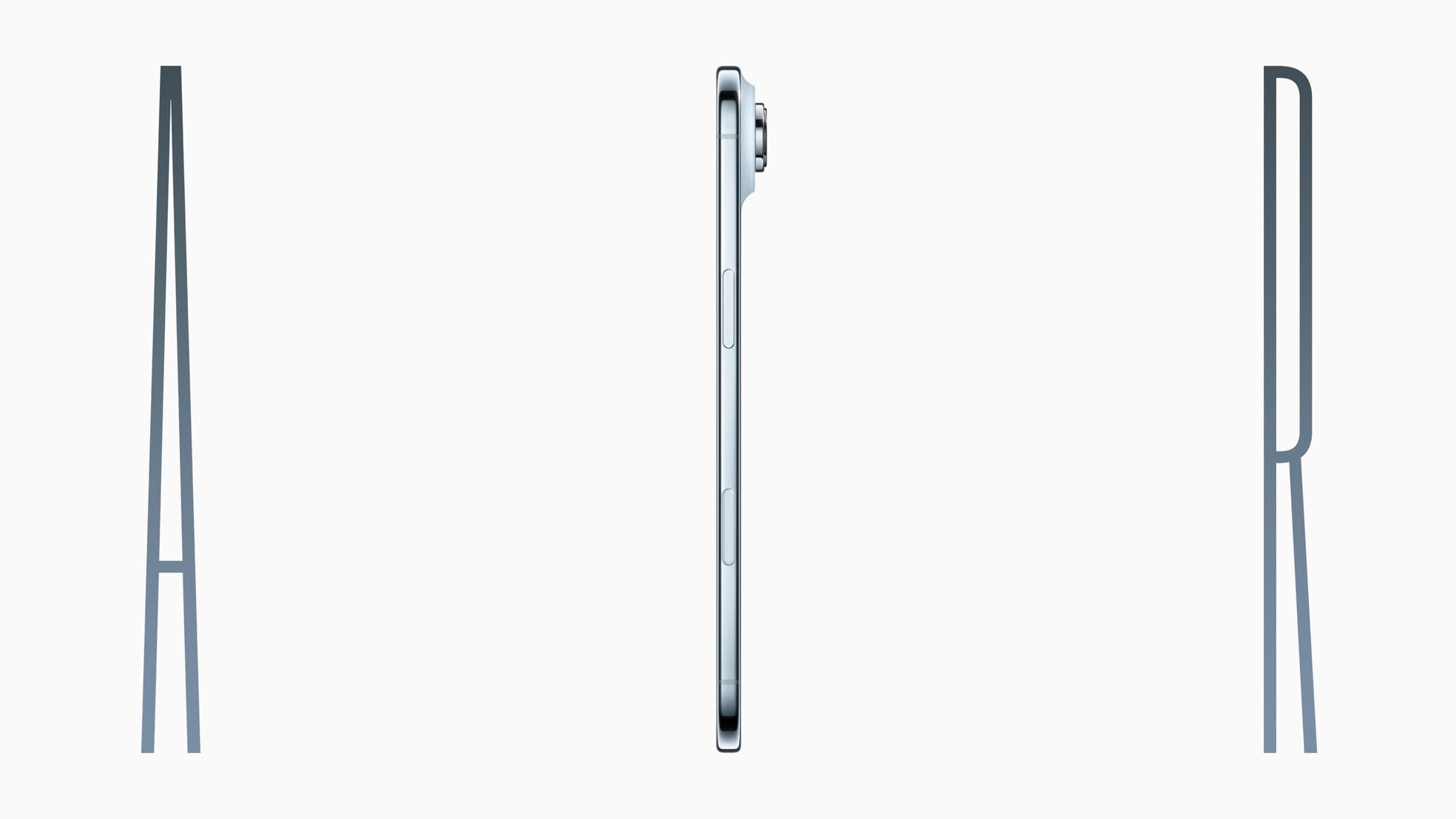
This is where the two phones diverge most in daily use. Closed, the iPhone Duo measures 84.1 x 117.8 x 11.3mm and weighs 8.96 ounces (254 grams), per Apple’s iPhone Duo specification page. Unfolded, it opens out to 164.6 x 117.8 x 5.2mm — thinner than a single iPhone 18 Pro Max panel, but only when fully open. The iPhone 18 Pro Max, with its single non-folding 6.9-inch display, measures 163.4mm tall by 78.0mm wide by 8.75mm thick and weighs 8.78 ounces (249 grams).
In other words, the two phones are almost identical in total mass — 254g versus 249g, a five-gram difference that’s hard to notice in the hand. The real difference is shape: the Duo is a short, thick rectangle in your pocket that unfolds into something nearly twice as wide, while the Pro Max is a single slab that’s taller and noticeably thinner at every moment you’re using it. Neither phone is “lighter” in any way that matters; what changes is whether you want a phone that gets physically bigger when you need it to.
Displays: one big screen vs two screens
The iPhone 18 Pro Max has one 6.9-inch OLED display running at 2868x1320 resolution (460 ppi), with ProMotion up to 120Hz, an Always-On state, and a peak outdoor brightness of 3000 nits, according to Apple’s specification page.
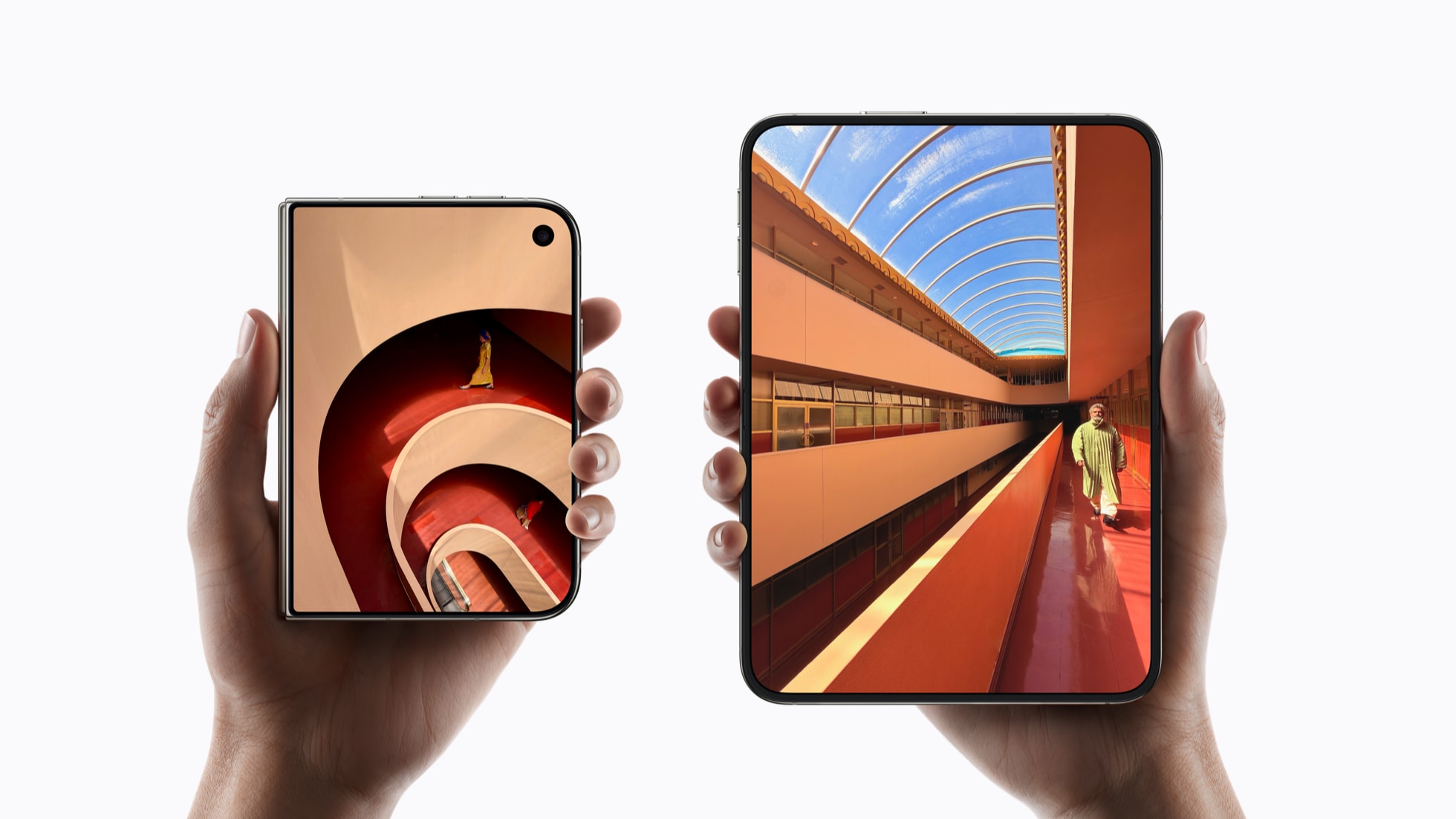
The iPhone Duo instead carries two displays. Closed, you get a 5.4-inch outer OLED panel (1398x2034, 460 ppi); open it, and the inner folding OLED panel measures 7.6 inches (1878x2670, 430 ppi) — which Apple’s press release calls the largest display ever on an iPhone, and roughly 50% larger in area than the iPhone 18 Pro Max’s screen. Both of the Duo’s displays also carry ProMotion, Always-On and the same 3000-nit outdoor peak brightness as the Pro Max, so brightness and refresh rate aren’t a trade-off here — only screen count and the mechanics of folding are.
What Apple’s materials don’t address directly is display creasing, a characteristic that has affected most folding phones on the market to date due to the physical stress of repeated bending at the fold line. Apple has not published a crease-visibility claim or test result for the iPhone Duo’s inner display, so if that’s a concern for you, it’s worth checking hands-on impressions once review units are out rather than taking either phone’s marketing at face value.
Cameras: megapixels look similar, the lenses don’t
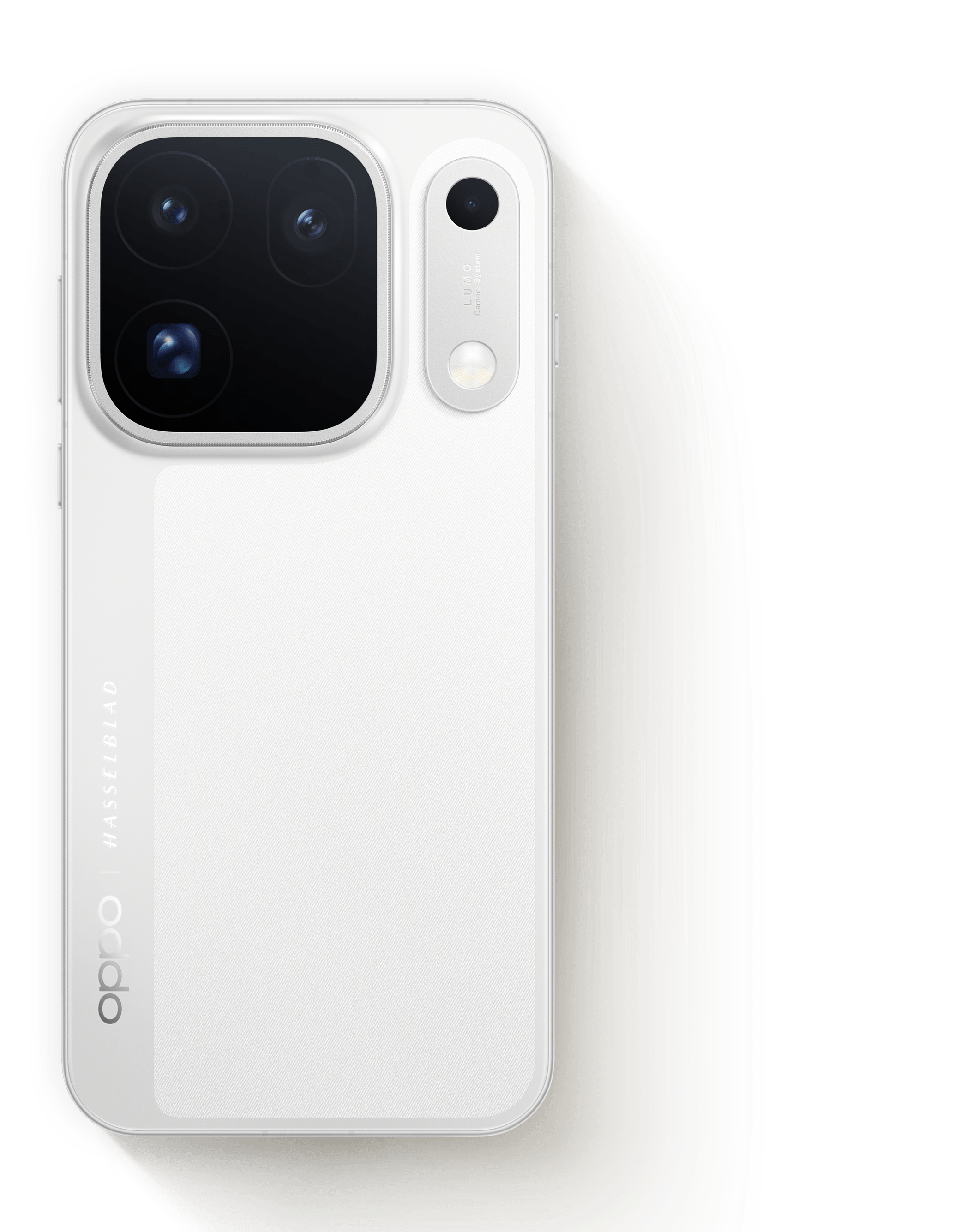
Both phones advertise a 48-megapixel main camera and a 48-megapixel Ultra Wide camera, and on paper the numbers look close. The gap shows up at telephoto. The iPhone 18 Pro Max has an actual third lens: a 48MP, 100mm, ƒ/2.8 telephoto offering genuine 4x optical zoom, plus 12MP optical-quality crop modes at 2x and 8x, for what Apple’s own specification page lists as a 16x optical-quality zoom range and up to 40x digital zoom.
The iPhone Duo has no separate telephoto lens at all. Its “2x Telephoto” is a 12MP crop from the center of the 48MP main sensor — useful, and genuinely good in bright light, but not the same hardware as a dedicated zoom lens, and Apple’s own specs list digital zoom topping out at 10x. If zoomed photography — concerts, kids’ sports, wildlife, distant architecture — matters to you, the Pro Max’s true telephoto lens is a meaningful, verifiable advantage, not a marketing nuance.
Both phones use Center Stage front cameras, and the Duo additionally has an under-display FaceTime camera built into its inner screen for video calls while folded open — something the single-screen Pro Max obviously doesn’t need.
Chip and performance
Both phones run Apple’s A20 Pro chip, built on a 2-nanometer process with a 6-core CPU, 7-core GPU and a dual 16-core Neural Engine, according to each phone’s own Apple specification page. The underlying silicon is the same part number on paper; the difference Apple describes is cooling. Apple’s iPhone Duo press materials claim up to 35% better sustained performance than the iPhone 17 Pro, attributing it to a new cooling system fitted around the fold mechanism. Apple’s iPhone 18 Pro and Pro Max press release separately claims up to a 40% sustained-performance gain over the previous generation, crediting a redesigned vapor chamber.
Those two percentages are each phone’s comparison to its own predecessor, not a benchmark of the Duo against the Pro Max directly — Apple hasn’t published that comparison, and nothing here should be read as implying the Pro Max is “faster” by some fixed margin. The honest takeaway is that both phones should perform very similarly for everyday tasks, with the Pro Max likely holding its clock speeds a little longer during sustained loads like gaming or video export, given its simpler single-slab cooling design.
Battery life: the Pro Max wins clearly
This is one of the more concrete gaps between the two. The iPhone 18 Pro Max is rated for up to 30 hours of typical use and up to 45 hours of video playback (40 hours streamed), per Apple’s specification page — what Apple’s press release separately calls the largest increase in battery life ever on iPhone.
The iPhone Duo is rated for up to 24 hours of typical use with both displays used equally. Video playback varies a lot depending on which screen you watch on: up to 44 hours on the smaller 5.4-inch outer display, but only up to 31 hours on the larger 7.6-inch inner display (26 hours and 37 hours respectively when streaming rather than playing local files). In practice, that means the more you actually use the Duo’s headline feature — the big folding screen — the shorter your day gets. The Pro Max’s rating doesn’t have that caveat, because it only has one screen to measure.
Durability, materials and the fold question
Both phones share an IP68 water and dust resistance rating (tested to a maximum depth of 6 meters for up to 30 minutes, per IEC 60529) and Ceramic Shield 2 on the front glass, according to each phone’s Apple specification page. From there they diverge: the iPhone Duo uses a Grade 5 titanium foldable frame with a mirror-polished finish and Ceramic Shield on its back panel as well, while the iPhone 18 Pro Max uses an aluminum unibody. Titanium is generally the more dent- and scratch-resistant metal of the two, which matters more for the Duo given it has a hinge mechanism and two glass surfaces to protect through thousands of fold cycles.
Apple does not publish a fold-cycle rating or a crease depth measurement for the iPhone Duo on its specification page or in its press release, and no independent durability testing has been verified for this article. Given that every current folding phone — regardless of maker — has shown some degree of a visible or felt crease on its inner display after regular use, it is reasonable to expect the Duo’s inner screen will show one too, but that is a general characteristic of the foldable display category rather than a claim Apple itself makes about this specific phone. Readers who’ve already compared the Duo against Samsung’s Galaxy Z Fold8 will recognize this as the same open question that applies to every foldable on the market right now.
Software and multitasking
Both phones ship running iOS 27 — the iPhone Duo specifically launches on iOS 27.1, per Apple’s press release — so day-to-day software features like Apple Intelligence, Siri and the Camera app are shared between them. The practical difference is what the Duo’s bigger inner display unlocks: Apple’s own marketing materials show side-by-side app windows (Safari next to Slack, Notes next to Zoom, and similar combinations) running on the unfolded 7.6-inch screen, a layout the Pro Max’s single 6.9-inch display doesn’t have room for. If you regularly want two apps on screen at once without connecting to an external monitor, that’s a genuine, software-visible reason to prefer the Duo — it isn’t just a bigger version of the same experience, since the extra width is specifically used for multitasking rather than just more of the same single-app view.
iPhone Duo vs iPhone 18 Pro Max: full spec comparison
| Spec | iPhone Duo | iPhone 18 Pro Max |
|---|---|---|
| Starting price (US, 256GB) | $1,999 | $1,299 |
| Display | 5.4-inch outer + 7.6-inch folding inner OLED | 6.9-inch fixed OLED |
| Resolution | 1398x2034 (outer) / 1878x2670 (inner) | 2868x1320 |
| Chip | A20 Pro | A20 Pro |
| Rear cameras | 48MP Main, 48MP Ultra Wide, 12MP 2x crop “Telephoto” | 48MP Main, 48MP Ultra Wide, 48MP 4x optical Telephoto |
| Optical-quality zoom range | Up to 10x digital (no dedicated tele lens) | 16x optical-quality, up to 40x digital |
| Typical-use battery | Up to 24 hours | Up to 30 hours |
| Video playback battery | Up to 44h (outer) / 31h (inner) | Up to 45 hours |
| Weight | 254g (8.96 oz) | 249g (8.78 oz) |
| Dimensions (closed/single body) | 84.1 x 117.8 x 11.3mm | 78.0 x 163.4 x 8.75mm |
| Build | Grade 5 titanium, Ceramic Shield 2 front + Ceramic Shield back | Aluminum unibody, Ceramic Shield 2 front + Ceramic Shield back |
| Water/dust resistance | IP68 | IP68 |
| Storage options | 256GB / 512GB / 1TB / 2TB | 256GB / 512GB / 1TB / 2TB |
| Colors | Star White, Night Sky | Black, Silver, Glacier, Burgundy |
Figures above come directly from Apple’s published specification pages for each device and from Apple’s launch press releases; nothing in this table is a third-party estimate.
So which one should you actually buy?
Buy the iPhone 18 Pro Max if you want the best all-round iPhone camera system, the longest battery life Apple currently offers, and a $700 lower price — which, for most people upgrading from an older iPhone, is the more sensible pick. It’s also the safer bet if you’ve read our full rundown of what changed between the iPhone 18 Pro and iPhone 17 Pro and are simply due for a generational upgrade rather than a new form factor.
Buy the iPhone Duo if a genuinely bigger screen for reading, documents, split-screen multitasking or watching video is worth a real $700 premium, a shorter battery day when you actually use that big screen, and a telephoto camera that’s a crop rather than a true zoom lens. It’s a first-generation product in a category Apple is new to, so going in with realistic expectations about the trade-offs above — not just the headline “largest display ever on iPhone” claim — will serve you better than buying on spec-sheet excitement alone.
What to do next
If you’re still deciding, start by being honest about which trade-off you can live with: a smaller battery buffer on heavy screen days, or a smaller, single display. From there, check current stock and exact pricing for your storage tier and carrier plan directly on Apple’s store pages before ordering either phone, since promotional carrier credits can change the effective price gap described here. If you want to see how the Duo stacks up against Android’s folding competition rather than Apple’s own non-folding flagship, our coverage of the Duo against Samsung’s and Xiaomi’s foldables covers that ground in more depth.
Frequently asked questions
Which is better, the iPhone Duo or the iPhone 18 Pro Max?
For most buyers, the iPhone 18 Pro Max is the better overall phone: it costs $700 less, has longer battery life, and includes a genuine 4x optical telephoto lens. The iPhone Duo is worth the premium only if you specifically want a folding, tablet-sized inner display for reading, documents or multitasking.
How much more does the iPhone Duo cost than the iPhone 18 Pro Max?
The iPhone Duo starts at $1,999 for 256GB, while the iPhone 18 Pro Max starts at $1,299 for the same storage, a $700 difference that holds across matching storage tiers, according to Apple's own pricing.
Does the iPhone Duo have a worse camera than the iPhone 18 Pro Max?
The iPhone 18 Pro Max has a dedicated 48MP, 4x optical telephoto lens. The iPhone Duo has no separate telephoto lens; its '2x Telephoto' mode is a 12MP crop of the main sensor, so zoomed shots are noticeably weaker on the Duo.
Which phone has better battery life?
The iPhone 18 Pro Max rates up to 30 hours of typical use and up to 45 hours of video playback. The iPhone Duo rates up to 24 hours typical use, and its video playback figure drops from 44 hours on the outer display to just 31 hours when watching on the larger inner display.
Will the iPhone Duo's inner screen show a crease?
Apple has not published a crease-visibility claim or test result for the iPhone Duo. Every folding phone released so far by any manufacturer has shown some degree of a visible or felt crease on its inner display over time, so it is reasonable to expect the Duo will too, though this is not a figure Apple itself has confirmed.
Can the iPhone Duo run two apps at once?
Yes. Apple's own marketing for the iPhone Duo shows side-by-side app windows running on the unfolded 7.6-inch inner display, a multitasking layout the single-screen iPhone 18 Pro Max does not support.
Sources
Nadia Osei covers mobile and consumer gadgets for Pandromeda: smartphones, tablets, smartwatches, earbuds and smart-home devices. She tracks launches, software updates and pricing across Apple, Google, Samsung and the rest, and builds comparisons from the manufacturers' published specifications.