iPhone Duo vs Galaxy Z Fold8: Specs, Price and Which to Buy
Apple's $1,999 iPhone Duo goes on sale Oct. 23. Here's how its screens, cameras and price stack up against Samsung's Galaxy Z Fold8.
The short answer: Apple's iPhone Duo is the better buy if you're invested in Apple's ecosystem and want the thinnest, most polished foldable money can buy, while the Galaxy Z Fold8 is the better buy if you want a mature foldable platform, a cheaper entry price, and S Pen-style productivity tools that Apple still hasn't fully switched on. Apple's first folding iPhone starts at $1,999 and goes on sale October 23, 2026, landing directly against Samsung's fifth-generation Fold, which has been shipping since late July. Here's how the two phones compare on display, cameras, performance, software and price, and who should actually buy each one.
Quick verdict
Buy the iPhone Duo if: you're already on iPhone, want the thinnest folding phone available, and care about long-term software support and resale value.
Buy the Galaxy Z Fold8 if: you want a lower starting price, a wider cover screen that's easier to use one-handed, or S Pen input and Samsung's more mature multitasking software.
Skip both if: you don't already rely on a case or screen protector habit — both phones are still foldables, with crease lines and higher repair costs than a standard phone.
Price and availability
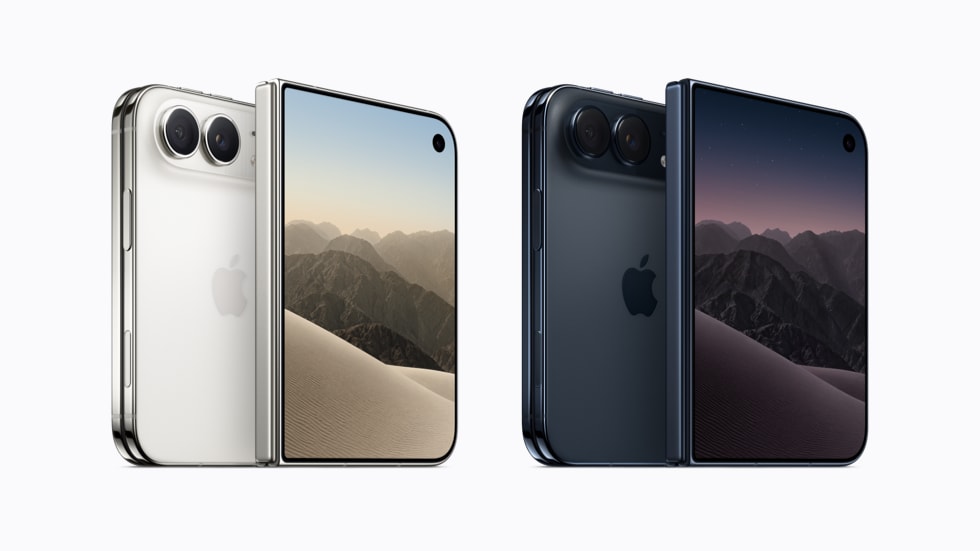
The iPhone Duo starts at $1,999 for 256GB, Apple's most expensive iPhone to date, with 512GB, 1TB and 2TB options above that. Apple is also offering it at $83.29 a month over 24 months. Pre-orders opened October 16, 2026, and the phone goes on sale October 23. Apple sells it in two finishes, star white and night sky, built from Grade 5 titanium with a mirror-polished edge (full details on Apple's iPhone Duo product page).
The Galaxy Z Fold8 has been on sale since Samsung's Unpacked launch in July 2026, so by the time the iPhone Duo arrives, Samsung's foldable will already be a well-reviewed, broadly available phone rather than a day-one launch. Samsung's official starting price is $1,899.99 for 256GB and $2,099.99 for 512GB, with a 1TB option above that, plus a $79.17-a-month financing plan before any trade-in. That makes the entry-level Z Fold8 $100 cheaper than the entry-level iPhone Duo, though both companies regularly run trade-in promotions that can cut the effective price by several hundred dollars. The Z Fold8 ships in Pistachio, Lavender, Cream and Graphite, with Lavender sold as a Samsung.com exclusive.
Displays: inner and outer screens compared
Both phones use the same basic formula — a small cover screen for quick tasks and a large inner screen that unfolds into something closer to a small tablet — but the numbers differ in ways that matter day to day.
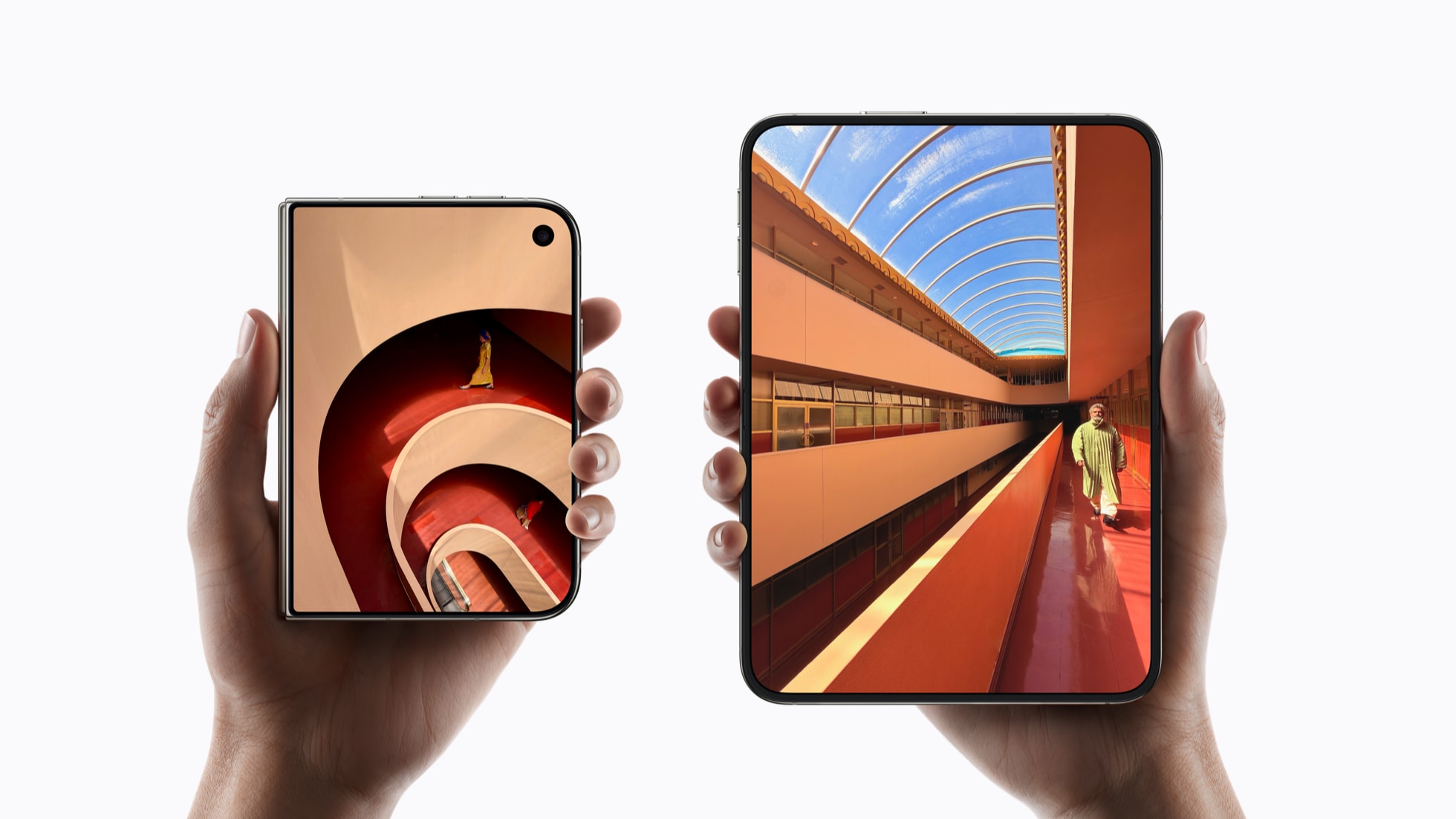
The iPhone Duo's outer display is 5.4 inches, and its inner display is 7.6 inches, both Super Retina XDR panels with ProMotion, an Always-On mode and 3,000 nits of peak brightness. Apple also sells a version of the inner display with a nano-texture finish that cuts glare, and both displays share the same aspect ratio so content scales proportionally when you unfold the phone rather than needing to be redrawn.
The Galaxy Z Fold8's cover screen is slightly larger at 5.5 inches (1,248 x 1,972, 428 ppi) with a tall 10:16 aspect ratio, which makes it noticeably easier to type on and use one-handed than a narrower cover screen. Its main screen is also 7.6 inches (1,848 x 2,448, 403 ppi) with a 4:3 aspect ratio, 120Hz refresh rate, an anti-reflective coating and up to 3,000 nits of brightness — matching Apple's peak brightness figure almost exactly. In practice, the Z Fold8's wider cover screen is the bigger everyday difference: Samsung has had several generations to refine that outer-screen shape, and it shows (see Samsung's full Galaxy Z Fold8 specs page for panel details).
Design, weight and durability
Apple says the iPhone Duo is the thinnest iPhone ever made when open, built around a dual-battery architecture — one battery on each side of the hinge — housed in a titanium frame. It carries an IP68 rating for dust and water resistance, matching Apple's standard flagship phones.
The Galaxy Z Fold8 weighs 201 grams, Samsung's lightest Fold yet, and measures 4.5mm thick when unfolded and 9.7mm when folded. It carries an IP48 rating, which covers full water immersion but a lower level of dust resistance than the iPhone Duo's IP68 — worth noting if you spend time at the beach or on a construction site. Neither company has published independent fold-durability or crease-depth figures, so the usual foldable smartphone caveats apply: both screens are more vulnerable to scratches and cracks than glass-covered phones, and neither is cheap to repair out of warranty.
Chips and performance
The iPhone Duo runs Apple's A20 Pro, the same chip in the iPhone 18 Pro, with a 6-core CPU Apple says is up to 20% faster than the A19 Pro, a 7-core GPU up to 40% faster, and a dual 16-core Neural Engine with twice the compute power of the previous generation. Apple also claims 35% better sustained performance versus the iPhone 17 Pro, which matters more on a foldable than a normal phone since thermal headroom inside a folding chassis is tighter.
The Galaxy Z Fold8 runs the Snapdragon 8 Elite Gen 5 for Galaxy, paired with 12GB or 16GB of RAM depending on which storage tier you buy (256GB/512GB get 12GB RAM, the 1TB model steps up to 16GB). Both chips are current-generation flagship silicon, and neither will feel like the bottleneck in daily use; the more meaningful difference is how each company's software uses that extra screen real estate, covered below.
Cameras
Apple's iPhone Duo uses a 48MP Fusion main camera with a 2x optical-quality telephoto crop and zero shutter lag, plus a 48MP Fusion Ultra Wide camera that Apple says matches the iPhone 18 Pro's ultra-wide. Selfies and video calls use a Center Stage front camera with auto-orientation, and there's a separate FaceTime camera hidden under the inner display for when the phone is unfolded. Apple is also touting 4K120fps Dolby Vision video recording and updated Photographic Styles with new texture and grain controls.
Samsung's Galaxy Z Fold8 pairs a 50MP Wide camera with 2x optical-quality zoom and a 50MP Ultra Wide camera on the back, with up to 10x digital zoom, plus dual 10MP front cameras — one on the cover screen, one under the main display. On paper the megapixel counts favor Samsung, though Apple's computational pipeline and video codecs have historically closed that gap in real-world photos; neither company's claims here can be verified without independent lab testing, so treat the spec sheet as a starting point rather than the final word.
Battery and charging
The iPhone Duo's dual-battery design is rated by Apple for up to 31 hours of video playback using the inner display, 44 hours using the outer display, or 24 hours of mixed use. It supports fast charging to 50% in about 20 minutes wired, or about 30 minutes over MagSafe or Qi2 wireless charging.
The Galaxy Z Fold8 packs a 4,800 mAh battery rated for up to 26 hours of video playback, with 45W wired Super Fast Charging 2.0, Super Fast Wireless Charging at 20W, and reverse Wireless PowerShare so the phone can top up earbuds or a watch. Samsung's wired charging speed is faster on paper, but Apple's dual-battery approach and its outer-display-only video figure (44 hours) suggest the Duo may last longer in screen-off or cover-screen-only use, where many people spend most of a foldable's battery life anyway.
| Spec | iPhone Duo | Galaxy Z Fold8 |
|---|---|---|
| Starting price | $1,999 (256GB) | $1,899.99 (256GB) |
| Outer/cover display | 5.4" Super Retina XDR, ProMotion | 5.5" WUXGA+ (428 ppi), 10:16 |
| Inner/main display | 7.6" Super Retina XDR, ProMotion, 3,000 nits | 7.6" QXGA+ (403 ppi), 120Hz, 3,000 nits |
| Chip | Apple A20 Pro | Snapdragon 8 Elite Gen 5 for Galaxy |
| RAM | Not disclosed by Apple | 12GB or 16GB |
| Storage options | 256GB / 512GB / 1TB / 2TB | 256GB / 512GB / 1TB |
| Rear cameras | 48MP Fusion Main (2x tele) + 48MP Fusion Ultra Wide | 50MP Wide (2x tele) + 50MP Ultra Wide |
| Battery | Dual-battery, up to 44 hrs video (outer) | 4,800 mAh, up to 26 hrs video |
| Charging | ~50% in 20 min wired | 45W wired / 20W wireless |
| Water/dust resistance | IP68 | IP48 |
| Weight | Not disclosed by Apple | 201g |
| Stylus support | Apple Pencil (USB-C), via later software update | No built-in S Pen slot on Fold8 |
| OS at launch | iOS 27 | Android 17 with Galaxy AI |
| Colors | Star white, Night sky | Pistachio, Lavender, Cream, Graphite |
| Pre-order / release | Pre-order Oct. 16, on sale Oct. 23, 2026 | Shipping since July 2026 Unpacked |
Software, multitasking and ecosystem
The iPhone Duo ships with iOS 27 and introduces Split View, letting people open two apps side by side on an iPhone for the first time, or two windows of the same app — useful for comparison shopping or referencing one document while writing in another. Apple is also bringing Apple Pencil support to the Duo, using the USB-C Apple Pencil on both the outer and inner displays, but that feature is arriving as a later software update rather than at launch, so buyers who want pen input on day one will be waiting.
The Galaxy Z Fold8 runs Android 17 with Samsung's Galaxy AI layered on top, plus the multi-window and app-continuity tools Samsung has refined across five generations of Fold hardware — including drag-and-drop between split-screen apps and a taskbar built for the big inner display. Samsung's foldables have also long supported Google's Circle to Search, which works across both the cover and main screens. If you want a stylus today rather than "later this year," Samsung's wider foldable lineup has historically been the safer bet, though the standard Z Fold8 itself doesn't include a built-in S Pen slot.
Who should actually buy each one
If you're already deep in Apple's ecosystem — iMessage, AirDrop, a family on iPhone, an Apple Watch — the Duo is the obvious pick, and its titanium build, IP68 rating and 2TB storage ceiling make it the more future-proof option for people who hold onto phones for years. It's also worth cross-shopping against Apple's own carrier trade-in deals, which can meaningfully soften that $1,999 starting price.
If you want a foldable now rather than waiting for Apple Pencil support to switch on, or you'd simply rather save $100 to $200 at the register, the Galaxy Z Fold8 is the more complete package on day one. It's also worth a look next to other Android foldables that have launched this year if price is the deciding factor, since competition in the segment has pushed several Samsung rivals to undercut both of these flagships — see our Xiaomi 18 Fold vs. iPhone Duo comparison for one example of how that plays out.
Bottom line
On paper, the iPhone Duo and Galaxy Z Fold8 are closer than their different operating systems make them feel: both have 7.6-inch inner displays, both claim 3,000 nits of peak brightness, and both start around $1,900 to $2,000 depending on configuration. The real differences are in the details — Samsung's wider cover screen and lower starting price against Apple's IP68 rating, titanium build and higher storage ceiling. Neither phone will convert someone who's skeptical of folding phones generally, but for people already shopping in this category, the choice mostly comes down to which ecosystem you're already living in, and whether you're willing to wait for Apple to finish turning on Pencil support.
Frequently asked questions
When does the iPhone Duo go on sale and how much does it cost?
Apple's iPhone Duo starts at $1,999 for 256GB. Pre-orders opened October 16, 2026, and the phone went on sale October 23, 2026, with 512GB, 1TB and 2TB options available at higher prices.
What's the difference between the iPhone Duo's and Galaxy Z Fold8's displays?
Both have 7.6-inch inner displays with up to 3,000 nits of brightness. The iPhone Duo's outer display is 5.4 inches versus the Galaxy Z Fold8's 5.5-inch, taller 10:16 cover screen, which is generally easier to use one-handed.
Does the iPhone Duo support Apple Pencil like the Z Fold8 supports S Pen?
The iPhone Duo supports the USB-C Apple Pencil on both displays, but Apple says that feature arrives via a later software update rather than at launch. The standard Galaxy Z Fold8 does not include a built-in S Pen slot.
Which foldable has the better camera on paper?
The Galaxy Z Fold8 has higher megapixel counts, with dual 50MP rear cameras versus the iPhone Duo's dual 48MP Fusion cameras. Both offer roughly 2x optical-quality zoom, and real-world image quality depends heavily on each company's image processing, which neither company's own materials can verify.
Is the Galaxy Z Fold8 cheaper than the iPhone Duo?
Yes. Samsung's Galaxy Z Fold8 starts at $1,899.99 for 256GB, about $100 less than the iPhone Duo's $1,999 starting price, though both brands offer trade-in promotions that can change the effective price.
Should I buy the iPhone Duo or the Galaxy Z Fold8?
Choose the iPhone Duo if you're invested in Apple's ecosystem and want its titanium build, IP68 rating and higher storage ceiling. Choose the Galaxy Z Fold8 if you want a lower price, a wider cover screen, and a more mature foldable software experience today.
Sources
- Apple Newsroom: Apple unveils iPhone Duoapple.com
- Apple: iPhone Duo product pageapple.com
- Samsung Newsroom: Galaxy Z Fold8 Ultra, Fold8 and Flip8 announcementnews.samsung.com
- Samsung: Galaxy Z Fold8 specssamsung.com
- Samsung: Galaxy Z Fold8 buy page and pricingsamsung.com
Nadia Osei covers mobile and consumer gadgets for Pandromeda: smartphones, tablets, smartwatches, earbuds and smart-home devices. She tracks launches, software updates and pricing across Apple, Google, Samsung and the rest, and builds comparisons from the manufacturers' published specifications.