Steam Frame vs Steam Deck OLED: Specs, Price, Which to Buy
Valve's new standalone VR headset vs its handheld gaming PC: chipset, display, battery, storage tiers, price, release date, and which one to actually buy.
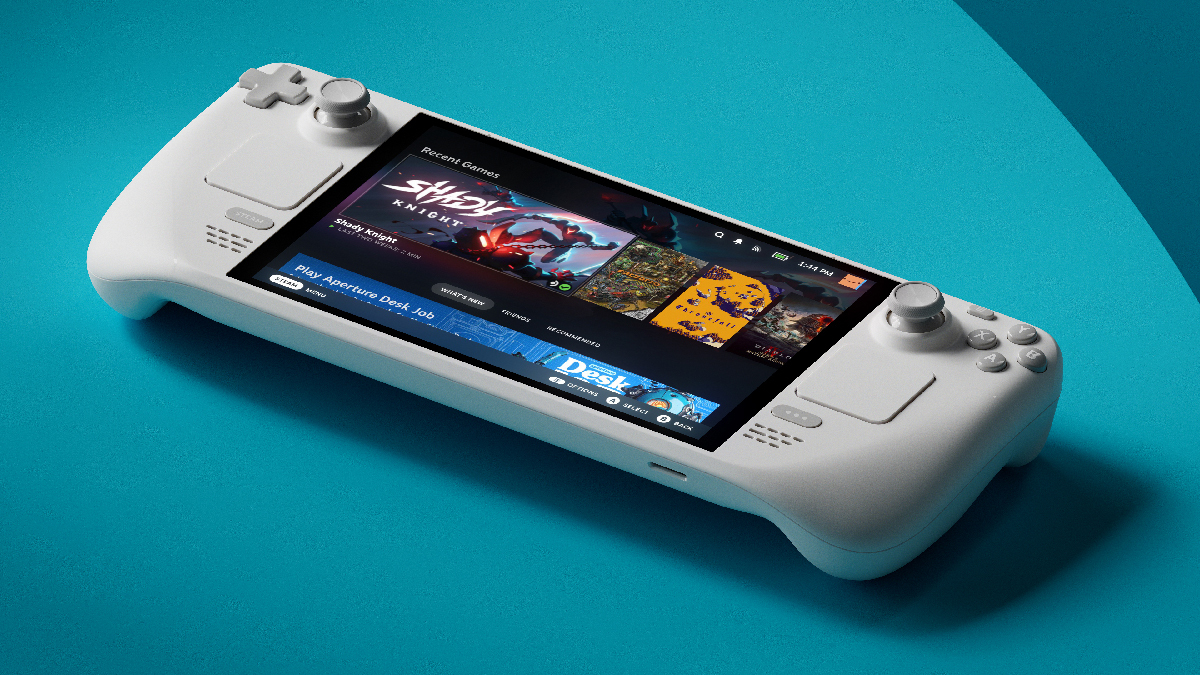
Steam Frame is not a rival handheld to the Steam Deck OLED — it is Valve's new standalone VR headset, powered by a 4nm Snapdragon 8 Gen 3 chip, while Steam Deck OLED remains Valve's AMD-powered handheld gaming PC with a 7.4-inch HDR OLED screen. If you want a screen you hold and play your whole Steam library on at your desk or on a plane, Steam Deck OLED is still the answer. If you want to stand in front of your TV or step into VR and stream or run games untethered on your face, Steam Frame is the new option, starting at $1,059 and shipping through a reservation queue as of late September 2026. Below is what the official specs from Valve actually say, side by side.
- Steam Frame is a standalone VR headset: 4nm Snapdragon 8 Gen 3, 16GB LPDDR5X, dual 2160x2160 LCD panels, Wi-Fi 7, from $1,059 (256GB) / $1,299 (1TB), officially listed release date September 14, 2026, sold through a randomized reservation system.
- Steam Deck OLED is a handheld gaming PC: 6nm AMD Zen 2 + RDNA 2 APU, 16GB LPDDR5, 7.4-inch HDR OLED at up to 90Hz, from $789 (512GB) / $949 (1TB) after Valve's May 2026 price increase.
- They solve different problems. Buy Steam Frame for wireless VR and living-room streaming. Buy Steam Deck OLED for a handheld screen that plays your whole library on the go. Most people asking "which one" actually want the Deck.
What you're really comparing
Search interest in "Steam Frame vs Steam Deck" has spiked because both devices come from Valve, both run SteamOS 3, and both are pitched as ways to play your Steam library without being tied to a desktop PC. But they are not the same category of hardware. Steam Deck OLED is a handheld: a screen, a battery, and a controller built into one slab you hold in two hands. Steam Frame is a head-mounted VR device: two lens-and-panel assemblies strapped to your face, with a separate pair of motion controllers for your hands. According to Valve's own Steam Frame hardware page, it's described plainly as "a PC" that "runs SteamOS" — the pitch is that it's a full standalone computer you wear, not a lighter version of the Deck. For a deeper walkthrough of that device on its own, Pandromeda's Steam Frame explainer covers the announcement in full.
That distinction matters for the "which one should I buy" question, because the honest answer is usually "neither is a substitute for the other." Someone who wants a portable screen for Balatro on the train has no use for a VR headset. Someone who wants to play Half-Life: Alyx standing in their living room has no use for a 7-inch handheld. The comparison is still worth doing properly, though, because both machines share a surprising amount of underlying philosophy — SteamOS, wireless streaming from a gaming PC, and a Valve-designed controller layout — and the spec differences explain why they cost so differently and behave so differently in practice.
Chipset and performance
Steam Deck OLED runs a custom 6nm AMD APU built around a Zen 2 CPU — four cores, eight threads, clocked 2.4-3.5GHz for up to 448 GFlops FP32 — paired with an 8-compute-unit RDNA 2 GPU running at 1.6GHz for 1.6 TFlops FP32, all inside a 4-15W power envelope. That's an x86 chip, the same architecture as a Windows gaming PC, which is why the Deck can run almost anything in a Windows or Linux Steam library, natively or through Valve's Proton compatibility layer.
Steam Frame instead uses a 4nm Qualcomm Snapdragon 8 Gen 3, an ARM64 mobile chip, with 16GB of unified LPDDR5X memory. Valve has not published FP32 GFlops or TFlops figures for the Snapdragon the way it did for the Deck's APU, so there's no official apples-to-apples throughput number to compare — anyone quoting a specific "X times faster" figure between these two chips is not quoting Valve. What Valve has confirmed is the job each chip is asked to do: the Snapdragon needs to decode a wirelessly streamed video feed at low latency for PC games, and separately run lighter, natively-compiled Android and SteamOS VR titles standalone. It is not being asked to render current PC games at native resolution the way the Deck's APU is. Because the two chips are different architectures built for different workloads — sustained handheld gaming PC performance on one side, VR decode-and-stream plus lightweight standalone titles on the other — there is no official Valve benchmark that puts them on the same scale, and treating this as a straightforward "who wins" processor race misses what each device is actually for.
Display: a handheld screen vs two VR panels
Steam Deck OLED's screen is the more familiar quantity: a 7.4-inch diagonal HDR OLED panel at 1280x800, refreshing up to 90Hz, with a contrast ratio Valve rates above 1,000,000:1, 110% of the P3 color gamut, and peak brightness of 1,000 nits in HDR (600 nits SDR), per the specifications on Valve's Steam Deck hardware page. It's a single screen you look at from arm's length, touch-enabled, with response time under 0.1ms.
Steam Frame's optics are built for a completely different viewing distance: two 2160x2160 LCD panels, one per eye, viewed through custom pancake lenses that Valve says provide a field of view up to 110 degrees. Refresh rate runs 72-144Hz, with 144Hz marked as an experimental mode rather than a guaranteed spec. Interpupillary distance (IPD) adjusts across a 60-70mm range, and the headset supports eyeglasses up to 140mm wide without needing prescription inserts. There's no meaningful "which display is better" comparison here — a 7.4-inch handheld LCD/OLED panel and two edge-to-edge stereoscopic VR panels are solving different optical problems. What's worth noting is that Steam Frame's passthrough (the view of your real room while wearing it) is monochrome only, via the headset's outward-facing tracking cameras — Valve has not built in color passthrough, so it's less capable at "mixed reality" than some competing headsets.
Battery life and charging
Steam Deck OLED carries a 50Whr battery that Valve rates for 3 to 12 hours of gameplay, heavily dependent on the title and settings — Valve's own footnote on the spec sheet clarifies that estimate assumes 30FPS, 50% brightness, and 50% volume, and that uncapped framerates or higher brightness will drain it faster. It charges via USB-C PD3.0 at up to 45W, with a 2.5-meter cable included in the box.
Steam Frame's headstrap holds a much smaller 21.6Wh rechargeable Li-ion battery, charged through a rear USB-C 2.0 port at up to 45W (15V, 3A). Valve has not published a headline "hours of standalone playtime" figure for the headset itself the way it did for the Deck, so treat any specific runtime number you see elsewhere as an estimate rather than an official spec. The included motion controllers run on user-replaceable AA batteries instead of a rechargeable cell, with Valve quoting roughly 40 hours of battery life per controller — a deliberate choice that avoids controller battery anxiety even if the headset itself needs recharging more often. Notably, the Steam Frame headset kit does not include a power brick in the box; Valve sells the "Steam Hardware Power Supply Unit" separately for $29.
Storage tiers and pricing compared
Both devices come in two storage tiers, and both add microSD expansion, but the price gap between them is large and it's widened further by a 2026 price increase on the Deck side. Valve confirmed in May 2026 that it was raising Steam Deck OLED pricing "due to rising memory and storage costs," pushing the 512GB model from its original $549.99 launch price to $789, and the 1TB model from $649.99 to $949 — increases of roughly 40-46%. The base Steam Deck LCD model, at $449 for 512GB, remains the cheapest way into the Steam Deck line.
| Tier | Storage | Price (USD) | What's included |
|---|---|---|---|
| Steam Deck (LCD) | 512GB NVMe SSD | $449 | Handheld, 45W charger, carrying case |
| Steam Deck OLED | 512GB NVMe SSD | $789 | Handheld, 45W charger, carrying case |
| Steam Deck OLED | 1TB NVMe SSD | $949 | Handheld, 45W charger, carrying case |
| Steam Frame | 256GB UFS + microSD | $1,059 | Headset, 2 controllers, Half-Life: Alyx (power supply sold separately) |
| Steam Frame | 1TB UFS + microSD | $1,299 | Headset, 2 controllers, Half-Life: Alyx (power supply sold separately) |
Two things stand out. First, Steam Frame's listed price is for the full kit — headset plus both motion controllers plus a copy of Half-Life: Alyx — while the power supply is a separate $29 purchase, so real out-the-door cost is closer to $1,088-$1,328. Second, even the cheapest Steam Frame configuration costs more than a fully-loaded 1TB Steam Deck OLED, which is the clearest signal that these two devices are not aimed at the same budget or the same buyer.
Release date and availability
Steam Deck OLED has been shipping since November 2023 and, per Valve's storefront, is currently listed as in stock with standard shipping — the May 2026 price increase came alongside a return to stock after months of shortages. Steam Frame is brand new: Valve's official store listing gives it a release date of September 14, 2026, but rather than a normal first-come, first-served launch, Valve is selling it through a randomized reservation queue. Valve's own FAQ on the Steam Frame reservation page notes a signup cutoff of September 17 at 10 a.m. Pacific for priority consideration in the initial reservation lottery, with order confirmation emails going out to selected reservation holders shortly after. In practice, that means anyone reading this in late September 2026 may still be waiting on a reservation slot rather than being able to simply add a Steam Frame to a cart and check out — a very different buying experience from the Deck, which you can order today.
Controllers, weight, and ergonomics
Steam Deck OLED is a single object: 298mm x 117mm x 49mm and about 640 grams, with its D-pad, ABXY buttons, twin analog sticks, two 32.5mm haptic trackpads, and a 6-axis gyro all built into the handheld body — there's nothing extra to hold or pair.
Steam Frame is necessarily a multi-piece system. The core headset module weighs 185 grams by itself, or 440 grams with the full headstrap attached (which itself integrates dual audio drivers and the rechargeable battery). Each of the two motion controllers adds 130 grams with its AA battery installed (107 grams without), and measures 126mm x 73mm x 87mm. The controllers support full 6-degrees-of-freedom tracking, capacitive finger sensing for a rough approximation of individual finger position, magnetic TMR thumbsticks, and a haptic motor apiece, connecting to the headset over a dedicated 2.4GHz link. Comfort and weight distribution across a headstrap, versus a single handheld you set in your lap, is a fundamentally different ergonomic proposition — one that no spec sheet fully captures, since fit varies by head shape and how long a session runs.
What you can actually play on each
Steam Deck OLED plays essentially the same Steam library a gaming PC would, since it's running x86 SteamOS 3 with the same Proton compatibility layer used on Linux desktops; Valve and the community both maintain "Deck Verified" ratings for how well individual games run on the handheld's screen and controls.
Steam Frame plays two different kinds of content. It can stream a full PC's Steam library wirelessly, using the included Wi-Fi 6E adapter for what Valve describes as a direct, low-latency link between the headset and a separate gaming PC — in that mode, the PC does the heavy rendering and the headset just displays the result, similar in spirit to how the Deck's own screen works, but wireless and over a network link rather than local hardware. Separately, because the Snapdragon chip and 16GB of RAM can run software natively, Steam Frame also supports "standalone" play — VR and flatscreen titles that are verified to run directly on the headset's own ARM hardware without needing a PC at all. Valve maintains a running list of Steam Frame Standalone Verified titles on its Great on Frame storefront page, and that list is explicitly described as growing rather than fixed, so what plays without a PC on day one is smaller than what plays with one.
Which one should you actually buy?
If you already know you want VR — motion controllers, a headset, room-scale or seated immersive games, and the option to also stream your existing PC library wirelessly to your face instead of a monitor — Steam Frame is the only one of these two devices that does that job, and at $1,059 to $1,299 it's priced in line with other high-end standalone VR headsets rather than against the Deck. If what you actually want is a handheld: something you can pick up, play Balatro or Hades or a AAA PC game on the couch or on a flight, and put back down, Steam Deck OLED remains the more mature, better-supported, and (even after this year's price hike) meaningfully cheaper option, especially if you don't need the OLED screen and are fine with the base LCD Deck at $449.
Buyers cross-shopping Valve's whole current lineup rather than just these two devices may also want to look at Steam Machine, Valve's new living-room console, or see how Steam Deck OLED's specs and price stack up against ASUS's ROG Xbox Ally handhelds before committing to a handheld purchase.
Bottom line
Steam Frame and Steam Deck OLED share a logo, an operating system, and a launch window in late 2026, but they aren't competing for the same purchase. Steam Frame is Valve's first standalone VR headset in years, built around a mobile Snapdragon chip, dual 2160x2160 panels, and a reservation-only launch that's still gating who can even buy one as of this writing. Steam Deck OLED is a mature, in-stock, AMD-powered handheld that plays your existing library today, now at a noticeably higher price than when it launched. If your search brought you here trying to decide between them as if they were two versions of the same product, the honest next step is to first decide whether you want a VR headset or a handheld — the answer to that question will make the rest of this comparison irrelevant, because you'll already know which one you're buying.
Frequently asked questions
Is Steam Frame a handheld like the Steam Deck?
No. Steam Frame is a standalone VR headset you wear on your head, with two separate motion controllers for your hands. Steam Deck OLED is a handheld gaming PC with its own screen and controls built into one device. They both run SteamOS 3, which is why they get compared, but they are different hardware categories.
What chip does Steam Frame use compared to Steam Deck OLED?
Steam Frame uses a 4nm Qualcomm Snapdragon 8 Gen 3 (ARM64), with 16GB of unified LPDDR5X RAM. Steam Deck OLED uses a 6nm AMD APU with a Zen 2 CPU and RDNA 2 GPU, with 16GB of LPDDR5. Valve has not published directly comparable throughput figures for the two chips, since they're built for different jobs: sustained native PC gaming on the Deck versus VR streaming and lightweight standalone titles on Frame.
How much does Steam Frame cost compared to Steam Deck OLED?
Steam Frame starts at $1,059 for the 256GB kit and $1,299 for 1TB, including two controllers and Half-Life: Alyx, with the power supply sold separately for $29. Steam Deck OLED costs $789 for 512GB and $949 for 1TB, after Valve raised OLED pricing in May 2026 from its original $549.99/$649.99 launch prices.
When does Steam Frame release, and can I buy it right now?
Valve's official store listing gives Steam Frame a release date of September 14, 2026, but it is being sold through a randomized reservation queue rather than a normal checkout, with a signup deadline of September 17 at 10 a.m. Pacific for the initial priority queue. As of late September 2026, many buyers are still waiting on a reservation email rather than able to purchase immediately.
Can Steam Frame play my existing Steam library?
Yes, in two ways. It can wirelessly stream your full Steam library from a separate gaming PC using its included Wi-Fi 6E adapter, and it can also run a growing list of titles natively on its own Snapdragon hardware without a PC, which Valve tracks on its Great on Frame storefront page.
Is Steam Deck OLED still worth buying in 2026?
It's still the more mature and far cheaper option if what you want is a handheld screen for your Steam library, even after 2026's price increase to $789/$949. The base Steam Deck (LCD) at $449 remains the cheapest entry point if you don't need the OLED panel.
Sources
- Valve - Steam Frame hardware specsstore.steampowered.com
- Valve - Steam Deck hardware specsstore.steampowered.com
- Valve - Steam Frame store listing (pricing & release date)store.steampowered.com
- Valve - Great on Frame (Standalone Verified games)store.steampowered.com
- Video Games Chronicle - Valve's Steam Deck gets huge price increase, 1TB OLED model now $949videogameschronicle.com
Jonah Reyes leads Pandromeda's gaming coverage: console and handheld hardware, release dates, pricing changes, patch notes and the business moves behind the biggest franchises. He sources every date and price from the platform holders and publishers themselves, and says plainly when something is still only a rumour.