Railway vs Render vs Fly.io in 2026: Which Should You Pick?
Pricing, free-tier limits, databases, and regions compared across Railway, Render, and Fly.io, using numbers pulled directly from each platform's own docs.
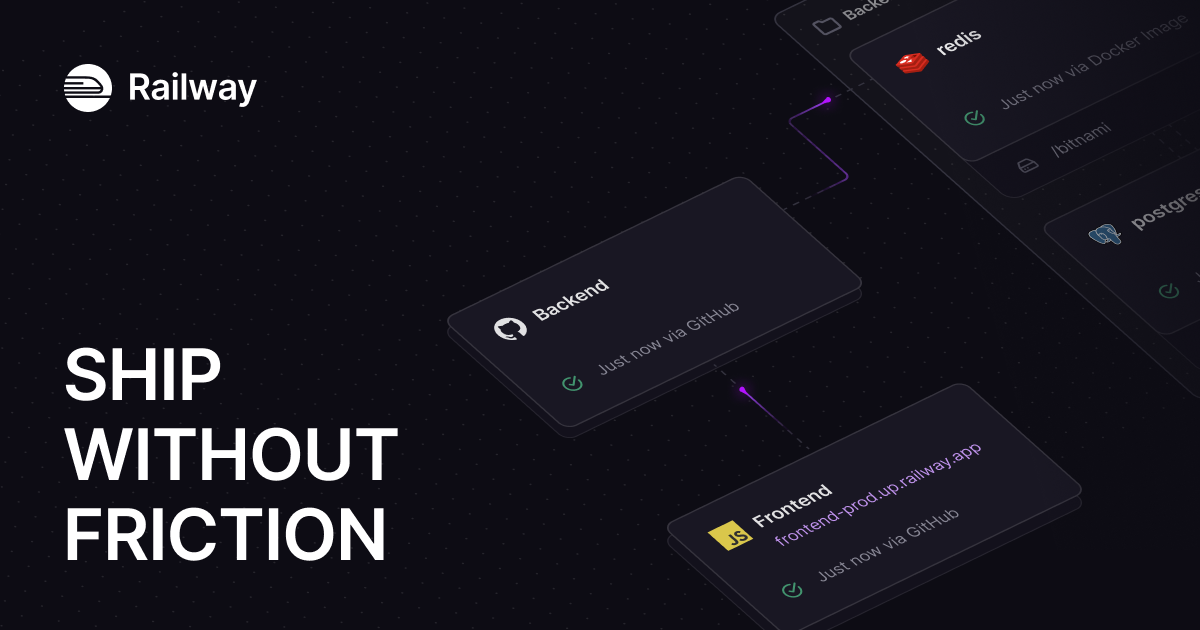
Short version: Railway is the fastest path from a GitHub repo to a running app, with usage-based billing that starts at a $5/month Hobby plan. Render is the more structured, enterprise-friendlier option, with clearer fixed-price compute tiers and a 750-hour free web service plan that spins down when idle. Fly.io drops the free tier entirely but gives you the most control, the widest regional footprint (18+ regions versus Render's five and Railway's four), and the cheapest raw compute if you're comfortable configuring things yourself. Below is what each platform's own pricing and docs pages actually say, so you can match the bill to the way you build.
The quick answer: who should pick what
All three platforms do the same basic job: take a Git repository or container image and run it on managed infrastructure, with a database a click or a CLI command away. The differences show up in billing model, free-tier generosity, and how much infrastructure control you're expected to manage yourself.
- Pick Railway if you want the shortest distance between "push to GitHub" and "app is live," you're fine with metered, per-second billing, and your team is small enough that Pro's flat $20/workspace fee (unlimited seats included) feels generous rather than restrictive.
- Pick Render if you want predictable, named compute tiers (Starter, Standard, Pro, and up), a genuinely free always-on-while-active web service tier for side projects, and features aimed at teams — like a $499/month Scale plan with the compliance and support options larger orgs ask for.
- Pick Fly.io if your app needs to run close to users in many regions, you want fine-grained control over machine sizing and placement, and you don't mind that there's no free tier anymore — only a small, time-limited trial credit.
- Cheapest way to keep something running for free: Render's free web service (spins down after 15 minutes idle, 750 instance-hours/month).
- Cheapest paid entry point: Railway Hobby at $5/month, which also covers $5 of usage.
- Most regions: Fly.io, with 18+ worldwide versus Render's 5 and Railway's 4.
- No free tier at all: Fly.io — new accounts get a $1, 7-day trial credit instead.
Pricing and free-tier limits compared
Here is what each company's own pricing page lists for entry-level plans, pulled directly from Railway's pricing page, Render's pricing page, and Fly.io's pricing documentation.
| Platform | Free tier | Cheapest paid plan | Billing model |
|---|---|---|---|
| Railway | $1/month usage credit, 1 vCPU / 0.5 GB max per service (plus a one-time $5, 30-day trial credit for new accounts) | Hobby: $5/month subscription, includes $5 of usage, up to 48 vCPU / 48 GB per service | Per-second metered: ~$10/GB-month RAM, ~$20/vCPU-month CPU, on top of the plan fee |
| Render | Free web service: 0.1 CPU / 512 MB, spins down after 15 minutes idle, 750 free instance-hours/month per workspace | Starter compute: $7/month (0.5 CPU / 512 MB) on the free Hobby workspace plan | Fixed monthly price per named compute tier, billed per instance |
| Fly.io | None for new orgs; a $1, 7-day trial credit only | shared-cpu-1x Machine: from $2.19/month (256 MB), scaling up with RAM/CPU size | Per-second metered compute, plus separate charges for storage, bandwidth, and IPs |
Railway's Pro plan costs $20 per workspace per month with unlimited seats included, scales a single service up to 1,000 vCPU / 1 TB RAM, and includes $20 of usage credit toward the metered bill. Render's workspace plans run Hobby (free), Professional ($25/month), and Scale ($499/month) — separate from the per-service compute price, which climbs from Starter ($7/month) through Standard ($25), Pro ($85), Pro Plus ($175), Pro Max ($225), and Pro Ultra ($450) as you add CPU and RAM. Fly.io has no separate "workspace" fee; you pay purely for the Machines, volumes, bandwidth, and add-ons you provision, with optional prepaid reservation blocks that knock about 40% off compute for teams with steady usage.
If you're also comparing CI spend alongside hosting spend, it's worth lining this up against a GitHub Actions vs. Jenkins pricing breakdown, since build minutes and deploy costs tend to move together.
Compute pricing and scaling as you grow
Railway and Fly.io both meter compute by the second, which rewards apps that don't run at full tilt around the clock. Railway charges roughly $0.00000772 per vCPU-second (about $20/vCPU-month) and $0.00000386 per GB-second of RAM (about $10/GB-month), plus $0.05/GB for network egress and $0.00000006 per GB-second for volume storage (about $0.15/GB-month). Fly.io's shared-cpu machines start at $2.19/month for a 256 MB instance and move up to $13.39/month for a 2 GB shared-cpu-2x machine, with dedicated "performance" machines at $33/month (2 GB) and $66/month (4 GB); stopped machines bill only $0.15/GB-month for their root filesystem, and outbound bandwidth is $0.02/GB in North America and Europe, rising to $0.12/GB in Africa and India.
Render takes the opposite approach: fixed, named instance sizes you select up front rather than a running meter. That makes a Render bill easier to predict month to month, but it also means you're paying for Standard's full 2 GB/1 CPU even during quiet hours, since only the free tier spins down automatically. Fly.io also sells prepaid "reservation blocks" — roughly a 40% discount on performance or shared-CPU compute and extra RAM if you commit to a fixed monthly spend for a year, which can meaningfully lower the bill for an app with steady, predictable traffic rather than spiky usage.
Databases and managed add-ons
Railway doesn't sell separate, fixed-price database plans. Postgres, MySQL, Redis, MongoDB, and ClickHouse all deploy from one-click templates with automated backups and a dashboard, and then bill under the same per-second CPU/RAM/volume rates as any other service — plus network egress if you connect over Railway's TCP proxy.
Render's databases are priced on their own tiers, separate from compute, as detailed in Render's compute plans documentation. Render Postgres starts with a free instance (0.1 CPU, 256 MB RAM, 1 GB storage) that expires 30 days after creation, with a 14-day grace period to upgrade before the data is deleted; paid plans run from Basic-256mb at $6/month up through Pro-tier instances priced by CPU and RAM, with storage billed separately per GB. Render Key Value (its Redis-compatible store) has its own free plan (25 MB RAM, 50 connections, in-memory only) and paid tiers starting at $10/month and scaling to larger instances with higher connection limits for busier caching or session-storage workloads.
Fly.io's Managed Postgres runs $38/month (Basic) up to $1,922/month (Performance), with storage metered at $0.28/GB-month on top; Fly also offers an older, self-managed Postgres cluster option that's cheaper (roughly $2/month for a single-node dev setup) but explicitly unsupported for production use. For teams weighing managed Postgres against a backend-as-a-service approach instead of rolling your own, it's worth also reading the site's Supabase vs. Firebase comparison.
Deploy speed and developer experience
None of the three companies publishes a formal deploy-time SLA, so treat any specific "X seconds to deploy" number you see elsewhere as anecdotal rather than a documented spec. What each vendor does say about itself: Railway's own product pages describe pushing code and having it live "in seconds," and its deployment flow is built around pointing a service at a GitHub repo or container image, after which Railway builds and deploys automatically with override hooks for custom build and start commands. Fly.io's documentation describes its Machines (the underlying compute unit) as designed to start and stop in milliseconds once an image exists, which is what makes its scale-to-zero autostop/autostart behavior practical for bursty workloads. Render's deploy model sits in between: standard Git-triggered builds onto fixed compute instances, with the free tier's roughly one-minute cold start after 15 minutes of inactivity being the one hard number Render documents.
In practice, the meaningful DX difference isn't raw speed so much as how much you configure. Railway and Render both lean on buildpacks/auto-detection for common frameworks with a Dockerfile fallback; Fly.io expects a fly.toml and is more explicit about machine sizing and regions, which gives you more control at the cost of a slightly longer learning curve. If your deploy pipeline already revolves around containers, the groundwork from a Docker vs. Podman comparison carries over directly to any of the three.
Regions and global reach
This is the sharpest differentiator among the three. Railway currently runs four "Metal" regions — US West (California), US East (Virginia), EU West (Amsterdam), and Southeast Asia (Singapore). Render offers five regions — Oregon, Ohio, and Virginia in the US, plus Frankfurt and Singapore. Fly.io, by contrast, advertises 18+ regions worldwide and is built around running the same app in multiple regions simultaneously, placing compute closer to users rather than in one or two central hubs. If low latency for a geographically spread-out user base is the deciding factor, Fly.io's footprint is in a different league from the other two.
Reliability, support, and enterprise features
Render's top workspace tier (Scale, $499/month) and Railway's Enterprise plan (custom pricing) both target teams that need SSO, audit logs, and dedicated support rather than just more compute. Fly.io sells support as a separate line item outside of compute: Standard support runs $29/month, Premium $199/month, and Enterprise support starts at $2,500/month — a structure that assumes you're already comfortable self-serving through docs and community channels at the free/trial level. None of the three platforms published a specific uptime SLA percentage on the pages checked for this piece, so if guaranteed uptime matters contractually, confirm current SLA terms directly with sales before committing.
Log retention is another quiet differentiator worth checking before you standardize on one platform for anything regulated or debugging-heavy: Railway keeps logs for 3 days on its Free plan, 7 days on Hobby, and 30 days on Pro. Render and Fly.io don't advertise a single headline log-retention number in the same way, so if your team needs long-lookback debugging or compliance logging, plan on shipping logs to an external sink regardless of which platform you choose.
Which platform fits which use case
- Side projects and prototypes: Render's free web service (if your app can tolerate spin-down) or Railway's $5 Hobby plan for something that needs to stay warmer.
- Small production backend/API: Railway Pro for simplicity and flat per-workspace pricing, or Render Standard/Pro if you'd rather have a fixed, predictable bill than a metered one.
- Latency-sensitive or globally distributed apps: Fly.io, on the strength of its 18+ regions and sub-second Machine start/stop model.
- Teams that need managed Postgres without babysitting it: Any of the three works, but compare Render's flat Postgres tiers against Fly's Managed Postgres pricing ($38–$1,922/month) and Railway's usage-metered template before committing, since the billing shapes are genuinely different.
- Cost-sensitive, spiky workloads: Railway or Fly.io, since both meter by the second and both let idle compute cost close to nothing when scaled to zero; Render's fixed tiers are harder to shrink below a flat monthly floor once you're off the free plan.
What to do next
Pricing pages change — Render's own flexible-plan rollout and Fly.io's 2024 removal of its original free tier are reminders that none of this is static. Before committing a production workload, pull up each platform's current pricing page yourself, run a small test deployment on your actual stack, and track the metered bill for a few days if you're going with Railway or Fly.io, since real-world usage-based costs can differ meaningfully from a back-of-envelope estimate. If your team is still deciding on the surrounding infrastructure — CI/CD, containers, or the database layer — the related comparisons linked throughout this piece cover those adjacent decisions in the same amount of detail.
Frequently asked questions
Is Railway cheaper than Render?
It depends on usage. Railway's Hobby plan starts at $5/month and bills by the second for compute, memory, and storage, so light or spiky workloads can cost less than Render's fixed $7/month Starter instance. Heavier, constantly busy apps can end up costing more on Railway's metered model than on Render's flat-rate compute tiers.
Does Fly.io have a free tier?
No. Fly.io's own pricing documentation states there is no free tier or monthly free usage allowance for new organizations. New accounts get a one-time $1 trial credit valid for 7 days, and a payment method is required once the trial ends.
Which platform has the most regions?
Fly.io, with 18+ regions worldwide, according to its own site. Render offers five regions (Oregon, Ohio, and Virginia in the US, plus Frankfurt and Singapore), and Railway currently runs four 'Metal' regions: US West, US East, EU West, and Southeast Asia.
Can I run a free-tier app 24/7 on Render?
Only partially. Render's free web service plan spins down after 15 minutes without inbound traffic and takes about a minute to wake back up, and the workspace is capped at 750 free instance-hours per month.
Do Railway, Render, and Fly.io all support managed Postgres?
Yes, but the pricing shapes differ. Railway bills Postgres through the same usage-metered compute and storage rates as other services. Render prices Postgres on fixed per-GB/CPU tiers starting around $6/month after its 30-day free database expires. Fly.io's Managed Postgres runs $38 to $1,922 per month, plus per-GB storage.
Which is best for a side project with no budget?
Render's free web service is the closest thing to a true free tier among the three, since Railway's free plan only covers about $1/month of usage and Fly.io has no free tier at all beyond its 7-day, $1 trial credit.
Sources
- Railway Pricingrailway.com
- Railway Deployment Regions (Docs)docs.railway.com
- Render Pricingrender.com
- Render Free Tier Limits (Docs)render.com
- Render Compute Plans (Docs)render.com
- Fly.io Pricing Docsdocs.fly.io
Felix Moreau writes Pandromeda's software coverage and how-to guides. He covers Windows, macOS and Linux updates, the apps people rely on, emulators and developer tools, and turns official documentation into clear, numbered steps that work on the current version.