What Is End-to-End Encryption? How It Works and Where It's Used
What end-to-end encryption really means, how the key exchange works, and whether it's actually on by default in WhatsApp, Signal, iMessage and Google Messages.
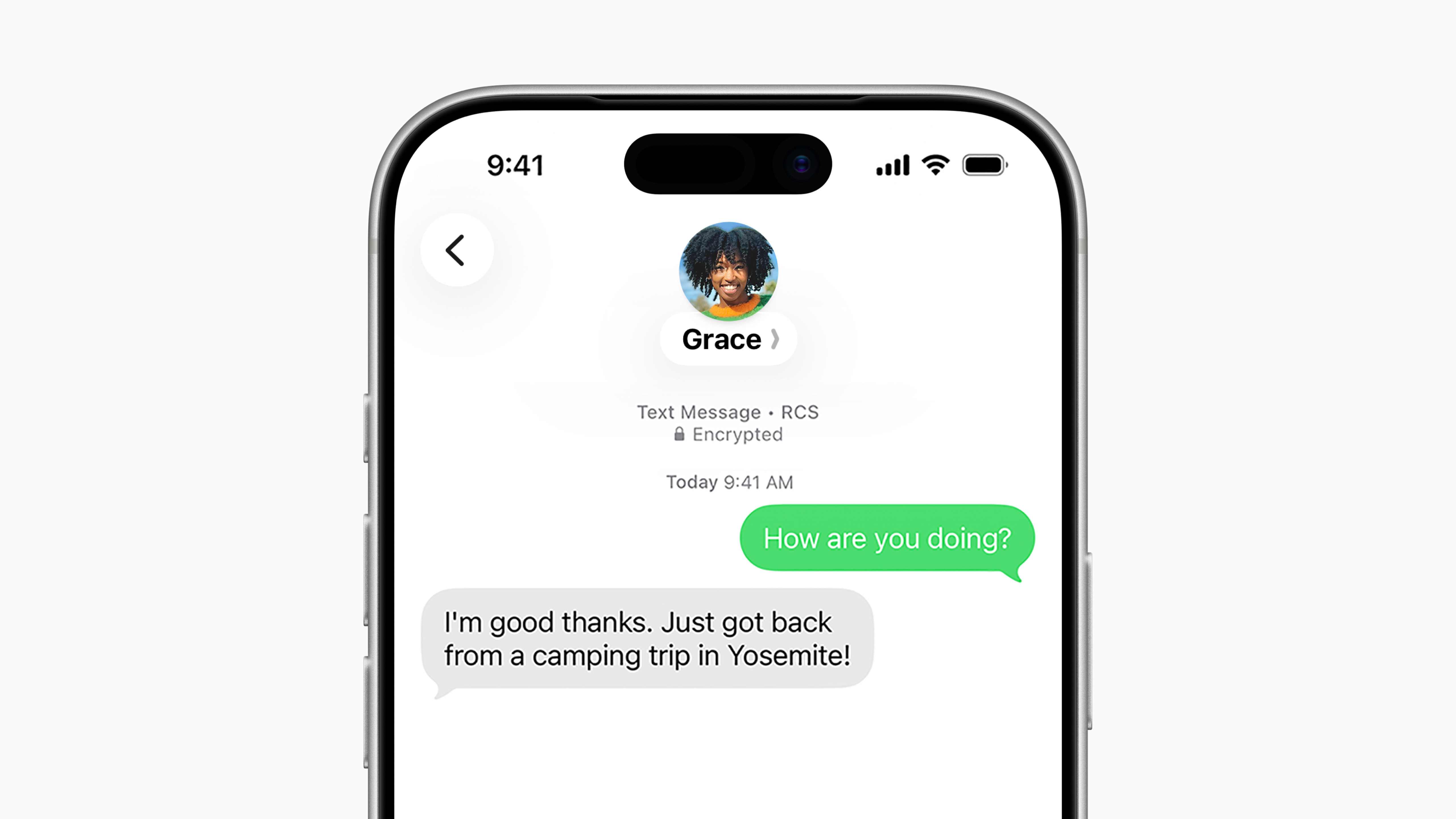
End-to-end encryption (E2EE) means a message is scrambled on the sender's device and can only be unscrambled on the recipient's device — not by the app maker, not by your carrier, and not by anyone who intercepts it in between. That's the core idea behind the lock icons you now see in WhatsApp, Signal, Apple Messages, Google Messages and Facebook Messenger, and it's different from the more general "your data is encrypted" claims companies make about servers and Wi‑Fi connections.
The short version: With true end-to-end encryption, only you and the person you're messaging hold the keys needed to read the conversation. The company running the app can see that a message was sent, and often when and to whom, but not what it says. Apple describes this directly for its own service in its Messages & Privacy documentation: "iMessage is end-to-end encrypted... there's no way for Apple to decrypt the content of your conversations when they are in transit between devices."
What "end-to-end encryption" actually means
Every text you send travels through several hops: your device, your carrier or Wi‑Fi network, the messaging company's servers, and finally the recipient's device. At each of those hops, something could potentially read the message if it isn't protected. End-to-end encryption closes that gap specifically between the two endpoints — your phone and the other person's phone (or computer) — so that none of the hops in the middle, including the company's own servers, can see the plaintext content.
Signal, whose underlying technology other apps also rely on, puts it plainly on its own site: "We can't read your messages or listen to your calls, and no one else can either." That "no one else" line is the practical test for whether something is really end-to-end encrypted, as opposed to just "encrypted" in a looser sense.
End-to-end encryption vs. encryption in transit vs. encryption at rest
These three terms get used interchangeably in marketing copy, but they describe different protections:
- Encryption in transit protects data while it moves between your device and a server — the same kind of protection a VPN or any HTTPS website uses. The server itself still receives the data in readable form.
- Encryption at rest protects data while it's stored on a server or device, typically with keys the storage provider controls. If the provider is compromised or legally compelled, data encrypted only at rest can potentially be decrypted by that provider.
- End-to-end encryption protects data for its entire journey, from sender to recipient, using keys that only the sender and recipient hold. The service provider's servers relay encrypted data they cannot themselves read, even though that same data is "at rest" momentarily while queued for delivery.
A message can be encrypted in transit and at rest on a company's servers without being end-to-end encrypted — that's exactly the distinction Apple draws when it separates iMessage content (end-to-end encrypted) from ordinary SMS (carrier-delivered, not end-to-end encrypted) within the same Messages app.
How the key exchange works, conceptually
You don't need to understand elliptic-curve math to get the gist. When you start an end-to-end encrypted conversation, your device and the other person's device each generate a pair of mathematical keys: one public, one private. The public keys can be shared openly — even posted on a billboard — because they're only useful for encrypting a message to that specific device, not for decrypting it. Each device keeps its private key secret and uses it to decrypt whatever was encrypted against its matching public key.
The most widely deployed system for doing this in consumer messaging is the Signal Protocol, developed by Open Whisper Systems (work begun by Trevor Perrin and Moxie Marlinspike) and used, by Signal's own description, as the engine "powered by the open source Signal Protocol" behind its app. According to Wikipedia's technical summary of the protocol, it combines a handshake — originally a triple Diffie–Hellman exchange, more recently extended with the post-quantum PQXDH protocol — with the Double Ratchet Algorithm, which generates a brand-new encryption key for every single message. That constant key-rotation is what limits the damage if any one key is ever exposed: compromising today's key doesn't unlock yesterday's or tomorrow's messages.
Because the Signal Protocol is open and published, other companies have built their own messaging encryption on top of it rather than designing something from scratch. WhatsApp's security whitepaper describes the Signal Protocol as the foundation of its end-to-end encryption, and Meta has said it built Messenger's default encryption "on strong cryptographic principles, such as the Signal Protocol, and our own novel Labyrinth Protocol." Google likewise built end-to-end encrypted RCS chat in Google Messages on the Signal Protocol.
What is end-to-end encryption on WhatsApp?
On WhatsApp, end-to-end encryption is automatic for personal and group chats, calls, photos, videos, voice messages, documents and status updates whenever everyone involved is on an up-to-date version of the app. WhatsApp's own announcement of the feature states that "the only person who can read it is the person or group chat that you send that message to," and that this protection is "on by default and all the time" — there's no setting to find or toggle on. You can independently verify you're talking to the right person and that no one has intercepted the conversation by comparing the "security code" shown in a contact's encryption details inside the app.
What is end-to-end encryption on Signal?
Signal is the reference implementation of the protocol that bears its name, and every message, call, and group chat on Signal is end-to-end encrypted with no opt-in required — Signal describes this as the whole point of the app rather than an optional mode: "Privacy isn't an optional mode — it's just the way that Signal works." Because Signal's client and server code is published for outside review, independent researchers can and do audit how the encryption is implemented, which is part of why the Signal Protocol became the default building block other platforms adopted. For a closer look at how Signal stacks up against WhatsApp and Telegram on privacy features beyond encryption, see our comparison of Signal, WhatsApp and Telegram.
What is end-to-end encryption on iMessage and iPhone?
On an iPhone, "Messages" is really two different services wearing one app: iMessage (the blue bubbles, Apple-to-Apple) and SMS/MMS/RCS (the green bubbles, carrier-based). Apple states directly that "iMessage is end-to-end encrypted," meaning Apple itself cannot decrypt the content of your conversations as they move between devices, and the same protection extends to attachments. That protection has historically applied only between Apple devices.
What's newer, and directly relevant if you text Android users, is that Apple and Google jointly began rolling out end-to-end encryption for RCS conversations between iPhone and Android in May 2026. Apple's newsroom announcement describes the companies having "led a cross-industry effort" so that "encryption is on by default and will be automatically enabled over time for new and existing RCS conversations," with a lock icon appearing in the chat to confirm it's active. The rollout requires iOS 26.5 with a supported carrier on the iPhone side. One important carve-out remains: messages that fall back to plain SMS or MMS — for example when RCS isn't available — are not end-to-end encrypted on either platform.
It's also worth separating message-in-transit encryption from message storage: if you turn on iCloud Backup or Messages in iCloud, Apple says those backups are "encrypted," and Apple's Advanced Data Protection setting extends end-to-end-style protection to that backed-up copy too — but that's a distinct setting from the encryption applied to messages as they're delivered.
What is end-to-end encryption in Google Messages (RCS) on Android?
Google Messages has end-to-end encrypted RCS conversations between Google Messages users by default for several years, and Google's support documentation is explicit about the requirements: both people must use the Google Messages app, have RCS chats turned on, and be connected over data or Wi‑Fi — "RCS conversations between Google Messages users default to end-to-end encryption," Google says, but "end-to-end encryption isn't available for SMS/MMS messages," and a chat that drops back to SMS (for instance, when someone loses data or Wi‑Fi) loses that protection until RCS is available again. For background on how RCS itself works as a texting standard, independent of encryption, see our explainer on how RCS messaging works on iPhone and Android.
The cross-platform piece — Android talking to iPhone with end-to-end encryption — is the May 2026 rollout described above. Google's blog post on that launch confirms the same mechanics from the Android side: encrypted RCS chats between Android and iPhone show "the same lock icon previously used in RCS chats," and the feature requires the latest version of Google Messages.
What is end-to-end encryption on Messenger?
Facebook Messenger offered end-to-end encryption as an opt-in "Secret Conversations" feature starting in 2016, but Meta began switching that on as the default for personal chats and calls in December 2023. Meta's announcement says the company "started to rollout end-to-end encryption for all personal chats and calls on Messenger and Facebook," built using the Signal Protocol alongside Meta's own Labyrinth Protocol, and that the global rollout to Messenger's more-than-a-billion users would "take a number of months to complete." As part of the upgrade, Meta prompts users to set a recovery method, such as a PIN, since the company — by design — no longer holds a readable copy of your chat history to help you recover it. Group chats were called out separately in Meta's rollout and were not guaranteed the same default-on timeline as one-to-one chats and calls.
Which popular apps use end-to-end encryption by default?
| App | E2EE status | What's covered |
|---|---|---|
| Default, always on | Chats, group chats, calls, media, status updates | |
| Signal | Default, always on | Chats, group chats, calls |
| Apple Messages (iMessage) | Default between Apple devices | iMessage chats and attachments; RCS to Android now encrypted by default as of iOS 26.5 (beta); SMS/MMS fallback is not encrypted |
| Google Messages (RCS) | Default when both sides support it | RCS chats between Google Messages users (and, as of May 2026, cross-platform RCS with supported iPhones); SMS/MMS fallback is not encrypted |
| Facebook Messenger | Rolling out as default (since Dec. 2023) | Personal one-to-one chats and calls; group chats were opt-in at launch of the default rollout |
Note that "default" doesn't always mean "universal." Group chats, business messaging threads, and conversations that fall back to an unencrypted protocol (plain SMS, for instance) can be exceptions even within apps that encrypt one-to-one chats automatically — always check for the lock icon or "Encrypted" label each app surfaces when you want certainty.
What end-to-end encryption doesn't protect
E2EE is powerful but narrow in scope. It typically does not hide:
- Metadata — who you messaged and roughly when. Apple is explicit that for iMessage, "metadata, such as the timestamp and APNs routing information, isn't encrypted."
- Unencrypted backups — a chat history backed up to a cloud service without end-to-end protection on the backup itself can potentially be accessed by that cloud provider, even if the original messages were end-to-end encrypted in transit.
- The device itself — if your phone is unlocked or compromised with spyware, messages are readable in plaintext on-screen regardless of how they were encrypted in transit. This is also why securing your device login matters as much as the app's encryption.
- The other person — end-to-end encryption guarantees only that no third party can read the message; the recipient can always screenshot or forward it.
What's next for end-to-end encryption
The biggest practical shift in 2026 is the collapse of the iPhone/Android encryption gap for text messaging. For years, texting across that divide meant falling back to plain, unencrypted SMS — the literal "green bubble" problem. With Apple and Google's joint RCS encryption rollout now live in beta, that gap is closing, though it still depends on carrier support and both people running current software, so coverage will be uneven for a while. Expect Meta to keep expanding default encryption into Messenger group chats, and expect the lock icon to keep showing up in more places as RCS encryption graduates from beta to a standard, carrier-independent expectation. For now, the safest assumption is to check for the lock icon or "Encrypted" label in-app rather than assume a given conversation is protected by default.
Frequently asked questions
Is end-to-end encryption the same as regular encryption?
No. Regular encryption (encryption in transit or at rest) can still leave the service provider able to read your data on its own servers. End-to-end encryption uses keys that only the sender and recipient hold, so the company running the app can't decrypt the message content even if it wanted to.
Is WhatsApp actually end-to-end encrypted by default?
Yes. WhatsApp turns on end-to-end encryption automatically for chats, group chats, calls and media with no setting to enable — it applies whenever everyone in the conversation is using a current version of the app.
Does iMessage use end-to-end encryption?
Apple states that iMessage is end-to-end encrypted between Apple devices, so Apple itself cannot decrypt message content in transit. Texts that fall back to plain SMS or MMS are not end-to-end encrypted, though as of iOS 26.5 in beta, RCS messages between iPhone and Android can now be end-to-end encrypted too.
What is end-to-end encryption in Google Messages?
Google Messages automatically end-to-end encrypts RCS chats when both people use the Google Messages app, have RCS turned on, and are connected over data or Wi-Fi. It does not apply to SMS/MMS, and as of May 2026 it also extends to RCS conversations with iPhone users running iOS 26.5, via a joint Apple-Google rollout.
Is Messenger end-to-end encrypted?
Meta began rolling out default end-to-end encryption for personal one-to-one chats and calls on Messenger in December 2023, built on the Signal Protocol and Meta's own Labyrinth Protocol. The rollout was gradual and, at launch, group chats were not guaranteed the same default-on protection as one-to-one conversations.
What is the Signal Protocol?
The Signal Protocol is an open-source encryption protocol originally developed by Open Whisper Systems that combines a key-exchange handshake with the Double Ratchet Algorithm, which generates a new encryption key for every message. It underlies Signal itself and has been adopted, in whole or in part, by WhatsApp, Google Messages and Facebook Messenger.
Sources
- Apple – Messages & Privacyapple.com
- Apple Newsroom – End-to-end encrypted RCS messaging begins rolling out today in betaapple.com
- WhatsApp Blog – End-to-end encryptionblog.whatsapp.com
- Signal.orgsignal.org
- Google Messages Help – About end-to-end encryptionsupport.google.com
- Meta Newsroom – Launching Default End-to-End Encryption on Messengerabout.fb.com
Sana Qureshi runs the security and privacy desk. She reports on actively exploited vulnerabilities, vendor patches and data breaches, and covers the password managers, VPNs and authentication tools readers use to protect themselves. Her alerts cite vendor advisories, CISA and the CVE record directly.