Proton Mail vs Tuta: Which Encrypted Email Should You Use in 2026?
Proton Mail and Tuta differ sharply on what they actually encrypt, where they're legally based, and what each costs per mailbox.
Proton Mail and Tuta are the two biggest names in end-to-end-encrypted email, but they don't encrypt the same things. Proton Mail locks down message bodies and attachments but leaves subject lines and sender/recipient addresses only server-side encrypted, not end-to-end encrypted. Tuta encrypts the subject line itself, plus your entire calendar and contacts, and has already moved every account to post-quantum encryption. Proton is based in Switzerland and charges $3.99–$9.99 a month; Tuta is based in Germany and charges roughly €3–€8 a month. Which one you want depends less on brand recognition and more on exactly what you're trying to hide, and from whom.
Key facts
- Proton Mail does not end-to-end encrypt subject lines or sender/recipient addresses — Tuta does.
- Proton AG is based in Geneva, Switzerland; Tutao GmbH (Tuta) is based in Hanover, Germany.
- Proton Mail Plus starts at $3.99/month (15 GB); Tuta's Revolutionary plan is €3/month per mailbox (20 GB).
- Tuta moved all accounts to post-quantum encryption (TutaCrypt) by March 2026; Proton Mail began a gradual, opt-in post-quantum rollout in May 2026.
- Both publish open-source client apps and commission independent third-party security audits.
What each service actually encrypts
"End-to-end encrypted" is doing a lot of marketing work for both companies, and it's worth being precise about where the encryption stops.
Proton's own support documentation is unusually candid about this: emails between two Proton Mail users are always end-to-end encrypted in the body and attachments, but "subject lines and recipient/sender email addresses are encrypted, but not end-to-end encrypted." Proton encrypts those fields at rest with zero-access encryption — meaning Proton's own staff can't casually browse them — but the company has told users that if a Swiss court orders it, Proton does have the technical ability to hand over subject lines. Proton's rationale is twofold: subject lines sit in the unencrypted header portion of the PGP standard it uses, and keeping them server-readable is what lets you search your inbox by subject at all.
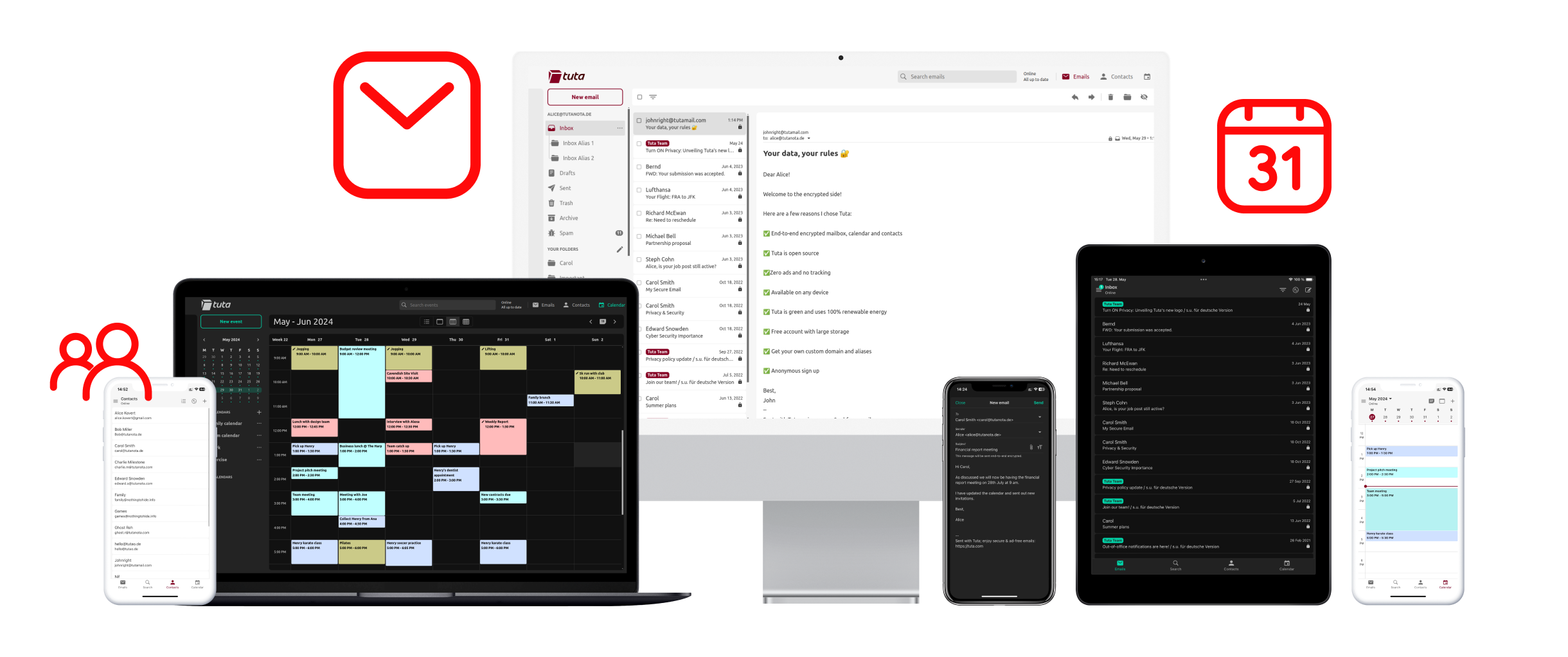
Tuta made the opposite trade-off from day one. According to Tuta's encryption page, the subject line, message body, every attachment, and sender/recipient names are all end-to-end encrypted — along with your entire calendar (descriptions, times, locations, attendees), your full contacts list, your search index, and even your inbox filters and signature. Tuta has specifically cited this as a reason it avoids OpenPGP for its own protocol, noting that "PGP does not encrypt the subject line." The trade-off: Tuta still can't hide the raw email addresses of sender and recipient, since mail servers need those to route messages, and it can see the date and time an email was sent or received.
Neither company encrypts the metadata a mail server fundamentally needs to deliver mail — who sent it and when. The real difference is the subject line and the rest of the message envelope, which Tuta treats as sensitive content and Proton treats as searchable metadata.
Switzerland vs. Germany: why jurisdiction matters
Encryption only matters as much as the legal system standing behind it. Proton AG is headquartered in Plan-les-Ouates, near Geneva, and its privacy policy states plainly that the service "is therefore governed by the laws and regulations of Switzerland." Switzerland has historically strict data-protection law and sits outside the EU, though Proton itself acknowledges that Swiss authorities can still compel it to disclose the limited data it holds — which is exactly the loophole that applies to subject lines.
Tuta operates under Tutao GmbH, registered at Deisterstr. 17a in Hanover, Germany, per its official pricing and legal pages. Germany applies EU/GDPR data-protection law, which is also strict, but German courts can and do issue their own disclosure orders — Tuta has previously had to fight a German court ruling that attempted to apply telecoms-style retention rules to its service. Neither jurisdiction makes a provider immune from legal process; they just differ in what process looks like and what data would actually be worth compelling. Because Tuta end-to-end encrypts the subject line, a German court order against Tuta yields less readable content than a Swiss court order against Proton would.
Pricing and storage, plan by plan
Both companies publish their pricing directly, and both structure it similarly: a free tier with 1 GB of storage and no custom domain, then two or three paid tiers that scale storage, aliases, and domains together.
Per Proton's official pricing page, Proton Mail Free gives you 1 GB and a single encrypted address. Mail Plus runs $3.99/month on annual billing (or $4.99 billed monthly) for 15 GB, 10 email addresses, 1 custom domain, and 10 hide-my-email aliases. Proton Unlimited — which bundles Proton Mail with Proton VPN, Drive, Pass, and Calendar — runs $9.99/month annually (or $12.99 monthly) for 500 GB, up to 15 extra addresses, 3 custom domains, and unlimited aliases.
Per Tuta's official pricing page, the Free plan also caps out at 1 GB with no custom domain or aliases. The Revolutionary plan costs €3 per mailbox per month and includes 20 GB of storage, 15 alias addresses, and 3 custom domains. The Legend plan costs €8 per mailbox per month for 500 GB, 30 aliases, and 10 custom domains. Tuta's family and business options use the same per-mailbox pricing, just multiplied across users.
| Category | Proton Mail | Tuta |
|---|---|---|
| Headquarters / jurisdiction | Geneva, Switzerland | Hanover, Germany |
| Subject line encryption | Not end-to-end encrypted | End-to-end encrypted |
| Calendar / contacts encryption | Not fully end-to-end by default | Fully end-to-end encrypted |
| Free plan storage | 1 GB, 1 address | 1 GB, no custom domain |
| Entry paid plan | Mail Plus: $3.99/mo (annual), 15 GB | Revolutionary: €3/mo per mailbox, 20 GB |
| Top personal plan | Proton Unlimited: $9.99/mo (annual), 500 GB, bundles VPN/Drive/Pass | Legend: €8/mo per mailbox, 500 GB, 10 custom domains |
| Post-quantum encryption | Opt-in, gradual rollout from May 2026 | Default for all accounts since March 2026 (TutaCrypt) |
| Open source | Web, iOS, Android clients on GitHub | All client apps on GitHub; backend not published |
| Independent audit | Securitum audited Proton Mail's code pre-launch | SySS GmbH penetration-tested the service |
Open source and independent audits
Both companies lean on "open source and audited" as a trust signal, and both back it up to a similar degree. Proton says its Mail and Calendar source code went through an independent audit by Securitum — a European firm Proton describes as running more than 300 security-testing engagements a year — before the redesigned Proton Mail launched, and the resulting report was published. Proton's web, iOS, and Android Mail clients are open source, and its OpenPGP.js library, used far beyond Proton's own apps, has been maintained publicly since 2016.
Tuta publishes the entire client codebase — Windows, macOS, Linux, Android, iOS, and web — on GitHub, and says independent security experts audited its apps before public release, including a penetration test by German firm SySS GmbH that reportedly could not breach the system or access encrypted data. Neither company has published its server-side backend as open source, which means you're trusting both on the operational side even if the client is auditable.
Which one is actually quantum-safe right now
This is the sharpest recent differentiator between the two. Tuta began rolling out a hybrid post-quantum protocol called TutaCrypt — combining the NIST-standardized CRYSTALS-Kyber algorithm with classical X25519 key exchange — back in 2024, and by March 2026 it says every Tuta account, old and new, is protected by it. That matters because the threat isn't quantum computers decrypting your mail today; it's "harvest now, decrypt later" — an adversary saving encrypted traffic now in order to crack it once a sufficiently powerful quantum computer exists.
Proton only started addressing this in a May 5, 2026 announcement, and even then it's an opt-in setting you have to manually enable from the encryption-keys section of your account, rolling out gradually, and only applying to new emails going forward — older messages stay on classical RSA/ECC keys for now. If "my email needs to survive a future quantum computer" is part of your threat model, Tuta has had a two-year head start.
Beyond email: calendars, aliases, and ecosystems
Proton's biggest practical advantage is scope. Proton Unlimited bundles Mail with Proton VPN, Proton Drive, Proton Pass, and Proton Calendar under one subscription and one encrypted identity, which is convenient if you want to consolidate your entire privacy stack with one company — our comparison of Proton VPN against Mullvad covers how that VPN side stacks up on its own. Tuta is narrower by design: email, calendar, and contacts, done to a stricter encryption standard, without the surrounding suite.
Both services support custom domains and alias addresses at every paid tier, both run ad-free, and both have mobile and desktop apps. Where they diverge is search: because Proton keeps subject lines and addresses server-readable, server-side search works more like a conventional webmail client. Tuta encrypts its search index too, which means search works client-side but can feel slightly slower on large mailboxes, particularly on mobile.
Which threat model each one suits
If your concern is a generic email provider mining your inbox for ads, or a government with a broad subpoena against a US-based company like Google or Microsoft, either Proton Mail or Tuta represents a dramatic upgrade — both get you out of the Gmail/Outlook surveillance-advertising model and into a country with real data-protection law. For that baseline case, pick whichever ecosystem you'd rather live in.
If your concern is more specific — you're a journalist, researcher, lawyer, or activist whose subject lines alone could reveal who you're talking to and about what — Tuta's decision to end-to-end encrypt the subject line is the more defensible design, and its head start on post-quantum protection adds a second layer against future decryption. That's the same kind of metadata-minimization thinking behind using Tor instead of a VPN when the goal is hiding who's talking to whom, not just encrypting what's said.
If your concern is consolidating a whole privacy stack — VPN, password manager, cloud storage, email — under one audited company and you're comfortable with Swiss jurisdiction, Proton's ecosystem argument is real, and Mail Plus at $3.99/month is cheap enough to try alongside everything else. Whichever you pick, lock the account itself down properly; see our guide on passkeys versus passwords for how to secure the login, since even perfect message encryption is moot if someone else can just sign in.
The bottom line
Neither service is "more secure" in some abstract sense — they made different, defensible engineering trade-offs. Proton Mail end-to-end encrypts message content and attachments, keeps subject lines and addresses under zero-access (but not end-to-end) encryption for searchability, sits under Swiss law, and wraps a large bundled suite around the mailbox. Tuta end-to-end encrypts the subject line along with the body, calendar, and contacts, has already finished a post-quantum migration for its entire user base, sits under German/EU law, and keeps its product deliberately narrower. For most privacy-conscious users switching away from Gmail or Outlook, either is a major upgrade. For anyone whose subject lines themselves are sensitive, Tuta is the more conservative choice.
What to do next
Before committing to either, pull up each company's current pricing page yourself — proton.me/mail/pricing and tuta.com/pricing — since both run periodic promotions on annual plans. If you're migrating an existing inbox, start with the free tier of whichever service you're leaning toward, import a few weeks of mail and contacts, and confirm your must-have features (custom domain, specific alias count, calendar sharing) work the way you expect before paying for a full year upfront. And regardless of which provider you choose, treat the encrypted inbox as only one piece of your setup — pair it with strong account-login security and, if your threat model calls for it, a VPN or Tor for network-level anonymity on top of mailbox-level encryption.
Frequently asked questions
Does Proton Mail encrypt subject lines?
No. Proton's own support documentation states that subject lines and sender/recipient email addresses are encrypted but not end-to-end encrypted, meaning Proton could be compelled to disclose them under a Swiss court order. Message bodies and attachments between Proton Mail users are end-to-end encrypted.
Does Tuta encrypt subject lines?
Yes. Tuta's encryption page lists subject lines, message bodies, attachments, and sender/recipient names as end-to-end encrypted, along with the full calendar, contacts, and search index.
Which is cheaper, Proton Mail or Tuta?
Tuta's entry paid plan, Revolutionary, costs €3 per mailbox per month for 20 GB of storage. Proton Mail's entry plan, Mail Plus, costs $3.99/month on annual billing for 15 GB — the two land in a similar price range once currency is accounted for.
Is Proton Mail or Tuta quantum-safe?
Tuta moved every account to its post-quantum TutaCrypt protocol by March 2026. Proton Mail only began a gradual, opt-in post-quantum rollout in May 2026, and it currently applies only to newly sent messages.
Are Proton Mail and Tuta open source?
Both publish their client apps as open source and commission independent third-party security audits — Proton's code was audited by Securitum, and Tuta's was penetration-tested by SySS GmbH. Neither has published its backend server code as open source.
Where are Proton Mail and Tuta legally based?
Proton AG is based in Geneva, Switzerland, and is governed by Swiss law. Tuta is operated by Tutao GmbH in Hanover, Germany, under German and EU law.
Sources
- Proton Mail Pricingproton.me
- What Is Encrypted Within Proton Mailproton.me
- Proton Privacy Policyproton.me
- Tuta Pricingtuta.com
- How Tuta Encryption Workstuta.com
- Tuta Open Sourcetuta.com
Sana Qureshi runs the security and privacy desk. She reports on actively exploited vulnerabilities, vendor patches and data breaches, and covers the password managers, VPNs and authentication tools readers use to protect themselves. Her alerts cite vendor advisories, CISA and the CVE record directly.