Vivo X Fold 6 vs Samsung Galaxy Z Fold8: Price & Specs
Price, specs, cameras, battery and availability compared for Samsung Galaxy Z Fold8 and Vivo X Fold 6 to help you decide which foldable to buy.
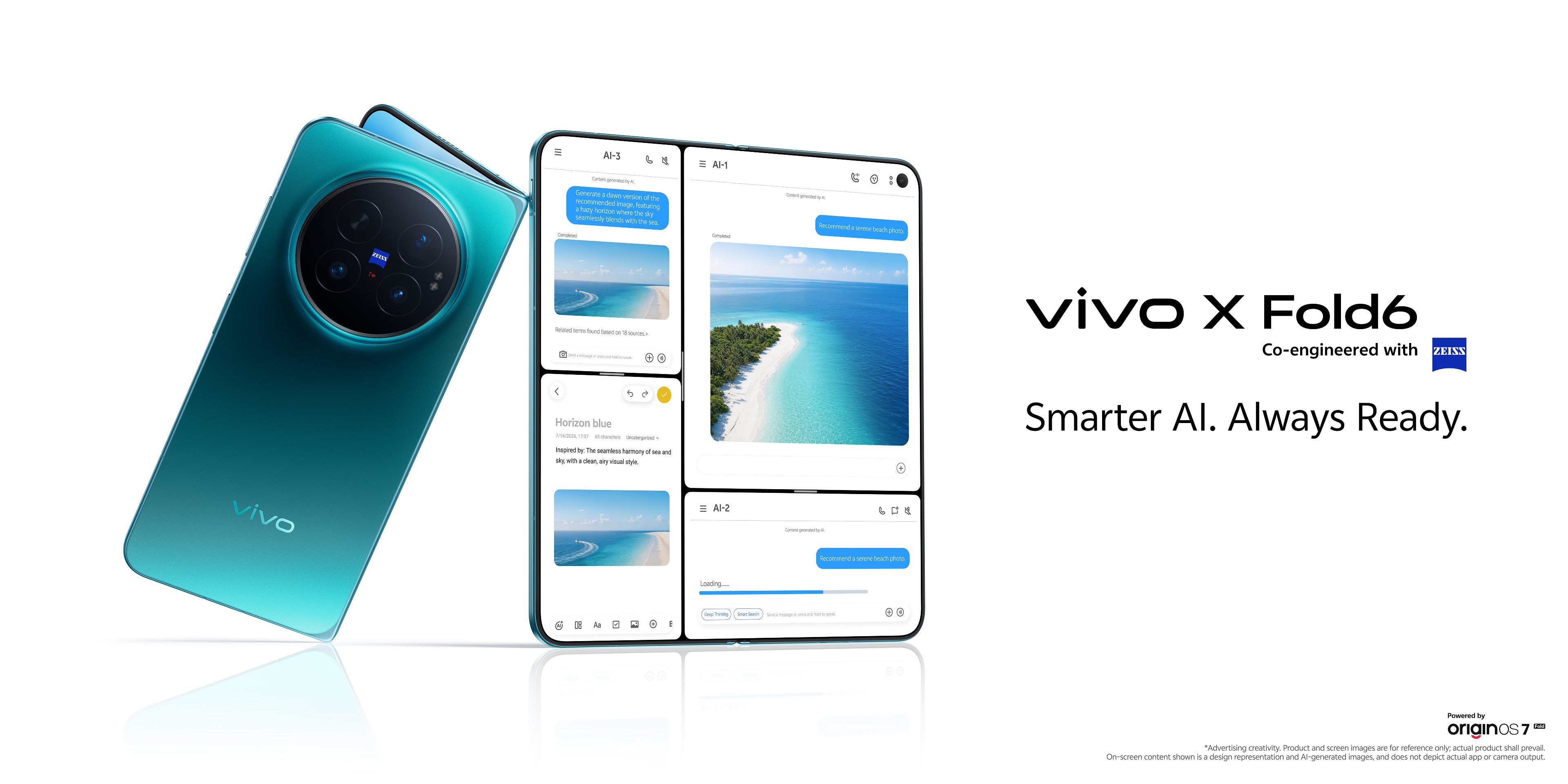
If you only have thirty seconds: the Samsung Galaxy Z Fold8 is the safer, more widely available pick, with a lighter build, a tighter 201g body, up to seven years of OS and security updates, and official sales in the US and most global markets starting at $1,899.99. The Vivo X Fold 6 is the better phone on paper for anyone who prioritizes a bigger screen, a 200MP ZEISS triple-camera system with a real telephoto lens, and a much larger 6,900mAh battery with 80W charging — but it's officially sold only in China and India (₹2,19,999 for the single 12GB/512GB configuration), with no confirmed US or wide-global retail launch. Which one to buy comes down to where you live and whether you'd trade Samsung's software longevity and lighter hinge for Vivo's bigger screen, camera versatility, and battery life.
- Buy the Galaxy Z Fold8 if you want the lightest, most broadly available foldable with the longest software-support promise (up to 7 years) and don't mind giving up a telephoto lens.
- Buy the Vivo X Fold 6 if you're in China or India, want the larger 8.02-inch inner display, a 200MP ZEISS camera system with real zoom, and a bigger 6,900mAh battery with much faster charging.
- Price: Z Fold8 from $1,899.99 (US, 256GB) vs X Fold 6 at ₹2,19,999 in India for 12GB/512GB (no official US price exists).
- Availability: Z Fold8 sells globally including the US; X Fold 6 is limited to China (launched June 2026) and India (launched October 13, 2026).
Vivo X Fold 6 vs Galaxy Z Fold8: the short version
Both phones are 2026's top book-style foldables, and both lean into the same basic formula: a phone-sized cover screen that unfolds into a tablet-like inner display. Where they diverge is philosophy. Samsung's Galaxy Z Fold8 is built around being the lightest, most pocketable Fold yet, backed by Samsung's longest-ever software promise. Vivo's X Fold 6 goes the other direction, packing a larger screen, a flagship ZEISS camera system borrowed from Vivo's X-series phones, and a noticeably bigger battery. The catch is availability: Samsung sells the Z Fold8 almost everywhere, while Vivo has so far kept the X Fold 6 to China and India.
Price and availability by region
Samsung officially launched the Galaxy Z Fold8 alongside the Z Fold8 Ultra, Flip8, Watch Ultra2 and Watch9 in early August 2026, and the phone is sold through Samsung's own stores and carriers across the US, UK, EU, Middle East, Southeast Asia, Oceania and beyond. In the US, Samsung lists the Z Fold8 starting at $1,899.99 for the 256GB/12GB configuration, with 512GB and 1TB (16GB RAM) options available at higher price points.
Vivo's rollout has been narrower. The X Fold 6 first went on sale in China in late June 2026, and Vivo's own India newsroom confirms the phone launched in India on October 13, 2026 at ₹2,19,999 (inclusive of taxes) for the only configuration sold there, 12GB RAM with 512GB storage, in Nebula Teal and Prism Black, through Vivo's e-store, Flipkart, Amazon and retail partners. That works out to roughly the same ballpark as Samsung's price once converted, though Vivo has not announced a US or broad international retail launch, so there's no official global or US price to compare directly. Anyone outside China or India currently has to import the X Fold 6 rather than buy it through an authorized channel.
For more on how Vivo has staged this rollout outside China, see the earlier coverage of the X Fold 6's global release plans.
Displays and cover screens
Vivo's inner screen is larger: an 8.02-inch "ZEISS Master Color Display" with an adaptive 1-120Hz refresh rate and up to 5,000 nits of local peak brightness, paired with a 6.51-inch cover display running the same adaptive refresh and brightness class. Samsung's Z Fold8 uses a 7.6-inch main screen and a 5.5-inch cover screen, with anti-reflective coating and up to 3,000 nits of brightness — still extremely bright, just not as bright on paper as Vivo's figure.
The practical difference is shape and footprint as much as size. Samsung has spent generations narrowing the Fold's inner bezel and widening the hinge gap specifically to make the open screen feel less like two panels and more like one continuous display, while Vivo's larger panel leans into giving you more real screen real estate for split-screen multitasking and media.
Hinge, durability and design
Samsung's pitch for the Z Fold8 is weight and refinement: at 201 grams it's the lightest Fold Samsung has shipped, with a 9.7mm folded profile and 4.5mm when unfolded. That's built on an Armor FlexHinge (now on its eighth generation of tuning), an Armor Aluminum frame, Corning Gorilla Glass Victus 2 on the outer panels, and two titanium layers underneath the main display for extra screen protection. Samsung's official spec listing puts water resistance at IP48 — enough to survive an accidental splash or submersion in up to 1.5 meters of fresh water for 30 minutes, but not a full IP68 rating, and it does not support the S Pen.
Vivo doesn't publish an exact weight or folded/unfolded thickness for the X Fold 6 on its product page, but it does claim stronger dust and water resistance: IP5X dust protection combined with IPX8 and IPX9 water-resistance certification (commonly written as IP58/IP59), wrapped in a 2.5D metal frame. If dust and water resistance at the spec-sheet level matters more to you than shaving off every gram, that's a point in Vivo's favor; if you want the lightest possible foldable, Samsung still wins clearly.
Chipset and performance
Both phones use 2026's top-tier mobile silicon, just from different suppliers. The Galaxy Z Fold8 runs on the Snapdragon 8 Elite Gen 5 for Galaxy, a Samsung-tuned version of Qualcomm's flagship chip. The Vivo X Fold 6 runs MediaTek's Dimensity 9500 Super Edition, a 3nm chip that also powers several of Vivo's other 2026 flagships. Neither Samsung nor Vivo publishes third-party benchmark scores on their own product pages, so there's no official head-to-head number to cite — both are built to handle split-screen multitasking, desktop-style modes and on-device AI features without issue.
Cameras compared
This is where the two phones diverge most. Samsung kept the Z Fold8's rear camera system simple: a 50MP Wide and 50MP Ultra Wide, with no dedicated telephoto lens this generation, plus a 10MP cover-screen camera and a 10MP under-display main-screen camera with a 100-degree field of view for group selfies. It's a competent setup, but it's a step back from phones (including Samsung's own Z Fold8 Ultra) that keep a telephoto.
Vivo went the opposite direction. The X Fold 6 pairs a 200MP ZEISS main camera (1/1.4-inch sensor, f/1.68, with OIS) with a ZEISS ultra-wide-angle camera and a ZEISS APO telephoto camera rated for up to 100x ZEISS HyperZoom. For anyone who actually uses zoom — concerts, wildlife, travel shots across a room — the X Fold 6's camera system is the more capable of the two on spec alone.
Battery and charging
Vivo's advantage here is significant. The X Fold 6 uses a dual-cell battery (2,845mAh + 3,915mAh at 3.78V) that Vivo markets as equivalent to a single 6,900mAh cell (rated capacity 6,670mAh), charging at 80W wired and 40W wireless. Samsung's Z Fold8 uses a 4,800mAh battery, which Samsung says is good for up to 26 hours of continuous video playback; Samsung's own product page doesn't list the exact wired or wireless charging wattage, though it supports both. On raw battery capacity and charging speed, Vivo's figures are well ahead.
Software and update support
Samsung's biggest long-term selling point is software support: the Z Fold8 is covered by Samsung's pledge of "up to 7x OS upgrades and security updates," meaning buyers can expect roughly seven years of Android version upgrades and patches, timing permitting on their market and carrier. The X Fold 6 ships with Vivo's OriginOS 7 out of the box, but Vivo's India launch materials don't publish a specific multi-year update commitment the way Samsung does, so if guaranteed long-term software support is a priority, Samsung currently has the clearer public promise.
That update gap echoes a broader trend this year across folding and bar-style flagships alike — for a look at how another 2026 foldable stacks up against Samsung's book-style phone on software and price, see this comparison of the iPhone Duo against the Galaxy Z Fold8.
Spec comparison: Vivo X Fold 6 vs Galaxy Z Fold8
| Spec | Vivo X Fold 6 | Samsung Galaxy Z Fold8 |
|---|---|---|
| Main display | 8.02", adaptive 1–120Hz, up to 5,000 nits | 7.6", up to 3,000 nits |
| Cover display | 6.51" | 5.5" |
| Chipset | MediaTek Dimensity 9500 Super Edition | Snapdragon 8 Elite Gen 5 for Galaxy |
| RAM / storage | 12GB / 512GB (only India config) | 12GB/256GB, 12GB/512GB, 16GB/1TB |
| Rear cameras | 200MP ZEISS main (OIS) + ZEISS ultra-wide + ZEISS APO telephoto (up to 100x HyperZoom) | 50MP Wide + 50MP Ultra Wide (no telephoto) |
| Inner/cover cameras | Not published by Vivo | 10MP cover + 10MP inner (100° FOV) |
| Battery | 6,900mAh (dual-cell), 80W wired / 40W wireless | 4,800mAh, wired & wireless (wattage not published) |
| Durability | IP5X dust, IPX8/IPX9 water (IP58/IP59) | IP48 water resistance, Gorilla Glass Victus 2, Armor FlexHinge |
| Weight | Not published by Vivo | 201g (9.7mm folded / 4.5mm unfolded) |
| Software | OriginOS 7 (no published update pledge) | Up to 7 generations of OS & security updates |
| Price | ₹2,19,999 (India, 12GB/512GB) | From $1,899.99 (US, 256GB) |
| Availability | China, India only (as of October 2026) | Global, including US |
Which one should you buy?
If you live in the US, Europe, or most other markets where Samsung actually sells the Z Fold8, the decision is mostly made for you — Vivo isn't a realistic option without importing. Within that group, choose the Galaxy Z Fold8 if you want the lightest possible foldable, the best-documented long-term software support, and don't mind losing the telephoto lens that past Fold models had.
If you're shopping in China or India, where both are genuinely available, lean toward the Vivo X Fold 6 if a bigger inner screen, a more versatile ZEISS camera system with real optical-class zoom, and a noticeably bigger, faster-charging battery matter more to you than shaving down to the lightest possible chassis or getting Samsung's seven-year update runway. Buyers who want Samsung's camera focus and software longevity but in a larger, higher-zoom package may also want to compare the pricier Galaxy Z Fold8 Ultra, which does keep a telephoto lens and a bigger 8-inch screen, at a higher price than the standard Fold8.
Bottom line
Neither phone is a bad buy on its own terms. Samsung's Galaxy Z Fold8 is the more polished, lighter, and far more widely purchasable foldable, with the clearer software-support promise. Vivo's X Fold 6 is the spec-sheet overachiever — bigger screen, bigger battery, faster charging, and a camera system with real zoom — but it's currently a China-and-India-only phone with no official US price or sale date. Shop by availability first, then by whether a telephoto lens and a larger battery are worth more to you than Samsung's lighter build and longer update window.
Frequently asked questions
Is the Vivo X Fold 6 available in the US?
No. As of October 2026, Vivo sells the X Fold 6 only in China (launched June 2026) and India (launched October 13, 2026). Vivo has not announced a US or broader global retail launch.
How much does the Samsung Galaxy Z Fold8 cost?
Samsung lists the Galaxy Z Fold8 starting at $1,899.99 in the US for the 256GB/12GB configuration, with 512GB and 1TB (16GB RAM) options priced higher.
How much does the Vivo X Fold 6 cost in India?
Vivo's India launch price is ₹2,19,999 (inclusive of taxes) for the only configuration sold there, 12GB RAM with 512GB storage, available from October 13, 2026.
Which foldable has the better camera system?
The Vivo X Fold 6 has the more versatile camera on paper, with a 200MP ZEISS main sensor plus a ZEISS APO telephoto lens rated for up to 100x HyperZoom. The Galaxy Z Fold8 uses a simpler 50MP Wide and 50MP Ultra Wide pair with no telephoto lens.
Which phone has longer software support?
Samsung publicly commits to up to 7 generations of OS upgrades and security updates for the Galaxy Z Fold8. Vivo's X Fold 6 launch materials do not publish an equivalent multi-year update pledge.
Which foldable has the bigger battery?
The Vivo X Fold 6's dual-cell battery is rated as equivalent to 6,900mAh with 80W wired and 40W wireless charging, well ahead of the Galaxy Z Fold8's 4,800mAh battery.
Sources
- Samsung: Galaxy Z Fold8 official product pagesamsung.com
- Samsung Newsroom: Official launch of Galaxy Z Fold8 Ultra, Fold8, Flip8, Watch Ultra2 and Watch9news.samsung.com
- Samsung Newsroom: The engineering behind the Galaxy Z Fold8's 201g weightnews.samsung.com
- Vivo: X Fold6 official product page (India)vivo.com
- Vivo India Newsroom: X Fold6 India launch, price and specificationsvivonewsroom.in
Nadia Osei covers mobile and consumer gadgets for Pandromeda: smartphones, tablets, smartwatches, earbuds and smart-home devices. She tracks launches, software updates and pricing across Apple, Google, Samsung and the rest, and builds comparisons from the manufacturers' published specifications.