iPhone Duo vs Galaxy Z Fold8: Price, Specs and Verdict
Apple's $1,999 foldable debut goes head-to-head with Samsung's Galaxy Z Fold8 on price, screens, durability, cameras, AI and battery life.
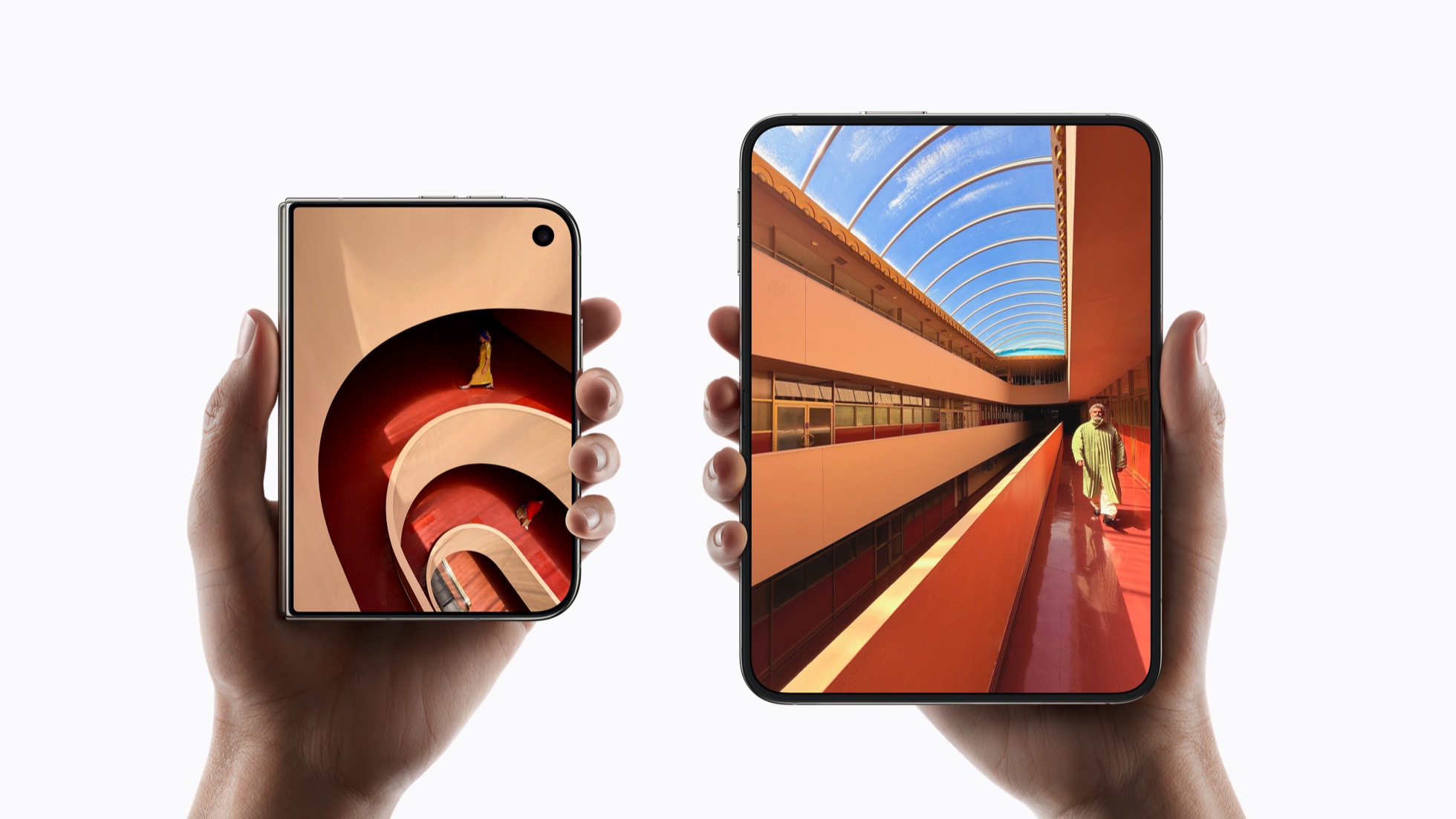
Short answer: iPhone Duo starts at $1,999 for 256GB and pairs a 5.4-inch cover display with a 7.6-inch inner screen, a titanium frame and an A20 Pro chip, but it ships with only two cameras and no true telephoto lens. Samsung's Galaxy Z Fold8 starts lower, at $1,899.99 for 256GB, with a 5.5-inch cover screen, the same 7.6-inch inner size, a Flex Titanium hinge, Snapdragon 8 Elite Gen 5, and a 2x optical-quality zoom on its 50MP main camera. If you want the newest book-style foldable and don't mind paying Apple's premium for iOS and Siri AI, iPhone Duo is the pick. If you want a lower entry price, a lighter body, and Android's wider app and file-management flexibility on a big screen, Galaxy Z Fold8 is the better buy.
The verdict in brief
- Price: iPhone Duo from $1,999 (256GB); Galaxy Z Fold8 from $1,899.99 (256GB), Samsung's own store currently discounting to $1,699.99.
- Screens: Both open to a 7.6-inch main display. iPhone Duo's cover screen is 5.4 inches; Galaxy Z Fold8's is 5.5 inches.
- Durability: iPhone Duo uses a titanium enclosure with Ceramic Shield 2 and IP68; Galaxy Z Fold8 uses Flex Titanium with a lower IP48 rating.
- Cameras: iPhone Duo has two 48MP sensors and no dedicated telephoto; Galaxy Z Fold8 has two 50MP sensors with a 2x optical-quality crop zoom on the main lens.
- Software: iPhone Duo runs iOS 27 with Siri AI (beta); Galaxy Z Fold8 runs Android 17 with Galaxy AI and Gemini Intelligence.
- Buy iPhone Duo if: you want Apple's ecosystem, the toughest build and the biggest battery headroom on the cover screen.
- Buy Galaxy Z Fold8 if: you want a cheaper entry price, a lighter phone, and a more mature multi-window Android experience.
Price and storage: what each foldable costs
Apple's iPhone Duo starts at $1,999 for the 256GB model in the United States, according to Apple's own newsroom release. Apple's online store lists the full range as $1,999 (256GB), $2,199 (512GB), $2,599 (1TB) and $3,199 (2TB). Apple also offers installment pricing of $83.29 a month for 24 months on the base model, or an Apple Upgrade Program lease starting at $57.99 a month.
Samsung's Galaxy Z Fold8 undercuts that at the entry tier. Samsung's U.S. store lists the standard price at $1,899.99 for 256GB, $2,099.99 for 512GB and $2,499.99 for 1TB, though Samsung's own site was running a promotional price of $1,699.99 / $1,899.99 / $2,299.99 at the time of writing, plus trade-in credit. In the UK, Samsung's listed RRP is £1,699 (256GB) up to £2,209 (1TB).
Neither company sells a 2TB Galaxy Z Fold8, so Apple's top tier is unmatched on the Samsung side. At every shared tier, though, Galaxy Z Fold8's sticker price comes in under iPhone Duo's, and Samsung has said demand for its foldable has kept climbing as iPhone Duo's launch approached.
Screen sizes: open and closed
Both phones converge on almost the same inner display: Apple's iPhone Duo measures 7.6 inches when unfolded, matching the 7.6-inch QXGA+ Dynamic AMOLED 2X panel on Galaxy Z Fold8. Apple's inner panel is rated as 50% larger than the iPhone 18 Pro Max's screen; Samsung's inner display runs at 2,448 x 1,848 resolution with a 1-120Hz adaptive refresh rate.
The cover screens are close but not identical. iPhone Duo's outer display is 5.4 inches, which Apple says covers 90% of the screen area of the iPhone 18 Pro. Galaxy Z Fold8's cover screen is 5.5 inches (WUXGA+, 1,248 x 1,972) in Samsung's spec sheet, with a footnote that measuring it as a full rectangle instead gives 5.4 inches — effectively the same size as Apple's panel once you account for rounded corners.
In practice, anyone switching from either phone's main rival will not notice a meaningful difference in screen real estate. The bigger differentiator is aspect ratio: Apple's inner and outer displays share a ratio, so content scales cleanly between them, while Samsung's cover screen is a taller 10:16 shape built for one-handed use, with the main screen closer to 4:3 for side-by-side apps.
Hinge, build and durability
Apple built iPhone Duo around a Grade 5 titanium enclosure with a mirror-polished, micro-blasted hinge cover made from more than 100 components, a 3D-printed part Apple highlighted as new engineering. The front of both displays uses Ceramic Shield 2, which Apple rates at three times better scratch resistance than the previous generation. Crucially, iPhone Duo carries an IP68 rating for dust, splash and water resistance — the same rating Apple's non-folding iPhones carry.
Samsung's Galaxy Z Fold8 uses what it calls Flex Titanium, pairing a titanium-alloy film with a titanium plate to support the display, absorb impact, and reduce crease visibility over repeated folds, with hinge, display tension and magnetic force tuned for a smoother unfolding action. Samsung's own UK press materials put Galaxy Z Fold8's resistance at IP48 — water resistant to 1.5 meters for 30 minutes, but with no official dust rating, and Samsung explicitly advises against beach or pool use.
That IP68-versus-IP48 gap is the single clearest durability difference between the two phones on paper. Weight favors Samsung: Galaxy Z Fold8 is 201g, which Samsung calls its lightest Fold yet, at 4.5mm thick unfolded. Apple's newsroom release does not publish an official weight figure for iPhone Duo, so we are not including an unverified number here.
Cameras compared
Apple cut iPhone Duo's rear camera system down to two lenses: a 48MP Fusion Main camera (which shoots 24MP by default) with what Apple calls an "optical-quality" 2x telephoto crop, and a 48MP Fusion Ultra Wide. There is no dedicated telephoto lens — a notable omission compared with Apple's own non-folding Pro models. The inner display also hides a new FaceTime camera beneath the screen, alongside a Center Stage front camera on the cover.
Samsung's Galaxy Z Fold8 also uses two rear lenses rather than three: a 50MP wide sensor with OIS and the same kind of 2x optical-quality crop zoom, plus a 50MP ultra-wide. Front-facing, Samsung fits a 10MP camera under the cover screen and a 10MP camera for the inner display, both at f/2.2. Samsung's rear cameras shoot up to 8K video; Apple's Main camera records 4K at 120fps in Dolby Vision.
On paper, the two are closely matched: similar megapixel counts, the same reliance on sensor crops instead of a true telephoto, and comparable video ceilings. Neither company's own release claims a benchmark score or side-by-side comparison, so judge final image quality once independent lab reviews land — this piece only reports what Apple and Samsung state about their own hardware.
Software and AI features
iPhone Duo ships with iOS 27 (version 27.1 out of the box) and leans on the fold for multitasking: Split View, an upgraded StandBy mode, and foldable-specific camera modes Apple calls Smart Take, Duo Preview and Duo FaceTime. Siri AI, Apple's generative assistant layer, is in beta and launches in English first, with more languages arriving in October, as part of the broader Apple Intelligence rollout that began with iOS 27 on September 14.
Galaxy Z Fold8 runs Android 17 with One UI 9 and Samsung's Galaxy AI tuned specifically for the bigger unfolded screen. Samsung's features include Now Brief (personalized daily insights, plus security and privacy alerts), Now Nudge (contextual suggestions pulled from conversations, such as checking a calendar), and Gemini Intelligence for multi-step tasks across dozens of apps, alongside Gemini Notebook for gathering notes, files and images in one place. Samsung bundles six months of Google AI Pro with the phone, and Samsung's Knox, Knox Vault and an AI Assistant Activity dashboard round out the security side.
The practical difference is maturity and breadth: Samsung's Galaxy AI suite on Fold8 draws on several AI generations of One UI tuning for foldables specifically, while Apple's Siri AI on iPhone Duo is explicitly labeled a beta at launch. Buyers who want an AI assistant that is further along today may lean Samsung; buyers who want Apple's privacy framing and tighter hardware-software integration may still prefer iPhone Duo even with the beta tag.
Battery and charging
Apple quotes iPhone Duo's battery life in video-playback hours rather than milliamp-hours: up to 31 hours of video playback using the inner display alone, up to 44 hours using the outer display alone, and up to 24 hours with both displays used equally. Apple says wired charging reaches 50% in about 20 minutes, and wireless charging (MagSafe or Qi2) reaches 50% in about 30 minutes.
Samsung publishes a conventional capacity figure for Galaxy Z Fold8: a typical 4,800mAh battery (rated at 4,660mAh), with 45W wired charging (a separate adapter is required) reaching about 63% in 30 minutes, plus 20W wireless charging and Wireless PowerShare for topping up other devices.
Because Apple and Samsung measure battery life in different units — hours of playback versus mAh capacity — there is no way to directly convert one figure into the other without an independent lab test, and neither company's release supplies one. What's comparable is charging speed: Samsung's 45W wired charging is the faster of the two on paper, while Apple does not publish a wattage figure for iPhone Duo's wired charging at all.
Chip and performance
iPhone Duo runs on Apple's A20 Pro, built on a 2-nanometer process, with a 6-core CPU Apple says is up to 20% faster than the A19 Pro, a 7-core GPU up to 40% faster, and a dual 16-core Neural Engine with twice the compute power of its predecessor. Apple also claims up to 35% better sustained performance than iPhone 17 Pro, which matters for a foldable that is more likely to be used for extended multitasking or gaming on the larger inner screen.
Galaxy Z Fold8 uses Qualcomm's Snapdragon 8 Elite Gen 5 for Galaxy, paired with 12GB of RAM on the 256GB and 512GB models, or 16GB of RAM on the 1TB model. Samsung does not publish its own CPU/GPU uplift percentages for Fold8 the way Apple does for iPhone Duo, and there is no microSD expansion on either phone's storage.
Both chips are each company's current flagship silicon, so day-to-day performance differences will likely come down to how each company's software schedules tasks across two open apps at once, rather than raw horsepower. Neither Apple nor Samsung has published directly comparable third-party benchmark numbers, so this article does not estimate one.
Spec comparison table
| Spec | iPhone Duo | Galaxy Z Fold8 |
|---|---|---|
| Starting price (256GB, US) | $1,999 | $1,899.99 (list); $1,699.99 (Samsung.com, at time of writing) |
| Top storage | 2TB ($3,199) | 1TB ($2,499.99 list) |
| Inner display | 7.6-inch | 7.6-inch QXGA+ Dynamic AMOLED 2X, 120Hz |
| Cover display | 5.4-inch | 5.5-inch WUXGA+ Dynamic AMOLED 2X, 120Hz |
| Chip | A20 Pro (2nm) | Snapdragon 8 Elite Gen 5 for Galaxy |
| RAM | Not published by Apple | 12GB (256/512GB) or 16GB (1TB) |
| Rear cameras | 48MP Fusion Main (2x crop zoom) + 48MP Fusion Ultra Wide | 50MP wide, OIS (2x crop zoom) + 50MP ultra-wide |
| Front/cover cameras | Center Stage front camera; under-display FaceTime camera | 10MP cover (f/2.2); 10MP under-display (f/2.2) |
| Battery | Up to 31h (inner) / 44h (outer) video playback | 4,800mAh typical (4,660mAh rated) |
| Wired charging | 50% in ~20 min (wattage not published) | 45W; ~63% in 30 min |
| Durability rating | IP68, Ceramic Shield 2 front | IP48 |
| Weight | Not published by Apple | 201g |
| Software | iOS 27, Siri AI (beta), Apple Intelligence | Android 17, One UI 9, Galaxy AI, Gemini Intelligence |
| US availability | Oct 23, 2026 (pre-orders opened Oct 16) | On sale since August 2026 |
Availability and rollout
iPhone Duo's pre-orders opened on Friday, October 16, 2026 at 5 a.m. Pacific, with general availability on Friday, October 23, 2026, in more than 70 countries and regions. Apple has already confirmed a second wave: 28 additional countries and regions get iPhone Duo starting October 30, widening the launch markets considerably within two weeks of the original on-sale date.
Galaxy Z Fold8 has had a longer runway. Samsung opened pre-orders on July 22, 2026, with the phone reaching stores from early August, giving Fold8 roughly ten extra weeks on shelves before iPhone Duo's US debut. That head start is part of why Samsung has been able to report rising demand right as Apple's rival launch neared — shoppers comparing the two in October are, in effect, weighing a brand-new Apple device against a Samsung foldable that already has real-world reviews and software updates behind it.
Who should buy which
Choose iPhone Duo if you are already deep in Apple's ecosystem — iMessage, FaceTime, AirDrop, Apple Watch pairing — and you want the most durable fold on paper, with IP68 resistance and Ceramic Shield 2 on the front glass. The A20 Pro's performance headroom and the longer cover-screen battery life (up to 44 hours of video) also suit someone who plans to use the compact outer display as their main screen most of the day and the inner display occasionally for bigger tasks.
Choose Galaxy Z Fold8 if price matters: it undercuts iPhone Duo by roughly $100-$300 depending on tier before any trade-in or promotional pricing, and Samsung's own store was discounting it further at the time of writing. It's also the lighter phone at 201g, has faster-rated wired charging, and runs an Android AI suite (Galaxy AI plus Gemini Intelligence) that is out of beta, unlike Siri AI on iPhone Duo. Multitaskers who want a more file-system-like, open approach to split-screen apps have historically found Samsung's One UI more flexible than iOS for that purpose, and Fold8's 10:16 cover screen is built around one-handed use in a way Apple's 5.4-inch panel, with its matched aspect ratio to the inner screen, is not.
If you're also weighing a third option, Pandromeda's comparison of the Vivo X Fold 6 against the Galaxy Z Fold8 is a useful next read for shoppers who want a cheaper alternative to both flagships.
What next
Pre-orders for iPhone Duo are open now through Apple's online store and retail partners, with units shipping from October 23. If you're in one of the 28 markets added on October 30, you'll be able to order a little later than first-wave buyers. Galaxy Z Fold8 is already shipping and widely available through Samsung.com, carriers and retailers, with Samsung periodically running trade-in and discount promotions worth checking before you buy at full list price. Whichever phone you choose, compare current promotional pricing directly on Apple's and Samsung's own stores before ordering, since both companies adjust offers and bundle deals frequently in the weeks after launch.
Frequently asked questions
Is iPhone Duo or Galaxy Z Fold8 cheaper?
Galaxy Z Fold8 is cheaper at every matching storage tier. Samsung lists it from $1,899.99 for 256GB (with promotional pricing as low as $1,699.99 on Samsung.com at the time of writing), while iPhone Duo starts at $1,999 for 256GB on Apple's store.
Do iPhone Duo and Galaxy Z Fold8 have the same size screen?
Their inner displays are both 7.6 inches when unfolded. The cover screens are close but not identical: iPhone Duo's is 5.4 inches, and Galaxy Z Fold8's is 5.5 inches (or 5.4 inches measured as a full rectangle, per Samsung's own footnote).
Which foldable is more durable?
iPhone Duo carries an IP68 rating plus Ceramic Shield 2 on the front glass. Galaxy Z Fold8 is rated IP48, which covers freshwater splashes and brief submersion but not dust, and Samsung advises against beach or pool use.
Does either foldable have a true telephoto camera?
No. Both companies use a 2x optical-quality crop zoom on their main rear sensor instead of a dedicated telephoto lens: iPhone Duo's 48MP Fusion Main camera and Galaxy Z Fold8's 50MP wide camera.
When can I buy iPhone Duo and Galaxy Z Fold8?
iPhone Duo's pre-orders opened October 16, 2026, with general availability from October 23 in more than 70 countries, expanding to 28 more countries on October 30. Galaxy Z Fold8 has been on sale since early August 2026.
Which has better AI features right now?
Samsung's Galaxy AI and Gemini Intelligence on Galaxy Z Fold8 are out of beta and build on several generations of One UI foldable tuning. Apple's Siri AI on iPhone Duo is explicitly labeled a beta at launch, rolling out in English first.
Sources
- Apple Newsroom: Apple unveils iPhone Duoapple.com
- Apple: Buy iPhone Duo (official pricing by storage tier)apple.com
- Samsung Newsroom: Galaxy Z Fold8 Ultra, Fold8 and Flip8 — Foldables, Perfected for Every Way of Livingnews.samsung.com
- Samsung: Galaxy Z Fold8 official US pricing and availabilitysamsung.com
- Apple Newsroom: iPhone Duo expands to 28 more countries and regions on October 30apple.com
Nadia Osei covers mobile and consumer gadgets for Pandromeda: smartphones, tablets, smartwatches, earbuds and smart-home devices. She tracks launches, software updates and pricing across Apple, Google, Samsung and the rest, and builds comparisons from the manufacturers' published specifications.