Garmin Fenix 9 vs Apple Watch Ultra 3: Which Should You Buy
Garmin's multi-week GPS flagship meets Apple's rugged titanium Ultra — here's how price, battery, accuracy, and ecosystem stack up.
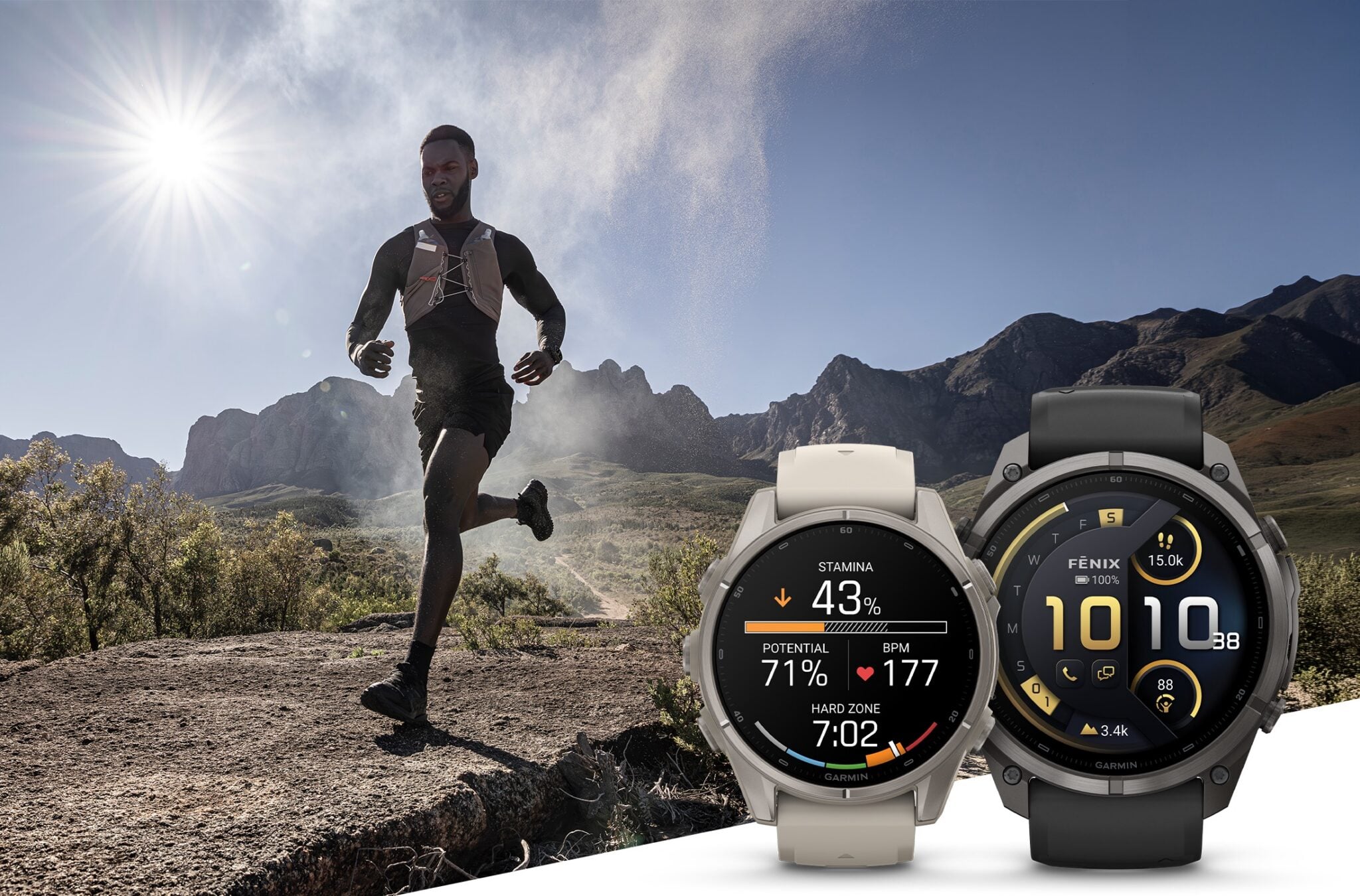
If you live in an iPhone and want the most capable Apple Watch ever built, the Apple Watch Ultra 3 is the easy pick. If you want a GPS watch built for multi-day expeditions, works just as well with an Android phone, and can go weeks without a charger, the Garmin Fenix 9 is the one to buy. Both are 2025-2026 rugged flagships aimed at the same buyer — serious runners, hikers, and outdoor athletes — but they solve the problem in almost opposite ways, and the right choice comes down to battery habits, phone ecosystem, and how deep you want to go into training data.
- Garmin Fenix 9: starts at $999.99, up to 29 days smartwatch battery (51mm), 43/47/51mm sizes, dive-rated to 40 m.
- Apple Watch Ultra 3: starts at $799, up to 42 hours battery (72 hours in Low Power Mode), 49mm case, MIL-STD-810H tested, 100 m water resistance.
- Pick Garmin for multi-day battery life, Android compatibility, and deep endurance-training tools.
- Pick Apple for app depth, Apple Health integration, cellular calling, and a lighter day-to-day smartwatch experience.
Price and availability
The Garmin Fenix 9 starts at $999.99 for the entry-level 43mm or 47mm models, with the 51mm version pushing past the $1,000 mark; the step-up Fenix 9 Pro, which adds a titanium case and optional satellite connectivity, starts at $1,099.99, according to Garmin's own launch announcement. Garmin confirmed the Fenix 9 and Fenix 9 Pro on August 25, 2026, and both are shipping now.
The Apple Watch Ultra 3 starts at $799 in the U.S., per Apple's own product announcement. It launched with pre-orders on September 9, 2025, and went on sale September 19, 2025. Unlike the standard Apple Watch line, every Ultra 3 includes cellular connectivity — there's no cheaper GPS-only tier.
On sticker price alone, the Ultra 3 is the cheaper watch by $200. But Garmin's number already includes a titanium-adjacent build and multi-week battery life with no monthly fees attached to GPS tracking, while Apple's satellite features are free only for the first two years and cellular service requires an ongoing carrier plan.
Design, materials, and durability
Both watches are built for abuse, but they get there differently. The Fenix 9 ships in 43mm, 47mm, and 51mm case sizes, with a scratch-resistant sapphire lens and what Garmin describes as leakproof buttons; the watch carries a 10 ATM (100 m) water rating with a separate 4 ATM recreational dive rating to 40 m certified under EN 13319, per Garmin's own owner's manual specifications. The Fenix 9 Pro goes further with Garmin's first full titanium case, built using a nano-molding process that blends metal and plastic to keep the watch lighter than a solid-titanium shell would be.
The Apple Watch Ultra 3 keeps the Grade 5 titanium case Apple introduced with the original Ultra, now measuring 49mm tall by 44mm wide by 12mm deep with a flat sapphire crystal front. According to Apple's official technical specifications, it's rated for 100 m water resistance (ISO 22810:2010), recreational scuba diving to 40 m (EN13319), IP6X dust resistance, and MIL-STD-810H testing covering altitude, temperature extremes, temperature shock, immersion, freeze/thaw cycling, and shock and vibration. That MIL-STD-810H line is notable: Apple publishes a specific military-standard test regime for the Ultra 3, while Garmin's fenix 9 launch materials lean on the sapphire lens and water rating rather than citing a MIL-STD number for this exact model.
Weight is where the two diverge most. Apple lists the Ultra 3 at 61.6 g (Natural titanium) or 61.8 g (Black titanium) for a single 49mm size. Garmin doesn't publish official weights in its launch materials, but offering three case sizes down to 43mm means the Fenix 9 can be built noticeably smaller and lighter than the Ultra 3, which comes in one size only.
Display
Apple's Ultra 3 uses an Always-On Retina display built on LTPO3 OLED technology with a 1 Hz minimum refresh rate, a 422-by-514 pixel resolution at 326 ppi, and a peak brightness Apple rates at up to 3,000 nits, dropping to 1 nit at its dimmest. Apple also says the Ultra 3's screen is the largest in Apple Watch history, with borders 24% thinner than the original Ultra in the same case size.
Garmin's standard Fenix 9 uses an AMOLED panel the company describes as twice as bright as the Fenix 8's display, behind a sapphire lens. The step-up Fenix 9 Pro 51mm gets Garmin's largest-ever fenix screen at 1.5 inches — 15% larger than the Fenix 8 without growing the case — and Garmin rates the Pro's AMOLED panels at up to 3,000 nits, matching Apple's peak brightness figure on paper. Both companies' brightness numbers are vendor-reported; neither has published independent, lab-verified lux measurements for these exact models.
| Spec | Garmin Fenix 9 | Apple Watch Ultra 3 |
|---|---|---|
| Starting price (US) | $999.99 (Fenix 9 Pro from $1,099.99) | $799 |
| Case sizes | 43mm, 47mm, 51mm | 49mm only |
| Case material | Fiber-reinforced polymer / titanium rear (Pro: full titanium) | Grade 5 titanium |
| Weight | Not published by Garmin | 61.6–61.8 g |
| Display | AMOLED, sapphire lens (Pro up to 3,000 nits, 1.5" on 51mm) | LTPO3 OLED, 1Hz, up to 3,000 nits, 422×514px |
| Battery (typical use) | Up to 29 days smartwatch mode (51mm); Pro up to 31 days; Pro Solar up to 57 days (vendor-claimed, solar-assisted) | Up to 42 hours normal use |
| Battery (max saver mode) | Varies by GNSS/display settings (not disclosed for base sizes) | Up to 72 hours in Low Power Mode |
| Water resistance | 10 ATM (100 m); 4 ATM / 40 m dive rating (EN 13319) | 100 m (ISO 22810:2010); 40 m recreational dive (EN13319) |
| Durability testing | Not specified in launch materials | MIL-STD-810H; IP6X dust resistance |
| Storage | 64 GB (up to ~7,000 songs) | 64 GB |
| Cellular / satellite | Satellite & LTE on Fenix 9 Pro only, plan required | Built-in satellite (SOS/Find My free 2 yrs); 5G RedCap cellular model |
| App ecosystem | Garmin Connect (iOS & Android) | watchOS, Apple Health (iPhone only) |
Battery life
This is the single biggest practical difference between the two watches. Garmin says the Fenix 9 runs up to 29 days in smartwatch mode on its largest 51mm size, the Fenix 9 Pro stretches that to 31 days, and the Fenix 9 Pro Solar claims up to 57 days — a figure Garmin qualifies as assuming all-day wear with three hours per day outdoors at 50,000 lux of sunlight, per its official press materials. Garmin didn't publish separate smartwatch-mode figures for the smaller 43mm and 47mm cases in its launch announcement, so expect those numbers to be lower than the 51mm's headline figures.
Apple rates the Ultra 3 at up to 42 hours of normal daily use and up to 72 hours in Low Power Mode, with a special Low Power Mode variant that keeps full GPS and heart-rate tracking running for roughly 20 hours of continuous outdoor workout time. Charging is fast: Apple says 15 minutes on the charger restores up to 12 hours of normal use, and a full charge to 80% takes about 45 minutes.
Both figures are vendor-reported and will vary with always-on display settings, GPS accuracy mode, cellular use, and workout tracking frequency — neither company's numbers should be read as guaranteed in daily use. But even accounting for that, the gap is structural, not marginal: Garmin's watch is designed to run for weeks between charges, while Apple's is designed to be charged most nights like a phone, trading battery runway for a brighter, more power-hungry always-on display and a full smartphone-grade app platform.
GPS, running, and fitness accuracy
Apple's Ultra 3 uses dual-frequency (L1 and L5) GPS pulling from GPS, GLONASS, Galileo, QZSS, and BeiDou satellite constellations, which Apple says improves location accuracy in dense urban environments and tree cover. Garmin's own launch materials for the Fenix 9 emphasize new training-load features — stamina zones and a stamina curve that estimate how much effort you have left mid-run, VO2 max and power-curve tracking for indoor rowing when paired with a power meter-equipped rowing machine, and rucking tools that let you adjust pack weight (up to 100 kg) mid-activity — rather than publishing new GNSS chipset specifics for this generation.
Garmin's broader fenix line has built its reputation on multisport and ultra-endurance tracking: structured training plans, recovery metrics, and course navigation with offline maps are core to the Garmin Connect ecosystem that the Fenix 9 plugs into. Apple's Workout app on the Ultra 3 covers the same core run/bike/swim/hike activity types and layers in Apple's own training load and recovery metrics introduced in recent watchOS updates, but it remains built around shorter single-session workouts rather than multi-day expedition tracking.
Neither company has published independent, third-party GPS-accuracy test data for these exact models as of this writing, so treat any "more accurate" claims you see elsewhere — including ones about this exact pairing — with some skepticism until reputable third-party test labs publish head-to-head track or trail accuracy results.
Health, safety, and sensors
Apple's health sensor suite on the Ultra 3 includes an electrical heart sensor for ECG, a third-generation optical heart sensor, blood oxygen sensing, a skin temperature sensor, a depth gauge with water temperature sensor, and an always-on altimeter, compass, ambient light sensor, high-g accelerometer, and high dynamic range gyroscope. Software features include Sleep Score, Cycle Tracking, Medications tracking, and notifications for irregular heart rhythm, high/low heart rate, sleep apnea signs, and hypertension — all detailed on Apple's own specs page.
For safety, the Ultra 3's built-in satellite connectivity covers Emergency SOS via satellite without needing a cellular plan, Find My via satellite, and Messages via satellite (U.S., Canada, and Mexico, carrier plan required for Messages and Find My). Apple includes these satellite features free for two years from activation.
Garmin positions safety differently: on the Fenix 9 Pro, built-in satellite and LTE connectivity (requiring an active Garmin plan) unlocks two-way calling, texting, SOS, LiveTrack sharing through Garmin Messenger, Garmin Locate, and satellite weather forecasts — inReach-style features that, for the first time, are available across all three Fenix 9 Pro case sizes. The base Fenix 9 (non-Pro) does not include built-in satellite connectivity.
Software and ecosystem: Garmin Connect vs. watchOS
This is where the decision often makes itself. The Apple Watch Ultra 3 requires an iPhone 11 or later running a current iOS version — it is not usable, even in a limited way, with an Android phone. In exchange, you get deep integration with Apple Health, Apple Pay, Messages, Siri, and the full watchOS app ecosystem, plus features like GymKit for syncing with gym equipment.
The Garmin Fenix 9 runs on Garmin Connect, which works with both iOS and Android phones, making it the only realistic choice for Android users who want this tier of rugged GPS watch. Garmin Connect's strength has long been structured training plans, long-term trend data, and deep third-party integrations (Strava, TrainingPeaks, and others sync routinely), though its day-to-day smartwatch features — third-party apps, messaging, voice assistants — are noticeably thinner than watchOS. If your phone runs Samsung's Galaxy AI features or any other Android skin, Garmin Connect is the one of these two watches you can actually pair with it; the Ultra 3 simply won't set up without an iPhone.
For a broader look at what else is happening across smartwatch and wearable releases this year, see our smartwatches topic hub.
Who should buy the Garmin Fenix 9
The Fenix 9 makes sense if any of the following describe you:
- You use Android, or switch between iOS and Android and don't want to be locked to one platform.
- You regularly go multiple days without a reliable charging source — backpacking, expedition travel, or multi-day races.
- You want granular endurance-training tools: stamina modeling, structured workouts, offline topo maps, and long-term training load trends.
- You want satellite messaging and SOS without necessarily owning the newest iPhone (Fenix 9 Pro only).
Who should buy the Apple Watch Ultra 3
The Ultra 3 is the better fit if:
- You're already on an iPhone and want your watch, phone, and health data working together without extra setup.
- You want a true smartwatch experience day-to-day — third-party apps, Apple Pay, calls and messages on your wrist, Siri.
- You'd rather charge nightly (or near-nightly) for a brighter always-on display and more responsive software than carry a watch for weeks on one charge.
- You want Apple's specific medical-adjacent features — ECG, sleep apnea notifications, hypertension notifications — integrated with the Health app.
Bottom line
There's no single winner here because the two watches are optimized for different failure points. The Garmin Fenix 9 is built so you almost never think about charging it, at the cost of a less polished day-to-day smartwatch experience and no native iPhone-style app store. The Apple Watch Ultra 3 is built to be the best all-around Apple Watch, with genuinely rugged specs (MIL-STD-810H testing, a titanium case, 100 m water resistance) bolted onto it, at the cost of needing a charger most nights and requiring an iPhone to function at all.
If your outdoor adventures regularly stretch past two or three days, or you're not on iOS, the Fenix 9 is the safer buy. If you want one device that handles serious workouts and everyday phone-replacement duties equally well, and you're already bought into Apple's ecosystem, the Ultra 3 is very hard to beat for $799.
Frequently asked questions
Is the Garmin Fenix 9 or Apple Watch Ultra 3 better for runners?
Both track running well, but they emphasize different things. The Fenix 9 leans on Garmin Connect's structured training plans, stamina modeling, and multi-week battery life for ultra-distance training blocks. The Ultra 3 leans on dual-frequency GPS and tighter integration with Apple Health and the Workout app for single-session accuracy and day-to-day convenience. Neither company has published independent third-party GPS accuracy tests for these exact models.
Does the Apple Watch Ultra 3 work with Android phones?
No. Apple's own specifications require an iPhone 11 or later running a current iOS version to set up and use an Apple Watch Ultra 3; it cannot be paired with an Android phone.
How long does the Garmin Fenix 9 battery actually last?
Garmin rates the Fenix 9 at up to 29 days in smartwatch mode on its largest 51mm case, the Fenix 9 Pro at up to 31 days, and the Fenix 9 Pro Solar at up to 57 days under specific solar-exposure assumptions. These are vendor-reported figures that will be lower with heavy GPS tracking, always-on display use, or music storage.
Is the Apple Watch Ultra 3 rated for diving?
Apple rates the Ultra 3 for 100 m water resistance (ISO 22810:2010) and recreational scuba diving to 40 m under EN13319. The Garmin Fenix 9 carries a comparable 10 ATM water rating with a 4 ATM (40 m) dive rating under the same EN13319 standard.
Which is cheaper, the Garmin Fenix 9 or Apple Watch Ultra 3?
The Apple Watch Ultra 3 starts at $799 in the U.S., while the Garmin Fenix 9 starts at $999.99 and the step-up Fenix 9 Pro starts at $1,099.99, per each company's own pricing.
Does the Garmin Fenix 9 have cellular or satellite connectivity?
Built-in satellite and LTE connectivity is reserved for the Fenix 9 Pro, which adds inReach-style calling, texting, SOS, and satellite weather with an active Garmin plan. The base Fenix 9 does not include built-in satellite or cellular connectivity.
Sources
- Garmin newsroom: fēnix 9 and fēnix 9 Pro launch announcementgarmin.com
- Garmin AU blog: fēnix 9 and fēnix 9 Pro detailsgarmin.com
- Garmin fēnix 9 Series Owner's Manual (official specifications)www8.garmin.com
- Apple Newsroom: Introducing Apple Watch Ultra 3apple.com
- Apple Watch Ultra 3 technical specificationssupport.apple.com
Nadia Osei covers mobile and consumer gadgets for Pandromeda: smartphones, tablets, smartwatches, earbuds and smart-home devices. She tracks launches, software updates and pricing across Apple, Google, Samsung and the rest, and builds comparisons from the manufacturers' published specifications.