Apple HomeView Is Available Today: Price, Specs and More
Apple HomeView, the company’s $299 smart home display with Siri AI and six-person face recognition, ships today in the US, UK, Canada, Australia, NZ, India and Singapore.
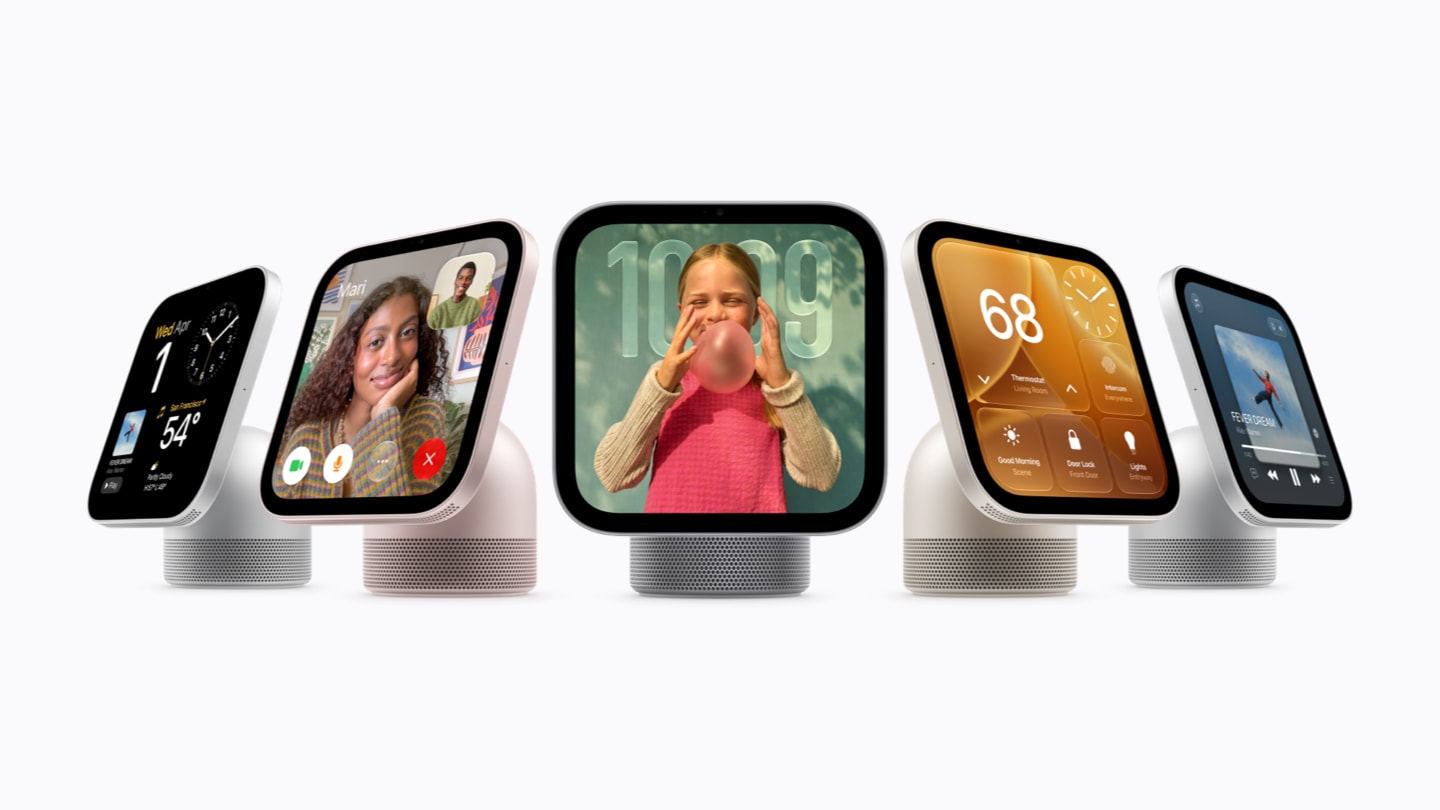
Apple HomeView, the company's $299 smart home display, became available today, November 13, 2026, in tabletop and wall-mounted models, exactly a month after Apple unveiled it on October 13. The 7-inch screen combines a shared household hub with a personal one: it recognizes up to six people by face, hands each of them their own Home Screen and content, and runs a new conversational version of Siri called Siri AI, currently in beta. It's on sale in the US, Canada, UK, Australia, New Zealand, India and Singapore — but not yet in the European Union, because Siri AI isn't available there.
Apple HomeView at a glance
- Price: $299 for the tabletop model, $299 for the wall-mounted model (mounting hardware sold separately)
- Display: 7-inch Liquid Retina with True Tone, 500 to 0.3 nits brightness
- Chip: A18, with Secure Exclaves for camera and microphone data
- Face recognition: Up to 6 people, each with a personalized Home Screen
- Siri AI: In beta on HomeView software 27.2; requires a paired Apple Intelligence iPhone or iPad for personal context
- Available today in: US, Canada, UK, Australia, New Zealand, India, Singapore (not the EU)
What is Apple HomeView?
Apple HomeView is a new product category for the company: a dedicated 7-inch touchscreen display designed to sit on a counter or mount on a wall and act as the control center for a household. Apple positions it as sitting between a HomePod speaker and an iPad — always-on, voice- and touch-controlled, and built to be used by an entire family rather than one person.
According to Apple's October 13 announcement, Greg Joswiak, the company's senior vice president of Worldwide Marketing, said Apple HomeView "is designed to be shared by everyone in the home yet feel completely personal to each user." That dual identity — a communal screen that still behaves differently depending on who's standing in front of it — is the core idea behind the product, and it's made possible by the face-recognition system described below.
HomeView handles four broad jobs: entertainment (music, photos, video), communication (FaceTime calls and messaging), home monitoring (camera feeds and alerts), and smart home control (lights, locks, thermostats and scenes). It's a notable expansion of Apple's smart home ambitions, arriving alongside a redesigned Apple TV 4K and a new HomePod mini — devices Apple explicitly grouped together as a single "connected home" lineup.
Price and models
Apple sells HomeView in two physical forms, both priced identically:
- Tabletop Apple HomeView: $299, in silver, starlight, rose pink and space gray
- Apple HomeView (Wall-Mounted): $299, in silver and space gray
The tabletop version ships with a matching USB-C cable and is ready to use once plugged in. The wall-mounted version needs a mount, sold separately through Apple's hardware partner Schneider Home: a Power Mount USB-C Wall Connector from $59.95, or a Power Mount AC Wired option from $79.95, both available now. A Power Mount PoE Wired version, priced from $129.95, isn't arriving until early 2027. Apple also lists professional installation for the wall-mounted model through ADT in select areas, full pricing and color details are on Apple's HomeView order page.
Release date and availability
Apple announced HomeView on October 13, 2026, and opened pre-orders the same day in Australia, Canada, India, New Zealand, the UK and the US. Pre-orders opened a couple of days later in Singapore, and South Africa's version is sold only through Apple Authorized Resellers. Today, November 13, 2026, is the general availability date Apple set at launch — the device is now shipping and in stores in every market where it's sold.
Apple's follow-up newsroom post, published today, confirms HomeView is now available "at Apple Store locations, on apple.com/store, and in the Apple Store app" in the supported countries, alongside the matching Apple TV 4K, which launched on the same day and at the same $299 price.
Where you can — and can't — buy it
At launch, Apple HomeView is sold in eight countries: the United States, Canada, the United Kingdom, Australia, New Zealand, India, Singapore and South Africa. It is explicitly not available in the European Union. Apple has said that's because Siri AI — the feature that defines much of the HomeView experience — isn't currently available in iOS in the EU, and that the company is working with regulators there "on a path forward." That echoes the staggered, market-by-market rollout Apple has used for other Apple Intelligence features since their debut, and it means EU shoppers will need to wait for a regulatory resolution before HomeView reaches local Apple Stores.
HomeView requires a paired iPhone running iOS 27.2 or later, or an iPad running iPadOS 27.2 or later, to unlock its personal-context Siri AI features — so even in supported countries, getting the full experience depends on updating a companion device first.
Specs: display, chip, camera and audio
HomeView's hardware is built around a 7-inch Liquid Retina display with True Tone support, with brightness that automatically adjusts from 500 nits down to as low as 0.3 nits in a dark room, and an interface that scales depending on how far away the viewer is standing, as detailed on Apple's HomeView product page. The body is aluminum with a domed speaker base, and the tabletop model uses a stainless steel hinge that lets the screen tilt.
Inside is Apple's A18 chip, which Apple specifically notes includes Secure Exclaves — isolated hardware used to process camera and microphone data before it's handled anywhere else on the device. For capturing video, HomeView uses a 12-megapixel Center Stage camera paired with four beamforming microphones for voice pickup across a room.
On the audio side, each HomeView packs two custom full-range drivers in the display, a down-firing woofer, and two force-cancelling passive radiators in the base, with support for Spatial Audio and computational audio tuning. The wall-mounted model swaps in two custom drivers specifically tuned for on-wall placement, where the acoustic environment is different from a tabletop unit.
| Spec | Apple HomeView |
|---|---|
| Price | $299 (tabletop or wall-mounted) |
| Display | 7-inch Liquid Retina, True Tone, 500–0.3 nits |
| Chip | A18 with Secure Exclaves |
| Camera | 12MP Center Stage |
| Microphones | 4 beamforming mics |
| Face recognition | Up to 6 people |
| Colors | Silver, Starlight, Rose Pink, Space Gray (tabletop); Silver, Space Gray (wall-mounted) |
| Requires | iPhone with iOS 27.2+ or iPad with iPadOS 27.2+ |
| Available | US, Canada, UK, Australia, NZ, India, Singapore, South Africa |
Face recognition for up to six people
HomeView's headline trick is recognizing up to six different people by face and switching to a personalized Home Screen for whoever is standing in front of it. Once recognized, a person's own content in Messages, FaceTime, Calendar, Reminders and Find My becomes available directly on the shared screen — without anyone having to log in or hand the device around. It's a similar trust model to how biometric sign-in has replaced typed credentials elsewhere in computing — much like passwordless authentication swaps a password for something you inherently are — except here it's scoped to a shared family device rather than an individual account.
That face-recognition layer is also why Apple leans so heavily on the A18 chip's Secure Exclaves: recognizing faces means processing camera data locally, and Apple's framing throughout its HomeView materials emphasizes that this recognition happens on-device rather than being sent out for cloud processing.
Siri AI: what it does and where it's limited
The software centerpiece of HomeView is Siri AI, a new, more conversational version of Siri that Apple says has broader world knowledge, on-screen awareness, and — when paired with an Apple Intelligence-enabled iPhone or iPad — access to personal context pulled from Calendar, Messages and Apple Music playlists. Users can customize Siri's voice expressiveness and pace from a paired device, though that's currently English-only. Conversations started on HomeView can continue later in the Siri app on another Apple device, and Siri AI requests are processed either on-device or through Apple's Private Cloud Compute, depending on complexity.
Two caveats are worth knowing before buying one for the Siri AI features specifically. First, Siri AI is explicitly labeled as being in beta on HomeView's software version 27.2 — Apple hasn't called it a finished, stable feature yet. Second, Apple's own materials note that some server-side Siri AI features carry daily usage limits, and that the company plans to introduce fees for expanded access at some point in the future. That's a notably different model from how Siri has worked historically, and it's worth watching as Apple AI features — HomeView's included — mature over the next few software updates, the same way rival assistants like Samsung's Galaxy AI have evolved their own free-versus-paid feature splits.
Siri AI in English currently works in the US, Australia, Canada, India, New Zealand, Singapore, South Africa and the UK — matching HomeView's hardware availability almost exactly. Canadian French support is planned for a later free software update, and it's this same Siri AI availability gap that's keeping HomeView out of EU stores for now.
FaceTime calls and home monitoring
For video calls, HomeView uses its Center Stage camera to keep people framed automatically, even as others join a call, while its four-microphone array is built to cut background noise for fully hands-free FaceTime conversations — useful in a kitchen or living room where the device is likely to sit.
On the monitoring side, HomeView's Home Camera interface can livestream up to nine video feeds from compatible cameras at once, and it's built to surface a front-door camera feed for quick entryway checks. With a supported iCloud+ plan, it can provide end-to-end encrypted recognition of specific people, familiar faces, pets, packages and vehicles seen on camera. It also listens for smoke and carbon monoxide alarm sounds and pushes alerts to a paired iPhone, iPad or Apple Watch, and it uses Apple Intelligence to group related notifications together and generate descriptions of what a camera recorded.
Voice automations and smart home control
Beyond media and calling, HomeView is built to be a touch- or voice-operated control panel for a smart home: adjusting cameras, thermostats, lights, locks and blinds, running Intercom between HomePod speakers and personal Apple devices, sending messages or placing calls by voice, and managing scenes and automations through the Home app. None of that works without existing HomeKit- or Matter-enabled accessories, which are sold separately.
Apple is also pairing HomeView's launch with its new Apple Home Collection — a line of cameras, a thermostat, and a lock developed with LG Electronics and Schneider Electric — though those accessories won't actually ship until December, with some pieces delayed into early 2027.
Apple TV 4K and HomePod mini 2: the rest of the lineup
HomeView didn't launch alone. Apple's October 13 event also introduced a redesigned, fourth-generation Apple TV 4K, priced at $299 and described by Apple as "supercharged by Siri AI," with built-in far-field microphones that let people talk to Siri completely hands-free. It went on pre-order the same day as HomeView and became available in stores today as well. Apple also introduced the HomePod mini 2, priced at $149, with Siri AI for that speaker arriving later through a software update rather than at launch.
Apple has grouped all of these — HomeView, the new Apple TV 4K, HomePod mini 2, and the Apple Home Collection accessories — into a single connected-home push, with four matched HomePod mini 2 or HomePod (2nd generation) speakers able to form a surround-sound home theater setup alongside the new Apple TV 4K. It's Apple's broadest simultaneous home-hardware release in years, following a similar pattern to how other device families — including competing hardware refreshes like Samsung's latest foldables — now launch as coordinated lineups rather than single standalone products.
What's next
With HomeView now shipping, the next milestones to watch are mostly software and regional ones rather than hardware. Siri AI remains in beta on HomeView's 27.2 software, so expect incremental updates that expand its capabilities, address the daily usage limits Apple has flagged, and eventually introduce the paid tier for expanded access that Apple has said is coming. Canadian French Siri AI support is due as a free update, and the Apple Home Collection accessories — cameras, a thermostat and a lock — are set to arrive in December, with the PoE wall-mount option and some accessories pushed into early 2027.
The biggest open question is the European Union. Apple has said it's working with EU regulators "on a path forward" for Siri AI, which is the only thing standing between HomeView and a wider European launch. Until that's resolved, EU shoppers interested in Apple's new smart home display will need to watch for an announcement rather than expect HomeView to simply show up in local Apple Stores alongside the rest of the world.
Frequently asked questions
How much does Apple HomeView cost?
Apple HomeView costs $299 whether you choose the tabletop model or the wall-mounted model. The wall-mounted version also requires a separate mount from Schneider Home, starting at $59.95 for a USB-C wall connector.
When did Apple HomeView come out?
Apple announced HomeView on October 13, 2026, and opened pre-orders the same day. It became generally available today, November 13, 2026, in supported countries.
Is Apple HomeView available in my country?
At launch it's sold in the US, Canada, the UK, Australia, New Zealand, India, Singapore and South Africa. It is not yet available in the European Union because Siri AI isn't currently available in iOS there.
What can Apple HomeView do?
It's a 7-inch smart display that recognizes up to six people by face and shows each one a personalized Home Screen, runs Siri AI for conversational voice help, handles FaceTime calls with Center Stage framing, streams up to nine home camera feeds at once, and controls HomeKit- or Matter-enabled smart home accessories by touch or voice.
Does Apple HomeView need an iPhone to work?
Yes, for its full feature set. HomeView requires a paired iPhone running iOS 27.2 or later, or an iPad running iPadOS 27.2 or later, to unlock Siri AI's personal-context features.
Is Siri AI on HomeView finished?
No. Apple labels Siri AI as being in beta on HomeView's 27.2 software, with daily usage limits on some server-side features and a paid tier for expanded access planned for the future.
Sources
- Apple Newsroom: Meet Apple HomeView, a new way to enjoy entertainment, stay connected, and manage the homeapple.com
- Apple Newsroom: Apple HomeView available todayapple.com
- Apple: Apple HomeView product pageapple.com
- Apple Store: Buy Apple HomeViewapple.com
- Apple Newsroom: Apple unveils the new Apple TV 4Kapple.com
- Apple Store: Buy HomePod miniapple.com
Nadia Osei covers mobile and consumer gadgets for Pandromeda: smartphones, tablets, smartwatches, earbuds and smart-home devices. She tracks launches, software updates and pricing across Apple, Google, Samsung and the rest, and builds comparisons from the manufacturers' published specifications.