OpenAI Brings Visual Ads to ChatGPT Image Generation
Starting this month, ChatGPT will show labeled visual ads beside the images it generates for US Free and Go users, OpenAI confirmed.
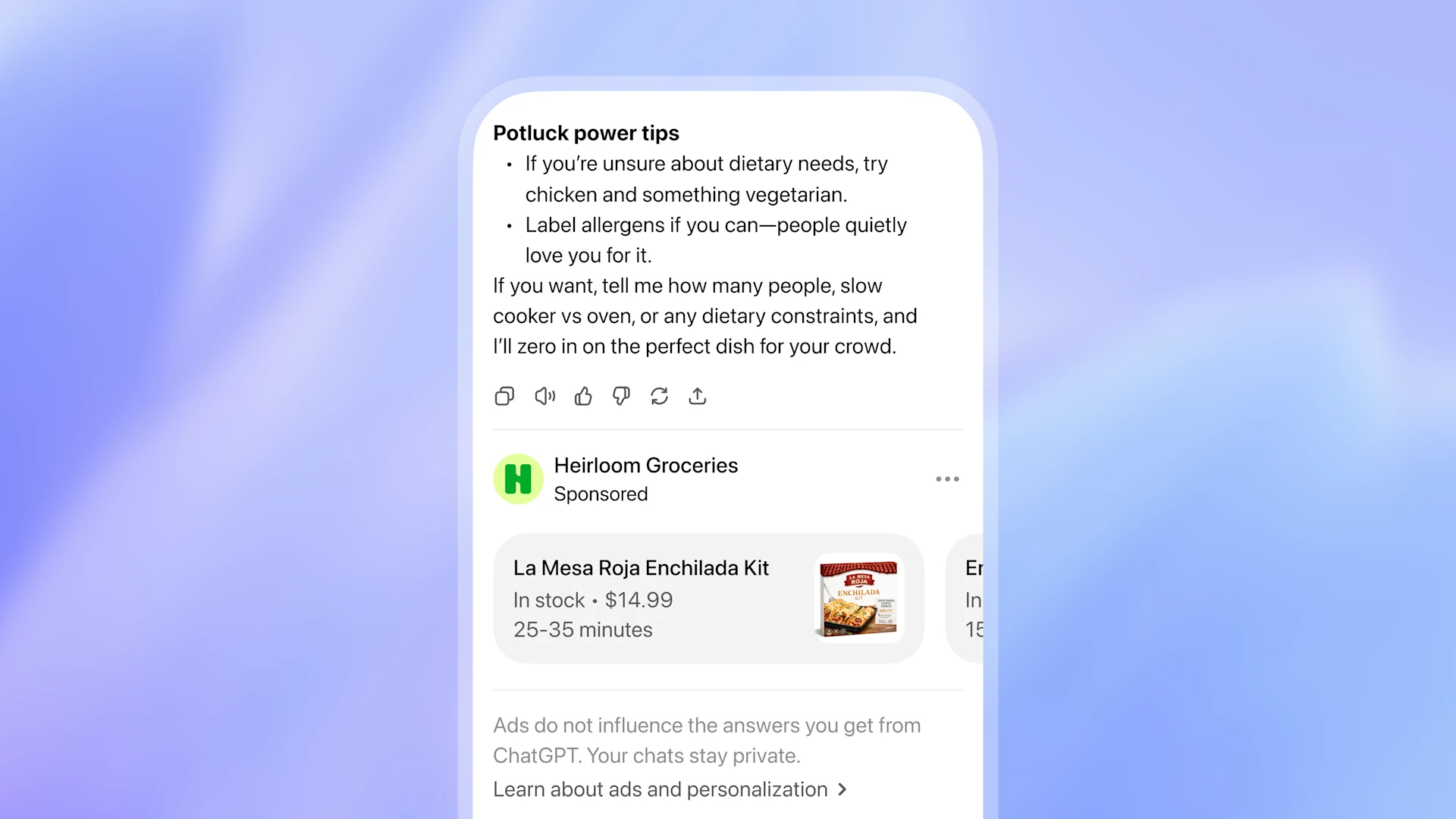
OpenAI has started showing visual display ads next to the images ChatGPT generates for users, the company confirmed to reporters on October 5, 2026. The new ad units will begin appearing later this month for logged-in adult users on ChatGPT's Free and Go plans in the United States, pairing sponsored product and service images with the pictures people create using ChatGPT's image generator. It is the first time OpenAI has placed ads directly alongside image-generation output, and it marks the next step in a ChatGPT Ads business that OpenAI itself says passed a $1 billion annualized revenue run rate within roughly 200 days of its February 2026 launch.
- What's new: Visual display ads now appear next to ChatGPT's generated images, not just below text answers.
- When: Rolling out "later this month" as of the October 5, 2026 announcement, U.S. only for now.
- Who sees them: Logged-in adult users on ChatGPT's Free and Go tiers. Plus, Pro, Business, Enterprise, and Edu stay ad-free.
- Labeling: OpenAI says the new ads "will also be clearly labeled and won't influence the answers ChatGPT provides."
- Business context: ChatGPT Ads reportedly hit a $1 billion annualized run rate in under 200 days and is available through OpenAI's sales team and partners in more than 40 countries, per OpenAI's own account.
What OpenAI actually launched
Until now, OpenAI's own ad rules explicitly carved out an exception for image generation: its help center documentation on ads in ChatGPT stated that ads would not appear after a user generated an image, during what it called "the current test phase." That carve-out is what's changing. According to TechCrunch's reporting, which cited OpenAI's own confirmation, the company will begin showing visual display ads next to image-generation results, featuring products and services from an initial group of test advertisers, with a wider rollout planned once the test phase proves out.
The company's language around the launch echoes the principles it has repeated since its very first ads pilot in February: ads are "clearly labeled" and "won't influence the answers ChatGPT provides." That matters more here than with text-based sponsored cards, because an image ad sitting next to an AI-generated image could, in theory, blur together visually if it weren't disclosed. OpenAI's framing suggests the new units will carry the same sponsorship labeling and visual separation it uses for the sponsored cards that already appear beneath chat answers — a disclosure box noting that the ad is a paid placement and that seeing it doesn't mean OpenAI endorses the advertiser or its product.
Notably, the change arrives alongside a tightened advertiser policy elsewhere in the program: earlier in the fall, OpenAI told advertising partners it would no longer approve campaigns for standalone image- and audio-generation tools that compete with ChatGPT's own capabilities, a shift reported by outlets covering the policy change. That means the test advertisers appearing next to ChatGPT's generated images are, by OpenAI's own rules, unlikely to include rival AI image generators — the new ad slot is being opened to brands and products, not to competing AI tools.
Where and how the ads appear
ChatGPT's existing ad format shows up as a separate card below the end of a text response, tagged "Sponsored" and visually boxed off from ChatGPT's own answer, as described in OpenAI's original ads announcement. The new format extends that same logic to image generation: rather than (or in addition to) a text card, the ad surfaces as a visual unit next to the image ChatGPT just produced for the user, drawing on the same matching system OpenAI already uses — pairing the topic of a person's request with ads submitted by advertisers.
TechCrunch's report notes OpenAI has also been broadening the infrastructure around its ad formats, expanding its roster of measurement and attribution partners (outlets reported names including AppsFlyer, Adjust, Branch, Kochava, and similar mobile-measurement firms) so advertisers can track outcomes like app installs or site visits that come from ChatGPT placements. That groundwork — built for ChatGPT's existing text-based ad cards — is what now extends to the image-generation surface.
How this fits into the ChatGPT Ads rollout
The image-ad launch is the latest step in a rollout OpenAI has been expanding steadily since the start of the year. OpenAI's own account of the program, published in its "milestone in expanding access to AI" post, lays out the pace:
| Date | Milestone |
|---|---|
| Feb 9, 2026 | Ads pilot begins for logged-in adult Free/Go users in the U.S. |
| Mar 26, 2026 | Pilot expands to Canada, Australia, New Zealand after "no impact on consumer trust metrics," per OpenAI |
| May 7, 2026 | Self-service Ads Manager opens; pilot expands toward UK, Mexico, Brazil, Japan, South Korea |
| Aug 11, 2026 | ChatGPT Ads live in UK, Mexico, Brazil, Japan, South Korea |
| Aug 31, 2026 | OpenAI says ChatGPT Ads hit a $1B annualized run rate in under 200 days; self-service access opens in India, Europe, the Middle East, and North Africa; coverage reaches 40+ countries |
| Oct 5, 2026 | OpenAI confirms visual ads will appear alongside image-generation results, starting with U.S. test advertisers |
OpenAI has previously told investors it is targeting roughly $2.5 billion in ad revenue for 2026 overall, with projections shared with investors pointing toward far larger numbers by the end of the decade — figures reported by eMarketer and other outlets covering the company's ad-business guidance. OpenAI itself hasn't published those longer-range targets on its own blog, so they should be read as investor-guidance reporting rather than an official company figure. What OpenAI has stated directly, on its own site, is the $1 billion run-rate milestone, the expansion to more than 40 countries through its sales team and partner network, and self-service Ads Manager access rolling out market by market. Image-generation ads add a new surface to that same expanding footprint rather than a separate product.
It's also worth separating the ad business's numbers from OpenAI's company-wide figures, which get reported in the same news cycles and are easy to conflate. OpenAI's overall annualized revenue run rate — spanning ChatGPT subscriptions, enterprise products, and API usage, not just ads — has been reported in the tens of billions of dollars by mid-2026, a company-wide figure that is an order of magnitude larger than the ad business's own $1 billion run rate. Advertising is one slice of a diversified business model, as OpenAI itself frames it, alongside consumer subscriptions, enterprise offerings, and usage-based APIs.
Free vs. paid: who actually sees these ads
As with every ad format OpenAI has shipped so far, the image-generation ads are scoped to the same two tiers: Free and Go. ChatGPT Plus, Pro, Business, Enterprise, and Edu accounts remain ad-free under OpenAI's stated policy. OpenAI also offers Free-tier users an "ads-free" toggle in exchange for a lower daily message allowance, so avoiding ads doesn't strictly require paying for Plus — it can mean accepting tighter usage limits instead. Readers who rely on ChatGPT heavily inside familiar productivity tools, such as the integrations covered in Pandromeda's look at ChatGPT in Microsoft Word, Excel, and PowerPoint, won't see these ad units in those contexts; this rollout is specific to the main ChatGPT app and image-generation feature.
Privacy, data use, and how to tell an ad from a real answer
OpenAI's ad principles, laid out on its approach to advertising page and repeated in its help center, rest on three claims: ads don't change what ChatGPT tells you, advertisers never see your actual conversations, and you can control how personalized the ads are. According to OpenAI's help center, advertisers receive only aggregated performance data — impressions and clicks — and never get access to chat content, chat history, memories, or other personal details, and OpenAI says it does not sell user data to advertisers.
On personalization specifically: if a user leaves ad personalization on, ChatGPT's ad system can draw on signals from the person's broader usage — past chats, memory, and prior ad interactions — to pick a more relevant ad. Turning personalization off limits ad selection to the context of the current conversation only. Either way, OpenAI says it will not show ads to accounts it believes belong to users under 18, and it excludes sensitive categories such as health, mental health, and political topics from ad targeting.
For telling a real ChatGPT answer from an ad, OpenAI's design rests on labeling and visual separation rather than anything users need to figure out themselves: ad units are tagged as sponsored and boxed off from ChatGPT's generated content, whether that content is text or, now, an image. Users get a menu to hide an ad, flag it, or ask "why am I seeing this" to see the stated targeting reason, and OpenAI says ad history and personalization data can be cleared from account settings at any time.
The trust question: telling a generated image from a paid one
Pairing ads with image generation raises a sharper version of a question OpenAI has faced since February: how obvious is the line between what ChatGPT made for you and what a brand paid to put next to it? With a text answer, the sponsored card sits below the response in its own box. With an image, the ad is competing for attention with a visual the user may have spent several prompts refining — a picture of a product, a design mockup, a piece of art. OpenAI's public answer is that the format will carry the same disclosure treatment as its existing ads: a sponsored label and visual separation from ChatGPT's own output, plus the same "why am I seeing this" controls.
What OpenAI hasn't detailed publicly, as of this launch, is exactly how the new unit is laid out on screen — whether it appears as a distinct card beside the generated image, a strip beneath it, or something else — or whether there are separate, image-specific controls beyond the existing ad-history and personalization settings. Pandromeda will update this story as OpenAI's help center documentation is revised to reflect the new format; for now, the clearest guidance remains OpenAI's general rule that any ad in ChatGPT, regardless of surface, must be labeled as sponsored and must not alter what ChatGPT itself produces.
What advertisers get
For brands, the image-generation placement is a new inventory type layered onto a buying system OpenAI has been building out all year. Advertisers can already buy ChatGPT ads either through OpenAI's managed sales and partner network or, in a growing list of markets, through self-service Ads Manager, OpenAI's country-availability page shows. OpenAI's own reporting on the ad business describes CPC and outcome-optimized bidding as now accounting for the majority of campaigns, alongside pixel- and API-based conversion tracking that lets advertisers measure what a ChatGPT placement actually drives — installs, sign-ups, or site visits — rather than just impressions.
Extending ad placement to the image-generation surface gives advertisers a new, visually native way to appear at a moment when a user is already looking at generated imagery — a context OpenAI and outside analysts have both framed as commercially valuable because people often turn to ChatGPT while actively comparing options or deciding what to buy. OpenAI's own post on the program's growth also points to an expanding partner ecosystem: the company says it now works with more than 50 technology and measurement partners, up from a managed-sales, agency, and partner-led model at launch. OpenAI has also pointed to early advertiser results from its broader program, including one e-commerce advertiser it says achieved a 3x return on ad spend over a 28-day campaign, and a technology partner that reported more than 80% of ad-driven ChatGPT traffic came from new customers rather than repeat buyers — figures OpenAI published itself rather than independently audited numbers.
For smaller brands, the self-service Ads Manager — opened in May 2026 and since extended to dozens of countries — means a business doesn't need an agency relationship to get into the test pool for a new placement like this one. OpenAI says small and medium-sized businesses already represent "a material share" of total ad spend on the platform, a shift from the agency- and enterprise-heavy advertiser base the program started with in February.
What to watch next
OpenAI has framed every stage of its ads rollout as a test it's prepared to adjust based on feedback, and the image-generation format is no exception — it's starting in the U.S. only, with an initial pool of test advertisers, before any broader expansion. Three things are worth watching: whether OpenAI extends the format to more countries on the same timeline it used for its text-based ad cards, whether image ads come with their own dedicated controls beyond the existing ad-history and personalization settings, and whether the format expands beyond static visual ads toward the video and interactive formats OpenAI has signaled are coming as it chases its 2026 ad-revenue targets. For context on how aggressively OpenAI has been shipping product changes this year, see Pandromeda's coverage of OpenAI's DevDay 2026 announcements. And as ad-funded AI products scale globally, how regulators treat AI-served advertising is an open question worth tracking alongside efforts like the EU's own rules, detailed in Pandromeda's EU AI Act explainer.
Frequently asked questions
When do ChatGPT's new image-generation ads start appearing?
OpenAI confirmed the new visual ads on October 5, 2026, and said they will begin appearing "later this month," initially only for users in the United States.
Who will actually see ads next to their generated images?
Only logged-in adult users on ChatGPT's Free and Go plans. Plus, Pro, Business, Enterprise, and Edu subscribers do not see ads under OpenAI's stated policy.
Can advertisers see the images I generate or my conversations?
OpenAI says no. According to its help center, advertisers only receive aggregated performance data, such as how many times an ad was shown or clicked, and never get access to chat content, chat history, memories, or personal details. OpenAI also says it does not sell user data to advertisers.
How can I tell a sponsored image apart from what ChatGPT generated for me?
OpenAI's policy requires every ad to be clearly labeled as sponsored and visually separated from ChatGPT's own output, whether that output is text or an image. Users can also use a menu to see why an ad was shown, hide it, or report it.
Can I opt out of these ads or turn off personalization?
Yes. Free-tier users can turn off ad personalization in Settings, which limits ad selection to the current conversation only, and can choose an ads-free mode in exchange for a lower daily message limit. Upgrading to a paid plan like Plus also removes ads entirely.
How big is OpenAI's ChatGPT Ads business at this point?
OpenAI itself says ChatGPT Ads reached a $1 billion annualized revenue run rate within about 200 days of its February 2026 launch and is now available through its sales team and partners in more than 40 countries. Separately, outlets covering OpenAI's investor guidance have reported a roughly $2.5 billion ad-revenue target for 2026 overall, a figure OpenAI has not published directly on its own blog.
Sources
- OpenAI — Testing ads in ChatGPTopenai.com
- OpenAI — A milestone in expanding access to AIopenai.com
- OpenAI Help Center — Ads in ChatGPThelp.openai.com
- OpenAI — Our approach to advertising and expanding accessopenai.com
- TechCrunch — OpenAI launches visual ads that appear alongside image generation resultstechcrunch.com
- eMarketer — OpenAI's $1 billion ad run rate puts its 2026 target within closer reachemarketer.com
Theo Park runs the AI desk at Pandromeda. He follows model launches from the frontier labs and the open-weight community, tracks the assistants and developer tools built on them, and explains what each release changes on pricing, capability and safety. His reporting leans on primary sources: model cards, technical reports, API documentation and the companies' own announcements.