ChatGPT Go Explained: Price, Limits, and Plus vs Pro
OpenAI's $8/month ChatGPT Go sits between Free and Plus — here's exactly what it unlocks, what it skips, and whether it beats paying for Plus.
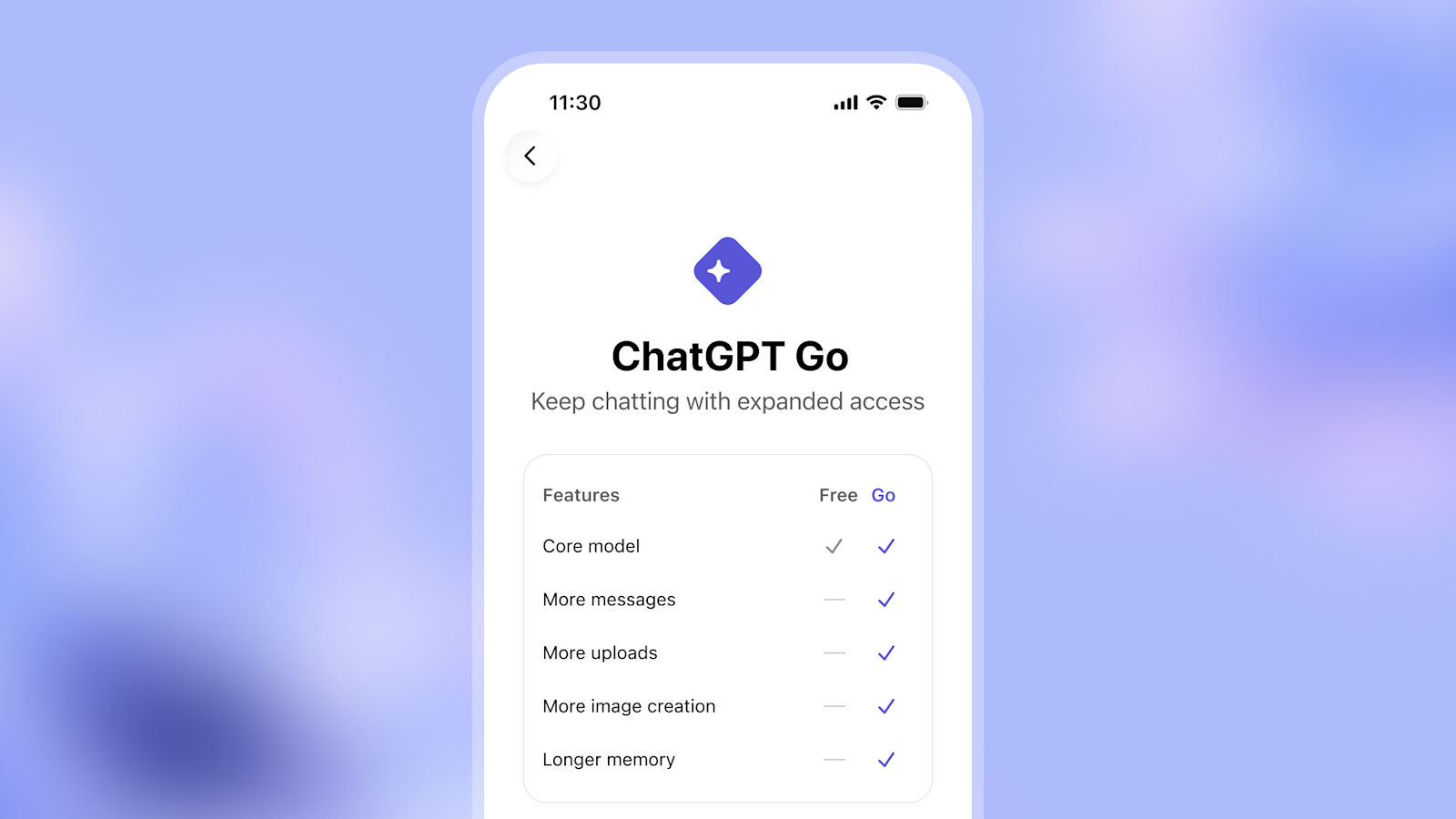
ChatGPT Go is OpenAI's cheapest paid ChatGPT plan, priced at $8 a month in the United States, sitting between the free tier and the $20-a-month Plus plan. It gives you higher usage limits than Free for messages, image generation, file uploads, and memory, but it does not include Plus and Pro's advanced reasoning models, Codex access, or ad-free browsing — and, like the Free tier, it may show ads. Here is exactly what you get, what you don't, and how to decide whether it's the right plan for you.
- Price: $8 USD/month in the US (billed monthly; no annual option)
- Availability: All countries where ChatGPT is supported, billed in USD with local-currency billing in some markets
- Launched: India, August 2025; expanded to the US and worldwide on January 16, 2026
- What it adds over Free: Higher limits for image generation, file uploads, data analysis, voice, and a longer memory window
- What it skips: Advanced reasoning models (GPT‑6 Astra/Sol), Codex, Projects-level extras, Sites, and an ad-free guarantee
- Ads: May show ads, same as Free; Plus, Pro, Business, and Enterprise stay ad-free
What is ChatGPT Go?
According to OpenAI's own help center, "ChatGPT Go is a low-cost subscription plan that provides expanded access to ChatGPT's most popular features at an affordable price." In practice, that means everything in the Free plan, plus noticeably higher usage ceilings for the features people hit limits on most: image generation, file uploads, advanced data analysis, and memory.
Go is not a cut-down version of Plus — it's better understood as a "Free, but without the friction" plan. You still don't get Plus's advanced reasoning models or Codex, but you stop running into Free's tight caps on uploads and images quite as quickly, and your conversations carry a longer memory window.
How much does ChatGPT Go cost, and where is it available?
ChatGPT Go costs $8 USD a month in the United States, billed automatically with no annual or multi-month option currently offered. OpenAI's launch announcement frames the current three-tier consumer lineup as Go at $8/month, Plus at $20/month, and Pro starting from $100/month (Pro now offers a choice of three usage tiers, where it used to be a flat $200/month at launch).
Go actually predates its US debut by several months. OpenAI first introduced it in India in August 2025 as a low-cost way to expand access to ChatGPT, before rolling it out to roughly 170 more countries over the following months. On January 16, 2026, OpenAI brought Go to the US and "everywhere ChatGPT is available," making it a genuinely global third tier rather than a regional experiment.
Per OpenAI's help article, ChatGPT Go "is available in all countries ChatGPT is supported in." All purchases are billed in USD by default, though OpenAI offers local-currency billing in a limited set of markets, and pricing can be adjusted over time as the company gathers feedback from early use.
What's included in ChatGPT Go
OpenAI's help center lists the following as what Go adds on top of everything in the Free plan:
- Expanded access to ChatGPT's tools — higher usage limits than Free for eligible features
- Extended image generation — more images for work or personal use
- Extended file uploads — analyze more documents, spreadsheets, and other files
- Extended advanced data analysis — more use of tools like Python for data work
- Longer memory — a larger context window so ChatGPT remembers more about you over time
- Access to projects, tasks, custom GPTs, and Library, subject to current feature availability and storage limits
- Sign in with ChatGPT support in third-party apps and sites, subject to plan limits and partner eligibility
On the model side, OpenAI's help center confirms that Go users can access its "Think" reasoning mode from the composer's plus menu (on mobile) or model picker (on web) — it runs on the GPT‑5.6 Luna model, though Go does not include GPT‑5.6 Sol, the step up reserved for paid tiers above it. Legacy models, including older GPT‑4-era options, are not available on Go.
ChatGPT Go vs Free vs Plus vs Pro
The table below is drawn directly from OpenAI's current plans and pricing page, which breaks the four consumer tiers down feature by feature.
| Feature | Free | Go | Plus | Pro |
|---|---|---|---|---|
| Price | $0/month | $8/month | $20/month | From $100/month |
| Everyday text chats | Unlimited* | Unlimited* | Unlimited* | Unlimited* |
| Response times | Limited on bandwidth/availability | Limited on bandwidth/availability | Fast | Ultrafast (eligible tiers) |
| Image generation | Limited | Yes (extended) | Yes | Yes (unlimited & faster) |
| Image generation with Thinking | No | No | Yes | Yes |
| File uploads | Limited | Yes (extended) | Yes | Yes |
| Advanced data analysis | Limited | Yes (extended) | Yes | Yes |
| Memory | Limited | Yes | Expanded | Expanded (maximum) |
| Voice mode | Yes | Expanded | Expanded | Unlimited* |
| Voice with video | No | Yes | Yes | Yes |
| Deep research | Limited | Limited | Yes | Yes (maximum) |
| Codex access | Limited | Limited | Yes | Expanded |
| Scheduled tasks | No | Yes | Yes | Yes |
| Sites / Dots | No | No | No / No | Yes / Yes |
| Advanced reasoning models (GPT‑6 Astra/Sol) | No | No | Yes | Expanded |
| GPT Instant context window | 27K | 54K | 54K | 128K |
| GPT Reasoning context window | Varies | 256K | 256K | 400K |
| Ads | May include ads | May include ads | Ad-free | Ad-free |
*Unlimited usage is subject to OpenAI's abuse-prevention guardrails. Figures reflect OpenAI's published consumer plan comparison as of October 2026 and can change as OpenAI updates its models and limits.
A few things stand out. Go roughly doubles Free's context window for everyday chats (54K vs 27K tokens) and gives you the same 256K reasoning context window as Plus — but Plus and Pro add the advanced GPT‑6 Astra and Sol reasoning models, faster response times, deep research, Codex, scheduled tasks, and (on Pro) features like Sites and Dot, OpenAI's always-on agent, that Go doesn't include at all.
Message, upload, and image-generation limits, explained
If you're hoping for a precise daily or hourly number — say, "40 images a day" — OpenAI doesn't publish one. Its help center describes Go's limits only in relative terms: "higher usage limits than on the Free plan" for eligible features, and notes that "usage is subject to plan limits, abuse guardrails, and temporary restrictions during high demand." The practical message is that Go's ceilings are meaningfully higher than Free's, scale with overall demand on OpenAI's infrastructure, and aren't fixed numbers you can bank on long-term.
What is fixed, and documented, is the model's context handling: Go gives you roughly 40 pages of text as an input maximum on GPT Instant (versus about 12 pages on Free), and around 320 pages of text on reasoning tasks — the same ceiling as Plus. Everyday text chat itself is unlimited on every tier, Free included, subject to the same abuse-prevention guardrails that apply across all plans.
One place Go clearly outruns Free is memory: Free's memory and "memory with past chats" are explicitly marked "Limited" on OpenAI's comparison table, while Go gets full memory access (not yet "Expanded" the way Plus and Pro's is, but functional rather than capped).
Ads on ChatGPT Go and Free
Go is, alongside Free, one of the two ChatGPT tiers where OpenAI may show ads. Per OpenAI's ads FAQ, "Ads may appear for users on the Free and Go plans. Plus, Pro, Business, Enterprise, and Edu accounts will not have ads." The company says ad testing started in the United States on February 9, 2026, rolling out gradually to eligible Free and Go users in select regions, with in-product notices for anyone included in the test.
Ads appear below a ChatGPT response, clearly labeled and separated from the organic answer, and OpenAI is also testing a multi-image visual ad format that surfaces during image generation — a format covered in more detail in our look at OpenAI's visual ad rollout. OpenAI states that ads "do not influence ChatGPT's answers," run on systems separate from the chat model, are never eligible to appear near sensitive topics like personal health or politics, and are withheld from accounts identified as belonging to users under 18.
If you'd rather not see ads at all without paying for Plus or Pro, Free-tier users (not Go) can switch to an "Ads-Free" version of Free from Settings → Ads controls, trading ads for lower usage limits and reduced feature access. That specific trade-off is a Free-plan option only — OpenAI's help center is explicit that "Ads-Free is a Free-plan option. If you're on a paid plan, you'd need to switch back to Free to use it, or upgrade to a plan that's already ad-free (like Plus or Pro)." In other words, Go itself has no built-in ad-free toggle; avoiding ads on a paid Go subscription means upgrading to Plus or Pro.
How Go compares to Plus for everyday work
Plus remains the plan OpenAI positions for people doing substantive work in ChatGPT — writing and editing long documents, research, or data analysis that benefits from its advanced reasoning models. Compared with Go, Plus adds the full GPT‑6 reasoning lineup, expanded messages and uploads, more complex and accurate image creation, expanded deep research and Codex usage, Projects, scheduled tasks, custom GPTs, and early access to new features. It also drops Go's "may include ads" asterisk entirely.
If your ChatGPT usage leans toward document and spreadsheet work, it's worth noting that Go, like Free, only gets "Limited" access to the Excel, Word, PowerPoint, and Google Sheets extensions that Plus unlocks in full — something we go into more in our explainer on using ChatGPT inside Word, Excel, and PowerPoint. And if you're curious how OpenAI's current GPT‑6 model family (the reasoning models that separate Plus and Pro from Go) actually works, we've also covered what GPT‑6 and ChatGPT's Intelligent UI change for free and paid users alike.
Pro, meanwhile, is built for people who want OpenAI's most capable reasoning model with the fewest caps: unlimited and faster image creation, maximum deep research and memory, Dot (OpenAI's always-on agent), and Sites — none of which Go includes at any level.
How to sign up for ChatGPT Go (or switch plans)
Signing up for Go takes three steps, per OpenAI's help center:
- Log into ChatGPT
- Click your profile icon, then Upgrade Plan
- Select Try Go
You can also start directly from chatgpt.com/explore/go. Subscriptions bill automatically every month and can be canceled at any time from Settings → Account, where you can also view invoices and manage billing.
If you're already on Plus or Pro and want to downgrade to Go, OpenAI's FAQ is specific about how that works: there's no partial refund for the time remaining on your current billing cycle. Your existing plan stays active until that cycle ends, at which point your account switches to Go and starts billing at the Go rate. The reverse — upgrading from Go to Plus or Pro — can be done any time from the same Settings → Account menu and takes effect immediately.
Is ChatGPT Go worth it?
Go makes the most sense if you've been using the Free plan and regularly hit its limits on image generation, file uploads, or data analysis, but don't need Plus's advanced reasoning models, Codex, or an ad-free guarantee. At $8/month, it's a meaningfully cheaper on-ramp than Plus's $20/month, especially in markets where OpenAI localizes the price further.
It makes less sense if ads are a dealbreaker on principle (Go doesn't remove them, only Plus and Pro do), or if your work depends on GPT‑6's advanced reasoning models, Codex, Projects-level organization, or Sites — all of which stay behind Plus or Pro regardless of how much you're willing to pay for Go's higher usage ceilings alone.
What's next: what to do now
If you're currently on Free and keep running into upload or image-generation limits, the fastest way to find out if Go solves your specific problem is to try it for a month — it's cancel-anytime, with no annual lock-in. If you're not sure whether Go or Plus fits better, compare your actual usage against the table above: if you regularly need Codex, deep research, or GPT‑6's advanced reasoning, Plus is the better $12/month step up. For the latest word on exact usage limits, OpenAI's own pricing page and Go help article are updated as limits and models change, and are worth rechecking before you commit.
Frequently asked questions
How much does ChatGPT Go cost?
$8 USD a month in the United States, billed monthly with no annual option. OpenAI localizes Go's price in some other markets rather than charging a flat $8 everywhere.
Is ChatGPT Go available in my country?
OpenAI says Go is available in all countries where ChatGPT itself is supported. Purchases default to USD billing, with local-currency billing offered in a limited set of countries.
What's the real difference between ChatGPT Go and Plus?
Per OpenAI's help center, "ChatGPT Go includes unlimited everyday text chats and higher limits than Free for eligible features such as image generation, file uploads, and data analysis," but it skips Plus's advanced GPT‑6 reasoning models, Codex, Projects, scheduled tasks, custom GPTs, and expanded deep research.
Does ChatGPT Go have ads?
It may. OpenAI's ads FAQ states that "ads may appear for users on the Free and Go plans," while "Plus, Pro, Business, Enterprise, and Edu accounts will not have ads." Ad testing began in the US on February 9, 2026, and is expanding gradually.
Can I switch from Plus or Pro down to Go?
Yes, from Settings → Account. There's no refund for your current billing cycle — your existing plan stays active until it ends, then your account switches to Go and starts billing at the Go rate.
Does ChatGPT Go include GPT‑6 or other advanced reasoning models?
Go includes access to "Think" mode, which currently runs on GPT‑5.6 Luna, but not GPT‑5.6 Sol or OpenAI's GPT‑6 Astra/Sol reasoning models, which stay reserved for Plus and Pro.
Frequently asked questions
How much does ChatGPT Go cost?
$8 USD a month in the United States, billed monthly with no annual option. OpenAI localizes Go's price in some other markets rather than charging a flat $8 everywhere.
Is ChatGPT Go available in my country?
OpenAI says Go is available in all countries where ChatGPT itself is supported. Purchases default to USD billing, with local-currency billing offered in a limited set of countries.
What's the real difference between ChatGPT Go and Plus?
ChatGPT Go includes unlimited everyday text chats and higher limits than Free for image generation, file uploads, and data analysis, but it skips Plus's advanced GPT-6 reasoning models, Codex, Projects, scheduled tasks, custom GPTs, and expanded deep research.
Does ChatGPT Go have ads?
It may. OpenAI's ads FAQ states that ads may appear for users on the Free and Go plans, while Plus, Pro, Business, Enterprise, and Edu accounts will not have ads. Ad testing began in the US on February 9, 2026, and is expanding gradually.
Can I switch from Plus or Pro down to Go?
Yes, from Settings then Account. There's no refund for your current billing cycle - your existing plan stays active until it ends, then your account switches to Go and starts billing at the Go rate.
Does ChatGPT Go include GPT-6 or other advanced reasoning models?
Go includes access to Think mode, which currently runs on GPT-5.6 Luna, but not GPT-5.6 Sol or OpenAI's GPT-6 Astra and Sol reasoning models, which stay reserved for Plus and Pro.
Sources
- OpenAI - ChatGPT Plans and Pricingopenai.com
- OpenAI Help Center - What is ChatGPT Go?help.openai.com
- OpenAI - Introducing ChatGPT Go, now available worldwideopenai.com
- OpenAI Help Center - Ads in ChatGPT FAQhelp.openai.com
- OpenAI - Our approach to advertising and expanding accessopenai.com
Theo Park runs the AI desk at Pandromeda. He follows model launches from the frontier labs and the open-weight community, tracks the assistants and developer tools built on them, and explains what each release changes on pricing, capability and safety. His reporting leans on primary sources: model cards, technical reports, API documentation and the companies' own announcements.