Redis vs Valkey: Which In-Memory Database Should You Use in 2026?
Valkey is the free, Linux Foundation-governed fork of Redis. Here's how its license, performance, and cloud support stack up against Redis in 2026.
If you just need the short version: Valkey is the free, Linux Foundation-governed fork of Redis that stays fully open source under the permissive BSD-3-Clause license, while Redis itself now ships under a choice of three licenses — two of which (RSALv2 and SSPLv1) are not open source by the OSI's definition, with AGPLv3 as the one copyleft open-source option. Both are drop-in compatible with the original Redis command set for most workloads, both are actively developed with real performance gains in their latest releases, and the practical decision for most teams in 2026 comes down to licensing comfort, cloud provider, and whether you need Redis Ltd's commercial/enterprise features.
- Valkey was created in March 2024 after Redis Ltd changed Redis's license away from permissive open source.
- Redis 8 and later ("Redis Open Source") now offers a choice of RSALv2, SSPLv1, or AGPLv3 — Redis Ltd says it intends to keep Redis Open Source under AGPLv3.
- Valkey 9.1 (May 2026) claims up to 2.1 million requests per second on a single server in its own benchmark, plus up to 44% lower per-key memory overhead for strings.
- AWS, Google Cloud, Alibaba Cloud, Aiven and Percona all back Valkey; AWS and Google Cloud both report double-digit cost savings and higher throughput versus their Redis OSS-based offerings.
Why Valkey exists: Redis's 2024 license change
Valkey only exists because of what Redis Ltd did to its own project. Until Redis 7.2, Redis was licensed under the permissive BSD-3-Clause license — the same license category used by projects like FreeBSD and Go. In March 2024, Redis Ltd switched Redis Community Edition versions 7.4 through 7.8 to a dual license of RSALv2 (Redis Source Available License v2) or SSPLv1 (Server Side Public License v1). According to Redis's own licensing page, RSALv2 is explicitly "not an open source license," and it prohibits using Redis to provide a competing managed database service to third parties.
That move — restricting what cloud providers and competitors could do with Redis — is what pushed the Linux Foundation, AWS, Google Cloud, Alibaba Cloud, Aiven, Percona, Ericsson and other long-time Redis contributors to fork the last BSD-licensed codebase and continue it as an independent, foundation-governed project: Valkey. Valkey keeps the BSD-3-Clause license Redis abandoned, including the BSD-licensed Redis code it was built from, and development now happens entirely under Linux Foundation governance rather than a single company's control.
Redis's current licensing: RSALv2, SSPLv1, or AGPLv3
Redis's licensing has shifted again since the initial 2024 backlash. As of Redis 8 and later — which Redis Ltd now calls "Redis Open Source" — the software is tri-licensed: you can use it under RSALv2, SSPLv1, or AGPLv3, your choice. AGPLv3 is an OSI-approved, copyleft open-source license, and Redis Ltd has stated it intends to keep Redis Open Source available under AGPLv3 going forward. That is a real concession to the open-source community, but AGPLv3 carries its own obligations: if you modify Redis and offer it as a network service, you generally have to release your modifications under AGPLv3 too, which is a heavier requirement than the BSD terms Valkey uses.
In practice, this means: pre-7.4 Redis and all current Valkey releases are unambiguously permissive open source. Redis 7.4–7.8 Community Edition is not open source by the OSI definition. Redis 8+ is open source again, but only under AGPLv3's copyleft terms unless you pick one of the two source-available alternatives instead.
Performance: what Valkey's latest releases claim
Valkey's maintainers have leaned hard into performance as a differentiator since the fork. Valkey 9.0 (October 2025) introduced "reply copy avoidance," which the Valkey project's own blog says cut p99.9 latency from 26.2ms to 3.10ms in a workload dominated by large-object requests — a roughly 8x tail-latency improvement in that specific test. Valkey 9.1, released in May 2026, added a redesigned I/O threading model and reports up to 2.1 million requests per second on a single server, measured with 512-byte payloads, 9 I/O threads, and a pipeline depth of 10. A follow-up Valkey blog post from August 2026 details a separate memory-efficiency pass that cuts per-key overhead by up to 44% for strings and by several bytes per sorted-set member, with no configuration changes required.
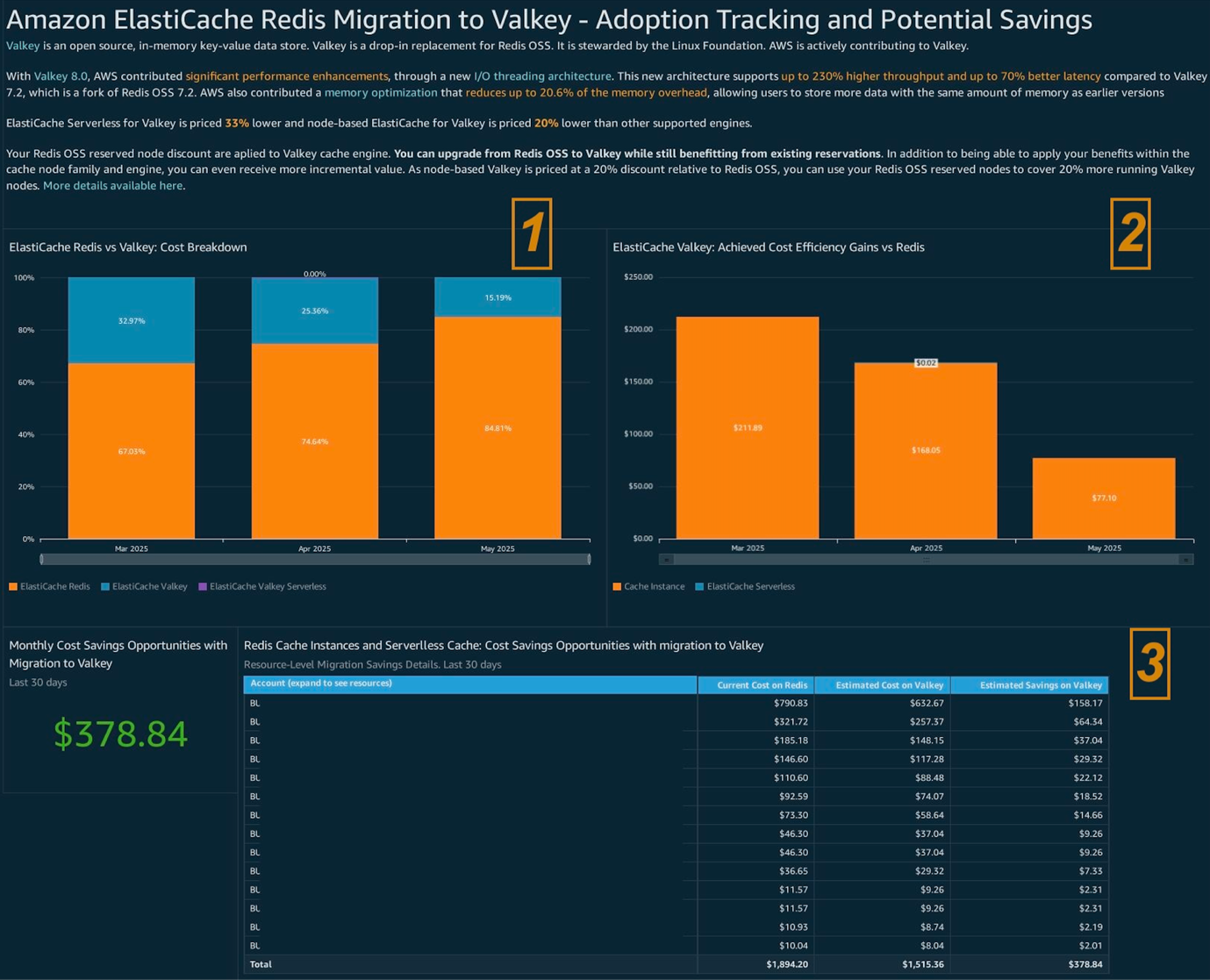
Cloud vendors building on Valkey report their own numbers. Google Cloud's Memorystore for Valkey 9.1, which went generally available in September 2026, claims up to 3x the queries per second at microsecond latency compared with Memorystore for Redis Cluster, crediting a lock-free, multi-queue messaging architecture with dynamic I/O thread scaling. AWS has separately credited Valkey 8.0's I/O threading architecture with up to 230% higher throughput and up to 70% better latency compared with the Valkey 7.2 baseline, plus up to 20.6% lower memory overhead, in materials published alongside its ElastiCache for Valkey cost-tracking dashboard. All of these figures come from vendor benchmarks under specific conditions — treat them as directional rather than guaranteed for your own workload, and benchmark your own read/write mix before migrating a production cache.
Which clouds and vendors back each one
This is where the fork has had its biggest practical impact. Every major cloud provider that used to sell managed Redis has now added, or switched its default to, Valkey:
- AWS offers Amazon ElastiCache for Valkey and MemoryDB for Valkey alongside its existing Redis OSS-compatible services, and actively steers customers toward Valkey in its own cost and migration guidance.
- Google Cloud offers Memorystore for Valkey, now at version 9.1, as its recommended in-memory datastore going forward, alongside legacy Memorystore for Redis.
- Alibaba Cloud, Aiven, Percona, and Heroku all list Valkey-based managed offerings, several marketed explicitly as compatible replacements for legacy Redis OSS deployments.
Redis Ltd, for its part, continues to sell Redis Enterprise and Redis Cloud directly, along with the newer "Redis Open Source" line under its tri-license. If you want a single vendor's commercial support contract, enterprise SLA, and the newest Redis-exclusive features (Redis Ltd has been pushing vector search and AI-agent-memory features under the Redis brand), Redis Ltd is still the only source for that. If you want your in-memory store to be interchangeable across AWS, Google Cloud, and other providers without a licensing conversation, Valkey is now the default answer most of those providers point to.
| Factor | Redis (8+, Redis Open Source) | Valkey |
|---|---|---|
| License | Choice of RSALv2, SSPLv1, or AGPLv3 | BSD-3-Clause |
| OSI-approved open source | Only if you choose AGPLv3 | Yes |
| Governance | Redis Ltd (single company) | Linux Foundation (multi-vendor) |
| Latest major version | Redis 8.x | Valkey 9.1 |
| Headline 9.x perf claim | Vendor-specific (Redis Ltd enterprise benchmarks) | Up to 2.1M requests/sec (single server, vendor benchmark) |
| Major cloud backers | Redis Ltd direct; some legacy managed Redis still sold | AWS, Google Cloud, Alibaba Cloud, Aiven, Percona |
| Typical managed cost vs legacy Redis OSS | N/A (same baseline) | Reported 20-33% lower list price, up to ~60% combined with memory gains (AWS figures) |
Pricing and cost savings
If you're running a managed cache, the cost argument for Valkey is one of the clearest in open-source infrastructure right now. AWS prices Amazon ElastiCache Serverless for Valkey 33% lower, and node-based ElastiCache for Valkey 20% lower, than its other supported cache engines — and it lets you keep applying existing Redis OSS reserved-node discounts after you switch. Combined with Valkey's memory-efficiency improvements, which can let you downsize node types, AWS has published combined-savings estimates reaching roughly 60% for some workloads. Those are AWS's own published figures for its own service; they describe the economics of the managed offering, not a universal law, and your actual savings depend on your traffic pattern, node sizes, and how much of that discount compounds with your existing reservations.
If you self-host instead of using a managed service, the cost comparison is really a licensing-risk comparison: Valkey carries no license restrictions on how you use or resell it, while Redis's RSALv2 and SSPLv1 options both restrict offering the software as a competing managed service — a distinction that matters to cloud vendors and SaaS companies far more than to a team just running a cache behind its own app.
Compatibility and migration
Valkey was forked from the last BSD-licensed Redis codebase and has tracked the original Redis command set closely since. AWS describes ElastiCache for Valkey as a "drop-in replacement for Redis OSS," and Google Cloud's own migration guidance for Memorystore for Valkey describes moving "from self-managed Redis OSS/Valkey" using online replication and validation, with a cutover that typically requires only an application endpoint change rather than code changes. That compatibility has limits at the edges — newer Redis-exclusive features released after the fork point (like some of Redis Ltd's AI/vector-search additions) won't appear in Valkey, and newer Valkey-exclusive commands like HGETDEL or CLUSTERSCAN won't exist on Redis. For most caching, session-store, and queueing use cases built on standard string, hash, list, set, and sorted-set commands, the two remain functionally interchangeable.
Which one should you actually use in 2026?
Pick Valkey if: you're deploying on AWS, Google Cloud, or another provider that already defaults to it; you need a license with zero usage restrictions; or you want a roadmap steered by a multi-vendor foundation rather than one company. Pick Redis (8+) if: you specifically need a Redis Ltd enterprise feature not yet replicated in Valkey, such as its newer vector-search or agent-memory tooling, or you're comfortable with AGPLv3's copyleft terms and want to stay on the project the broader Redis brand and documentation ecosystem still centers on. For a typical web application using a cache or session store the way most teams in Pandromeda's audience do, Valkey's combination of a no-strings license, multi-cloud support, and recent performance work makes it the lower-friction default — but check your own cloud provider's current pricing and the specific Redis commands your application depends on before migrating either way.
Who's actually running Valkey in production
Beyond the cloud providers' own managed offerings, AWS has published several customer case studies on its Database Blog describing real migrations rather than just benchmark numbers. Amazon's own advertising division, Amazon Ads, reported moving internal workloads from ElastiCache for Redis OSS to ElastiCache for Valkey and measured over 45% lower infrastructure cost alongside roughly 12% higher throughput, with no application downtime during the cutover. Security-analytics vendor Securonix reported a 20% reduction in caching costs after migrating hundreds of clusters to Valkey, and travel and media companies cited in AWS's migration guidance report the switch requiring no application code changes at all, since the client libraries and command set stayed compatible. These are vendor-published case studies rather than independent audits, but they describe production traffic rather than synthetic lab conditions, which is a useful signal on top of the raw throughput and latency numbers above.
What to do next
If you're on a managed Redis OSS cache today, start by reading your cloud provider's own Valkey migration documentation rather than relying on blog benchmarks — compatibility edge cases and exact savings vary by account and region. If you're choosing a cache for a new project and want more background on what an in-memory store is for in the first place, Pandromeda's Redis explainer covers the fundamentals. Teams comparing backend-as-a-service options more broadly may also want to see how Supabase stacks up against Firebase, and anyone managing the infrastructure a cache sits inside of can see how Terraform compares with OpenTofu for provisioning it.
Frequently asked questions
What is Valkey and why was it created?
Valkey is an open-source, in-memory data store forked from Redis in March 2024, after Redis Ltd changed Redis's license away from permissive open source. It is governed by the Linux Foundation with backing from AWS, Google Cloud, Alibaba Cloud, Aiven, and Percona, among others, and is licensed under the permissive BSD-3-Clause license.
Is Redis still open source?
It depends on which license you pick. Redis 8 and later offer a choice of three licenses: RSALv2 and SSPLv1, which Redis's own licensing page says are not open source by the OSI definition, or AGPLv3, which is OSI-approved and the one Redis Ltd says it intends to keep using going forward.
Is Valkey compatible with Redis?
Largely, yes. Valkey was forked from the last BSD-licensed Redis codebase and has kept close command-set compatibility since. AWS describes its ElastiCache for Valkey as a drop-in replacement for Redis OSS, and cloud migration guidance generally describes moving existing Redis clients to Valkey with an endpoint change rather than code changes, though newer commands added to either project after the fork are not available on the other.
Is Valkey cheaper than Redis?
On managed cloud services, often yes. AWS prices ElastiCache for Valkey 20-33% lower than its other supported cache engines and has published combined savings estimates of up to roughly 60% when memory efficiency gains are included, while still letting customers apply existing Redis OSS reserved-node discounts. Self-hosting either one has no licensing fee either way; the difference there is usage rights, not sticker price.
Which major cloud providers support Valkey?
AWS (Amazon ElastiCache for Valkey and MemoryDB for Valkey), Google Cloud (Memorystore for Valkey), Alibaba Cloud, Aiven, and Percona all offer managed Valkey services as of 2026.
Sources
- Redis Ltd: Redis licenses explainedredis.io
- Valkey project: Valkey 9.1 delivers improvements in security, performance, and morevalkey.io
- Valkey project: homepage and license/participantsvalkey.io
- AWS Database Blog: Reduce your Amazon ElastiCache costs by up to 60% with Valkey and CUDOSaws.amazon.com
- Google Cloud Blog: Memorystore for Valkey 9.1 — up to 3x QPS for cachingcloud.google.com
Felix Moreau writes Pandromeda's software coverage and how-to guides. He covers Windows, macOS and Linux updates, the apps people rely on, emulators and developer tools, and turns official documentation into clear, numbered steps that work on the current version.