GitHub Agentic Workflows Is Now Generally Available: What's New
GitHub's Markdown-to-Actions automation tool is now GA for Free, Team, and Enterprise plans, with self-hosted ARC runners, budget forecasting, and micro-VM agent isolation.
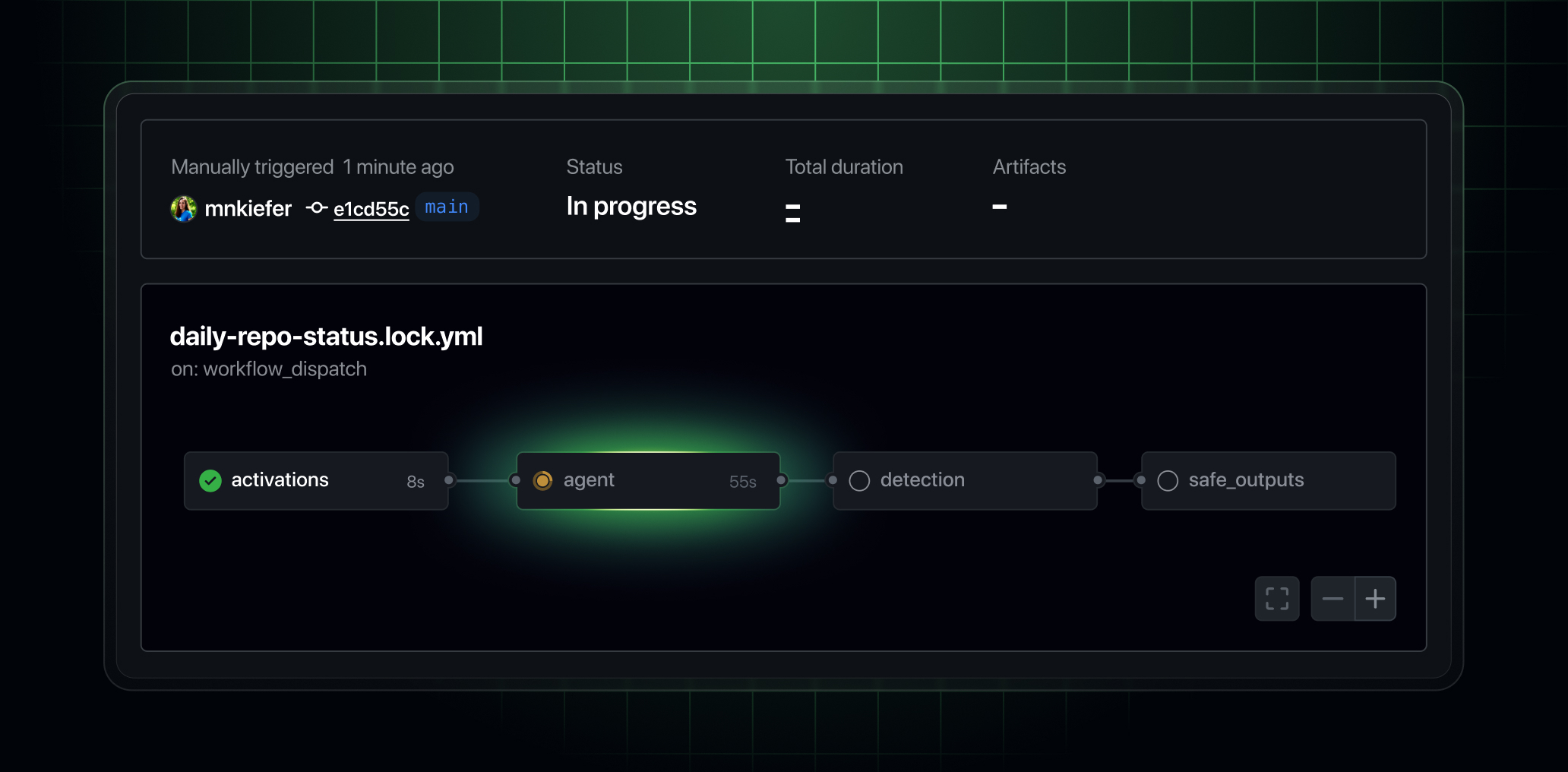
GitHub Agentic Workflows, the tool that lets developers write automation in plain Markdown instead of YAML, reached general availability on October 28, 2026. GitHub announced the move in its official changelog, timed with GitHub Universe 2026, roughly eight months after the project launched as a GitHub Next technical preview in February 2026. The general-availability release adds self-hosted runner support with Docker-in-Docker, graduates the `gh aw forecast` budgeting command out of experimental status, and tightens agent isolation with micro-VM execution and enclaves for workflows that span multiple repositories.
What is GitHub Agentic Workflows?
GitHub Agentic Workflows is an open source project, originally incubated by GitHub Next, that automates reasoning-heavy repository tasks such as issue triage, CI failure analysis, documentation updates, and test writing. Instead of hand-writing GitHub Actions YAML, a developer describes the task in a natural-language Markdown file. The companion gh aw CLI compiles that Markdown into a standard Actions workflow file, which then runs on GitHub's existing runner infrastructure like any other job.
Because the compiled output is ordinary GitHub Actions YAML, agentic workflows inherit a repository's existing runner groups, branch protections, and policy constraints rather than bypassing them. Each workflow can be powered by the default engine, GitHub Copilot CLI (which requires a Copilot license), or configured to run a developer's own coding agent instead.
General availability: what changed since preview
The project first shipped as a technical preview on February 13, 2026, when GitHub Next researchers Don Syme and Peli de Halleux introduced the Markdown-to-Actions compiler alongside read-only-by-default permissions and "safe outputs" for any write operation. The October 28 changelog post lists several capabilities that are new, or newly stable, at general availability:
| Area | Technical preview (Feb 2026) | General availability (Oct 2026) |
|---|---|---|
| Runners | GitHub-hosted Actions runners | Adds self-hosted Actions Runner Controller (ARC) runners with Docker-in-Docker support |
| Cost visibility | Not available | gh aw forecast graduates out of experimental status, with threat-detection credits and monthly ranges |
| Agent isolation | Sandboxed container execution | Adds micro-VM execution (Cloud Hypervisor or NVX) and enclaves for cross-repository workflows |
| Engines and templates | Copilot CLI or a configured coding agent | Refreshed model inventory, per-workflow provider choice, and new templates via gh aw add-wizard |
| Availability | Preview via the gh aw CLI extension | Generally available on github.com for GitHub Free, Team, and Enterprise |
How a Markdown workflow becomes an Actions job
Every agentic workflow file has two parts: YAML frontmatter that sets the trigger, permissions, available tools, and safe outputs, followed by Markdown instructions describing the goal in plain language. The typical setup, documented in the project's GitHub Pages site, is to install the CLI extension with gh extension install github/gh-aw, write or generate the Markdown file, run gh aw compile to produce a .lock.yml Actions file, and commit both files. Workflows can then trigger on a schedule, an issue event, or a manual dispatch, the same as any other Actions job.
This two-file structure is also what lets teams review agent behavior the way they review code: the Markdown states intent, the compiled YAML shows exactly what GitHub Actions will execute, and both are version-controlled artifacts in the repository.
Self-hosted ARC runners and Docker-in-Docker
At general availability, agentic workflows can run on self-hosted Actions Runner Controller (ARC) runners rather than only GitHub-hosted ones. GitHub's changelog specifies Docker-in-Docker support for these runners, which matters for workflows that need to build or test inside containers as part of an agent's task — for example, running a project's own test suite before proposing a fix, rather than relying on a mocked environment. Organizations that already run ARC for their regular CI workloads can point agentic workflows at the same self-hosted infrastructure instead of GitHub-hosted runners, which also keeps a repository's build tooling, caches, and network access consistent between a human-triggered CI run and an agent-triggered one.
gh aw forecast leaves experimental status
Running agents inside Actions consumes compute minutes and, with the default Copilot engine, premium Copilot requests — one for the agentic work itself and typically one more for the safe-outputs guardrail check. The gh aw forecast command, previously experimental, is now a supported part of the CLI. GitHub's changelog says it now accounts for threat-detection credits in addition to the underlying agent run, and reports monthly ranges rather than a single estimate, giving teams a clearer budgeting picture before they turn on a new workflow across a repository or organization.
Stronger agent isolation: micro-VMs and enclaves
Preview-era workflows already ran agents inside a sandboxed container by default, with read-only permissions and an allowlist of tools. General availability adds a stronger isolation option: agents can execute inside a Cloud Hypervisor or NVX micro-VM, and GitHub has added enclaves specifically to prevent data leaking between repositories in workflows that touch more than one repo. Combined with the project's existing Agent Workflow Firewall and a dedicated threat-detection job that scans proposed changes before they're applied, this isolation layer is aimed at organizations running agentic workflows across many repositories at once, where a single compromised or misbehaving workflow should not be able to affect another.
Common workflow patterns
GitHub's own materials describe agentic workflows as a way to extend continuous integration into reasoning-based tasks that CI pipelines traditionally couldn't handle on their own. GitHub Next's documentation and the February preview announcement group common use cases into recurring patterns:
- Continuous triage — summarizing, labeling, and routing new issues as they arrive.
- Continuous documentation — flagging or drafting documentation updates when code changes.
- Continuous code simplification and continuous test improvement — proposing cleanups or additional test coverage.
- Continuous quality hygiene — investigating CI failures and suggesting fixes.
- Continuous reporting — for example, a scheduled daily status workflow that opens an issue summarizing repository activity.
GitHub Next's documentation refers to the broader category of scheduled, repository-aware automation as "Continuous AI," and frames it as something that runs alongside existing CI/CD rather than replacing it — the compiled workflow still shows up as a normal Actions run in a repository's Actions tab, with the same logs and audit trail as any other job. Teams can mix named patterns like ChatOps (agents responding to chat-style commands in issues or PRs), DailyOps (scheduled daily jobs), IssueOps, ProjectOps, and MultiRepoOps (workflows that span more than one repository) depending on the trigger and scope they configure in a workflow's frontmatter.
What one early adopter reported
GitHub's general-availability changelog includes a customer account from Accenture. Ben Alton, a senior manager on Accenture's Strategy, Architecture and Innovation team, is quoted estimating that one team lead saved roughly 29 hours a week after adopting agentic workflows, and says the team's average velocity more than doubled while AI-authored commits reached 91% of the team's total. The same quote attributes a drop in production errors from about 11,000 a day to under 1,000. These figures come directly from GitHub's published customer quote rather than from an independent audit or a Pandromeda test, and GitHub does not say how "production errors" or "velocity" were measured, so they should be read as one organization's self-reported experience rather than a representative benchmark for every team adopting the feature.
Built-in safeguards that carry over from preview
Several guardrails introduced during the preview remain the backbone of the GA release:
- Agents run with read-only permissions by default; any write — such as opening a pull request or commenting on an issue — must go through a safe output, a pre-approved, reviewable GitHub operation.
- Agents follow an integrity filter that governs how they can read and act on GitHub content.
- Execution happens in a sandboxed container, and now optionally a micro-VM, behind the Agent Workflow Firewall.
- A dedicated threat-detection job scans all proposed changes before they're applied.
- Pull requests opened by an agentic workflow are never merged automatically — a human still has to review and approve them.
Plan availability and pricing
GitHub Agentic Workflows is generally available on github.com for GitHub Free, Team, and Enterprise plans. The feature itself doesn't carry a separate license fee, but using the default engine — GitHub Copilot CLI — requires an active Copilot license, and agent runs still consume standard GitHub Actions compute minutes plus, where applicable, Copilot premium requests. GitHub's documentation notes that with default settings, a single run of Copilot's engine typically costs two premium requests: one for the agentic work itself and a second for the safe-outputs guardrail check that validates whatever the agent proposes to change. Teams that configure a different coding agent as the engine should check that agent's own licensing and usage costs separately, and Enterprise customers can still apply their existing Actions runner-group and policy constraints to agentic workflows, since the compiled output is standard Actions YAML rather than a separate execution path.
Getting started
Developers who already piloted the technical preview can keep their existing .md workflow files; GitHub's changelog frames general availability as an expansion of runner, isolation, and tooling options rather than a breaking change to the workflow format. The basic setup, unchanged from preview, runs through the gh aw CLI extension:
- Install the extension with
gh extension install github/gh-aw. - Write a workflow's Markdown file, either by hand or with an interactive coding agent, describing the trigger, permissions, tools, and the task in natural language.
- Run
gh aw compileto generate the corresponding.lock.ymlActions file. - Commit both files, add any required secrets (such as an API key for a non-default engine), and push.
Once pushed, the workflow runs on GitHub Actions the same way any other job would — on a schedule, on an issue or pull request event, or on manual dispatch. For teams starting fresh, the project's own release notes and example workflows in the agentics repository cover common patterns such as scheduled issue triage, CI failure analysis, and documentation upkeep. As with any workflow running inside GitHub Actions, it's worth auditing the permissions and safe outputs a new agentic workflow requests before merging it, the same way a team would review any other CI change.
Agentic workflows sit alongside, rather than replace, other AI features GitHub has shipped into its developer tools this year, including the Copilot updates covered in GitHub Copilot's Fusion and Code Review additions. Teams evaluating where automation fits into their delivery pipeline may also find it useful to revisit the fundamentals in our plain-English DevOps explainer before turning on scheduled, repository-wide automation.
What's next
GitHub has not published a public roadmap beyond the general-availability changelog, so further additions — such as new engines, additional runner types, or expanded enclave coverage — are unconfirmed until GitHub posts about them directly. The project's documentation and release notes remain the primary channels GitHub uses to announce changes, and the #agentic-workflows channel on the GitHub Next Discord, along with a pinned GitHub Community discussion, are where GitHub has been collecting developer feedback since the preview launched.
Frequently asked questions
When did GitHub Agentic Workflows become generally available?
GitHub Agentic Workflows reached general availability on October 28, 2026, announced in GitHub's official changelog alongside GitHub Universe 2026. It had been in technical preview since February 13, 2026.
What is GitHub Agentic Workflows?
It's an open source project, originally from GitHub Next, that lets developers describe repository automation (issue triage, CI failure analysis, documentation updates, test writing) in plain Markdown files. The gh aw CLI compiles that Markdown into standard GitHub Actions YAML, which then runs as a normal Actions job.
Which GitHub plans include it?
GitHub Agentic Workflows is generally available on github.com for GitHub Free, Team, and Enterprise plans. Using the default GitHub Copilot CLI engine additionally requires an active Copilot license.
What's new at general availability that wasn't in the preview?
GA adds self-hosted Actions Runner Controller (ARC) runner support with Docker-in-Docker, graduates the gh aw forecast budgeting command out of experimental status, and adds stronger agent isolation through micro-VM execution and enclaves for workflows spanning multiple repositories.
Can I use a coding agent other than GitHub Copilot?
Yes. Each workflow can be configured to run GitHub Copilot CLI, the default engine, or a developer's own coding agent instead, according to GitHub's changelog and documentation.
What stops an agentic workflow from making unreviewed changes?
Agents run with read-only permissions by default. Any write operation must go through a pre-approved 'safe output,' a dedicated threat-detection job scans proposed changes before they're applied, and pull requests opened by a workflow are never merged automatically.
Sources
- GitHub Changelog: GitHub Agentic Workflows are now generally available (Oct 28, 2026)github.blog
- GitHub Blog: Automate repository tasks with GitHub Agentic Workflows (technical preview, Feb 13, 2026)github.blog
- GitHub Changelog: GitHub Agentic Workflows are now in technical preview (Feb 13, 2026)github.blog
- gh-aw documentation (GitHub Next)github.github.com
- gh-aw architecture: Agent Workflow Firewallgithub.github.com
- github/gh-aw releasesgithub.com
Felix Moreau writes Pandromeda's software coverage and how-to guides. He covers Windows, macOS and Linux updates, the apps people rely on, emulators and developer tools, and turns official documentation into clear, numbered steps that work on the current version.