ExpressVPN Keys vs 1Password: Price and Features Compared
ExpressVPN folded its password manager into a standalone app called ExpressKeys. Here's how its pricing, passkeys, and audits stack up against 1Password.
ExpressVPN's password manager is best for people who already pay for ExpressVPN's VPN and want one extra tool bundled in; 1Password is the better pick for anyone who wants a dedicated, mature password manager with the widest platform support and the most proven family and business tiers.
- ExpressVPN's password manager started in 2023 as a built-in feature called "Keys," then split into a standalone app called ExpressKeys in February 2026, with the in-app version retired on March 5, 2026.
- ExpressKeys is included free with ExpressVPN's Advanced (from $3.99/mo) and Express Pro (from $6.99/mo) plans, or available as its own subscription whose standalone price ExpressVPN does not publish.
- 1Password's Individual plan starts at $2.99/mo and Families at $4.49/mo (both billed annually, current promotional rates), with Teams Starter Pack at $24.95/mo for 10 members and Business at $8.99 per user/mo.
- Both companies cite independent audits: ExpressVPN points to Cure53 reviews of ExpressKeys (most recently July 2026), and 1Password has long published its own third-party security assessments.
What is ExpressVPN Keys / ExpressKeys?
ExpressVPN first added a password manager called "Keys" directly inside its VPN app, announcing a full rollout to all users in November 2023 after an earlier beta. It was built in and required no separate app or subscription at the time, and ExpressVPN said it had the independent firm Cure53 audit the iOS and Android apps and the Chrome extension as part of that launch.
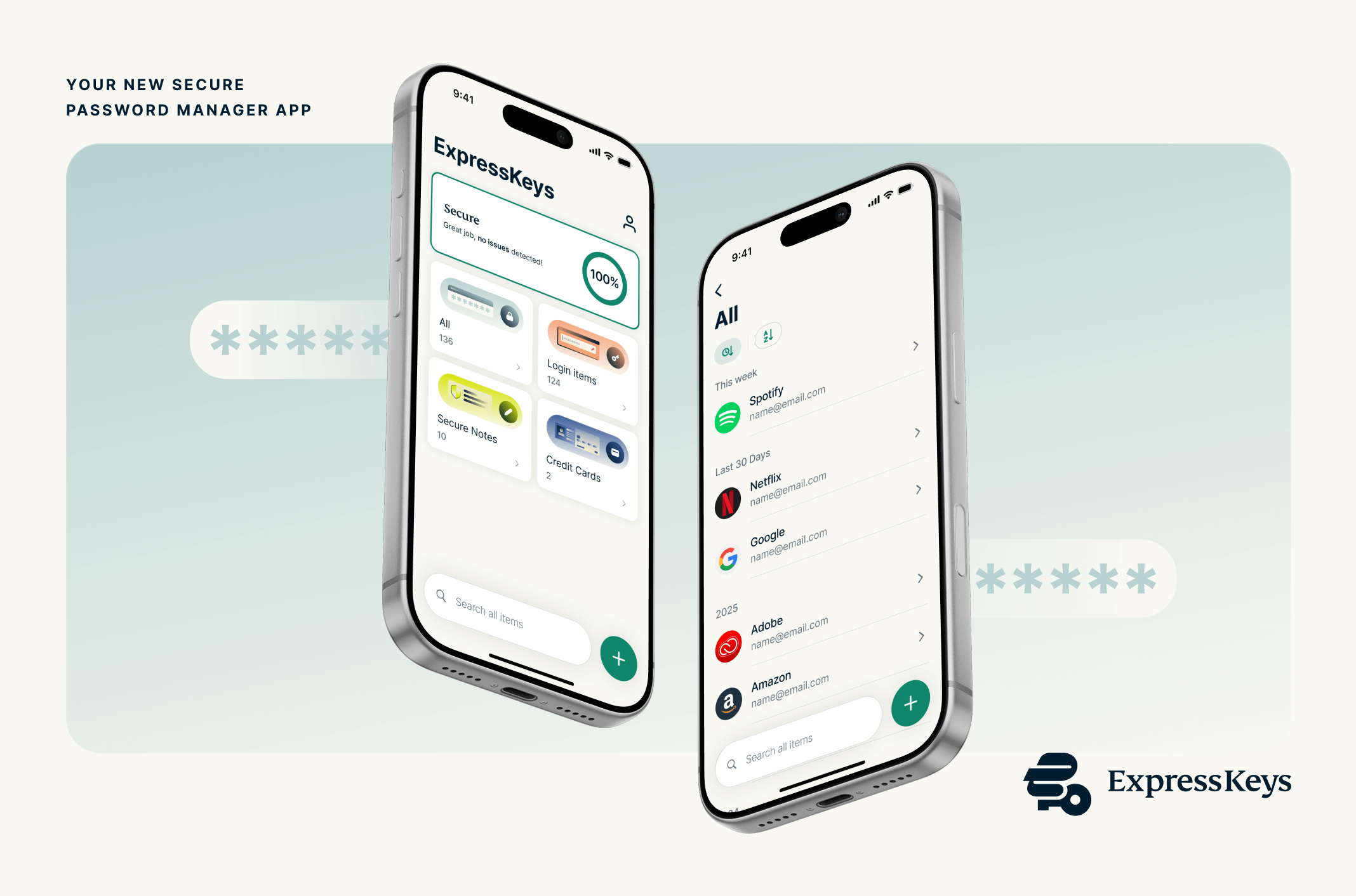
In February 2026, ExpressVPN relaunched the feature as ExpressKeys, a standalone password manager app for iOS and Android (plus browser extensions), separate from the main VPN app. ExpressVPN's own announcement says the split lets the password manager "develop faster" while the VPN app stays focused on connection protection, and that the mobile VPN apps kept the integrated password manager only temporarily to support migration. According to ExpressVPN's ExpressKeys product page, the app now covers Android, iOS, and macOS, plus browser extensions for Chrome, Edge, Brave, and Firefox, and stores "unlimited passwords, passkeys, cards, and notes in one secure vault." Existing Keys users are signed in automatically with their ExpressVPN account, and their saved items carry over.
What is 1Password?
1Password is a standalone, commercial password manager with no bundled VPN. It sells directly to individuals, families, teams, and large businesses through its own personal pricing page and business pricing page, and it is one of the most established names in the category, distinct from newer entrants like ExpressVPN's password tool. It is also one of several password managers Pandromeda has compared head-to-head, including in our 1Password vs NordPass comparison.
Platforms and apps supported
ExpressKeys currently covers Android, iOS, macOS, and browser extensions for Chrome, Edge, Brave, and Firefox, per ExpressVPN's product page. There's a notable gap: the macOS app cannot create or sign in with passkeys (it can only view saved ones), and it has no autofill of its own — ExpressVPN tells macOS users to rely on the browser extension instead. There is currently no native Windows or Linux desktop app for ExpressKeys; Windows users are limited to the browser extension.
1Password's platform coverage is broader on desktop: native apps exist for Windows, Mac, and Linux, alongside iOS and Android apps and browser extensions for Chrome, Safari, Firefox, Brave, and Edge. For anyone who regularly works across a Windows PC, a Mac, and a phone, that wider desktop coverage is a practical difference, not just a feature-list one.
Pricing compared: ExpressVPN Keys vs 1Password
Pricing is where the two products diverge most. ExpressKeys isn't really sold on its own at a published price — it's a perk tucked into two of ExpressVPN's three VPN pricing tiers — while 1Password is priced purely as a password manager, with tiers built around how many people need access.
| Plan | Price | Password manager included? | Notes |
|---|---|---|---|
| ExpressVPN Basic | From $2.79/mo (2-yr intro), renews at $99.95/yr | No | VPN only; ExpressKeys is not available on this tier |
| ExpressVPN Advanced | From $3.99/mo (2-yr intro), renews at $119.95/yr | Yes | Includes ExpressKeys with 5GB of file-attachment storage |
| ExpressVPN Express Pro | From $6.99/mo (2-yr intro), renews at $199.95/yr | Yes | Includes ExpressKeys with 10GB of attachment storage, plus other suite tools |
| ExpressKeys standalone | Not published by ExpressVPN | Yes (free trial offered) | Can be bought without the VPN, but ExpressVPN does not list a price for it |
| 1Password Individual | $2.99/mo billed annually (promotional; list price $3.99/mo) | Yes — this is the product | 1 user, unlimited devices |
| 1Password Families | $4.49/mo billed annually (promotional; list price $5.99/mo) | Yes | Up to 5 people, shared vaults, admin recovery |
| 1Password Teams Starter Pack | $24.95/mo billed annually | Yes | 10 members included ($2.49/user); extra seats $4.99/mo each |
| 1Password Business | $8.99 per user/mo billed annually | Yes | Adds SSO integrations (Okta, Entra ID), Watchtower alerts, advanced permissions |
Two honesty notes on pricing. First, ExpressVPN's listed per-month rates are long-term introductory offers tied to a roughly 28-month first term; the renewal prices above are what ExpressVPN itself lists for after that term. Second, 1Password's $2.99 and $4.49 figures are the current promotional rates shown on 1Password's own pricing page; its list prices are $3.99 and $5.99 per month respectively, and 1Password has publicly stated consumer-plan prices were set to rise. Always check each company's live pricing page before buying, since both run frequent seasonal discounts (ExpressVPN's own page, for instance, currently advertises a Black Friday promotion).
Passkeys, autofill, and secure sharing
Both tools now support passkeys, but 1Password got there first and supports more surfaces. 1Password lets you view, create, move, and share passkeys from its desktop and mobile apps. ExpressVPN added "full passkey support" to ExpressKeys in a July 2026 update, letting users generate, store, and manage passkeys inside the app — though its macOS app still can't create or use passkeys directly.
Autofill works similarly in both: one-click filling of logins and card details, with domain-matching checks that ExpressVPN says help prevent phishing by only offering saved credentials on the matching site. Secure sharing is also now present in both products. ExpressVPN's July 2026 update added the ability to share individual logins, cards, or notes via links with configurable expiry (from 1 hour to 30 days), optional email verification, and one-time viewing. 1Password has offered secure, permissioned sharing of vault items for considerably longer, and extends it to file attachments as well.
Breach monitoring and two-factor authentication
Both products flag weak, reused, and exposed passwords. ExpressVPN calls this "Password Health" and says it checks for exposed credentials and personal information turning up in data breaches. 1Password's equivalent, Watchtower, flags weak or compromised logins, surfaces accounts that could be upgraded to a passkey, and checks whether a site supports a more secure connection.
Both also include a built-in authenticator: ExpressKeys generates six-digit TOTP codes for two-factor-enabled accounts, and 1Password does the same, so either tool can replace a separate authenticator app for most sites. Neither company's own pages position this as a full dark-web monitoring service beyond credential-breach checks, so anyone wanting broader identity monitoring should treat this as a password-health feature rather than a complete identity-protection product.
Security audits: Cure53 and beyond
ExpressVPN has repeatedly commissioned the independent security firm Cure53 to review its password manager. Cure53 reviewed the original Keys feature inside the iOS and Android apps and the Chrome extension around the 2023 launch, and returned for a newer white-box review of the ExpressKeys apps tied to the July 2026 feature update — a 16-day test with five testers and full source-code access that found no High or Critical severity issues, after which ExpressVPN says it fixed the issues Cure53 raised and had them retested. ExpressVPN's press materials say that report brought its total published independent audit count to 28, a figure it attributes to itself rather than an outside tally.
1Password similarly commissions and publishes independent security assessments of its apps and infrastructure, and its vault architecture — encryption keys generated on-device, with the account password never leaving the device — is a longer-standing, more extensively documented design than ExpressKeys', which only recently moved out of a VPN add-on and into a dedicated app.
The ExpressKeys migration and subscription details
Anyone still using the old in-app "Keys" feature inside the ExpressVPN app needs to know the cutoff: ExpressVPN's own announcement states that after March 5, 2026, password management in the mobile VPN apps ends, and it continues only inside the dedicated ExpressKeys app. Existing users don't need to re-enter their vault — logging into ExpressKeys with an ExpressVPN account carries passwords, cards, and notes over automatically.
On ongoing access, ExpressVPN's own ExpressKeys page states that an active subscription is required to set up the password manager, and that afterward you retain read-only access to your saved vault items — worth knowing before relying on it as a permanent free-standing vault if a VPN subscription later lapses. 1Password, by contrast, is sold and licensed purely as a password manager, so subscription status there maps directly and only to password-manager access, not to a bundled VPN plan.
Which to choose: verdicts for different users
You already pay for ExpressVPN Advanced or Express Pro: ExpressKeys is already included at no extra cost, covers the basics (passwords, passkeys, cards, notes, 2FA codes, secure sharing), and is one less subscription to manage. Just note the lack of a Windows/Linux desktop app and the audit history is shorter than 1Password's.
You want a dedicated, platform-agnostic password manager: 1Password is the stronger choice. It has native apps on more desktop platforms, a longer track record of third-party audits, and Individual pricing ($2.99/mo promotional) that's competitive even against ExpressVPN's bundled VPN-plus-password-manager tiers.
You need a family or business plan: 1Password again has the more mature offering — Families covers up to 5 people with admin recovery tools, and Teams Starter Pack/Business plans add role-based permissions and identity-provider integrations (Okta, Entra ID) that ExpressKeys does not publish an equivalent for.
You're only shopping for a VPN and password management is secondary: Compare ExpressVPN's own VPN tier against competitors first — our Surfshark vs ExpressVPN comparison covers that side of the decision — and treat ExpressKeys as a bonus rather than the deciding factor.
Frequently asked questions
Is ExpressVPN Keys the same thing as ExpressKeys? Yes. "Keys" was the original built-in feature name; "ExpressKeys" is the current standalone app that replaced it in February 2026.
Can I still use the password manager inside the ExpressVPN app? No, not for new passwords — ExpressVPN says password management moved exclusively to the ExpressKeys app after March 5, 2026.
Does ExpressKeys support passkeys now? Yes, as of a July 2026 update, though its macOS app still can't create or use passkeys directly; the browser extension and mobile apps can.
Which is cheaper, ExpressKeys or 1Password? It depends on what you're comparing. 1Password Individual (from $2.99/mo) is cheaper than ExpressVPN's Advanced plan ($3.99/mo) if you only want a password manager and don't need a VPN. But if you already want ExpressVPN's VPN anyway, ExpressKeys comes at no extra cost on Advanced or Express Pro.
Has either product's security been independently verified? Both companies say yes. ExpressVPN points to repeated Cure53 audits of ExpressKeys, most recently in mid-2026. 1Password also commissions and publishes independent security reviews of its apps and infrastructure.
What's next
Watch two things going forward: whether ExpressVPN starts publishing a standalone ExpressKeys price (rather than bundling it only inside VPN tiers), and whether it adds native Windows and Linux apps to close the platform gap with 1Password. On the 1Password side, expect its previously announced consumer price increases to show up on renewal invoices, and expect continued expansion of passkey support across more of its apps. Anyone choosing between the two today should check each company's live pricing page before buying, since both run frequent promotional pricing that can change the comparison month to month. For more background on how password managers work in general, see our explainer on what a password manager is and whether you need one.
Frequently asked questions
Is ExpressVPN Keys the same thing as ExpressKeys?
Yes. "Keys" was the original built-in feature name inside the ExpressVPN app; "ExpressKeys" is the current standalone app that replaced it in February 2026.
Can I still use the password manager inside the ExpressVPN app?
No, not for new passwords. ExpressVPN says password management moved exclusively to the ExpressKeys app after March 5, 2026.
Does ExpressKeys support passkeys now?
Yes, as of a July 2026 update, though its macOS app still can't create or use passkeys directly; the browser extension and mobile apps can.
Which is cheaper, ExpressKeys or 1Password?
1Password Individual (from $2.99/mo) is cheaper than ExpressVPN's Advanced plan ($3.99/mo) if you only want a password manager. If you already want ExpressVPN's VPN anyway, ExpressKeys comes at no extra cost on Advanced or Express Pro.
Has either product's security been independently verified?
Both companies say yes. ExpressVPN points to repeated Cure53 audits of ExpressKeys, most recently in mid-2026. 1Password also commissions and publishes independent security reviews of its apps and infrastructure.
Does 1Password offer a free trial?
Yes. 1Password's Individual, Families, Teams Starter Pack, and Business plans each come with a 14-day free trial, according to 1Password's own pricing pages.
Sources
- ExpressVPN — ExpressKeys product pageexpressvpn.com
- ExpressVPN — ExpressKeys standalone app launch (Feb 2026)expressvpn.com
- ExpressVPN — Cure53 audit and feature update (Jul 2026)expressvpn.com
- ExpressVPN — VPN pricing plansexpressvpn.com
- 1Password — Individual and Families pricing1password.com
- 1Password — Teams Starter Pack and Business pricing1password.com
Sana Qureshi runs the security and privacy desk. She reports on actively exploited vulnerabilities, vendor patches and data breaches, and covers the password managers, VPNs and authentication tools readers use to protect themselves. Her alerts cite vendor advisories, CISA and the CVE record directly.