F5 BIG-IP vs Citrix NetScaler: Features, Pricing and Which to Choose
Both vendors call the other the weaker, costlier choice. Here is what F5 and Citrix actually claim about each other's NetScaler and BIG-IP platforms.
Both companies publish head-to-head pages arguing their application delivery controller (ADC) is the better choice, and both pages are marketing material rather than independent benchmarks. Citrix's NetScaler comparison page cites a vendor-commissioned IDC study claiming a 387% three-year ROI over F5; F5's NetScaler comparison page counters that NetScaler is "optimized primarily for traditional HTTP and VDI traffic" and weaker on bursty modern workloads. Neither vendor publishes a shared, independently verified benchmark against the other, so the honest answer to "which ADC is better" depends on what each company actually says it does differently — not whose marketing page you read first. Here's what each platform claims on deployment, security and pricing, and where the two actually diverge.
The essentials:
- Deployment: NetScaler positions itself as software-first across on-premises, hybrid and multi-cloud, with hardware consolidation via Citrix Networking SDX. F5 BIG-IP deploys as hardware (with FPGA acceleration), Virtual Edition software, a Kubernetes-native Cloud-Native Edition, or on NVIDIA BlueField DPUs.
- Security: Both bundle a WAF, bot mitigation and API protection into their ADC platform rather than selling it as a fully separate product.
- Licensing: F5 says Citrix has gone "subscription-first/subscription-only" for new purchases since 2023 with cloud-connected license activation. F5 itself offers perpetual licensing (GBB), subscriptions, and a Flex Consumption Program.
- Reviewer signal: On G2, reviewers rate NetScaler's ease of setup at 8.3 versus 7.6 for F5 Advanced WAF. On Gartner Peer Insights, both WAF products sit at 4.5 stars (249 reviews for F5, 250 for NetScaler).
- Vendor-reported outcomes (unverified by either side): Citrix cites an IDC-sourced 387% three-year ROI and $434,300 in average annual savings for NetScaler customers. F5 cites a single anonymous customer case study reporting an 80% smaller hardware footprint and 2.4x rated throughput after moving to F5 rSeries.
Deployment models: hardware-first vs software-first
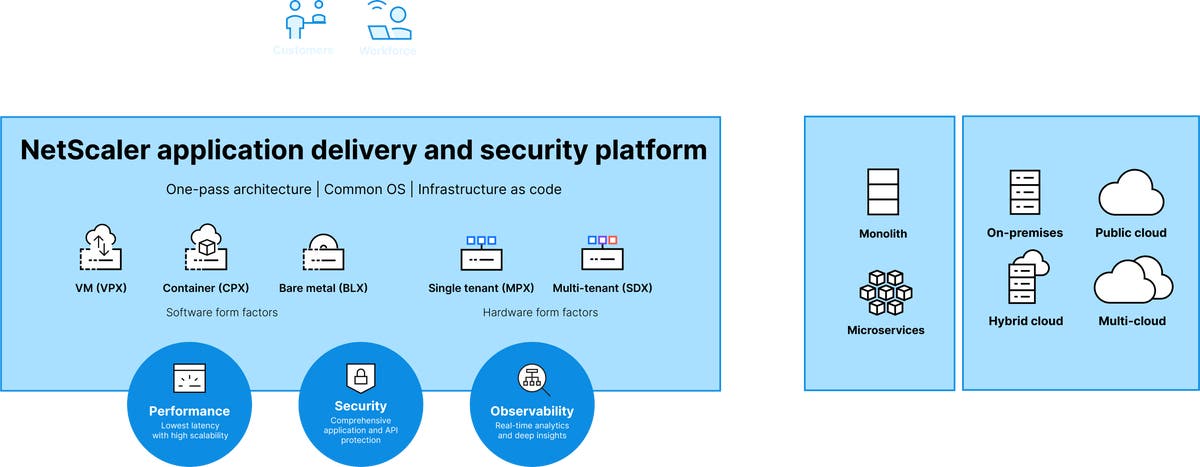
The two platforms frame themselves differently from the ground up. NetScaler's own platform page describes it as "the only application delivery and security platform where you can manage all of your ADC operations in one place," built around a single management plane spanning hybrid, on-premises and multi-cloud environments, including cloud-native workloads, with support for AWS, Azure, Google Cloud, IBM Cloud and Oracle Cloud Infrastructure, plus Kubernetes, OpenShift, EKS, AKS, GKE and Rancher. Citrix's comparison page pitches NetScaler as software-first, with the Citrix Networking SDX appliance used to consolidate multiple ADC instances onto shared hardware.
F5 BIG-IP, by contrast, explicitly supports more deployment shapes: physical hardware using FPGA acceleration for high throughput and low latency, a Virtual Edition for public cloud, private cloud and virtualized environments, a Cloud-Native Edition (CNE) that runs natively in Kubernetes, and a newer option that runs BIG-IP services on NVIDIA BlueField DPUs. F5's own comparison page leans into this, telling customers it supports fully disconnected, air-gapped environments with customer-controlled licensing, telemetry and lifecycle operations — and argues that Citrix, while it also supports air-gapped deployments, still depends on a cloud-connected License Activation Service tied to a Citrix Cloud account.
Security features: WAF, bots and API protection
Both vendors build their web application firewall into the core ADC rather than treating it as a bolt-on. NetScaler's platform page describes a "one-pass architecture" where WAF inspection happens alongside other ADC functions in the same request pass, which it says reduces per-request latency, plus DNS-layer DDoS defense it claims can absorb up to one million requests per second at the edge. F5's BIG-IP page describes its WAF as protecting against zero-day vulnerabilities, application-layer denial-of-service, threat campaigns, application takeover and malicious bots, backed by a separate Advanced Firewall Manager for network-layer DDoS and an SSL Orchestrator for policy-based decryption and traffic steering through inspection devices.
On its own comparison page, F5 goes further and characterizes NetScaler's security approach as "module-based, signature-driven" and requiring heavy manual updates, versus what it calls its own "AI-driven WAF" with automated API discovery and bot defense. That's F5's framing of its competitor, not an independent assessment — Citrix's comparison page makes no equivalent claim about F5's security architecture one way or the other, so treat this specific contrast as one vendor's sales pitch rather than a settled fact.
Licensing and pricing model
Neither company publishes list prices on its comparison page, but the licensing philosophy differs in ways that matter for budgeting. F5's page states that Citrix moved to a subscription-first (and, for new purchases, subscription-only) licensing model starting in 2023, while continuing to support existing perpetual-license customers, and recommends checking what happens to critical NetScaler services if its cloud-based License Activation Service becomes unreachable. F5 itself advertises three options: traditional perpetual licensing under what it calls GBB, term subscriptions, and a Flex Consumption Program pitched as "predictable spend" with one agreement covering annual usage rather than per-product true-ups. F5's page also acknowledges, in its own words, that its products "can be more expensive and hardware-heavy" and that final pricing depends on performance tier, feature set and support level — a rare moment of a vendor comparison page conceding a weakness rather than only attacking the competitor.
Citrix's own comparison page takes the opposite tack on cost: it argues that organizations running both platforms end up paying for duplicate ADC functionality, and that consolidating onto NetScaler avoids that overlap, especially for customers who already hold a broader Citrix agreement. It frames F5 as "hardware-centric and hardware-heavy," which it says adds cost and slows modernization — the mirror image of how F5 characterizes NetScaler's security model above.
Migration tooling and iRules
If you're currently on one platform and considering a move, Citrix's comparison page specifically advertises dedicated tooling to convert F5 iRules — F5's proprietary scripting language for customizing traffic behavior — into NetScaler policies, alongside Citrix professional services to support the migration. The same page cites a TechValidate survey in which 31% of companies that migrated away from F5 named technical challenges with F5 as their reason for switching. F5, for its part, treats iRules as a selling point rather than a liability: its own comparison page lists "programmability" via iRules as one of its core advantages over what it calls NetScaler's "less dynamic programmability." Whether iRules is a migration headache or a flexibility advantage depends entirely on whether you're the one leaving F5 or the one being pitched to join it.
What independent reviewers say
Outside each vendor's own marketing, third-party review aggregators offer a partial, if imperfect, independent signal. On G2, reviewers score NetScaler's ease of setup at 8.3 out of 10 versus 7.6 for F5 BIG-IP Advanced WAF. On Gartner Peer Insights, the two WAF products land at an identical 4.5-star average, with 250 reviews for NetScaler and 249 for F5. Reviewers on TrustRadius are split in the other direction on management complexity: one user reports F5 is easier to manage with better health-monitoring capabilities, while another describes NetScaler as having more features than F5's access-management product and a friendlier interface for network administrators. None of these aggregator scores amount to a controlled performance benchmark, but they're a useful counterweight to the vendors' own comparison pages, which naturally favor whichever product is publishing them. Gartner Peer Insights and G2 both let reviewers self-identify their organization size and industry, so a healthcare enterprise evaluating either platform may still want to filter reviews down to similarly regulated, similarly sized deployments rather than relying on the aggregate score alone.
Kubernetes ingress and AI data delivery
F5's comparison page notes that both vendors support Kubernetes ingress for north-south traffic, but argues F5 offers more distinct approaches to it — BIG-IP itself, the NGINX product line, and F5 Distributed Cloud — versus a single NetScaler path. NetScaler's own platform page confirms broad orchestrator support across Kubernetes, Red Hat OpenShift, Amazon EKS, Azure AKS, Google GKE, Rancher and Pivotal Container Service, plus infrastructure-as-code integration with Terraform and Ansible and observability hooks into Splunk and Prometheus, so the ingress gap F5 describes is more about breadth of named products than a missing capability.
One narrower but specific claim is worth flagging because it's unusually concrete for a vendor comparison page: F5 says it offers native S3 object-storage support for AI data delivery workloads, while characterizing NetScaler's equivalent capability as requiring "custom Python scripting" to act as an S3 proxy — something F5 calls a bottleneck at scale. Citrix's own comparison page doesn't address AI data delivery or S3 compatibility at all, so there's no NetScaler-side rebuttal to weigh this against; if AI training or inference data pipelines are part of your evaluation, this is a question worth putting directly to both vendors' sales engineering teams rather than taking either page's framing at face value.
NetScaler vs F5 BIG-IP at a glance
| Area | Citrix NetScaler | F5 BIG-IP |
|---|---|---|
| Deployment shapes | Software-first; on-prem, hybrid, multi-cloud; SDX for hardware consolidation | Hardware (FPGA), Virtual Edition, Cloud-Native Edition (Kubernetes), NVIDIA BlueField DPU |
| WAF architecture | One-pass inspection alongside other ADC functions | Dedicated WAF plus separate Advanced Firewall Manager and SSL Orchestrator |
| DDoS claim | Edge DNS resolution up to 1M requests/sec (vendor-stated) | DDoS Hybrid Defender for inline, out-of-band and hybrid deployments |
| Licensing model | Subscription-first/subscription-only for new purchases since 2023 (per F5) | Perpetual (GBB), subscription, Flex Consumption Program |
| Air-gapped support | Supported, but relies on cloud-based License Activation Service (per F5) | Customer-controlled licensing, telemetry and lifecycle in disconnected environments (per F5) |
| Migration tooling | Dedicated iRules-to-NetScaler conversion tools and professional services | iRules positioned as a programmability advantage |
| G2 ease-of-setup score | 8.3 / 10 | 7.6 / 10 |
| Gartner Peer Insights | 4.5 stars (250 reviews) | 4.5 stars (249 reviews) |
Which one should you choose
If your organization is already standardized on Citrix for virtual desktops or application delivery, NetScaler's tighter integration with that ecosystem and its dedicated iRules migration path make consolidation the path of least resistance, and the G2 ease-of-setup edge is worth something if your team is smaller or less specialized. If you need the widest range of deployment shapes — including Kubernetes-native ingress, DPU-based acceleration, or guaranteed air-gapped operation without any cloud dependency for licensing — F5's broader platform lineup and flexible licensing options (particularly the Flex Consumption Program) are built specifically for that flexibility. Neither vendor's own ROI or performance numbers should be treated as a substitute for testing your actual traffic patterns against both platforms; the TechValidate and IDC figures cited above come from vendor-selected customers and vendor-commissioned studies; they're informative, not independent proof of which platform performs better for your workload. Organizations with heavy container or Kubernetes investment and no existing Citrix footprint may lean toward F5 simply because it names more explicit Kubernetes-native products; organizations already paying for Citrix Virtual Apps and Desktops or Citrix Cloud licensing will usually find NetScaler's bundled pricing harder to walk away from, independent of either platform's raw technical merit.
What to do next
Request a proof-of-concept deployment from both vendors against your own traffic profile before committing, since neither comparison page includes a shared, independently audited benchmark. If you're evaluating broader network security appliances at the same time, our pfSense vs OPNsense firewall comparison covers the same kind of vendor-claim-versus-independent-review evaluation for open-source alternatives, and our Synology DSM vs QNAP QTS comparison applies a similar framework to NAS security postures.
Frequently asked questions
Is Citrix NetScaler cheaper than F5 BIG-IP?
Citrix's own comparison page argues NetScaler avoids duplicate ADC costs and cites vendor-commissioned IDC figures of a 387% three-year ROI and $434,300 in average annual savings. F5's page counters that its own flexible licensing (perpetual, subscription, or Flex Consumption) can be cost-competitive, while acknowledging its products can be more expensive and hardware-heavy. Neither publishes list prices, so get quotes for your specific deployment.
Which is easier to set up, NetScaler or F5 BIG-IP?
On G2, reviewers rate NetScaler's ease of setup at 8.3 out of 10 versus 7.6 for F5 BIG-IP Advanced WAF. On Gartner Peer Insights, both WAF products are rated 4.5 stars, so the independent signal is closer than G2's number alone suggests.
Can I migrate my F5 iRules configuration to NetScaler?
Citrix advertises dedicated tooling to convert F5 iRules into NetScaler policies, backed by Citrix professional services. F5, unsurprisingly, frames iRules as a programmability advantage of staying on its platform rather than something you need to migrate away from.
Does F5 BIG-IP support Kubernetes?
Yes, through BIG-IP Next for Kubernetes and a Cloud-Native Edition (CNE) built for Kubernetes environments, plus the separate NGINX product line and F5 Distributed Cloud. NetScaler also supports Kubernetes, OpenShift, EKS, AKS, GKE and Rancher through its own platform.
Are the ROI and performance numbers both vendors cite trustworthy?
Treat them as vendor-reported, not independently audited. Citrix's 387% ROI figure traces to an IDC white paper it commissioned, and F5's 80% footprint reduction and 2.4x throughput figures come from a single anonymous customer case study — neither is a controlled, third-party benchmark against the competing platform.
Sources
- Citrix: NetScaler vs F5 comparisoncitrix.com
- F5: Citrix NetScaler comparisonf5.com
- NetScaler: Application delivery and security platformnetscaler.com
- F5: BIG-IP application delivery and security servicesf5.com
- G2: F5 BIG-IP Advanced WAF vs NetScalerg2.com
- Gartner Peer Insights: NetScaler vs F5 BIG-IP Advanced WAFgartner.com
Sana Qureshi runs the security and privacy desk. She reports on actively exploited vulnerabilities, vendor patches and data breaches, and covers the password managers, VPNs and authentication tools readers use to protect themselves. Her alerts cite vendor advisories, CISA and the CVE record directly.