Galaxy Ring Sleep Apnea Detection: Release Date and How It Works
Samsung's graded Sleep Apnea detection is rolling out to the Galaxy Ring, Watch9 and Watch Ultra2, after separate clearances from the US FDA and Korea's MFDS.
Samsung's upgraded Sleep Apnea detection feature is rolling out this month to the Galaxy Ring, Galaxy Watch9 and Galaxy Watch Ultra2, after the company secured a fresh U.S. FDA clearance in July 2026 and approval from South Korea's Ministry of Food and Drug Safety (MFDS) in late October. The update moves beyond a simple risk flag: it now grades how many breathing disruptions per hour the device detected across a two-night monitoring window, giving wearers a clearer picture of severity before they talk to a doctor. Samsung says the rollout starts in Korea this November, with the company describing the Galaxy Ring as the first over-the-counter smart ring to offer sleep apnea risk detection.
- What's new: The Samsung Health Monitor app now shows "breathing disruptions per hour" instead of a basic risk flag.
- Devices: Galaxy Ring and Galaxy Watch9 (Wear OS 7.0+) support the update now; Galaxy Watch Ultra2 is named in Samsung's rollout; Galaxy Watch7 and Watch8 support is "coming through future software updates."
- Regulatory approvals: U.S. FDA clearance (July 2026) and Korea MFDS approval (October 2026), building on the original FDA De Novo authorization from February 2024.
- Rollout: Begins in South Korea in November 2026; Samsung says it plans to expand availability to more countries, without giving further dates.
- Requirement: Two valid nights of sleep data within a 10-day window, tracked through the Samsung Health Monitor app.
What Samsung announced
Samsung confirmed the update in a Samsung Newsroom post published November 3, 2026, titled "Upgraded Sleep Apnea Feature Now Available on Galaxy Ring Following Regulatory Approvals From US FDA and Korea MFDS." The post says the enhanced version of the feature, delivered through the Samsung Health Monitor app, received FDA clearance in July and MFDS approval in October, clearing the way for a broader rollout that now includes the Galaxy Ring alongside Samsung's smartwatches.
Jongmin Choi, Head of the Health R&D Group in Samsung's Mobile eXperience (MX) Business, framed the update as part of a longer-running push into sleep tracking: "Samsung has long worked to make sleep health a simple and seamless part of everyday life," he said, adding that the MFDS approval "along with our introduction of the world's first support for a smart ring, reflects our commitment to accessible innovation."
What's actually new in the upgraded feature
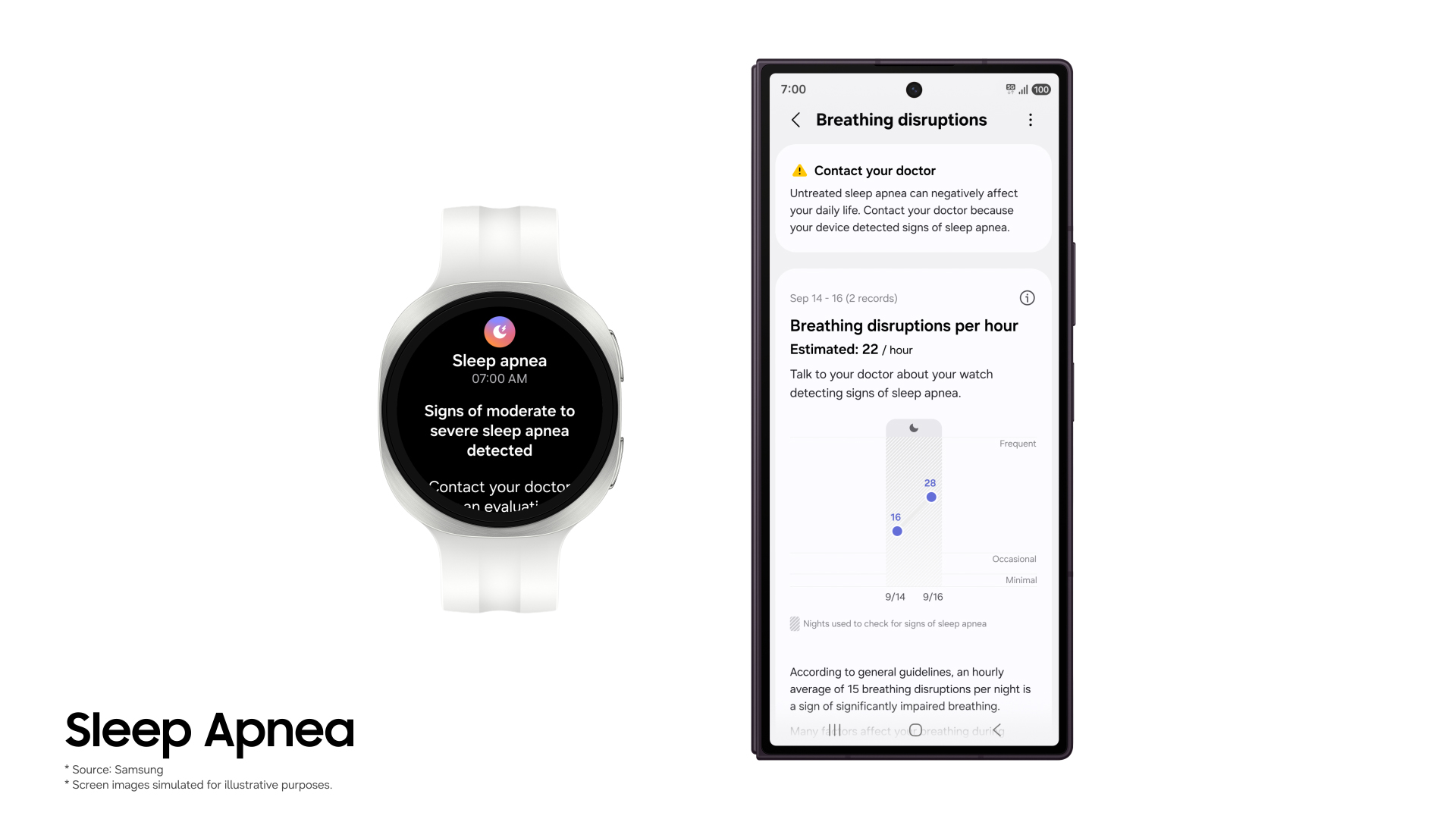
The original Sleep Apnea feature, cleared by the FDA back in February 2024, worked as a binary screening tool: after two nights of monitoring, it told users whether it had detected "signs of moderate to severe sleep apnea," full stop. The upgraded version keeps that same core detection but adds a graded output. According to Samsung, the Health Monitor app now displays an estimated number of "breathing disruptions per hour," charted night to night, so a user can see whether their readings sit closer to occasional or frequent disruption rather than just getting a single pass/fail-style alert.
Samsung's own promotional material for the update shows a sample reading of 22 disruptions per hour, with the app noting that, "according to general guidelines, an hourly average of 15 breathing disruptions per night is a sign of significantly impaired breathing." That extra context is meant to help people gauge urgency before booking a doctor's visit, though Samsung is careful to frame the whole feature as a pre-diagnosis screening tool, not a diagnosis itself.
The feature still requires two nights of valid data, collected within a 10-day window, and it's aimed at adults who have not already been diagnosed with sleep apnea. Samsung's official Instructions for Use document for the feature spells out the same limitation that applied to the original version: it's an over-the-counter, software-only medical app, it isn't a substitute for polysomnography or a clinician's diagnosis, and it isn't intended for continuous use as an apnea monitor.
Which devices support it
Three products are named in Samsung's rollout:
- Galaxy Ring — now supported, and positioned by Samsung as the first smart ring on the market with sleep apnea risk detection.
- Galaxy Watch9 — supported, provided the watch is running Wear OS 7.0 or later.
- Galaxy Watch Ultra2 — included in Samsung's rollout messaging for the update alongside the Watch9 and Ring.
Owners of the Galaxy Watch9, Watch7 and Watch8 can already run the original, non-graded version of the Sleep Apnea feature if their region supports it. For the graded upgrade specifically, Samsung says Watch7 and Watch8 support "will expand through future software updates," meaning those two watches are not getting the new breathing-disruption breakdown on day one — only the newer Watch9, the Watch Ultra2 and the Ring are.
As with the original 2024 version, compatibility ultimately depends on which Galaxy Watch and phone pairing is used, and on whether the feature has been authorized in the user's country. Samsung has historically rolled features like this out market by market rather than globally on day one, and that pattern is repeating here.
| Device | Graded breathing-disruption update | Minimum requirement |
|---|---|---|
| Galaxy Ring | Supported | Paired Galaxy phone, Samsung Health Monitor app |
| Galaxy Watch9 | Supported | Wear OS 7.0 or higher |
| Galaxy Watch Ultra2 | Supported (named in rollout) | Samsung Health Monitor app |
| Galaxy Watch8 | Original feature only; upgrade "coming" | Future software update required |
| Galaxy Watch7 | Original feature only; upgrade "coming" | Future software update required |
The regulatory approvals behind the update
Sleep apnea detection on a consumer wearable isn't a simple software feature from a regulatory standpoint — it's treated as a medical device function, and Samsung has had to clear it twice: once for the original version, and again for this upgraded, more detailed one.
The original feature received De Novo authorization from the FDA in February 2024 — a regulatory pathway the agency uses for novel, lower-risk devices that don't have an existing predicate on the market. Samsung's announcement at the time billed it as the first authorization of its kind for a sleep apnea feature built into a wearable. South Korea's MFDS had already approved the original feature in late 2023.
For the new, graded version, Samsung says it received FDA clearance in July 2026, followed by MFDS approval in Korea in October 2026. Clearance (rather than full approval) is a distinct FDA pathway from the original device's De Novo authorization, and it typically applies to incremental changes to an already-cleared device function. Samsung's Newsroom post doesn't specify exact clearance dates beyond "July" and "last October," and it doesn't name additional regulators outside the U.S. and Korea for this particular update.
How to use the updated Sleep Apnea feature
The setup process mirrors the original version. Inside the Samsung Health Monitor app on a paired phone, users open the Sleep Apnea tab and follow the on-screen prompts to start tracking. Samsung's instructions recommend charging the watch or ring to at least 30% before going to sleep, since the device needs enough battery to monitor through the night. After a valid night of data, the app can take up to roughly 90 minutes to finish analyzing the recording.
Because the feature needs two valid nights within a 10-day window, a single skipped or interrupted night (for example, taking the watch or ring off, or a charge running out mid-sleep) won't produce a result — the app will prompt for another attempt within the window. Once two valid nights are recorded, the Health Monitor app displays the graded breathing-disruptions chart alongside the plain-language guidance about when disruption levels may be worth discussing with a doctor.
Why this matters
Obstructive sleep apnea is widely underdiagnosed — many people with moderate to severe cases don't realize they have it because the condition shows up during sleep, when they're not awake to notice symptoms like repeated breathing pauses. Left untreated, it's been linked to a higher risk of conditions including high blood pressure, heart failure and stroke. A wearable that can flag a potential issue during normal, no-extra-equipment sleep — without a trip to a sleep lab — lowers the bar for people to get checked out in the first place.
Samsung's original 2024 press materials for the feature cited National Sleep Foundation estimates that roughly 25% of U.S. men and 10% of U.S. women have obstructive sleep apnea, and many of them go undiagnosed. That gap between how common the condition is and how few people get formally checked for it is the problem Samsung is positioning this feature to chip away at — not by diagnosing anyone, but by giving people a reason to book that first doctor's appointment.
Putting the capability on a ring specifically matters for a different reason: rings are generally more comfortable to sleep in than a watch for a lot of people, and Samsung is betting that comfort translates into more consistent, higher-quality overnight data. The Galaxy Ring has marketed overnight comfort as one of its core advantages since it launched in 2024, and folding a regulatory-cleared health screening feature into that form factor is a logical next step for Samsung's wearable lineup.
What the feature doesn't do
Samsung is explicit that this remains a screening tool, not a diagnostic one. The feature is intended for adults who have not already been diagnosed with sleep apnea, it isn't meant to replace clinical diagnostic methods such as polysomnography (an overnight sleep study), and it isn't designed for continuous, ongoing apnea monitoring the way a prescribed medical device would be. A positive detection is meant to be the start of a conversation with a doctor, not an endpoint. Samsung's instructions-for-use documentation also notes that the feature can be affected by factors outside sleep apnea itself, so results should be read as an indicator of risk rather than a certainty either way.
Availability outside Korea and the US
Samsung's Newsroom post is specific that the November rollout begins in South Korea, and the company separately confirmed FDA clearance covering the U.S. market in July. Beyond those two markets, Samsung says only that it plans "to expand availability so more people around the world can use the feature," without naming additional countries or a timeline. Given how Samsung handled the original 2024 rollout — which reached different markets on a staggered schedule over several months as individual regulators signed off, starting with South Korea's MFDS clearance in late 2023 before the U.S. followed via FDA De Novo authorization in February 2024 and a Samsung Health Monitor rollout that quarter — a similarly gradual expansion for this upgrade looks likely, though Samsung hasn't confirmed specifics for any other country yet.
What to watch next
Three things are worth tracking from here. First, whether Samsung actually extends the graded breathing-disruption view to Galaxy Watch7 and Watch8 owners as promised, and on what timeline — the Newsroom post commits to "future software updates" without a date. Second, whether the feature lands outside Korea and the U.S. before the end of 2026, since Samsung's own wording leaves that open-ended. And third, how this plays into Samsung's broader wearable strategy heading into its next hardware cycle; health-detection features like this one are increasingly a selling point Samsung leans on alongside raw specs when it lines up the next generation of watches and rings against rivals — something to keep in mind if you're also weighing Samsung's Galaxy lineup against Google's phones as part of a broader ecosystem decision. For now, Galaxy Ring, Watch9 and Watch Ultra2 owners in Korea can expect the update this month, with everyone else waiting on Samsung's next move.
Frequently asked questions
What is Samsung's upgraded Sleep Apnea feature?
It's an updated version of the Samsung Health Monitor app's Sleep Apnea detection tool that, instead of only flagging a risk of moderate to severe sleep apnea, now shows an estimated number of breathing disruptions per hour so users can gauge severity.
Which devices support the new Sleep Apnea update?
Galaxy Ring and Galaxy Watch9 (with Wear OS 7.0 or higher) support it now, along with Galaxy Watch Ultra2. Galaxy Watch7 and Watch8 currently have the original, non-graded version, with Samsung saying upgraded support is coming in a future software update.
When is the Galaxy Ring sleep apnea feature rolling out?
Samsung says the rollout begins in South Korea in November 2026, following MFDS approval in October 2026 and US FDA clearance in July 2026. Samsung has not given a timeline for other countries.
Is the Galaxy Ring sleep apnea feature a medical diagnosis?
No. Samsung describes it as an over-the-counter, software-only screening tool intended to detect signs of moderate to severe sleep apnea. It is not a substitute for clinical diagnosis methods like polysomnography, and a positive result is meant to prompt a doctor's visit, not serve as a diagnosis.
How does the Sleep Apnea feature work?
Users track two nights of sleep within a 10-day window using a compatible Galaxy Watch or Galaxy Ring paired with the Samsung Health Monitor app. The watch or ring should be charged to at least 30% before bed, and analysis can take up to about 90 minutes after a valid night.
Is the Galaxy Ring really the first smart ring with sleep apnea detection?
Samsung describes the Galaxy Ring as the first over-the-counter smart ring to offer FDA-cleared sleep apnea risk detection, a claim made in its official Newsroom announcement.
Sources
- Samsung Newsroom: Upgraded Sleep Apnea Feature Announcementnews.samsung.com
- Samsung Health Monitor Sleep Apnea Instructions for Use (PDF)images.samsung.com
- Samsung Mobile Press: Original FDA De Novo Authorizationsamsungmobilepress.com
- Samsung.com: Galaxy Watch9 Product Pagesamsung.com
- FDA De Novo Classification Databaseaccessdata.fda.gov
- Wikipedia: Samsung Galaxy Ringen.wikipedia.org
Nadia Osei covers mobile and consumer gadgets for Pandromeda: smartphones, tablets, smartwatches, earbuds and smart-home devices. She tracks launches, software updates and pricing across Apple, Google, Samsung and the rest, and builds comparisons from the manufacturers' published specifications.