Nvidia GR00T 2: What the New Robot AI Model Can Do
At CoRL 2026 in Austin, Nvidia introduced GR00T 2, Isaac Lab 3.0 and the Newton physics engine, claiming a 71% one-shot task success rate.
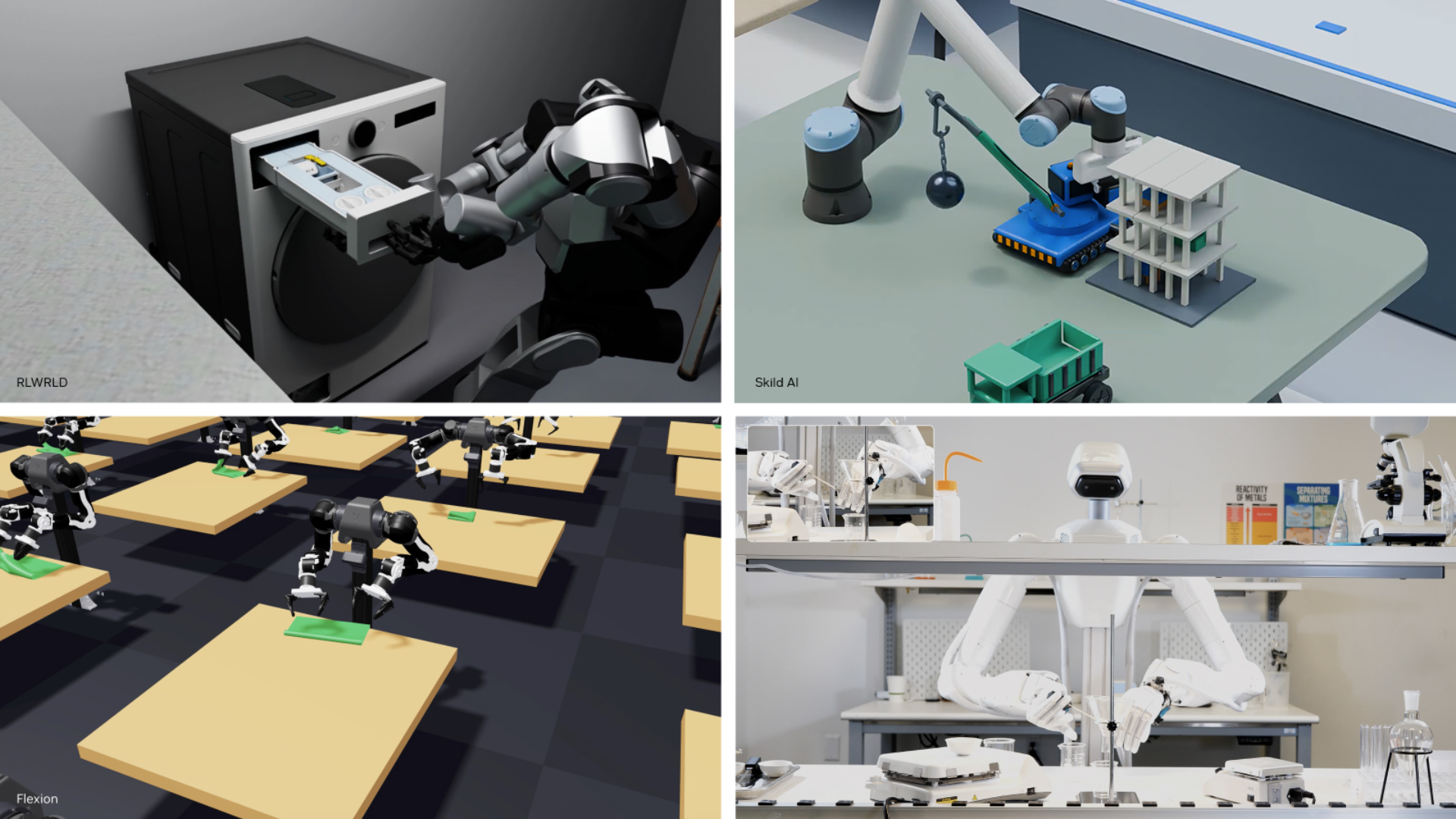
Nvidia unveiled GR00T 2, a new open "world action model" designed to let humanoid and other robots learn and generalize new physical tasks from far fewer demonstrations than before. The company announced the model alongside Isaac Lab 3.0, the Newton physics engine, and a set of new robotics benchmarks in a blog post timed to the Conference on Robot Learning (CoRL) in Austin, Texas, on November 9, 2026. Nvidia says GR00T 2 averaged 71% success across 50 held-out tasks with just one demonstration per task, rising to 95% with five.
Key facts
- Announced: November 9, 2026, at CoRL in Austin, Texas
- What it is: an open "world action model" (WAM) that predicts future video and robot actions together
- Nvidia's claimed results: 40% zero-shot success on 50 unseen tasks; 71% with one demonstration; 95% with five
- Also announced: Isaac Lab 3.0, the Newton physics engine, DexBench, VABAR and an Isaac Lab-Arena 0.4 preview
- Availability: Nvidia says GR00T 2 code is coming in December 2026; it has not published a weights release date
- Named partners evaluating or testing GR00T 2: Foxconn, Siemens, Nexuni, and others using Isaac Lab/Newton, including Flexion
What is Nvidia GR00T 2?
GR00T 2 is the latest entry in Nvidia's Project GR00T line of robot foundation models, but the company is positioning it differently from earlier GR00T releases. Rather than calling it a vision-language-action (VLA) model outright, Nvidia describes GR00T 2 as a "world action model" (WAM): a single diffusion transformer that denoises predicted future video and the robot action chunks that would produce that future, together, in one loop. According to Nvidia's research page for the project, the model reads recent camera video, a robot's current state, and a language instruction, then repeatedly predicts what the scene will look like next and which actions cause that change, before handing the plan to small, per-robot "action heads" that convert it into motor commands for a given body — whether that's a parallel gripper, a dexterous hand, or a full humanoid.
That architecture is what Nvidia says lets GR00T 2 transfer skills across different robot embodiments without needing robot-specific demonstration data for every new body it runs on, and why the company is pitching it as a step beyond standard VLA models toward something closer to a general physical-world simulator paired with a controller.
GR00T 2 vs. GR00T N1.6: what's actually new
Nvidia's CoRL materials do not frame GR00T 2 as a direct, side-by-side upgrade of GR00T N1.6 — the two are built on different premises. N1.6, released in late 2025, is a roughly 3-billion-parameter vision-language-action model built around a Cosmos-Reason-2B backbone and a 32-layer diffusion-transformer action head, and it predicts robot actions relative to the robot's current state rather than as absolute joint positions.
GR00T 2 changes the underlying approach: instead of a VLA that maps language and vision straight to actions, it jointly predicts video and actions, which Nvidia says gives the model a richer, more transferable sense of physical cause and effect. A smaller variant, GR00T 2 Turbo, uses a more compressed 2-billion-parameter joint video-action transformer and a lighter video encoder, aimed at running on robot-grade hardware such as Nvidia's Jetson Thor at low per-prediction latency. Nvidia has not published a parameter count for the full-size GR00T 2 model.
On training data, Nvidia says GR00T 2's pretraining mixture includes roughly 402,730 hours of egocentric human video, about 10,184 hours of handheld-gripper demonstrations across nearly 2,900 tasks, and around 23,500 hours of robot teleoperation data spanning arms such as YAM, Franka, Sharpa and Wuji hands, plus the Unitree G1 humanoid. A 100,000-hour slice of that human video, called Human-1M-100K, is already posted on Hugging Face.
The benchmark numbers, according to Nvidia
Nvidia's reported performance figures come from its own internal evaluation suite of 50 tasks and should be read as the company's claims rather than independently verified results:
- Zero-shot: Nvidia says GR00T 2 completed 40 of 50 evaluated tasks at least once with no task-specific demonstrations on the target robot — a roughly 40% success rate.
- One demonstration: with a single demonstration per task, Nvidia reports an average 71% success rate across the same 50 tasks.
- Five demonstrations: that figure rises to 95%, with Nvidia saying 37 of the 50 tasks succeeded in every trial, after what it describes as a 30-minute LoRA fine-tune on a single RTX 5090 GPU using under three minutes of robot data.
- Dexterity tasks: Nvidia cites 85% success seating GB300 memory modules and 65% assembling a toy truck.
- Contact-rich insertion (reinforcement learning): 88–96% across three real-world insertion tasks.
- Agentic control: 98, 97 and 97 out of 100 successes across three toy-assembly sequences when GR00T 2 is driven through its API by an AI agent chaining skills together.
- Instruction following: Nvidia says "visual steering" lifted instruction-following accuracy on a YAM arm from 40% to 92%.
- GR00T 2 Turbo: on a Unitree G1, Nvidia reports 48 out of 48 successful trials on a popcorn-handling task and 93% on table clearing, with roughly 124 milliseconds per prediction on Jetson Thor hardware.
Nvidia also claims GR00T 2 currently ranks among the top three models in both the vision-language-action and world-action-model categories across the RoboCasa365, RoboLab, RoboDojo and MolmoSpaces leaderboards, with what it calls multiple outright wins.
| Test condition | Nvidia's reported success rate | Notes |
|---|---|---|
| Zero demonstrations (zero-shot) | ~40% (40/50 tasks) | Task coverage: succeeded at least once, not a per-trial rate |
| 1 demonstration per task | 71% average | Across the same 50-task suite |
| 5 demonstrations per task | 95% average | 37/50 tasks succeeded every trial; ~30-min LoRA fine-tune |
| Dexterity: GB300 memory seating | 85% | Single dexterous-manipulation task |
| Dexterity: toy truck assembly | 65% | Single dexterous-manipulation task |
| Contact-rich insertion (real-world RL) | 88–96% | Three insertion tasks |
| GR00T 2 Turbo: table clearing | 93% | On Unitree G1; ~124 ms/prediction on Jetson Thor |
Isaac Lab 3.0 and the Newton physics engine
Alongside GR00T 2, Nvidia announced Isaac Lab 3.0, the next version of its open-source robot learning framework. The release lets developers set up training environments using simulation-ready assets, switch between Nvidia's existing PhysX physics solver and the newer Newton engine, choose different renderers for perception-based training, and apply a new reinforcement-learning post-training library to models such as GR00T.
Newton is an open-source physics engine built to model deformable objects — things like cables and cloth — as well as complex articulated systems such as multi-jointed robotic hands, which standard rigid-body solvers struggle to simulate accurately. Nvidia's headline throughput claim is that Isaac Lab 3.0 running on Newton achieves up to 2.5 times the training throughput of Isaac Lab 2.3 running on PhysX, measured on a vision-based dexterous-manipulation benchmark.
Nvidia also pointed to results from AlphaNIST, a policy built in Isaac Lab that learns all 20 tasks on the NIST Assembly Task Board with a single policy, reporting over 98% training success versus 81% for separate per-task policies — using, Nvidia says, roughly 39 times less GPU time than training each task separately. The company attributes part of that efficiency gain to a new technique it calls Success-Guided Sampling (SGS), which it says lets training scale beyond a million parallel simulated environments.
New benchmarks: DexBench, VABAR and Isaac Lab-Arena 0.4
Nvidia and partners also introduced several new evaluation suites meant to standardize how robot generalization is measured:
- DexBench — developed by RLWRLD with Nvidia, this benchmark covers 15 tasks across four scenes (retail, logistics, manufacturing and hospitality), testing how well a policy generalizes across object, spatial and physics variations. Nvidia says it's available through Bifrost's Manifold platform with free initial credits, and that Genesis AI and mimic robotics are among the early-access evaluators.
- VABAR (Variational Automation Benchmark for Agentic Robotics) — built with UC Berkeley, VABAR evaluates robots on six industrial tasks, each with standardized variations, difficulty tiers and success metrics.
- Isaac Lab-Arena 0.4 — released as a developer preview at CoRL, this framework runs policies across thousands of procedurally generated variations in parallel to surface failure conditions that narrower test sets might miss.
Named partners: Foxconn, Siemens, Nexuni and others
Nvidia named several companies evaluating or testing GR00T 2 and its surrounding tools, though it describes most of this work as testing or evaluation rather than confirmed production deployment:
- Foxconn — applying GR00T 2 to factory automation for server manufacturing.
- Siemens — evaluating GR00T 2 across industrial use cases.
- Nexuni — testing GR00T 2 for robotic laundry handling.
- Flexion — used Isaac Lab and Newton to train Reflect, its own robot-intelligence model combining reasoning with whole-body manipulation.
- MicroAGI — used a reinforcement-learning post-trained version of GR00T 2 for Ethernet cable-swapping on a YAM arm.
- Skild AI — announced STEEL, a rigid-body physics solver built on Newton.
Nvidia also listed Ambi Robotics, Bosch Research, Dexmate, Dyna Robotics, Field AI, Noitom Robotics, RLWRLD, UC Berkeley, Walden Robotics and the University of Washington as contributors to the broader CoRL showcase. These are Nvidia's own characterizations of partner activity; none of the figures above have been independently verified against partner-side disclosures.
Release timing and availability
Nvidia's research page for the project lists GR00T 2 code as "available in December" 2026, but as of the CoRL announcement the company had not published a specific date for releasing model weights or detailed the license terms that would apply. A 100,000-hour slice of the human egocentric video used in pretraining, called Human-1M-100K, is already posted on Hugging Face. By contrast, Isaac Lab 3.0 itself is open source and available now on GitHub under the isaac-sim/IsaacLab repository, alongside the Newton engine.
This matters for anyone evaluating GR00T 2 today: the benchmark numbers above describe Nvidia's internal testing, not a model that outside developers can currently download and reproduce results with. Teams that want to start building now have a more direct path through Isaac Lab 3.0 on GitHub, which is already public, while GR00T 2 itself remains a research preview until Nvidia ships code and, eventually, weights.
How this fits the broader robotics AI race
GR00T 2 lands as competition in "physical AI" and humanoid robot foundation models has intensified across the industry. Google DeepMind's Gemini Robotics line pursues a related goal — general-purpose robot control driven by a large multimodal model — via a different architecture and company, and Nvidia's framing of GR00T 2 as a "world action model" rather than a conventional VLA appears partly aimed at differentiating its approach from rivals pursuing similar demonstration-efficiency goals. Nvidia's robotics push also continues even as the company has seen leadership turnover at the top; CEO continuity matters to partners betting multi-year roadmaps on Nvidia's robotics stack, a topic Pandromeda has covered separately in its report on Nvidia's CEO transition.
For now, the claims in this piece — the success rates, the throughput multiplier, the partner list — all originate from Nvidia's own CoRL announcement and research materials. Independent, third-party benchmarking of GR00T 2 has not yet been published, and given that code isn't due until December and weights have no announced date, outside verification is unlikely before early 2027 at the earliest.
What's next
The near-term calendar to watch: Nvidia's stated December 2026 timeline for releasing GR00T 2 code, which would let outside researchers begin reproducing or challenging the company's benchmark claims; whether a model-weights release follows and under what license; and how DexBench, VABAR and Isaac Lab-Arena 0.4 get adopted as shared evaluation standards across robotics labs that don't work for Nvidia. Also worth tracking is how named partners like Foxconn and Siemens describe their results once evaluation periods wrap, since Nvidia's own disclosures so far describe testing rather than deployed production use. Pandromeda will follow up once Nvidia publishes GR00T 2 code and when real-world, third-party results start to appear.
Frequently asked questions
What is Nvidia GR00T 2?
GR00T 2 is Nvidia's new open "world action model" for robots, unveiled at CoRL 2026. Instead of mapping instructions directly to actions like a standard vision-language-action model, it jointly predicts future video and the robot actions that would produce it, then hands that plan to per-robot action heads.
How is GR00T 2 different from GR00T N1.6?
GR00T N1.6 is a roughly 3-billion-parameter vision-language-action model with a diffusion-transformer action head. GR00T 2 uses a different approach built around jointly predicting video and actions together, which Nvidia says improves transfer across different robot bodies. Nvidia has not published a direct benchmark comparison between the two models.
What success rate did Nvidia claim for GR00T 2?
Nvidia says GR00T 2 averaged 71% success across 50 held-out tasks with one demonstration per task, rising to 95% with five demonstrations. With zero demonstrations, Nvidia reports the model completed 40 of 50 tasks at least once. These are Nvidia's own reported figures from internal testing, not independently verified.
What is Isaac Lab 3.0?
Isaac Lab 3.0 is the latest version of Nvidia's open-source robot learning framework, adding support for the new Newton physics engine alongside the existing PhysX solver, new renderer options, and a reinforcement-learning post-training library. Nvidia claims up to 2.5x the training throughput of the prior version on a vision-based manipulation benchmark.
When can developers access GR00T 2?
Nvidia's research page lists GR00T 2 code as available in December 2026, but as of the CoRL announcement the company had not set a release date for model weights. Isaac Lab 3.0, by contrast, is already open source and available on GitHub.
Which companies are testing GR00T 2?
Nvidia named Foxconn (factory automation for server manufacturing), Siemens (industrial use cases) and Nexuni (robotic laundry handling) as companies evaluating or testing GR00T 2, with Flexion and MicroAGI building on Isaac Lab, Newton and GR00T 2 for their own robot-intelligence work.
Sources
- Nvidia Blog: Practice Makes Precise — At CoRL, Nvidia and Partners Reveal How Robots Rehearse Delicate Work in Simulationblogs.nvidia.com
- Nvidia Research (GEAR Lab): GR00T 2 project pageresearch.nvidia.com
- Nvidia Research (GEAR Lab): GR00T N1.6 project pageresearch.nvidia.com
- Nvidia: What Is a World Action Model? (glossary)nvidia.com
- GitHub: isaac-sim/IsaacLabgithub.com
- Conference on Robot Learning (CoRL) 2026corl.org
Theo Park runs the AI desk at Pandromeda. He follows model launches from the frontier labs and the open-weight community, tracks the assistants and developer tools built on them, and explains what each release changes on pricing, capability and safety. His reporting leans on primary sources: model cards, technical reports, API documentation and the companies' own announcements.