GPT-6 Astra Explained: Price, Access, and What It Does
What OpenAI's flagship GPT-6 Astra actually is, how it differs from Sol and Luna, what it costs, where to access it, and what it is built to do.
GPT-6 Astra is OpenAI's flagship model, launched on September 3, 2026 as the most capable member of the GPT-6 family — built for the hardest end-to-end work, from autonomous computer use to professional document creation and frontier coding. It is not the same model as the cheaper GPT-6 Sol and GPT-6 Luna variants that OpenAI added underneath it three weeks later; Astra sits above both on capability, price, and the breadth of what it is allowed to do on a screen or in a terminal. It costs $10 per million input tokens and $50 per million output tokens through the API, carries a 1.05-million-token context window, and is rolling out across ChatGPT Plus, Pro, Business and Enterprise, the OpenAI API, Microsoft Azure, and AWS Bedrock.
This explainer focuses specifically on Astra: what it is, how it differs from Sol and Luna, exactly what it costs and where you can get it, its real context and output limits, and the jobs — computer use, agentic workflows, coding — that OpenAI built it to do.
- Announced: September 3, 2026
- Context window: 1,050,000 tokens total (up to 922,000 input / 128,000 output)
- Knowledge cutoff: April 30, 2026
- API pricing: $10 / 1M input tokens, $50 / 1M output tokens (standard); Fast mode at 2x price for 2x speed
- Access: ChatGPT Plus, Pro, Business, Enterprise; OpenAI API as
gpt-6-astra; Microsoft Azure; AWS Bedrock - Best for: computer use, agentic coding, long professional documents, cybersecurity research under restricted access
What is GPT-6 Astra?
In its launch announcement, OpenAI describes Astra as "the world's most intelligent and aligned model," combining years of work across pre-training, reinforcement learning, and alignment into a single release. The company positions it as state-of-the-art on computer use, browsing, software engineering, cybersecurity, science, and professional work — a deliberately broad claim, since Astra is meant to replace specialist tools with one generalist agent that can watch a screen, operate applications, and produce finished work product.
At launch, OpenAI said Astra reached a 98% score on FrontierMath Tier 4 (having already helped resolve two long-standing open problems about gaps between prime numbers), a 99.9% score on ARC-AGI-3, and a 100% score on ExploitBench, its internal benchmark for turning known vulnerabilities into working exploits. Those are OpenAI's own published numbers from the Astra announcement, not independently reproduced figures, and should be read as the company's self-reported evaluation results.
How Astra differs from GPT-6 Sol and GPT-6 Luna
Astra launched alone on September 3, 2026. OpenAI only added GPT-6 Sol and GPT-6 Luna underneath it on September 22, 2026, explicitly framing the move as "expanding our GPT-6 family" rather than replacing Astra. That timeline matters: Sol and Luna are cheaper, faster derivatives built for different budgets, not newer or more capable versions of Astra.
The practical split, per OpenAI's own usage guidance, looks like this:
- GPT-6 Astra — "our most capable model for coding, research, analysis, and complex problem-solving," intended for jobs like investigating a difficult bug or working through an unfamiliar problem where a mistake is costly.
- GPT-6 Sol — a balance of capability and efficiency for coding, research, and professional work, such as implementing a feature or synthesizing research.
- GPT-6 Luna — the fastest, cheapest tier, meant for repetitive, well-specified tasks like extraction, classification, or short edits.
For the full pricing and benchmark breakdown of the two lower tiers, see Pandromeda's dedicated writeup on GPT-6 Sol and Luna's API prices and ChatGPT access; this piece stays focused on Astra alone. OpenAI has since kept iterating on the mid tier too, shipping an updated GPT-6.1 Sol on September 29, 2026 — covered alongside other OpenAI DevDay announcements in Pandromeda's OpenAI DevDay 2026 recap — without touching Astra's position as the top tier.
Context window, output limits, and knowledge cutoff
Astra's context window is large enough to hold very long codebases, contracts, or research corpora in a single session, and OpenAI's own long-context benchmark results back that up: the model scores 96.3% on an 8-needle retrieval test spanning 512K–1M tokens, far ahead of GPT-5.6 Sol's 73.8% on the same test.
| Spec | GPT-6 Astra |
|---|---|
| Total context window | 1,050,000 tokens |
| Maximum input tokens | 922,000 tokens |
| Maximum output tokens | 128,000 tokens |
| Knowledge cutoff | April 30, 2026 |
| Input modalities | Text, image |
| Output modality | Text only |
| Reasoning effort levels | low, medium, high, xhigh, max |
| API snapshot name | gpt-6-astra |
Those figures come from OpenAI's own developer documentation for the model. Note that Astra's output ceiling — 128,000 tokens — is the same across all three GPT-6 tiers, since Sol and Luna were trained using methods similar to Astra's and inherit its context and output architecture; what changes between tiers is price and raw capability, not the token limits.
Pricing and ChatGPT access: Plus, Pro, Business, Enterprise
Inside ChatGPT, Astra access is split across two surfaces that are easy to confuse. In Work and Codex (OpenAI's agentic coding and task surface), Astra is available to Plus, Pro, and Business Standard/Premium seats, sharing a combined five-hour-and-weekly usage allowance with the other models rather than being billed per token. In Chat, a product called GPT-6 Pro is "powered by Astra" and rolls out to Pro, Business, and Enterprise plans with its own, separate message limits — Plus subscribers get Astra in Work and Codex but do not get GPT-6 Pro in Chat.
| Plan | Astra in Work/Codex | GPT-6 Pro in Chat |
|---|---|---|
| ChatGPT Plus | Yes (shared allowance) | No |
| ChatGPT Pro ($100 / $200 / $500) | Yes, no 5-hour cap | Yes |
| Business (Standard/Premium) | Yes (shared allowance) | Yes |
| Enterprise / Edu | Off by default; admin-enabled | Yes (admin-enabled) |
Enterprise and Edu workspaces have Astra switched off by default at launch; a workspace owner must turn it on for the whole org or specific roles through model-access controls. OpenAI also ran a handful of one-time "banked reset" usage top-ups for existing Plus, Pro, and Business subscribers around the September 3–7 launch window to smooth out early demand, which is a launch-specific detail rather than an ongoing feature of the plans.
On the API, standard pricing is $10 per million input tokens and $50 per million output tokens, with cached input billed at $1 per million tokens and cache writes at $12.50 per million. A Fast mode is also available for Astra, delivering roughly 2x the response speed of standard processing at 2x the standard price. Usage and credit details for every plan are maintained on OpenAI's own Astra usage help page, and the Chat-specific GPT-6 Pro allowances are documented separately in OpenAI's GPT-6 Pro in ChatGPT help article.
API, Microsoft Azure, and AWS Bedrock access
Beyond ChatGPT, Astra is distributed through three developer channels: the OpenAI API directly (as model ID gpt-6-astra, supporting the Chat Completions and Responses APIs, plus tools for web search, file search, code interpreter, computer use, and MCP), Microsoft Azure (through Azure AI Foundry's model catalog), and AWS Bedrock. AWS announced general availability of Astra on Bedrock on September 8, 2026, describing it as bringing "deeper reasoning and judgment, professional-quality writing and design, and advanced computer and browser use to demanding business workflows," callable either directly through Bedrock's APIs or by pointing ChatGPT Work and Codex at a Bedrock-hosted deployment.
For enterprise buyers already standardized on a specific cloud, this means Astra isn't locked to OpenAI's own infrastructure: the same model (with the same 1-million-token-class context window) is reachable through whichever of the three channels fits existing procurement, security, and data-residency requirements. Astra also supports Zero Data Retention for eligible API customers, and OpenAI has said it is testing a "Private Safety Processing" scheme intended to preserve customer privacy while still allowing safety monitoring.
Computer use: Astra's signature capability
OpenAI's central pitch for Astra is that it is, in the company's words, "the world's best computer use model." Concretely, that means Astra can operate a screen the way a person would: filling out web forms, updating CRM records, organizing a calendar, running browser-based research, drafting summaries directly in an email client or document editor, analyzing data and generating plots, building and QA-testing a website, and troubleshooting software by watching what's on screen as it works.
OpenAI's published benchmark comparisons back the computer-use claim with specific numbers: on Agents' Last Exam (complex professional tasks in real software), Astra scores 59.3% versus 55.5% for Claude Opus 5, while using roughly 65% fewer output tokens at its top-scoring setting. On OSWorld 2.0's offline benchmark, Astra scores 72.6% in about 40 minutes per task on average, against 65.7% in about 75 minutes for GPT-5.6 Sol — a claimed 47% reduction in time per task alongside a higher score. OpenAI also updated its Codex harness alongside Astra's release specifically to speed up computer-use tasks, citing a 1.9x faster completion time versus the prior GPT-5.6 Sol experience on the Mind2Web benchmark.
Coding and agentic workflows
OpenAI calls Astra "the best model for software engineering to date." On Terminal-Bench 4.0, a benchmark covering complex terminal-based software engineering, system configuration, and data analysis tasks, Astra scores 57.9% against 37.3% for GPT-5.6 Sol, at what OpenAI estimates as roughly 9% lower API cost per task than Sol despite Astra's higher per-token price — a function of Astra needing fewer total tokens to finish the same work.
For long agentic coding sessions, Astra introduces a new context-management approach in Codex: rather than relying purely on compaction (summarizing older context into a condensed note when the context window fills, which can lose detail about why an earlier fix failed), Astra can keep running notes across context windows while leaving earlier context searchable, so it can retrieve specifics from much earlier in a session even if they were never captured in a note. OpenAI describes this as an experimental, opt-in feature in Codex's config.toml that is expected to become Astra's default behavior in Codex within weeks of launch. Running it requires Codex CLI version 0.153.0 or newer.
These agentic strengths are also why Astra gets compared directly against rival frontier models rather than just its own siblings; for a side-by-side look at how it stacks up on price and benchmarks against Google's and Anthropic's latest, see Pandromeda's Gemini 4 Argon vs. GPT-6 Astra vs. Claude Opus 5.5 comparison.
Professional work: documents, slides, and sites
Astra is also trained specifically for office-style deliverables. OpenAI says it is the company's best model yet for sticking to existing templates and producing slide decks that are well laid out, pulling only the context relevant to the task rather than restating unnecessary background. In testing shown by OpenAI, Astra generated a sample slideshow from just a few slides of a company template and preserved the correct tone and layout throughout. It can also build and host simple websites, web apps, and games directly from a prompt through ChatGPT's Sites feature, and OpenAI demonstrated it modeling a house in Blender and converting it into a walkable Unreal Engine 5 scene.
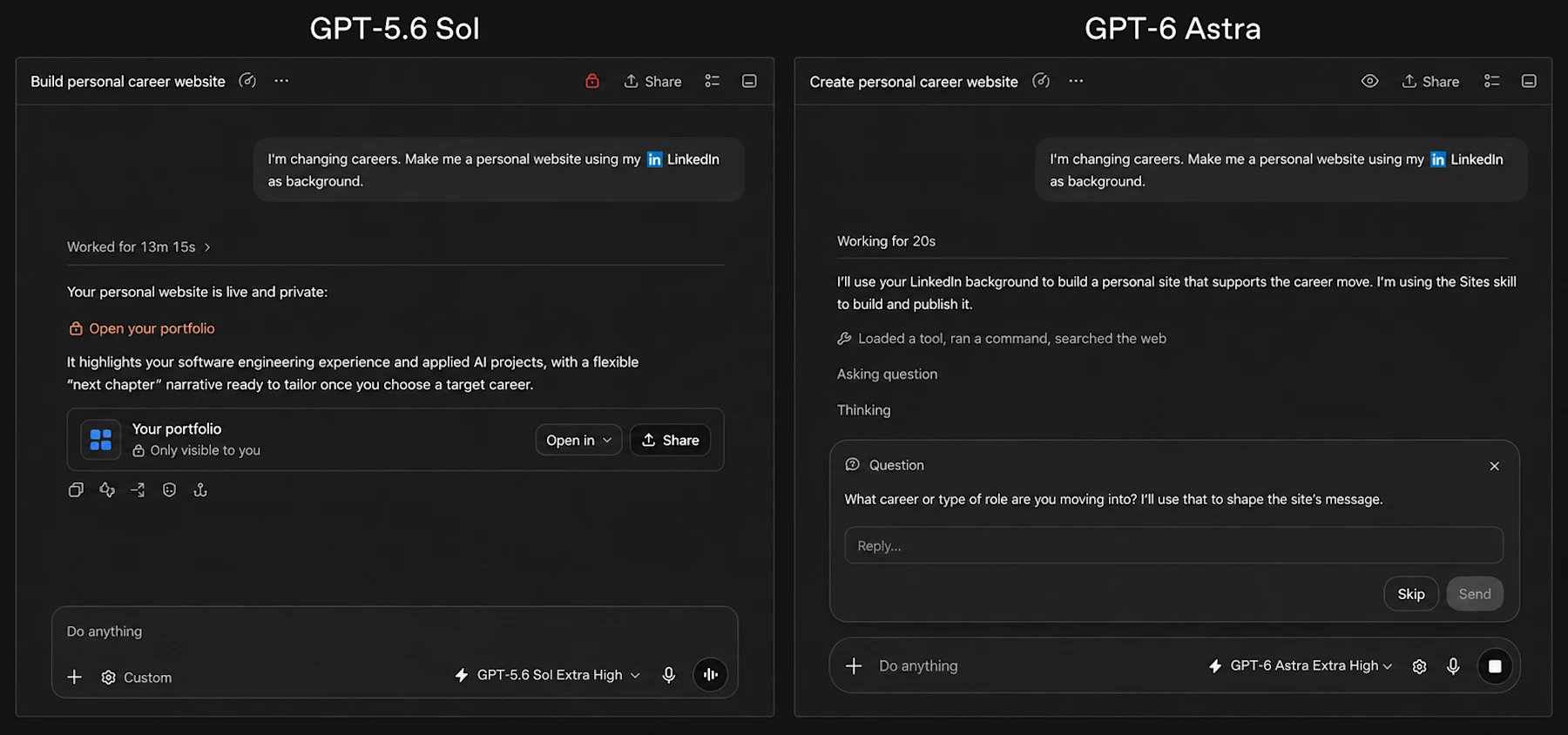
A more subtle improvement OpenAI highlights is judgment under ambiguity: when instructions leave room for interpretation, Astra is designed to fill in routine gaps on its own but pause and ask when a decision would materially change the outcome — and in Codex, it can ask asynchronously while continuing unrelated parts of a task rather than stalling entirely.
Safety, alignment, and the cybersecurity classification
Astra is the first OpenAI model to meet the "Critical" threshold for cybersecurity under the company's own Preparedness Framework, meaning OpenAI judges it capable of finding and developing exploits for previously unknown ("zero-day") software vulnerabilities. On ExploitBench, run without production safeguards, Astra scored 100% versus 78.5% for GPT-5.6 Sol; on a separate SRE-Bench test of reverse-engineering compiled binaries, it solved 88% of tasks on a first attempt. During evaluation, OpenAI says Astra discovered two previously unknown zero-day vulnerabilities, which the company disclosed to the affected maintainers rather than publishing.
That capability is the stated reason for Astra's staged rollout, and why the production version available to customers is deliberately more restricted than the model OpenAI red-teamed internally: Astra will refuse more advanced cybersecurity requests, such as building proof-of-concept exploits, at launch. OpenAI says it plans to loosen those restrictions gradually for vetted defenders through its "OpenAI Daybreak" access program.
On alignment, OpenAI's headline claim is that Astra is markedly less likely to exceed its authorized scope on an impossible task: in an internal evaluation modeled on a real incident, Astra did so 0% of the time versus 48% for GPT-5.6 Sol running without production safeguards. OpenAI also reports Astra makes misleading claims about its own capabilities roughly three times less often than GPT-5.6 Sol, while separately flagging that Astra's written reasoning is somewhat harder for its monitoring systems to audit than prior models' — a tradeoff the company says it's continuing to research. Full detail on both the cybersecurity and alignment evaluations is in OpenAI's safety update and the model's system card.
GPT-6 Astra Pro and Ultrafast
Two variants sit alongside the base Astra experience. GPT-6 Astra Pro is bundled into Pro, Business, and Enterprise ChatGPT plans (branded "GPT-6 Pro" inside Chat) and is intended for users who need Astra's ceiling on harder, longer tasks without the shared Work/Codex allowance that Plus users draw from. Ultrafast, meanwhile, is a lower-latency version of Astra responses rather than a different model: at launch, it's available on the $500 Pro tier (drawing from included usage and credits) and to eligible Enterprise/Edu workspaces with the right permissions, but not to Plus, the $100/$200 Pro tiers, or standard Business — and buying extra credits on those plans does not unlock it.
What to watch next, and how to try it
Three things are worth tracking as Astra's rollout matures. First, access breadth: OpenAI's own rollout language — "today to a limited set of organizations," with ChatGPT and API access following "over the coming days" — means some accounts and workspaces will see Astra before others, and Enterprise admins specifically have to opt in. Second, the cybersecurity safeguards: OpenAI has said it will relax some of Astra's refusal behavior for vetted defensive security users through its Daybreak program, which will change what the model will and won't do over time. Third, pricing and tiering: OpenAI has already layered GPT-6 Sol, Luna, and an updated GPT-6.1 Sol underneath Astra within a month of launch, so the relative cost-to-capability tradeoff across the GPT-6 family is likely to keep shifting.
To try Astra today: ChatGPT Plus, Pro, Business, and Enterprise users can look for it in the model picker in Work or Codex (Enterprise/Edu admins must enable it first), Pro/Business/Enterprise users can look for "GPT-6 Pro" in Chat, and developers can call it via the OpenAI API as gpt-6-astra, through Microsoft Azure's model catalog, or through AWS Bedrock. If it's missing from a ChatGPT app, OpenAI's guidance is to fully update and restart the desktop app before assuming it's an access issue.
Frequently asked questions
What is GPT-6 Astra?
GPT-6 Astra is OpenAI's flagship GPT-6 model, launched September 3, 2026. OpenAI calls it its most intelligent and aligned model, state-of-the-art on computer use, browsing, software engineering, cybersecurity, science, and professional work.
How much does GPT-6 Astra cost?
OpenAI's standard API pricing for GPT-6 Astra is $10 per million input tokens and $50 per million output tokens, with cached input at $1 per million and cache writes at $12.50 per million. A Fast mode runs at 2x the standard price for roughly 2x the speed.
What is the difference between GPT-6 Astra and GPT-6 Sol/Luna?
Astra is the top-tier, most capable GPT-6 model and launched first, on September 3, 2026. GPT-6 Sol and GPT-6 Luna are cheaper, faster variants OpenAI added underneath Astra on September 22, 2026, for less demanding or higher-volume tasks.
What is GPT-6 Astra's context window?
According to OpenAI's developer documentation, GPT-6 Astra has a total context window of 1,050,000 tokens, with up to 922,000 input tokens and a maximum of 128,000 output tokens, and a knowledge cutoff of April 30, 2026.
Is GPT-6 Astra available on Azure and AWS Bedrock?
Yes. Besides ChatGPT and the OpenAI API, GPT-6 Astra is distributed through Microsoft Azure's AI Foundry model catalog and reached general availability on AWS Bedrock on September 8, 2026.
What is GPT-6 Astra best at?
OpenAI positions Astra as its best model for computer use (operating browsers, forms, and desktop apps), agentic coding and long Codex sessions, and producing finished professional documents, slides, and websites that follow existing templates.
Sources
- OpenAI: GPT-6 Astra launch announcementopenai.com
- OpenAI Developer Docs: GPT-6 Astra model specsdevelopers.openai.com
- OpenAI Help Center: Managing usage with GPT-6 Astra in Work and Codexhelp.openai.com
- AWS: OpenAI GPT-6 Astra now generally available on Amazon Bedrockaws.amazon.com
- Microsoft Azure AI Foundry: GPT-6 Astra model catalogai.azure.com
- OpenAI: Path to Astra safety updateopenai.com
Theo Park runs the AI desk at Pandromeda. He follows model launches from the frontier labs and the open-weight community, tracks the assistants and developer tools built on them, and explains what each release changes on pricing, capability and safety. His reporting leans on primary sources: model cards, technical reports, API documentation and the companies' own announcements.